
You ask your friend if they are coming to the party, and one second later your phone buzzes: “OFC.” No emoji, no explanation — just three capital letters. Are they excited? Being sarcastic? Did autocorrect eat half the sentence? You stare at it for a moment longer than you would like to admit.
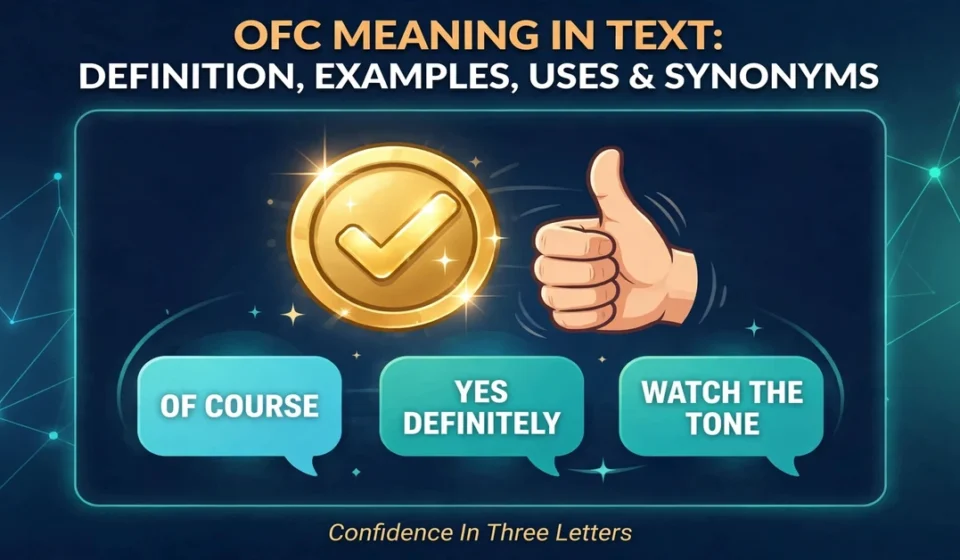
Here is the quick answer: OFC stands for “of course.” It is one of the most common acronyms in texting and online chat — a fast way to say yes, absolutely, or obviously without typing the whole phrase. It can be warm and friendly, or it can drip with sarcasm, and telling the difference is entirely about context.
In this guide, we will unpack the full OFC meaning in text: where it came from, how to use it naturally, the stronger emphatic version people sometimes mean, how to spot sarcasm, the other meanings it carries in fandom spaces, and the situations where you should spell the words out instead.
What Does OFC Mean in Text?
At its simplest, OFC = of course. It works as a one-word substitute for agreement, confirmation, or reassurance. When someone types OFC, they are really saying things like:
- Yes, definitely: “Are you coming tonight?” → “OFC!”
- Obviously: “Did you finish the show?” → “OFC, binged it in one night”
- No problem / happy to: “Thanks for the ride!” → “OFC, anytime”
- Naturally / as expected: “He forgot his keys again” → “OFC he did”
Notice how much work those three letters do. OFC is not just a shorter “yes” — it carries a flavor of certainty. “Yes” answers the question; “OFC” answers it like the question barely needed asking. That extra shade of meaning is exactly why it caught on: it sounds confident, casual, and a little bit fun.
The acronym is almost always written in all caps (OFC) rather than lowercase, though you will see “ofc” in fast typing. Capitalization does not change the meaning — it is just a style choice, the same way people type LOL or lol interchangeably.
Where OFC Came From: The SMS Era
OFC is a child of the early-2000s texting boom. Back then, phones had physical keypads, every message cost money or counted against a monthly limit, and SMS messages were capped at 160 characters. Typing “of course” meant tapping the 6 key three times for the letter “o,” then hunting down every other letter — so naturally, people started chopping phrases down to their initials.
“Of course” was a perfect candidate for abbreviation because it is one of those phrases everyone says constantly: agreeing to plans, confirming favors, reassuring friends. OFC slid right into the same family as BRB, LOL, OMG, and TTYL — the founding generation of texting slang that never really left.
As messaging moved from SMS to apps like WhatsApp, Snapchat, Instagram DMs, and Discord, OFC came along for the ride. It never needed a meme moment or a viral TikTok to survive; it survived because it is genuinely useful. Typing “of course” takes a full second longer than “OFC,” and in the economy of fast chat, that second matters.
Why OFC Outlived Other Abbreviations
Thousands of texting acronyms were born in the SMS era, and most of them died there. Nobody says “L8R” anymore. OFC survived for three reasons. First, it shortens a phrase people actually say out loud every day, so it never feels forced. Second, it works in almost any sentence position — start, middle, or end. Third, and most importantly, it carries tone: OFC can be sincere, sarcastic, enthusiastic, or dry, which gives it a range that one-note abbreviations never had.
How to Use OFC in Texts
Using OFC naturally comes down to matching it to the right moment. Here are the patterns native texters use without thinking:
Agreeing to plans:
- “Wanna grab coffee Saturday?” → “OFC, what time?”
- “Movie night still on?” → “OFC!!”
Confirming something:
- “You got the tickets, right?” → “OFC, already in my wallet”
- “Did you lock the door?” → “OFC I did”
Being polite or reassuring:
- “Sorry to bother you” → “OFC, no worries at all”
- “Thank you so much” → “OFC, happy to help”
Stating the obvious:
- “Is water wet?” → “OFC 💀”
- “Did the cat knock it over?” → “OFC, who else”
One thing to notice: OFC almost always travels with a follow-up — a detail, a question, an emoji. A bare “OFC” with nothing else can feel abrupt, the same way a bare “yes” does. Adding even two or three words (“OFC, see you at 7”) makes it feel warm instead of clipped.
The Emphatic Version: When OFC Hits Harder
Here is something most guides gloss over: OFC does not always expand to a polite “of course.” In heated, excited, or joking conversations, people often read it as the stronger version — “of f***ing course” — where the implied expletive adds punch.
You can usually tell which one is meant by the energy around it:
- Polite OFC: “OFC, happy to help!” — friendly, safe for anyone.
- Emphatic OFC: “OFC we won, did you doubt us??” — charged, triumphant, a little wild.
The letters are identical; the meaning lives in the punctuation, the emojis, and the relationship. Between close friends, the emphatic version is usually playful. With strangers or in mixed company, assume the polite reading — and if you are the one sending it, remember that your reader cannot hear your tone of voice.
This is worth knowing because it explains why OFC sometimes feels like it has an edge. It is the same acronym doing double duty: the friendly “of course” for everyday use, and the spicier “of f***ing course” when emotions run high.
The Sarcastic OFC: Agreement That Is Not Agreement
Like almost every piece of internet slang, OFC has a sarcastic mode, and it is extremely common. Sarcastic OFC means the opposite of agreement — it is an eye-roll in three letters. The clues are usually obvious once you know to look:
- The eye-roll emoji: “OFC you forgot the charger 🙄”
- The skull emoji: “OFC the WiFi died during the final 💀”
- The “not”: “OFC not, like I had a choice”
- Exaggerated misfortune: “OFC it started raining the second I left 😭”
Sarcastic OFC shows up most when something predictable goes wrong — the classic “of course this would happen to me” energy. It is self-deprecating more often than it is mean: people use it to laugh at their own bad luck rather than to attack someone else.
That said, it can carry shade. “OFC you’d say that” aimed at another person lands very differently from “OFC this happens to me.” The target of the sentence decides whether it is funny or pointed, so read the whole message — not just the acronym — before you react.
OFC Across Platforms: Snapchat, TikTok, Discord, and Work Chat
OFC is not picky about where it lives, but its flavor shifts slightly from platform to platform:
Snapchat and Instagram DMs: This is OFC’s natural habitat — fast, casual, emoji-rich. “OFC 😭😭” and “ofc bestie” are the native dialect. Lowercase “ofc” is especially common here.
TikTok comments: OFC shows up in agreement with creators — “OFC this is accurate” — and in the classic sarcastic reply to relatable misfortune. It also appears in captions as a tone-setter.
Discord and gaming: Gamers use OFC mid-match for quick confirmations — “OFC I’ll heal you” — where every keystroke counts. The emphatic version thrives here.
Work Slack and Teams: This is the danger zone. Among close coworkers in a casual channel, “OFC” is fine. In a message to your manager, a client, or anyone you are trying to impress, spell it out: “Of course, I’ll have it by Friday.” The acronym reads as breezy, and breezy is not always what you want at work.
Dating apps: OFC works as playful confidence — “OFC I know that spot” — but overuse can read as cocky. One per conversation is plenty.
Other Meanings of OFC You Might See
In everyday texting, OFC means “of course” about 99 percent of the time. But if you wander into certain corners of the internet, you will meet two impostors:
Original Female Character (fandom): In fanfiction communities on Tumblr, Archive of Our Own, and Wattpad, OFC stands for “original female character” — a character the author invented rather than borrowed from canon. “This fic has an OFC as the lead.” If the conversation is about stories and characters, this is the meaning in play.
What it does NOT mean: OFC is not “office,” “official,” “offer,” or “online fan club” in texting slang. If someone insists on a creative new expansion, that is their friend group’s private joke, not a real definition.
Context almost always resolves the ambiguity instantly. A text about weekend plans means “of course”; a Tumblr post about fanfiction means “original female character.” When in doubt, the surrounding words will tell you.
Common Mistakes When Using OFC
Even a simple acronym has failure modes. Here are the ones to avoid:
Using it in formal writing. OFC in a job application, a cover email, or a message to a professor reads as careless. Spell out “of course” — it costs you one second and buys you all the professionalism.
Sending it bare to someone upset. If a friend is venting about something serious, “OFC” alone can sound dismissive, like you are not really listening. Pair it with empathy: “OFC, that sounds awful — are you okay?”
Forgetting the sarcasm does not translate. In text, your reader cannot hear your voice. If you mean sarcastic OFC, the emoji or the “🙄” is not optional — it is the entire delivery mechanism. Without it, genuine agreement and mockery look identical.
Overusing it. OFC is seasoning, not the meal. If every reply is “OFC,” it starts to feel like you are on autopilot. Mix in “absolutely,” “definitely,” “for sure,” and plain old “yes” to keep your texts sounding human.
OFC vs. Similar Acronyms
OFC lives in a crowded neighborhood of agreement-words. Here is how it compares:
- OFC vs. FR (for real): OFC confirms something (“yes, obviously”); FR emphasizes truth (“I’m serious about this”). They often team up: “OFC, FR that was amazing.”
- OFC vs. IKR (I know, right?): IKR agrees with an opinion someone just stated; OFC agrees with a request, plan, or fact. “This show is great” → “IKR.” “Coming tonight?” → “OFC.”
- OFC vs. BET: BET is trendier and more casual — a Gen Z stamp of approval. OFC is the neutral, all-ages version that works with your mom too.
- OFC vs. NGL (not gonna lie): NGL frames honesty that might surprise; OFC frames certainty that should not surprise. They are almost opposites in energy.
Knowing the difference keeps your texts precise — and precision is the whole point of slang.
Frequently Asked Questions
1. What is the OFC meaning in text messages?
OFC stands for “of course” in text messages. It is used to agree, confirm, or reassure someone quickly — for example, “Are you coming?” → “OFC!” In fandom spaces it can also mean “original female character,” but in everyday texting it is almost always “of course.”
2. Is OFC rude or polite?
Usually it is friendly and polite — a casual way to say “of course, happy to.” But paired with a sarcastic emoji or aimed at a person (“OFC you’d say that 🙄”), it can carry shade. Context and emojis decide the tone.
3. Can I use OFC in professional messages?
It is best to avoid it. In casual chats with close coworkers it is fine, but in emails, messages to managers, or anything formal, spell out “of course” instead. The acronym reads as breezy, which is not ideal professionally.
4. What is the difference between OFC and “of f***ing course”?
They are the same letters with different energy. The polite “of course” is the default. The emphatic version with the implied expletive shows up in excited, joking, or heated moments — you can tell by the punctuation, emojis, and overall vibe of the message.
5. Is OFC still popular in 2026?
Yes. Unlike many SMS-era abbreviations that faded, OFC stayed relevant because it shortens a phrase people say daily and works in almost any sentence. It is common across Snapchat, TikTok, Discord, WhatsApp, and everyday texting.
Conclusion
The OFC meaning in text is beautifully straightforward: it is “of course,” compressed into three letters that have survived two decades of internet slang. It agrees, confirms, reassures, and — with the right emoji — rolls its eyes. From SMS character limits to TikTok comments, it earned its place by being genuinely useful, and it is not going anywhere.
So the next time your phone buzzes with a lone “OFC,” you will know exactly what to do: check the emoji, read the room, and reply in kind. And if you are the one sending it, remember the golden rule — a couple of extra words turn a clipped acronym into a warm reply. OFC, you have got this.