
<p>You are mid-argument with a friend, the messages are flying, and then — out of nowhere — four cold letters land in the chat: <strong>"dttm."</strong> No emoji. No punctuation. Just silence in acronym form. Your stomach drops a little. Are you being dumped as a conversation partner? Is this a joke? Should you reply, or is replying exactly what you are not supposed to do?</p>
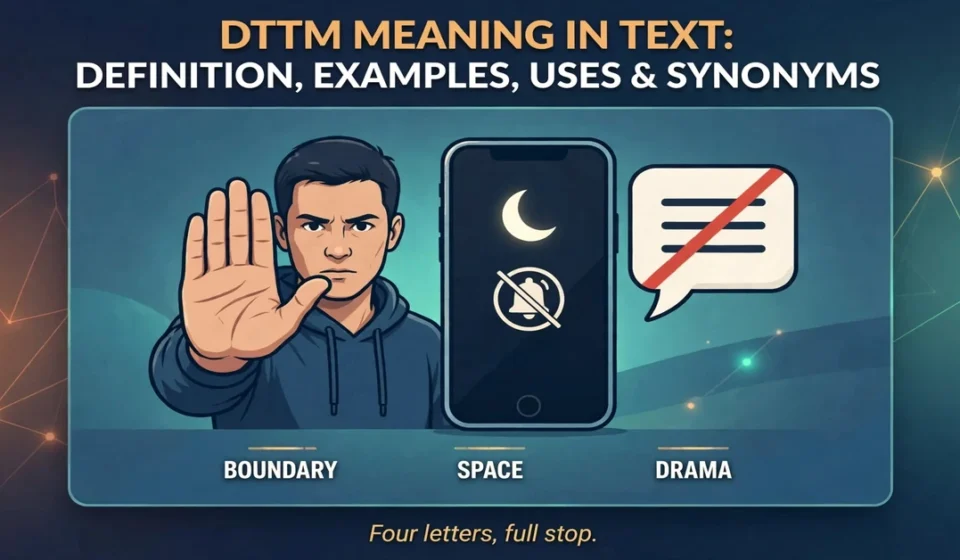
<p><strong>DTTM stands for "don't talk to me."</strong> It is one of the bluntest tools in the texting toolbox: a four-letter boundary, a conversation ender, a mood in miniature. Sometimes it is dead serious — a real request for space. Sometimes it is pure theater, the kind of exaggerated drama friends perform for each other over something trivial like a stolen fry. Telling the difference is the whole game.</p>
<p>In this guide, we will decode the full <strong>dttm meaning in text</strong>: what the letters stand for, where the slang came from, how tone changes everything, what it means in gaming and social media, how to respond when you receive one, and the etiquette of deploying it without starting a war.</p>
<figure class="wp-block-image"><img src="https://celebsnips.com/wp-content/uploads/2026/09/dttm-meaning-in-text-inline.webp" alt="A hand placing a smartphone face-down on a table to take a quiet break from messages"/></figure>
<h2>What Does "DTTM" Mean in Text?</h2>
<p><strong>DTTM = "Don't Talk To Me."</strong> Letter by letter: <strong>D</strong>on't <strong>T</strong>alk <strong>T</strong>o <strong>M</strong>e. It is a direct instruction, and it does not dress itself up. When someone types it, they are telling you — plainly — that they do not want to converse right now.</p>
<p>But "don't talk to me" is a sentence with a huge emotional range, and the acronym inherits all of it. Here are the main flavors:</p>
<ol>
<li><strong>The real boundary</strong> — genuine frustration, exhaustion, or overwhelm. <em>"I've had the worst day. DTTM."</em> This is someone raising a hand and asking for quiet. It deserves respect.</li>
<li><strong>The playful brush-off</strong> — exaggerated drama between friends. <em>"You ate the last slice?? DTTM 😤"</em> Nobody is actually ending the friendship over pizza. The overstatement is the joke.</li>
<li><strong>The flirty tease</strong> — mock annoyance as affection. <em>"Stop being cute. DTTM 🙄😂"</em> The eye-roll emoji does a lot of heavy lifting here; this "don't talk to me" means "keep talking to me, actually."</li>
<li><strong>The overwhelmed auto-reply</strong> — not angry at <em>you</em>, just at everything. <em>"Deadlines, laundry, my phone at 2%. DTTM."</em> You are collateral damage, not the target.</li>
<li><strong>The comedic reaction</strong> — responding to something outrageous. <em>"She really wore THAT to the wedding?? DTTM I'm done."</em> Here it means "I cannot even process this," not "leave me alone."</li>
</ol>
<p>The critical skill is reading which one you just got. The words are identical; everything else — emojis, punctuation, your relationship, what happened in the last five messages — is the actual message.</p>
<h3>Why four letters instead of the full sentence?</h3>
<p>Speed and punch. "Don't talk to me" typed out feels like a paragraph of anger; "dttm" feels like a slammed door — quicker, sharper, and somehow easier to send. The abbreviation also softens the blow slightly: it is the difference between shouting and muttering. That is why it works for jokes, too. Typing the full sentence "don't talk to me" as a joke would feel genuinely hostile. "DTTM 😂" reads as theater. The format is part of the meaning.</p>
<h2>Where Did DTTM Come From?</h2>
<p>DTTM follows the classic origin story of texting slang. In the early 2000s, SMS messages were limited to 160 characters, typing on numeric keypads was painfully slow, and every character sometimes literally cost money. Phrases people typed constantly got compressed for survival — LOL, BRB, OMG — and "don't talk to me," a sentence frustrated people have always needed, got the same treatment.</p>
<p>As texting culture matured through the 2010s, DTTM found its second home on <strong>Twitter</strong>, <strong>Snapchat</strong>, and <strong>Instagram</strong>, where brevity is a virtue and tone is carried by emojis. The acronym's bluntness made it perfect for the dramatic, performative style of social media communication: big feelings, small character counts. A single "dttm" under a friend's questionable selfie could carry an entire paragraph of loving judgment.</p>
<p>There is also a completely separate, technical DTTM worth knowing: in software and database design, <strong>DTTM is a common naming convention for a combined date-and-time value</strong> — a timestamp column recording when a record was created or modified. If you ever see "check the DTTM field" in a work context, nobody is telling you to stop talking; they are talking about data. Context, as always, is king.</p>
<h2>How DTTM Is Used in Different Contexts</h2>
<h3>In Casual Texts</h3>
<p>This is where DTTM lives most of its life. Between friends, it is usually theatrical: <em>"You picked the restaurant and it's closed?? DTTM."</em> The drama is proportional to nothing, and that is the fun. But the same four letters can carry real weight: <em>"I just need an hour. DTTM please."</em> The "please" changes everything — it turns a shutdown into a request. When you see DTTM with softening words around it, take it seriously and give the person space.</p>
<h3>On Social Media</h3>
<p>On TikTok, Instagram, and Twitter, DTTM is often a public performance — a comment, not a conversation. Under a friend's chaotic post: <em>"DTTM 😭😭."</em> Under a celebrity's wild take: <em>"dttm I'm begging."</em> Here it rarely means "stop talking" literally. It means "this is too much for me to process," delivered with the exaggerated flair social media rewards. It is closer to "I can't even" than to an actual boundary.</p>
<h3>The Flirty DTTM</h3>
<p>Worth its own mention because it confuses so many people: in flirting, "don't talk to me" frequently means its opposite. <em>"Ugh, stop making me laugh. DTTM 🙄"</em> is affection wearing a costume. The tells are emojis (🙄, 😂, 😘), the topic (something cute or funny just happened), and the relationship (you are close). If someone you are flirting with sends a bare "dttm" with no emoji after a real disagreement, though — that is not flirting. Read the room.</p>
<h2>DTTM in Real Conversations: Examples</h2>
<p><strong>Example 1 — the playful brush-off:</strong></p>
<blockquote>
<p><em>Sam: I ate your fries btw</em></p>
<p><em>Alex: DTTM 😤</em></p>
</blockquote>
<p><strong>Example 2 — the real boundary:</strong></p>
<blockquote>
<p><em>Maya: I just got home from the worst shift ever. DTTM for like an hour please</em></p>
</blockquote>
<p><strong>Example 3 — the overwhelmed auto-reply:</strong></p>
<blockquote>
<p><em>Dev: phone at 3%, laptop dying, assignment due at midnight. DTTM 😵</em></p>
</blockquote>
<p><strong>Example 4 — the social media reaction:</strong></p>
<blockquote>
<p><em>Comment under a chaotic video: "dttm this is the funniest thing I've seen all week 😭"</em></p>
</blockquote>
<p><strong>Example 5 — the flirty tease:</strong></p>
<blockquote>
<p><em>Priya: stoppp you're making me blush</em></p>
<p><em>Leo: make me</em></p>
<p><em>Priya: DTTM 🙄😂</em></p>
</blockquote>
<p>Notice how the emoji does the decoding work. Bare "DTTM" with a period is ice. "DTTM 😂" is theater. "DTTM please" is a genuine request wrapped in slang. When you are the sender, the emoji is not decoration — it is the difference between a joke and a wound.</p>
<h2>DTTM vs. Similar Boundary Slang</h2>
<p>The "leave me alone" family has several members, each with its own temperature:</p>
<ul>
<li><strong>BRB (be right back)</strong> — the polite one. No emotion, just absence. <em>"brb, doorbell."</em> Nobody's feelings are involved.</li>
<li><strong>TTYL (talk to you later)</strong> — the warm one. It ends the conversation but promises a future. DTTM makes no such promise.</li>
<li><strong>IDC (I don't care)</strong> — the dismissive one. It is about the <em>topic</em>, not the talking. "IDC" says your subject bores me; "DTTM" says <em>you</em> need to pause.</li>
<li><strong>STFU (shut the f*** up)</strong> — the nuclear one. Aggressive, confrontational, genuinely hostile in most contexts. DTTM is STFU's cooler-headed sibling — firm, but not a declaration of war.</li>
<li><strong>"Leave me alone"</strong> — the literal one. Spelled out, it can actually feel <em>more</em> final than DTTM, because the abbreviation's casualness softens it. Ironically, the slang version is often gentler than the plain English.</li>
</ul>
<p>What makes DTTM unique in this lineup is its range. BRB is always neutral. STFU is always aggressive. DTTM slides across the whole spectrum from joke to genuine boundary, which is exactly why it demands careful reading — and careful sending.</p>
<h2>When to Use DTTM (and When Not To)</h2>
<p><strong>Do use it</strong> playfully with close friends who know your humor — the exaggerated "DTTM 😤" over trivial things is a staple of group-chat comedy. <strong>Do use it</strong> as a genuine, honest boundary when you are overwhelmed: <em>"DTTM for an hour, I need to decompress"</em> is healthier than snapping at someone later. <strong>Do use it</strong> with a softener ("please," "for a bit") when you mean it for real.</p>
<p><strong>Do not use it</strong> as a weapon in a real argument. Typing "dttm" mid-fight to shut someone down is the digital equivalent of walking out and slamming the door — it escalates instead of resolving. <strong>Do not use it</strong> with people who will not get the joke: acquaintances, in-laws, your boss. The playful reading requires a relationship. <strong>Do not use it</strong> bare and unexplained when you actually need space from someone you care about — a sentence ("I need an hour to cool off, talk later?") respects them more than four cold letters. And <strong>never use it</strong> to ghost someone mid-conversation about something important; that is not a boundary, it is avoidance.</p>
<h2>How to Reply When Someone Sends You "DTTM"</h2>
<p>Your response should match the flavor you received. Here is the playbook:</p>
<p><strong>If it was playful</strong> — <em>"You ate my fries? DTTM 😤"</em> — play along. <em>"You'll survive 😌"</em> or <em>"dramatic, but okay 😂"</em> keeps the bit alive. This is banter; banter back.</p>
<p><strong>If it was a genuine boundary</strong> — <em>"DTTM for an hour please"</em> — respect it completely. A simple <em>"got it, talk later 👍"</em> is perfect. Do not reply with questions, do not send "are you mad at me?", do not test the boundary. The fastest way to turn a temporary "don't talk to me" into a longer one is to keep talking.</p>
<p><strong>If it was the overwhelmed auto-reply</strong> — <em>"everything is on fire, DTTM"</em> — offer support without demanding conversation: <em>"no worries, here if you need anything."</em> Then actually go quiet. Presence without pressure is the move.</p>
<p><strong>If it was flirty</strong> — <em>"stop being cute, DTTM 🙄😂"</em> — the correct response is to be exactly as cute as before, possibly cuter. <em>"never 😌"</em> is the canonical reply.</p>
<p><strong>If you genuinely cannot tell</strong> — and this happens — it is okay to ask, gently, once: <em>"hey, are you actually upset or is this a joke?"</em> One check-in is care. Five check-ins is the thing they asked you not to do.</p>
<h3>What if someone sends DTTM during a fight?</h3>
<p>Do not reply in the moment. A "dttm" mid-argument is someone's emergency brake — they are overwhelmed and shutting down to avoid saying something worse. The worst response is to chase: paragraph after paragraph demanding they engage. Give it time — an hour, an evening — then return with calm, full sentences. "DTTM" ended the <em>texting</em>; it does not have to end the conversation forever. But the next move has to be theirs to invite, or yours to make gently, later, in words rather than acronyms.</p>
<h3>Is DTTM rude?</h3>
<p>It can be, but it is not automatically rude. Bare "dttm." with a period, sent cold, is undeniably frosty. But most real-world uses come wrapped in emojis, jokes, or softening words that make the intent clear. The rudeness question is really a relationship question: between close friends, it is comedy; between strained acquaintances, it is a slap. If you are on the receiving end and unsure, look at the last ten messages before the "dttm." They will tell you everything.</p>
<h3>Can DTTM be used platonically between friends?</h3>
<p>Absolutely — that is its primary habitat. The vast majority of DTTMs ever typed were jokes between friends about trivial things: stolen food, bad takes, questionable fashion choices. The playful DTTM is a love language of the group chat, a way of saying "I am dramatically inconvenienced by you and I love you for it." The key ingredient is mutual understanding. If everyone knows it is theater, it is theater.</p>
<h3>What's the difference between DTTM and "don't text me" (DTM)?</h3>
<p>DTTM ("don't talk to me") is usually about the moment — a temporary state of annoyance, exhaustion, or comedic overwhelm. DTM ("don't text me") tends to signal a firmer, longer break from contact. If DTTM is "not right now," DTM is closer to "not for a while." DTTM also gets far more playful use; DTM is rarely a joke. When someone escalates from DTTM to DTM, take the hint: the boundary just got bigger.</p>
<h3>Does DTTM always mean someone is angry?</h3>
<p>No — and this is the most common misreading. Anger is only one of its flavors, and honestly not the most common one. Playful exaggeration, flirty teasing, overwhelmed venting, and comedic reaction all outnumber genuine anger in everyday use. The acronym <em>looks</em> angry because the words are blunt, but texting slang runs on overstatement. Assume theater first, especially from friends — and if it was anger, the conversation around it will make that obvious.</p>
<h2>Conclusion</h2>
<p>The <strong>dttm meaning in text</strong> fits in four letters — "don't talk to me" — but the real meaning lives in everything around them: the emoji or the pointed lack of one, the friendship or the friction, the joke or the genuine need for quiet. It is a boundary and a punchline in the same package, which makes it one of the most versatile and most misread acronyms in the texting dictionary.</p>
<p>So the next time "dttm" lands in your chat, pause before you react. Read the room, check the emojis, remember the last five messages. Most of the time, you are not being shut out — you are being invited into a joke, a flirtation, or a very dramatic opinion about stolen fries. And on the rare occasion it is real, honor it the way you would want yours honored: quietly, kindly, and with the conversation ready to resume when the silence has done its work.</p>