
You send a long, carefully worded text — maybe a plan, maybe a confession, maybe a meme you are disproportionately proud of. The reply comes back instantly. Two letters. “Hm.” No emoji. No follow-up. Just… hm. And suddenly you are doing the thing everyone does: rereading your own message, wondering what you did wrong.
Take a breath. HM is the typed version of the sound “hmm” — the little noise humans make when they are thinking, hesitating, doubting, or processing. It is not an acronym with a secret expansion; it is a feeling squeezed into two letters. And like the sound itself, its meaning changes completely with context.
In this guide, we will decode the full HM meaning in text: the many moods hiding inside those two letters, why “hmm” and “hmmmm” mean different things, how punctuation rewrites the message, the rare cases where HM stands for something else entirely, and exactly how to reply when someone hm’s you.
What Does HM Mean in Text?
Strip away every complication and HM = “hmm,” the universal human thinking sound, written down. It is what your brain sounds like when it is chewing on something. In a text conversation, HM fills the same role that a thoughtful pause fills in spoken conversation — it says “I heard you, and my brain is currently buffering.”
That is the core. Everything else is shading. Depending on the moment, HM can signal:
- Thinking: “Hm, I had not thought of it that way.”
- Hesitation: “Hm… I’m not sure about Friday.”
- Mild skepticism: “Hm. You sure about that?”
- Curiosity: “Hm, tell me more.”
- Soft disagreement: “Hm, I see it differently.”
- Polite stalling: “Hm, let me get back to you.”
Here is what makes HM fascinating and occasionally maddening: it never commits. It is the Switzerland of texting — neutral territory where the sender has not yet decided what they think. That neutrality is useful when you genuinely need a moment, and it is infuriating when you are on the receiving end wanting a real answer.
One crucial thing to understand: HM is almost never angry. People who are actually mad text in paragraphs, or in ice-cold single words like “fine” or “okay.” HM is too thoughtful to be furious. If you got an “hm,” the other person is pondering — not plotting.
The Many Moods of HM
Because HM is a sound rather than a word, it borrows its meaning from everything around it: the topic, your relationship, the time of day, and what came before. Here are the personalities it wears most often.
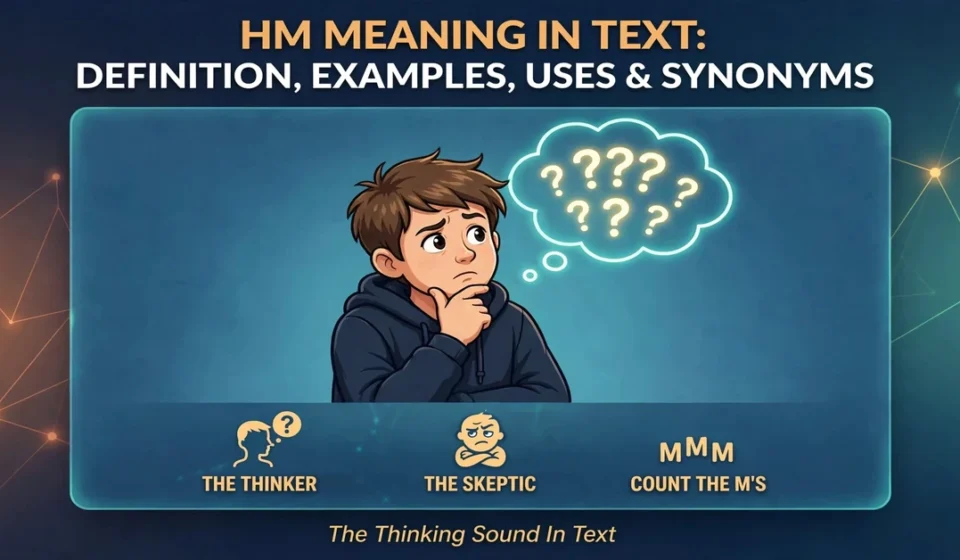
The Genuine Thinker
This is HM at its most innocent. You asked a real question — “Should we try the new sushi place or stick with pizza?” — and the other person is actually weighing options. The reply “Hm, tough call…” means exactly what it says: thinking in progress. Give it a minute and a real answer usually follows.
The Skeptic
Drop a bold claim in the group chat — “I could totally run a marathon” — and watch the hm’s roll in. “Hm.” with a period, especially, is the texting equivalent of a raised eyebrow. It says “I am not calling you a liar, but I am also not not calling you a liar.” Often paired with 😏 or 🤨, this is playful doubt, not an attack.
The Polite Dodger
Sometimes HM is a velvet “no.” “Hm, we’ll see” and “Hm, maybe” are the texting cousins of “let me check my calendar” — technically open, practically closed. This is not rudeness; it is conflict avoidance. The sender does not want to say no outright, so they hm their way into a soft landing.
The Dry Texter
Then there is the HM that launched a thousand overthinking spirals: the lone, lowercase “hm” with no emoji and no follow-up. In dry-texting culture, minimal replies read as low interest — and a bare “hm” is about as minimal as it gets. But before you panic, consider the sender. Some people text like telegrams. If they always reply in fragments, the hm is just their style, not a verdict on you.
The Flirty Ponderer
In the right context — late night, good banter, a little tension — “hm” can be playful. “Hm, do I want to see you this weekend? 😌” is not indecision; it is theater. The thinking sound becomes a tease, a way of making the other person wait half a beat for an answer they already know.
HM vs. HMM vs. HMMMM: Does Length Matter?
Yes — enormously. In texting, the number of M’s is a volume knob for thoughtfulness. This is one of the unwritten rules every native texter follows instinctively:
- Hm — a flicker of thought. Quick, casual, possibly distracted. The texter barely paused.
- Hmm — the standard. Genuine consideration, the classic thinking sound. This is the default “I’m pondering” signal.
- Hmmm — deeper waters. Something does not add up, or the decision is genuinely hard. Expect a follow-up question.
- Hmmmm… — full philosopher mode. The texter is either deeply intrigued or deeply suspicious, and you are about to get a paragraph.
It works the same way as “hey” vs. “heyyy” — extra letters stretch the feeling. A single “hm” can feel dismissive precisely because it is so short; the thinking seems too brief to be real. If you want your hm to land warmly, add an M or two. It costs nothing and changes everything.
Punctuation Changes Everything
Two letters, three punctuation marks, three completely different messages. This is the HM decoder ring:
“hm.” (with a period) — Final, flat, a door gently closing. The period adds weight and a hint of judgment. “Hm.” after your brilliant idea does not mean they are thinking — it means they have thought, and the verdict is unimpressed. This is the coldest hm.
“hm?” (with a question mark) — Curious and open. The question mark turns the thinking sound into an invitation: “I’m listening, explain more.” This is the warmest hm, and the easiest to reply to — just keep talking.
“hm…” (with an ellipsis) — Thinking out loud. The trailing dots are the sound of gears turning. “Hm… that’s actually interesting” signals genuine mental processing. This hm almost always comes with a follow-up thought, so give it a beat.
“hm!” (with an exclamation) — Rare, but delightful. The exclamation turns pondering into a small discovery: “Hm! I never noticed that.” It is thinking with enthusiasm.
“HM” (all caps) — Louder and more dramatic than lowercase. All-caps HM can read as exaggerated pondering (“HM, interesting…” said like a detective) or as genuine surprise. Either way, it has more energy than its lowercase sibling.
The Emoji Multiplier
Emojis are HM’s tone subtitles. The same two letters transform completely:
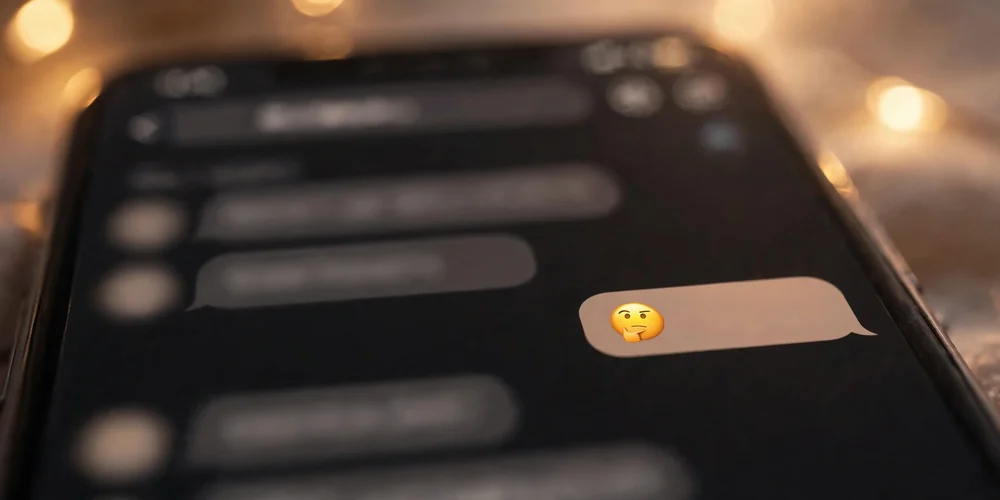
- “hm 🤔” — genuinely thinking, curious, engaged. The gold standard.
- “hm 😏” — sly, teasing, probably about to roast you lovingly.
- “hm 🙄” — skeptical to the point of eye-rolling. Proceed carefully.
- “hm 😅” — awkward. They do not know what to say and they know you know.
- “hm 👀” — intrigued and watching. Tell me everything.
If you send hm’s yourself, an emoji is the cheapest insurance against being misread. Two letters plus one emoji is still shorter than a sentence, and it saves the other person a spiral.
When HM Means Something Else Entirely
Ninety-five percent of the time, HM is the thinking sound. But the letters do moonlight as actual abbreviations in specific contexts:
High Maintenance. In dating and gossip conversations, “HM” can describe someone demanding — “She’s cute but very HM.” This usage is almost always capitalized and appears where a personality description fits, not where a reaction fits.
Hit Me Up. Occasionally “HMU” gets shortened to “HM” — “hm later” meaning “hit me up later.” Rare, and usually obvious from context.
Her Majesty. In British contexts, HM is the formal abbreviation for “Her Majesty” (“HM the Queen”). If the conversation is about royalty or government, this is the one.
How Much. In marketplace chats and bargaining — “HM for the bike?” — HM can mean “how much.” Common on buy-and-sell groups, confusing everywhere else.
The disambiguation rule is simple: if HM appears as a standalone reaction to something you said, it is the thinking sound. If it appears inside a sentence where a noun or verb should be, it is one of the abbreviations.
HM on Different Platforms
The thinking sound adapts to its habitat:
TikTok comments: “hm” is a whole genre of reaction — the skeptical “hm.” under a life-hack video, the intrigued “hm 👀” under a conspiracy theory. It is often performative, typed for the audience as much as the creator.
Discord and gaming: Quick “hm” during strategy talk means someone is processing the plan. Nobody overthinks it here — it is functional, not emotional.
Snapchat: A lone “hm” on a snap reply can sting because snaps feel personal. The thinking sound lands heavier when it is attached to a photo of your face.
WhatsApp and iMessage: This is where the overthinking happens, because these are your real relationships. An “hm” from your partner carries ten times the weight of an “hm” from a gaming buddy. The closer the relationship, the more the two letters get analyzed.
How to Reply When Someone Texts You “HM”
Getting hm’d does not have to start a spiral. Here is the playbook:
If it seems genuine: Give them space, then nudge. “Take your time — what are you leaning toward?” Open-ended and pressure-free.
If it seems skeptical: Address the doubt head-on with humor. “I know, sounds wild, but hear me out 😂” Defensiveness makes skepticism worse; confidence dissolves it.
If it is bare and dry: Do not chase. Reply to the topic, not the tone: “Anyway, the other option is…” If someone is consistently dry, that is a conversation for outside the chat.
If you are not sure: Ask plainly. “That hm feels loaded — what’s on your mind?” Directness beats three hours of rereading a two-letter text.
And the golden rule: never reply to “hm” with “hm.” Two people hmming at each other is how conversations go to die.
HM Etiquette: Do’s and Don’ts
Do use HM when you genuinely need a thinking beat — it is honest and human.
Do add an emoji or a few words so your thinking does not read as dismissal: “hm, interesting point 🤔” beats “hm” every time.
Do follow up. An hm is a placeholder, not an answer. If you hm’d someone, circle back with your actual thought.
Don’t use a bare “hm” in serious conversations — disagreements, apologies, bad news. It reads as cold when warmth is needed.
Don’t hm-bomb. Five hm’s in a row is not thinking; it is stalling, and everyone can tell.
Don’t read a novel into someone else’s hm. Sometimes “hm” just means “hm.” The simplest explanation is usually the right one — they are thinking, not sending coded messages.
Frequently Asked Questions
1. What is the HM meaning in text messages?
HM is the typed version of the thinking sound “hmm.” It signals thinking, hesitation, curiosity, or mild skepticism depending on context. It is not an acronym — it is a written-down vocal sound, like “uh” or “oh.”
2. Is getting “hm” as a reply a bad sign?
Not necessarily. HM most often means the person is thinking or processing. It only reads as cold or dismissive when it is a bare, lowercase “hm” with no emoji and no follow-up — and even then, some people just text tersely. Consider the sender’s normal style before worrying.
3. What is the difference between “hm” and “hmm”?
More M’s mean more thought. “Hm” is a quick flicker of consideration; “hmm” is the standard thinking signal; “hmmm” suggests deeper pondering or suspicion. Extra letters stretch the feeling, the same way “hey” and “heyyy” differ.
4. Can HM stand for something else?
Yes, in specific contexts: “high maintenance” (dating talk), “hit me up” (rare shortened form), “Her Majesty” (British formal use), or “how much” (marketplace chats). But as a standalone reaction in conversation, it is virtually always the thinking sound.
5. How should I reply to “hm”?
Match the energy: if it seems genuine, give space then ask what they are leaning toward; if skeptical, address it with humor; if dry, do not chase — reply to the topic, not the tone. And never reply “hm” to “hm.”
Conclusion
The HM meaning in text is wonderfully human: it is the sound of a brain working, typed out in two letters. It can be curious, skeptical, playful, or stalling — but at its heart, it is never empty. Someone took the half-second to show you they are thinking instead of leaving you on read, and that is worth something.
So the next time an “hm” lands in your chat, resist the spiral. Check the punctuation, glance at the emoji, consider the sender — and then just ask what is on their mind. Nine times out of ten, the thinking sound was the start of a good thought, not the end of the conversation.