

You are deep in a group chat when someone drops it: "atp I am just going to bed, this is hopeless." Or a friend captions their photo: "waited 40 minutes for my food, atp I am eating the napkins." Three letters, no explanation — and somehow you instantly feel the exhaustion radiating off the screen. What is going on with this little acronym?
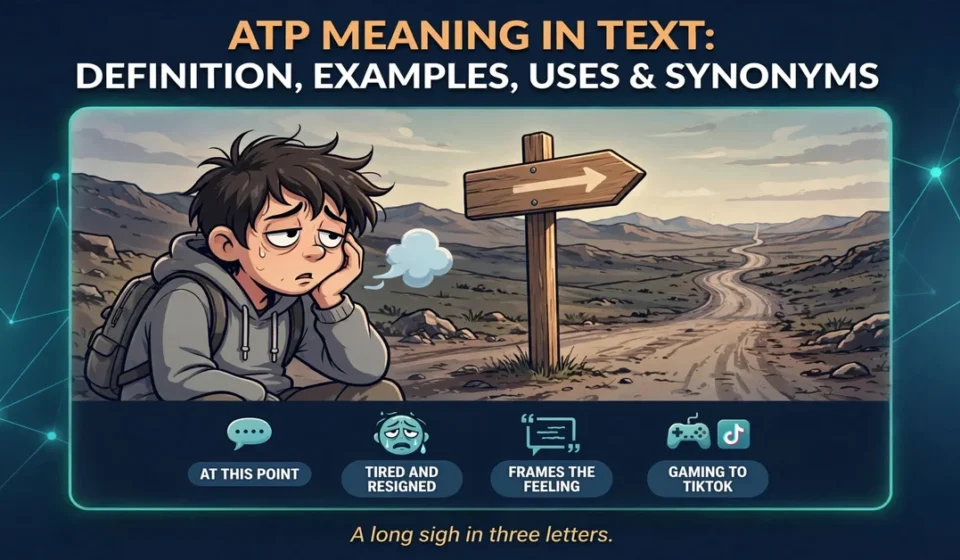
Here is the quick answer: ATP stands for "at this point." It is the texting equivalent of a long sigh — a way to say that based on everything that has happened so far, you have arrived at some conclusion, usually a tired, frustrated, or resigned one. It is one of the most emotionally expressive abbreviations in modern slang, packing a whole mood into three letters.
In this guide, we will unpack the full atp meaning in text: what it literally stands for, the emotions it carries, where it came from, how to use it without sounding dramatic, when to avoid it, how it differs from similar slang, and the questions everyone asks about it.

What Does ATP Mean in Text?
At its core, ATP = "at this point." It marks a moment of reckoning: after everything that has happened, here is where things stand. The phrase itself is old and ordinary — people have said "at this point" in English for centuries. The slang version just compresses it for speed and, more importantly, for feeling.
Real examples from everyday texting:
- "atp I do not even care who wins anymore" — resignation
- "atp just cancel the whole trip" — frustration boiling over
- "atp we might as well laugh about it" — acceptance with humor
- "atp I need a nap more than I need answers" — exhaustion, pure and simple
Notice that ATP almost always appears at the start of the message, like a drumroll for the feeling that follows. It frames everything after it as a conclusion drawn from mounting evidence. "I need a nap" is a statement. "Atp I need a nap" is a statement with a backstory — you can feel the long day behind it.
That is ATP's superpower: it implies history. You do not need to explain what happened; the acronym tells the reader that enough has happened.
Where ATP Came From: Gaming Forums to TikTok Captions
ATP's journey mirrors the classic slang pipeline. The earliest known online definition of ATP as "at this point" appeared on Urban Dictionary around 2010, but the acronym had been floating around gaming forums and early social media well before that. Gamers in particular loved it — nothing captures "my teammate has thrown the match for the fifth time" quite like "atp just end the game."
For most of the 2010s, ATP simmered as niche internet slang, used steadily on Twitter and in group chats but unknown to the wider public. Then came the TikTok acceleration of the early 2020s. Creators started dropping ATP into captions, comments, and on-screen text, and the algorithm did the rest. Suddenly "atp" was everywhere: in comment sections, in memes, in DMs between people who had never touched a gaming forum.
Why did it catch fire? Because ATP fills an emotional niche that other slang does not. "IDC" (I do not care) is blunt. "WTV" (whatever) is dismissive. ATP is neither — it is weary. It says "I have processed all of this and here is my verdict," which is exactly the energy of someone live-reacting to chaos, drama, or a day that will not end. In an era of constant group-chat drama and endless content, weariness turned out to be extremely relatable.
The Emotional Range of ATP: More Than Just Frustration
Newcomers assume ATP always means someone is angry. It does not. The acronym is emotionally versatile — the feeling comes from context, not the letters. Here is the spectrum:
Frustration: "atp the WiFi is doing this on purpose" — the classic use. Something keeps going wrong and patience has run out.
Resignation: "atp I have accepted that my package is never arriving" — not angry anymore, just done. This is ATP at its most peaceful.
Sarcastic realization: "atp my plants have a better social life than me" — self-deprecating humor. Very common in captions.
Detachment: "atp I am just watching the drama unfold 🍿" — opting out of caring. The observer's ATP.
Gentle finality: "atp I think we should just agree to disagree" — a soft way to close a debate without slamming the door.
Motivation (rare but real): "atp there is no going back, let us finish this" — occasionally ATP rallies instead of surrenders.
The thread connecting them all is the sense of an ending — of a process that has run its course. ATP is what you say when the deliberation phase is over and the verdict phase has begun.
Reading ATP Correctly
When someone sends you an ATP message, resist the urge to take it at face value as anger. Ask: what came before it? If they have been venting for twenty minutes, "atp I give up" is exhaustion, not an attack. The acronym is a window into their emotional state — treat it as information, not provocation.
How to Use ATP in Texts Naturally
ATP is easy to use well and easy to overuse. The key is placement and proportion. Here are the patterns that sound natural:
Leading a vent:
- "atp I am done explaining myself to people"
- "atp the group project is every person for themselves"
Reacting to absurdity:
- "he cancelled again, atp it is actually impressive"
- "atp I expect the plot twists at this point"
Stating a resigned decision:
- "atp I am ordering takeout, I accept defeat"
- "atp we are just going to be late, no point rushing"
In captions and comments:
- "POV: you have refreshed the tracking page 50 times. atp it is personal."
- "atp this fandom has seen things"
A few style notes: ATP is almost always lowercase in casual texting — "atp" reads as slang, while "ATP" in all caps can look like you are shouting or, worse, discussing cellular biology (adenosine triphosphate, the energy molecule, is the acronym's famous other life). Keep it at the start of the thought, and do not stack it with five other abbreviations — "atp idc wtv fr" is unreadable, not relatable.
When NOT to Use ATP
ATP is informal, emotional slang — which means there are rooms it should not enter. Knowing where it does not belong is as important as knowing how to use it.
Skip ATP when:
- Writing to your boss or in work emails. "Atp we should pivot the strategy" in a client email reads as unprofessional and oddly emotional. Use the full phrase "at this point" — it is perfectly professional without the slang baggage.
- Discussing something serious or sensitive. If a friend is sharing genuinely bad news, "atp that is rough" can sound flippant. Give real words to real feelings.
- Talking to someone unfamiliar with slang. Parents, grandparents, formal acquaintances — the acronym will confuse more than it communicates.
- You are actually angry and need to resolve something. ATP venting feels good in the moment but rarely moves a conflict forward. If something needs fixing, say so directly.
- In academic or formal writing. Essays, reports, applications — spell it out or restructure the sentence.
The rule of thumb: ATP belongs wherever "lol" would feel comfortable. If "lol" would be out of place, ATP is too.
ATP vs. Similar Slang: IDC, WTV, TBH, FR
ATP travels in a pack of emotional abbreviations, and they are easy to mix up. Here is how to tell them apart:
- ATP ("at this point") — a conclusion after a process. Implies history and weariness. "atp I am over it."
- IDC ("I do not care") — blunt disinterest, no process implied. "idc what we watch."
- WTV ("whatever") — dismissal, often with a shrug. "wtv, do what you want."
- TBH ("to be honest") — frames an honest opinion, not necessarily an emotional one. "tbh the movie was mid."
- FR ("for real") — emphasis or agreement. "fr, that was crazy."
They often appear together — "atp idc wtv" is practically a mood in itself — but each carries a distinct flavor. ATP is the storyteller of the group: it is the only one that says things have been happening, and this is where we landed.
Other Meanings of ATP (Yes, Including Biology Class)
In texting and social media, ATP means "at this point" roughly 99 percent of the time. But the acronym has other lives worth knowing, if only to avoid confusion:
- Adenosine triphosphate — the energy-carrying molecule in cells. If your biology homework mentions ATP, it is not slang.
- Answer the phone — occasionally used literally: "ATP! I am calling!" Rare, but it exists.
- Association of Tennis Professionals — the men's tennis tour. Sports contexts only.
- Across the platform — niche gaming/streaming usage.
Context makes the meaning obvious in practice. Nobody discussing mitochondria is texting slang, and nobody captioning a meme is discussing cellular respiration. When in doubt, though — especially with older texters — remember that not everyone got the slang memo.
ATP in Pop Culture: Memes, Captions, and Comment Sections
ATP truly found its audience in meme culture, where it became the unofficial caption of collective exhaustion. Scroll through any viral thread — a celebrity apology video, a disastrous product launch, a sports team's fourth straight loss — and you will find "atp" anchoring the top comments. It works because memes are communal: one person's "atp I give up" instantly becomes everyone's feeling, liked and reposted thousands of times.
The acronym also powers a specific caption formula: setup + ATP + punchline. "Studied for six hours. Atp the exam is just a formality" (confidence). "Studied for six hours. Atp I am teaching the class" (delusion, funnier). Creators love it because it adds a narrative arc to a single sentence — the ATP signals that something has been building, which makes the payoff hit harder.
Interestingly, ATP has also become a generational marker. Millennials tend to write out "at this point" or use older equivalents like "honestly…" while Gen Z reaches for "atp" instinctively. Brands trying to sound young have started dropping it into social copy — with mixed results. When a fast-food chain tweets "atp just order the nuggets," it lands. When a bank does it, the replies are merciless. The lesson: ATP is borrowed credibility. It only works if your audience already believes you are in on the joke.
Frequently Asked Questions About ATP Meaning in Text
Is ATP rude?
Not by itself. ATP expresses frustration, exhaustion, or resignation — which can sound sharp depending on context, but the acronym is not an insult. "atp I need sleep" is harmless; "atp you never listen" is sharp because of the sentence, not the slang. Tone comes from the words around it.
What does ATP mean on TikTok and Snapchat?
The same as in texting: "at this point." On TikTok it is huge in captions and comments for reacting to drama, fails, and relatable exhaustion. On Snapchat it usually appears in chat the same way — expressing a fed-up or resigned mood about whatever is happening.
Can ATP mean something other than "at this point"?
In everyday texting, essentially no. The only common alternative is the biology term adenosine triphosphate, which only appears in science contexts. If you see ATP in a chat, DM, or caption, "at this point" is the safe reading every time.
Is ATP formal or informal?
Completely informal. It is Gen Z and millennial slang for casual chats, captions, and comments. Never use it in work emails, academic writing, or formal messages — write out "at this point" instead, which is perfectly professional.
Who uses ATP the most?
Mostly Gen Z and younger millennials — the generations that grew up compressing feelings into abbreviations. It spread from gaming forums through Twitter to TikTok, and today it is mainstream enough that even many older texters recognize it, even if they do not use it themselves.
Conclusion
The atp meaning in text is small in letters and big in feeling: "at this point" — three words that carry the weight of everything leading up to them. From gaming lobbies to TikTok captions, ATP became the internet's favorite way to sigh in text form, marking the moment when patience ends and the verdict begins.
Use it where it belongs — casual chats, funny captions, friendly vents — and it will serve you well. Just remember what it really signals: not just a phrase, but a whole backstory. And sometimes, that backstory is simply that it has been a very long day.