
It is 1:47 in the morning. The group chat has been going for three hours — memes, voice notes, a debate about pizza toppings that got weirdly heated. Then one message appears, short and final: “gts guys 😴.” Within minutes, the chat goes quiet. Nobody asks what it means. Everybody just… goes to sleep.
That is the magic of GTS: in texting, it almost always means “go to sleep.” It is the digital equivalent of turning off the lights — a quick, friendly way to end a conversation, sign off for the night, or nudge someone toward bed. But those three letters have a few other lives, and guessing wrong can make a wholesome goodnight weirdly confusing.
In this guide, we will break down the full GTS meaning in text: the main definition, its alternate meanings, how context instantly tells you which one you are looking at, how different platforms use it, when it can sound rude, and how to reply when someone sends it your way.
What Does GTS Mean in Text?
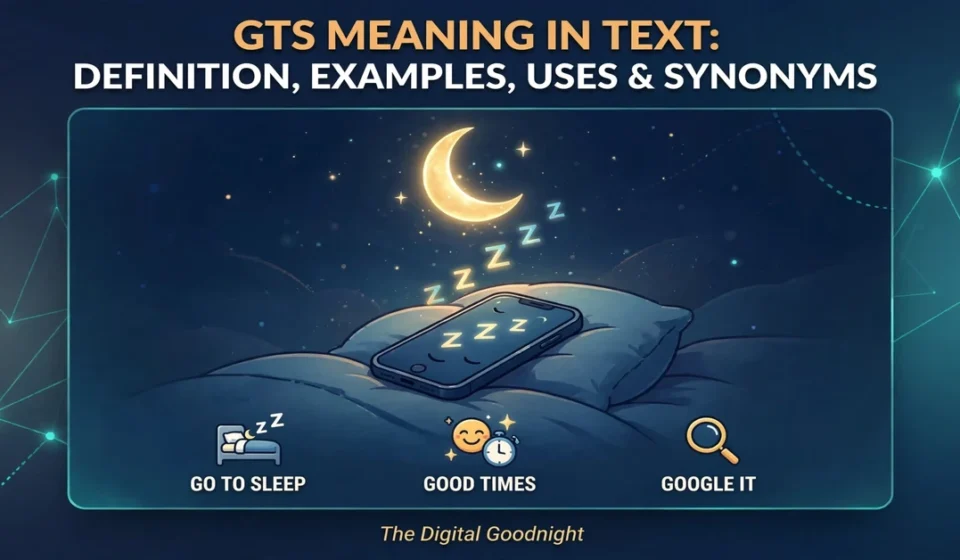
The headline answer: GTS = “go to sleep.” It is a casual sign-off used when someone is heading to bed, ending a chat, or suggesting the other person should rest. Think of it as the texting generation’s “goodnight,” minus the formality.
It shows up in two directions:
- About yourself: “I’m dead tired, gts. Talk tomorrow!” — announcing your exit.
- About the other person: “It’s 2am, gts already 😂” — a caring (or teasing) nudge toward bed.
Either way, the message is the same: the conversation is over for tonight, and sleep is the plan. It is short, warm, and universally understood among anyone who texts after midnight — which is to say, almost everyone under thirty.
GTS works because it solves a real social problem. Ending a chat can feel awkward — do you just stop replying? Send a formal goodnight? GTS splits the difference: it closes the conversation cleanly while sounding like something a friend would actually say, not a Hallmark card.
The Other Lives of GTS
“Go to sleep” owns the acronym about 90 percent of the time. But GTS moonlights, and knowing the alternates saves you from some genuinely funny misunderstandings.
Good Times
Under a throwback photo, in a caption about last weekend, or in a group chat reliving a legendary night out, GTS can mean “good times.” “That concert last night… gts fr 🔥” is not telling anyone to nap — it is raising a glass to the memory. The nostalgia context makes this one easy to spot: if people are reminiscing, GTS is celebrating, not sedating.
Google That Stuff
In a snappier mood, GTS means “google that stuff” — a playful way of telling someone to look it up themselves. “What does ‘defenestration’ mean?” → “idk, gts 😏” It is the polite cousin of “let me google that for you,” and it only appears when someone asks a question the sender does not feel like answering.
Glad To See
Less common but real: GTS as “glad to see” (or “good to see”). “GTS! It’s been ages” at the start of a conversation is a warm greeting, not a bedtime announcement. Position is the giveaway — this GTS opens chats, while “go to sleep” closes them.
The Non-Slang Meanings
Outside casual texting, GTS belongs to other worlds entirely: Gran Turismo Sport (the racing game), Global Trading System, and various technical terms. If you are in a gaming lobby talking about cars, GTS is not about sleep. Context, as always, is king.
How Context Tells You Which GTS You Got
With four possible meanings sharing three letters, how does anyone know which one is meant? In practice, it is almost never confusing, because the clues are loud:
Check the clock. A GTS sent at 1am means “go to sleep” with near-total certainty. A GTS under a Saturday afternoon photo dump means “good times.” Time of day is the single best decoder.
Check the position. Opening a conversation with GTS (“GTS! long time”) leans greeting. Closing one (“gts, dead rn”) leans sleep. Middle-of-chat GTS after a question leans “google that stuff.”
Check the emojis. 😴 🛏️ 🌙 = sleep, obviously. 🔥 ❤️ 🎉 = good times. 😏 🙄 = google it yourself. Emojis are the tone subtitles that remove all doubt.
Check the platform. On Snapchat at midnight, it is sleep. On Instagram under a carousel of party photos, it is good times. In a Discord debate, it might be “google that stuff.” Each platform has a home-turf meaning.
When all else fails, the sleep meaning is the safest default — it is correct the vast majority of the time, and even if you are wrong, nobody is offended by being wished good rest.
GTS on Snapchat, TikTok, and Discord
The acronym wears slightly different outfits depending on where it appears:
Snapchat: GTS is a streak-saver’s best friend. Late-night streak exchanges end with “streaks done, gts 😴” — a ritual millions of teens perform nightly. It is caring, routine, and completely unremarkable, which is exactly why it works.
TikTok: Here GTS splits. In comments, “gts” under a 3am-posted video means go to sleep (often jokingly — “gts, it’s 4am, why are we here”). In captions of nostalgic edits, #gts tags “good times” content. The comment section usually makes the meaning obvious.
Discord and gaming: “gts, logging off” ends gaming sessions the way it ends chats. But gamers also deploy it mid-argument — “not reading all that, gts 💀” — where it shades from caring into dismissive. The skull emoji is doing a lot of work there.
Instagram DMs: The good-times meaning thrives here, floating under shared memories and inside jokes. The sleep meaning appears too, usually with the moon emoji doing disambiguation duty.
How to Use GTS Naturally
Dropping GTS into your own texts is easy once you see the patterns. Here are the native-speaker templates:
Signing yourself off:
- “Alright I’m gonna gts, early morning tomorrow”
- “gts guys, this was fun 😴”
- “My eyes are closing on their own. gts!”
Nudging someone else (caring):
- “You’ve been up since 5am, gts already”
- “Gts! You need rest before the exam”
- “Okay but actually gts, you look exhausted 😂”
Nudging someone else (teasing):
- “It’s 3am and you’re still arguing about cereal. GTS.”
- “Gts bro, the group chat will survive without you”
The nostalgic one:
- “Remember that road trip? Gts fr 🥹”
- “These photos… gts ❤️”
Notice the rhythm: GTS rarely travels alone. It brings a reason (“early morning”), an emoji (“😴”), or a bit of warmth (“this was fun”). A bare “gts” with no garnish can feel abrupt — the digital equivalent of hanging up without saying bye. Two extra words fix it completely.
When GTS Sounds Rude (and How to Avoid It)
GTS is friendly by default, but tone is fragile in text. Here is where it goes wrong:
The conversation killer. Dropping “gts” in the middle of someone’s long, emotional message reads as “I stopped caring.” If someone is venting, do not GTS them — acknowledge first, sign off second: “That sounds rough, I’m here. I gotta gts but text me tomorrow?”
The dismissive GTS. “Gts” as a reply to an opinion you disagree with is just “shut up” with better branding. Everyone can tell. If you disagree, say so like an adult; do not hide behind bedtime.
The premature GTS. Sending it at 9pm to someone in another timezone who is wide awake is just confusing. The acronym assumes a shared night — check the hour on their end first.
The cold GTS. With strangers or in semi-formal contexts, “gts” can feel oddly intimate — you are commenting on someone’s sleep habits, after all. Stick to “goodnight” with people you do not know well.
The fix for all four is the same: add warmth. Emojis, a reason, a “talk tomorrow” — any of these turn a potentially blunt sign-off into a kind one.
GTS vs. Similar Sign-Offs
The bedtime-text family is crowded. Here is where GTS fits:
- GTS vs. GN (goodnight): GN is the classic — warm, simple, slightly formal. GTS is chattier and more casual, with a hint of humor. GN is what you text your mom; GTS is what you text the group chat.
- GTS vs. GTG (got to go): GTG ends a conversation for any reason — class, work, dinner. GTS specifically means sleep. GTG is the all-purpose exit; GTS is the bedtime one.
- GTS vs. TTYL (talk to you later): TTYL promises a future conversation without naming a time. GTS implies “tomorrow, after sleep.” They often team up: “gts, ttyl!”
- GTS vs. BRB (be right back): BRB means minutes; GTS means hours. Never GTS someone and reappear in ninety seconds — the acronym has a minimum absence.
How to Reply When Someone Sends GTS
Someone just GTS’d you. Your move:
The standard: “gn! 😴” or “gts, talk tomorrow!” — mirror the energy, close the loop.
The caring: “Sleep well! Don’t let the exam stress you” — add a personal touch when you know why they are tired.
The playful: “Fine, abandon me 😤 gn” — for the friend who GTS’s mid-conversation every single night.
The concerned (rare): If someone GTS’s at 7pm looking distressed, it might not be about sleep. “Everything okay? Here if you need to talk” costs nothing.
And what not to do: do not keep texting after a GTS. The whole point of the acronym is “I will not be replying.” Every message you send after it is a message into the void — save it for morning.
Frequently Asked Questions
1. What is the GTS meaning in text messages?
GTS most commonly stands for “go to sleep” in text messages. It is used to end a late-night conversation, announce you are heading to bed, or playfully tell someone else to get some rest — for example, “It’s 2am, gts already 😂.”
2. Can GTS mean “good times”?
Yes. In nostalgic contexts — throwback photos, captions about fun memories, group chats reliving a great night — GTS means “good times.” The reminiscing context makes this meaning easy to recognize.
3. Is GTS rude?
Not by default — it is usually caring or playful. But it can sound dismissive if dropped in the middle of someone’s serious message, used to shut down a disagreement, or sent with no warmth. Adding an emoji or a “talk tomorrow” keeps it friendly.
4. What is the difference between GTS and GN?
GN (goodnight) is the classic, slightly warmer and more universal sign-off. GTS (“go to sleep”) is chattier, more casual, and carries a hint of humor or teasing. GN suits anyone; GTS suits friends and group chats.
5. How do I know which meaning of GTS someone intends?
Check three things: the time (late night = sleep), the position (closing a chat = sleep, under memories = good times, after a question = “google that stuff”), and the emojis (😴 = sleep, 🔥 = good times). The sleep meaning is the safest default.
Conclusion
The GTS meaning in text is, most of the time, beautifully simple: “go to sleep.” It is the friendly little sign-off that ends a million late-night conversations — caring when it nudges a tired friend toward bed, funny when it teases a 3am debater, and nostalgic when it moonlights as “good times.”
So the next time your chat goes quiet after a well-placed “gts 😴,” you will know exactly what happened: the night is over, the phones are face-down, and everyone is doing the one thing the acronym asked. Honestly? We could all use the reminder. GTS.