
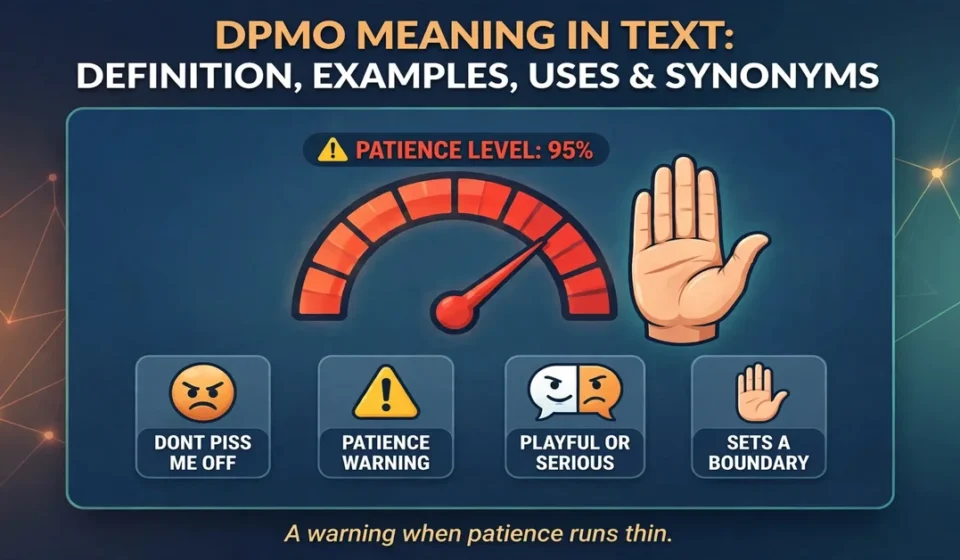

Some abbreviations are friendly little shortcuts; DPMO is a warning shot. When these four letters appear in a message, the temperature of the conversation just dropped several degrees. The dpmo meaning in text is "Don't Piss Me Off" — a blunt, preemptive boundary that tells the other person they are approaching someone's limit and should back off now.
But DPMO has a double life that makes it genuinely confusing. In the business world, the same four letters stand for something completely different: "Defects Per Mil lion Opportunities," a technical quality metric from Six Sigma methodology. Same letters, opposite universes — one emotional, one mathematical. In this guide, we will unpack both meanings, explain how to tell them apart instantly, explore the slang's tone and etiquette, walk through real examples, and answer the questions people ask most.
Whether you received a heated "DPMO" in a group chat, stumbled across it in a work document, or are just collecting text abbreviations, this article covers everything. By the end, you will know exactly what DPMO means wherever you meet it — and you will understand why context is the only thing standing between a quality metric and a fight.

What Does DPMO Mean in Texting?
In texting and casual online conversation, DPMO stands for "Don't Piss Me Off." It is a direct warning: the speaker is annoyed, their patience is thinning, and the other person should change course before things escalate. Think of it as the text-message equivalent of holding up a hand — stop, right now.
DPMO is best understood as an extension of PMO, an older and more common acronym with a split personality. PMO can mean "piss me off" ("that really pmo") or "put me on" ("pmo a good show" — i.e., recommend something). That ambiguity is exactly why DPMO exists as its own term: adding "Don't" to the front locks the meaning into the frustration lane. Nobody says "don't put me on" when asking for recommendations, so DPMO has one job and one job only — drawing a line.
In practice, DPMO shows up in a few recognizable situations. There is the playful warning between friends: "DPMO, I haven't had coffee yet 😤" — annoyed, but everyone knows it is theater. There is the genuine boundary: "DPMO, I already told you I'm busy" — the humor is gone, and the message is real. And there is the heated argument version, where DPMO lands like a slammed door. Same letters, three completely different temperatures — and misreading which one you received is where trouble starts.
One important note: DPMO is not a mainstream abbreviation like LOL or BRB. It is medium-frequency slang — common enough in certain online communities, group chats, and TikTok-adjacent spaces, but unfamiliar to plenty of people. If you use it with someone who does not know it, expect confusion rather than compliance. Obscure warnings do not warn very well.
DPMO in Six Sigma: "Defects Per Million Opportunities"
Now for the plot twist: in the professional world, DPMO has nothing to do with anger. It stands for "Defects Per Million Opportunities" — a core metric in Six Sigma, the quality-management methodology used in manufacturing, business operations, and process improvement.
The concept is straightforward. A "defect" is any failure to meet a specification; an "opportunity" is any chance for a defect to occur. DPMO measures how many defects occur per one million opportunities, giving organizations a standardized way to compare quality across different processes, products, and even industries. The formula is simple: divide defects by opportunities, multiply by one million. Lower DPMO means higher quality — world-class processes aim for fewer than 1,000 DPMO, and the famous Six Sigma benchmark is just 3.4 DPMO.
You will encounter this DPMO in quality reports, operations meetings, manufacturing documentation, and business school coursework — never in a group chat about weekend plans. It is formal, numeric, and entirely unemotional, which makes it the photographic negative of the slang version.
How to tell them apart instantly: look at the room. If the conversation involves factories, processes, metrics, or reports, it is Defects Per Million Opportunities. If it involves friends, feelings, arguments, or TikTok comments, it is Don't Piss Me Off. The surrounding vocabulary makes the meaning obvious within seconds — "our DPMO dropped to 800" and "DPMO I'm not in the mood" could not belong to more different worlds. When both meanings are theoretically possible (a work chat with casual culture), default to the professional reading unless the tone is clearly emotional.
The Origin of DPMO Slang
The slang DPMO does not have a single documented birth moment — like most internet slang, it emerged gradually from the way people actually talk. The phrase "don't piss me off" is old, blunt, everyday English, the kind of thing people have said in frustration for generations. When texting culture began compressing everything in the 2000s, long emotional phrases got the abbreviation treatment, and DPMO was a natural result.
Its more specific lineage runs through PMO, which gained serious momentum on TikTok in the early 2020s. As "pmo" spread as shorthand for "piss me off," the preemptive "don't" variant followed logically — if PMO describes irritation that already happened, DPMO warns against irritation that is about to happen. It is the difference between a damage report and a stop sign.
The slang also fits a broader pattern in digital communication: the rise of boundary-setting abbreviations. As online life made everyone more reachable, people needed faster ways to say "back off," and compressed warnings like DPMO, "stfu," and "f off" flourished in spaces where bluntness is the norm — group chats, gaming lobbies, comment sections. DPMO is part of that family: less crude than some of its cousins, but carrying the same "I am at my limit" energy.
It is worth noting the generational split. Younger users who live on TikTok and in gaming chats recognize DPMO instantly; older users and professionals usually know only the Six Sigma version — if they know it at all. That split is the source of most DPMO confusion, and it is why this article covers both meanings instead of pretending only one exists.
How to Use DPMO: Real Examples (and When Not To)
DPMO is a high-voltage abbreviation — powerful in the right socket, dangerous in the wrong one. Here is how it plays out in real conversations.
The playful warning. Between close friends, DPMO is theater — everyone knows nobody is actually angry.
- "DPMO guys, I haven't had my coffee yet ☕😤"
- "Touch my fries and DPMO."
The real boundary. The humor drains out, and the warning is genuine. This version deserves to be taken seriously.
- "DPMO, I've told you three times I'm not coming."
- Friend: "I'm going to post that embarrassing photo."
- You: "DPMO. I'm serious."
The argument accelerant. In heated exchanges, DPMO pours fuel on the fire. It rarely de-escalates anything.
- "Oh DPMO with that attitude."
Now the critical part — when not to use it. Do not use DPMO with strangers; without a relationship underneath, it reads as pure hostility. Do not use it at work, ever — even the "playful" version can land as aggression in professional settings, and HR does not grade on a curve for slang. Do not use it with people who do not know the slang; an obscure warning just creates confusion. And do not use it when you are genuinely furious — if you have truly reached your limit, an abbreviation trivializes the moment; use real words or step away from the conversation.
The underlying principle: DPMO is a shortcut for a feeling, and strong feelings deserve more than shortcuts. The playful version works because everyone is in on the joke. Every other version is a gamble — and the stakes are the relationship itself.
Reading the Tone: Playful vs. Serious DPMO
Because DPMO spans from joking to genuinely angry, reading it correctly is a real social skill. Here is how to calibrate.
Playful DPMO comes with softeners: laughing emojis, absurd overstatement, obvious theatricality. "DPMO, this WiFi is testing me 😭" is someone performing frustration for laughs. The topic is trivial, the tone is dramatic, and the intent is comedy. Respond in kind — laugh, tease back, carry on.
Serious DPMO comes stripped down: no emojis, short sentences, a real grievance underneath. "DPMO. I said no." has no performance in it — it is a boundary stated flatly. The topic matters to the speaker, the patience is genuinely thin, and the right response is to back off, not to joke. Meeting serious DPMO with laughter is one of the fastest ways to turn a warning into a fight.
The gray zone is where most misreadings happen: DPMO with a little humor and a little real irritation mixed together. "DPMO lol but actually stop" is doing two things at once — keeping it light while meaning it. In these cases, take the boundary seriously and the tone lightly: stop the behavior, keep the mood friendly.
A useful rule: the less decoration around DPMO, the more seriously you should take it. Emojis and exaggeration are the wrapping paper of playfulness; a bare DPMO is the warning with the wrapping torn off. And if you are the one sending it, be honest with yourself about which version you mean — because the recipient will decide for themselves, and they may not decide the way you hoped.
What does DPMO stand for in texting?
In texting and online slang, DPMO stands for "Don't Piss Me Off." It is a blunt warning that someone's patience is running thin and the other person should back off or change their tone. It ranges from playful teasing between friends to a genuinely serious boundary, depending on context.
What does DPMO mean in business?
In business and quality management, DPMO stands for "Defects Per Million Opportunities" — a Six Sigma metric measuring how many defects occur per one million chances for a defect. Lower DPMO indicates higher process quality, with the Six Sigma benchmark set at 3.4 DPMO. It appears in manufacturing, operations, and process-improvement contexts.
Is DPMO rude?
It can be. The phrase "don't piss me off" is inherently confrontational, so DPMO carries an edge even when used playfully. Between close friends with obvious humor, it is fine. Aimed at strangers, colleagues, or in serious moments, it reads as aggressive or disrespectful. When in doubt, choose kinder words — especially at work, where it should never appear.
What's the difference between DPMO and PMO?
PMO is the parent acronym with two meanings: "piss me off" ("that pmo") or "put me on" ("pmo a good playlist" — recommend something). DPMO adds "Don't" to the front, which eliminates the "put me on" reading entirely and turns the phrase into a preemptive warning. If PMO is ambiguous, DPMO is specific: it always means "don't piss me off."
How do I know which DPMO meaning someone intends?
Read the context. Technical vocabulary — processes, metrics, quality, reports, manufacturing — means Defects Per Million Opportunities. Emotional or casual conversation — friends, arguments, jokes, social media — means Don't Piss Me Off. The surrounding words make it obvious; the two meanings live in completely different worlds and almost never genuinely overlap.
You may also like: FML
Conclusion
The dpmo meaning in text depends entirely on which world you are standing in. In group chats and comment sections, DPMO means "Don't Piss Me Off" — a blunt, preemptive warning that someone's patience is wearing thin, ranging from playful theater to a genuinely serious boundary. In boardrooms and factories, it means "Defects Per Million Opportunities" — a precise Six Sigma quality metric with nothing emotional about it at all.
The skill is reading the room: technical context means the metric, casual context means the warning, and the tone around the slang version tells you whether to laugh or back off. Master that distinction, and these four letters will never confuse you again — whichever DPMO you meet.
Explore more on Celeb Snips.