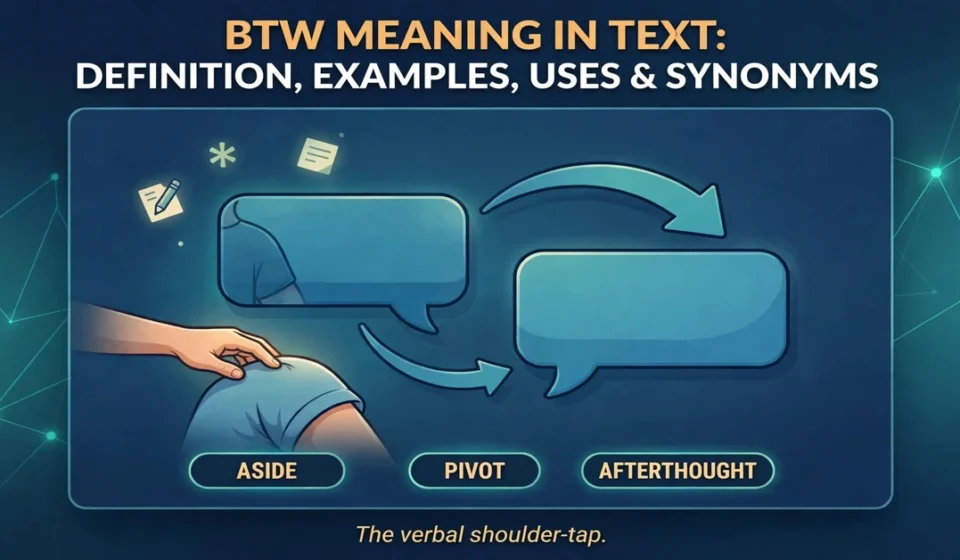

It is the most useful three letters in the texting dictionary, and you have probably typed it today without thinking. BTW — the conversational pivot, the afterthought engine, the verbal shoulder-tap that lets you change the subject without changing the mood. It is so embedded in digital speech that people now say "bee-tee-dubs" out loud, only half-joking.
BTW stands for "by the way." That is the entire definition, and it has not changed in the decades since the acronym first appeared. What has changed is how much work those three letters do: BTW is not just an abbreviation, it is a social tool — a way to slide side notes into conversations, soften topic changes, sneak in reminders, and occasionally deliver news with studied casualness.
In this guide, we will cover the complete btw meaning in text: what the phrase actually does in a sentence, where it came from (its roots stretch back further than you think), the many jobs it performs in modern messaging, how it differs from its cousins like FYI and TBH, and the small etiquette rules that keep your BTWs smooth instead of awkward.
What Does "BTW" Mean in Text?
BTW = "By The Way." It introduces information that is related to the conversation but not quite part of its main flow — an aside, an afterthought, a secondary point that deserves mentioning without derailing everything.
Think of it as a transition phrase. Its job is to signal: what I am about to say is a slight departure, but it is worth your attention. Here is the classic shape:
- "I finished the report. BTW, did you see Marcus's email?" — smooth topic pivot.
- "BTW, I loved your presentation today." — compliment slipped in sideways.
- "We're meeting at 7. BTW, bring your charger." — logistical afterthought.
- "BTW…" — the standalone, ominous or exciting depending on what follows.
The beauty of BTW is how it frames the incoming information. The same sentence hits differently with and without it. Compare "You left your jacket" (a plain report, possibly accusatory) with "BTW, you left your jacket" (a helpful aside, zero blame). Those three letters add a cushion of casualness — they say this is not a big deal, just mentioning it. That softening effect is why BTW survived while thousands of other acronyms faded: it does emotional work, not just typing work.
The grammar of the aside
BTW is remarkably flexible in placement. It can open a sentence ("BTW, are you free Friday?"), sit mid-sentence ("Are you, BTW, free Friday?" — rarer, more formal), or close one ("Are you free Friday, BTW?"). Opening is the most common in texts; closing gives the sentence a trailing, afterthought feel — as if the thought occurred to the sender just as they were hitting send. All three are correct. The choice is pure style: front-loaded BTW announces the pivot; trailing BTW performs spontaneity.
Where Did BTW Come From?
"By the way" as a phrase is centuries old — it appears in English writing going back to the 1500s, doing exactly the same job it does now: introducing a digression. The abbreviation BTW, though, is a child of the internet: it emerged in the late 1980s and early 1990s on bulletin board systems, Usenet newsgroups, and early chat rooms, where typing speed mattered and screen space was precious.
It was part of the first great wave of internet acronyms — LOL, BRB, IMHO, FYI — coined by people who lived in text and needed conversational tools, not just shortcuts. BTW thrived because it solved a real structural problem of early online chat: conversations scrolled fast, topics tangled, and you needed a way to flag "this is a side note" before your message got lost in the scroll. The acronym was the flag.
From forums it spread to instant messaging (AIM, MSN), then SMS, then every social platform in existence. What is remarkable is how little it changed along the way. Slang usually mutates as it migrates — meanings drift, irony layers accumulate. BTW stayed stubbornly literal for nearly four decades. "By the way" in 1992 meant what "btw" means in 2026. In the churn of internet language, that kind of stability is almost unheard of — a sign that the acronym filled its niche perfectly on the first try.
The Many Jobs of BTW in Modern Messaging
The btw meaning in text is stable, but the uses are wonderfully varied. Here are the main ones:
The topic pivot
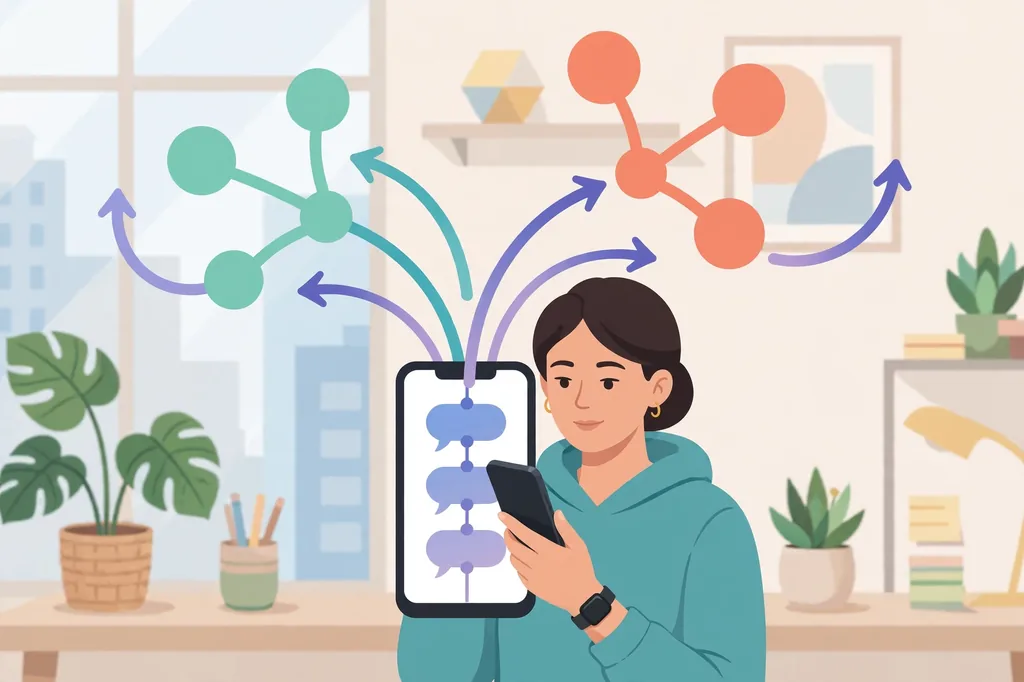
The classic. You are discussing one thing, you need to mention another, and BTW builds the bridge: "That pizza was amazing. BTW, did you finish the chem homework?" Without the BTW, the pivot feels abrupt — like changing the radio station mid-song. With it, the shift feels natural, almost polite. It is the conversational equivalent of a turn signal.
The softened reminder
BTW excels at delivering reminders without nagging. "BTW, rent is due Friday" lands ten times softer than "Rent is due Friday." The acronym frames the reminder as an afterthought rather than a demand — oh, while I am here — which lets the recipient save face. This is why BTW is everywhere in roommate chats, group projects, and workplace messages: it nags without sounding like nagging.
The casual bombshell
Sometimes BTW does the opposite of softening — it heightens by contrast. "BTW, I'm moving to another country" is funny precisely because the casual frame collides with the enormous news. This ironic use is a staple of group-chat comedy: the bigger the news, the smaller the BTW energy around it. "btw I got engaged" will get more reactions than any formal announcement precisely because of the deadpan delivery.
The preemptive clarification
"I'm running late, BTW traffic is insane" — here BTW introduces the reason as a secondary note, keeping the main message (I'm late) clean and upfront. It is organizational: main point first, supporting detail flagged as supporting detail. Good communicators use BTW this way instinctively.
BTW in Real Conversations: Examples
Example 1 — the topic pivot:
Maya: that movie was SO good
Maya: btw are we still on for Saturday?
Example 2 — the softened reminder:
Dev: btw don't forget your laptop tomorrow, you left it last time 😅
Example 3 — the casual bombshell:
Ana: btw I quit my job today lol
Example 4 — the compliment smuggler:
Sam: btw your playlist is elite, I've had it on repeat
Example 5 — the logistical afterthought:
Priya: meeting's at 3. btw, bring the printed copies
Example 6 — the standalone ominous:
Leo: btw…
Maya: don't "btw…" me, what happened
That last one deserves a note: a lone "btw…" with ellipsis is the texting equivalent of "we need to talk." It creates instant suspense, deliberately. Use it for comedic effect with friends; never use it before actual bad news unless you enjoy being feared.
BTW vs. FYI, TBH, and Other Cousins
BTW has close relatives, and mixing them up changes the message:
- FYI (for your information) — the formal cousin. FYI presents information as useful data; BTW presents it as casual aside. "FYI, the deadline moved" sounds official; "BTW, the deadline moved" sounds friendly. FYI can also carry a passive-aggressive edge ("FYI, I already told you this") that BTW almost never has.
- TBH (to be honest) — the confessional cousin. TBH frames what follows as candid truth; BTW frames it as tangential note. "TBH, I didn't like it" is a confession; "BTW, I didn't like it" is an aside. Different jobs entirely.
- NGL (not gonna lie) — TBH's edgier sibling. Same confessional function, more casual register. Neither overlaps with BTW's pivot function.
- IMO/IMHO (in my opinion) — the opinion-flag. Marks subjectivity; BTW marks topicality. "IMO it's overrated" vs. "BTW it's overrated" — the first says this is just my take, the second says changing the subject slightly.
- PS (postscript) — the ancestor. The handwritten "P.S." did BTW's job for centuries: the afterthought, added after the main message. BTW is essentially "P.S." for the instant-messaging age — which is why "btw" at the end of a message feels so natural. It is the old form wearing new letters.
What makes BTW unique in this family is its neutrality. FYI can sound cold, TBH sounds confessional, NGL sounds blunt — but BTW is almost pure function, carrying almost no attitude of its own. That neutrality is its superpower: it fits everywhere, offends no one, and does its job invisibly.
When to Use BTW (and When Not To)
Do use it for genuine asides, topic pivots, softened reminders, and casual follow-ups — that is its native territory, and it works in texts, emails, work chats, and social posts alike. BTW is one of the few slang acronyms that is genuinely safe in professional settings: "BTW, the client moved the call to Thursday" is perfectly fine in a work email. Do use it to smuggle compliments and soften requests; the cushioning effect is real.
Do not use it to bury important information. If something is the main point, do not BTW it — "BTW, you're fired" is a horror story, not a communication strategy. Important news deserves direct framing, not aside framing. Do not stack BTWs — "BTW… BTW… BTW…" in one message reads as scattered thinking; if everything is an aside, nothing is. Do not use the ominous lone "btw…" before serious news; the suspense it creates is cruel when the payoff is genuinely bad. And do not use BTW sarcastically to mean its opposite — "BTW, great job" after a failure — because the acronym's neutrality means the sarcasm often does not land, and you just sound confusing.
How to Reply When Someone Sends You "BTW"
The golden rule: respond to what follows the BTW, not the BTW itself. The acronym is packaging; the content is the gift. If someone writes "BTW, did you see the email?", answer about the email. If they write "BTW you left your jacket", answer about the jacket ("omg thank you, I'll grab it tomorrow"). Treating the BTW as the point of the message — "btw what?" — derails the conversation over nothing.
The one exception is the standalone "btw…" — the suspense-builder. That one is the point, and the correct response is to demand the payoff: "don't leave me hanging, WHAT." With friends, this is playful; the sender wanted this reaction. With anyone else, a calm "sure, what's up?" works.
If the BTW carried a compliment — "BTW, great job today" — accept it warmly ("thank you, that means a lot"). The aside framing was shyness, not insincerity. And if the BTW was the casual bombshell — "btw I'm moving" — match the energy with genuine engagement, not with jokes about the delivery. The deadpan was the joke; the news is real.
Is BTW rude?
Almost never. BTW is one of the politest tools in the texting kit — its whole function is to soften interruptions and reminders. The only way it turns rude is through misuse: burying important news in a BTW, stacking them until the message is incoherent, or deploying the ominous lone "btw…" before bad news. Used as intended — the casual aside, the gentle pivot — it is the opposite of rude. It is consideration in three letters.
What's the difference between BTW and FYI?
Tone and framing. BTW ("by the way") frames information as a casual aside — friendly, low-pressure, conversational. FYI ("for your information") frames it as useful data — more formal, more direct, occasionally colder. "BTW the meeting moved" sounds like a friend mentioning it; "FYI the meeting moved" sounds like an announcement. In practice: BTW for chats and friendly emails, FYI for anything where you want a slightly more official register. They overlap, but the vibe is the difference.
Can I use BTW in formal writing?
The acronym itself? Sparingly. In emails and work chats, "BTW" is widely accepted — it is one of the few internet abbreviations professionals use without thinking. But in formal documents — reports, academic papers, official letters — write it out as "by the way," or restructure the sentence to avoid the aside entirely. The rule of thumb: if the document might be printed, spell it out. If it lives in an inbox or a chat window, "BTW" is fine.
Why do people say "BT-dubs" out loud?
Because internet slang has fully merged with spoken language. "BT-dubs" (BTW pronounced as "bee-tee-dubs," with "dubs" standing in for W) started as a joke — saying the acronym aloud the way you would read it — and stuck around because it is fun to say. It is the same phenomenon as "lol" pronounced "loll" or "OMG" said as a word. When an abbreviation gets spoken aloud for laughs and survives, it has officially completed the journey from typing shortcut to real vocabulary. BTW made that journey years ago.
Is BTW outdated?
Not even slightly. While flashier slang burns out in months, BTW has been in continuous use for nearly four decades — older than most of the people typing it. It is not "trendy" slang; it is infrastructure slang, like "OK" or "PS." Trendiness is irrelevant to it. As long as conversations have side notes, BTW will have a job. If anything, its stability is the point: in a linguistic landscape where everything changes, BTW is the reliable tool that never needed an update.
Conclusion
The btw meaning in text is the simplest on this list — "by the way" — and somehow also the deepest. Those three letters carry nearly forty years of internet history, doing the quiet structural work that holds conversations together: the pivot, the aside, the softened reminder, the smuggled compliment. While other acronyms chased laughs or attitude, BTW just kept being useful, and usefulness turned out to be the ultimate survival strategy.
So keep typing it — in the group chat, in the work email, in the caption. Every "btw" is a tiny act of conversational care: I have something to add, and I am adding it gently. In a medium famous for abruptness, that gentleness matters more than it looks. By the way — now you know exactly why.