
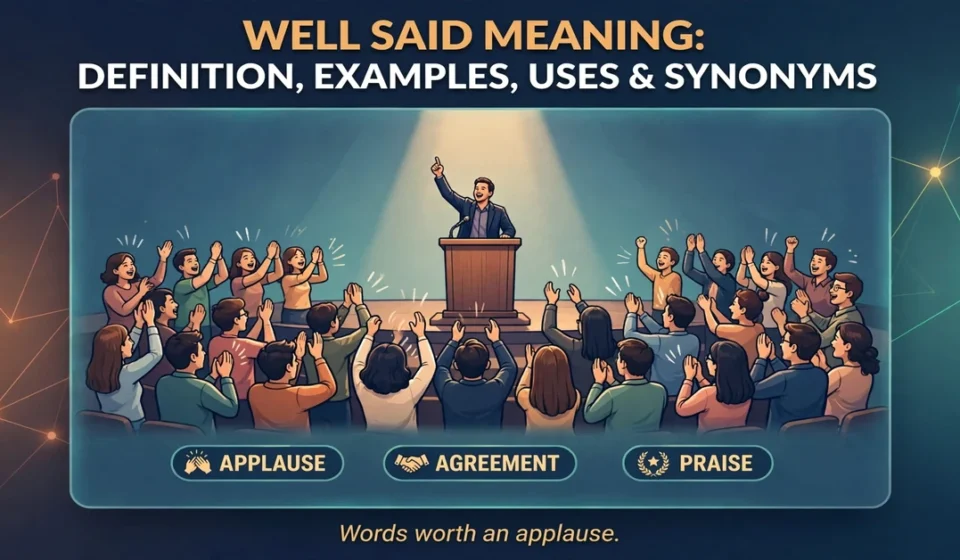

Few English phrases carry as much quiet approval as "well said." Two small words wrap up agreement, admiration, and respect in a single breath. You hear it after a powerful speech, read it under a thoughtful social media comment, and notice it in meeting rooms when someone finally voices what everyone was thinking. It sounds simple, but the well said meaning runs deeper than most people realize.
At its core, "well said" is a compliment about how something was expressed. It tells the speaker their words landed exactly right — clear, fitting, and persuasive — and it usually signals agreement with the point itself. You are saying two things at once: I agree with you, and you put it beautifully. That double meaning is why the phrase feels so satisfying to hear and so useful to know.
In this guide, we break down the full well said meaning with real examples, explore when native speakers use it, compare it with lookalikes like "well spoken" and "well put," and show you how to use it naturally in conversations, texts, and comment sections.

What Does "Well Said" Mean?
The phrase "well said" is an expression of approval and agreement. When someone says it to you, they are praising the way you expressed your point — telling you that your statement was clear, fitting, or eloquent. In everyday conversation, it also means they agree with what you said. It is the verbal equivalent of a nod of respect, and it almost always comes with genuine warmth behind it.
Grammar-wise, the phrase is straightforward: "well" is an adverb describing how the saying was done, and "said" is the past participle of "say." It can stand alone — "Well said!" — or open a longer sentence, such as "Well said, Maya. I could not have put it better myself."
Notice the two layers. The first is praise for expression: the words were chosen well. The second is agreement with the content: the idea itself was right. Usually both apply, but not always — a debate coach might say "well said" to a student whose argument was eloquent even while disagreeing with the conclusion. Context tells you which weight it carries.
When People Say "Well Said"
Native speakers reach for this phrase in specific situations. Here are the settings where it shows up most often.
Speeches and Debates
The classic home of "well said" is public speaking. After a stirring graduation speech, a sharp debate point, or a moving wedding toast, audience members use it to show the speaker that their words hit home.
Meetings and Classrooms
In professional settings, "well said" is a quick way to back a colleague without taking over the conversation. When someone articulates a concern clearly — raising a risk nobody wanted to mention, for example — responding with "well said" shows support and encourages others to speak up too.
In classrooms, teachers say it to students who answer with unusual clarity. For English learners, hearing a teacher say "well said" is a real confidence boost — it rewards not just the right answer but the right delivery.
Comment Sections and Social Media
Online, "well said" has become one of the most common responses to a comment people admire. Under opinion articles, videos, and social media posts, you will see it again and again, often followed by agreement: "Well said. I completely agree." It functions almost like a written round of applause — a way to stand behind a writer's words publicly.
This is also where the phrase picked up its visual companion: the clapping hands gesture. Online you will frequently see "Well said" paired with clapping hands imagery, or even a row of clapping hands standing in for the words entirely. This article uses no emojis, but in real digital conversation, "well said" and applause imagery go hand in hand.
Everyday Conversations
Outside formal settings, "well said" appears in ordinary talk more than you might expect. When a friend sums up a shared frustration perfectly — "This week has been one long meeting that could have been an email" — a warm "well said" is the natural reply. When a family member voices a difficult truth at the dinner table, the phrase offers quiet support.
"Well Said" vs "Well Spoken" vs "Well Put"
These three phrases look alike but are not interchangeable. Mixing them up is a common mistake, so here is the clear difference.
"Well said" comments on a specific statement — one thing someone just said, like a remark, an argument, or a sentence. "Well said, that sums up my view exactly." The praise targets a moment: those particular words, just now, were excellent.
"Well spoken" describes a person, not a moment. Calling someone well-spoken means they generally speak clearly, politely, and articulately — a lasting quality of their speech. A job reference might describe a candidate as "well-spoken." You would not say "well-spoken" to react to a single comment, because the comment is not a person.
"Well put" is closer to "well said" — it also praises a specific statement — but it focuses more on phrasing than agreement. "Well put" means the words were chosen cleverly or precisely. You can say "well put" about a sentence you find beautifully phrased even when you are neutral about its message. "Well said," by contrast, almost always carries agreement. Think of it this way: "well put" admires the packaging, while "well said" admires the packaging and buys the product.
A quick cheat sheet:
- Well said — about one statement; praise for expression plus agreement.
- Well spoken — about a person; they speak clearly and articulately in general.
- Well put — about one statement; praise for clever or precise phrasing.
Genuine Praise or Polite Filler?
Most of the time, "well said" is sincere. But like any phrase of approval, it can be used on autopilot, and it can occasionally carry an edge.
Genuine "well said" comes with specifics or emotion. When someone says, "Well said — that last point about burnout really hit home," the detail proves they were listening. The tone is warm, the timing is immediate. This is the version that builds people up, and it is worth giving freely when you mean it.
Polite-filler "well said" is vaguer. In a meeting where someone feels pressure to respond to every speaker, it can become a verbal nod — a way of saying "I acknowledge you" without adding anything. It is not rude, exactly, but it is hollow, and people can usually tell. If you catch yourself using it this way, add one specific detail about what you liked.
Then there is the rare sarcastic "well said." Tone does all the work. Said flatly or slowly after someone states the painfully obvious — "Wow, this traffic is bad" met with "Well said" — it becomes a gentle tease among friends, or a cutting remark among strangers. If you are not sure your warmth will come through, do not risk the sarcastic reading.
How to Use "Well Said" in Texts and Social Media
The phrase works as well on screen as it does out loud, but digital conversation has its own conventions.
As a standalone comment, "Well said." is complete and natural. Adding a name makes it warmer: "Well said, Sarah." Pairing it with agreement makes it stronger: "Well said. I could not agree more." On social media, people often add applause imagery alongside the words or as a reply on their own.
In text messages, brevity rules. A friend sends a long message about a difficult decision they finally made. Replying "Well said — proud of you" acknowledges both their words and their courage in a handful of characters. Another common pattern is quoting: paste the friend's best line back with "well said" in front of it, so they know exactly which words impressed you.
In professional chats, keep it slightly more formal: "Well said, James. Your summary of the client feedback was spot on." The intensifier "very well said" adds emphasis without changing the meaning: "That was very well said in today's presentation."
One caution: do not overuse it. If every comment you post online says "well said," it starts to look like a reflex rather than a reaction. Save it for the statements that genuinely impress you, and your "well said" will carry real weight.
Alternatives to "Well Said"
Variety keeps your English sounding natural. These alternatives carry a slightly different shade of meaning depending on the situation.
"I couldn't agree more." Pure agreement at maximum strength. Watch the tricky wording: "couldn't" sounds negative, but the meaning is "there is no way I could agree any more than I already do."
"Eloquently put." A slightly formal alternative that praises the beauty of the expression, good for written responses and professional settings.
"You took the words right out of my mouth." A warm, idiomatic way to say someone expressed exactly what you were thinking. It adds a personal connection: not only were the words good, they were your words too.
"Spot on." Short, casual, and British-leaning in flavor, though widely understood everywhere. It means the statement was exactly correct. Use it with friends and colleagues; avoid it in very formal writing.
"Beautifully said." A stronger, more emotional version of "well said," suited to moving statements — a eulogy, a wedding speech, a brave personal confession. Save it for moments that deserve the extra emotion.
"Exactly." The simplest alternative. One word, complete agreement, slightly more casual. In fast-paced conversation, "exactly" often replaces "well said" without anyone noticing the difference.
Common Mistakes to Avoid
A few errors crop up again and again. They are easy to fix once you know them.
First, the grammar: it is "well said," never "good said." "Well" is the adverb that describes the action of saying; "good" is an adjective and does not fit. "Well said" is the fixed, idiomatic form — do not rearrange it.
Second, punctuation matters. As a standalone sentence, it takes a period or an exclamation mark: "Well said." or "Well said!" — the exclamation mark adds enthusiasm. When addressing someone directly, use a comma: "Well said, David."
Third, do not confuse it with "well done." "Well done" praises an action or achievement — finishing a project, cooking a great meal, passing an exam. "Well said" praises words. You would not say "well said" to someone who fixed your car, nor "well done" to someone who gave a brilliant speech.
Finally, watch the formality level. "Well said" sits in the middle of the scale — fine for workplaces, classrooms, and polite conversation. In very casual slang-heavy chats it can sound a touch stiff; in the most formal writing, "as X eloquently argues" fits better. Match the phrase to the room.
Frequently Asked Questions
What does "well said" mean in simple terms?
In simple terms, "well said" means "you expressed that very well, and I agree with you." It is a short compliment about someone's words — telling you that your statement was clear, fitting, or persuasive.
Is it "well said" or "well-spoken"?
Both are correct, but they mean different things. "Well said" reacts to one specific statement that was just made. "Well-spoken" describes a person who generally speaks clearly and articulately. You say "well said" after a great remark, and you call a person "well-spoken" when their overall speaking style impresses you.
Can "well said" be sarcastic?
Yes, though it usually is not. Tone is everything. Said warmly and promptly, it is genuine praise. Said flatly or slowly — especially after someone states the obvious — it can be a gentle tease or a cutting remark. If you are unsure how your tone will land, add a specific detail about what you liked to keep it clearly sincere.
How do you respond when someone says "well said" to you?
A simple "thank you" is always safe and natural. You can add a little warmth: "Thank you, that means a lot" or "Thanks — I felt strongly about it." There is no need for a long reply. The phrase is a compliment, so accept it gracefully and move on.
Is "well said" formal or informal?
It sits comfortably in the middle. It is polished enough for meetings, classrooms, and professional messages, yet natural enough for everyday conversation and social media comments. It is neither slang nor stiffly formal.
Conclusion
"Well said" is one of those rare phrases that does two jobs at once: it praises the craft of someone's words while standing behind their meaning. From Shakespeare's stage to today's comment sections, it has survived for centuries because the need it serves never goes away — the need to tell someone that their words mattered.
The next time a colleague nails a point in a meeting, a friend voices a hard truth, or a stranger online writes the comment you wish you had written, try using it. Say it with warmth, mean it when you say it, and add a detail about what struck you. Two small words, used well, can be the highlight of someone's day — and now you know exactly how to use them.