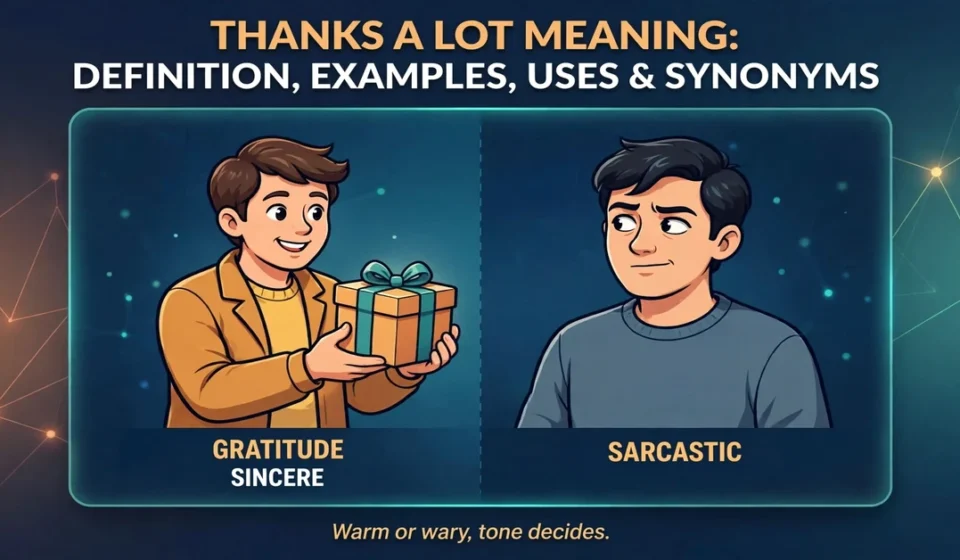

"Thanks a lot" is one of those English phrases that can warm your heart or make you wince, depending on how it is said. At face value, the thanks a lot meaning is simple: a casual, friendly way to express gratitude. It is what people say when a friend does them a favor, when a stranger holds the door, or when a colleague helps out with a task. It is informal, upbeat, and natural in everyday conversation.
But there is a catch. "Thanks a lot" is also one of the most common sarcastic expressions in English. Said with the right tone, "Thanks a lot!" means the exact opposite: you are annoyed or frustrated with the person. Someone cancels on you at the last minute, and you reply, "Oh, thanks a lot." Nobody hearing that thinks you are grateful. The words are identical; the tone flips the meaning upside down.
That is why this phrase confuses so many English learners and even trips up native speakers in writing, where tone disappears. In this guide, you will learn the thanks a lot meaning in both its sincere and sarcastic forms, how to tell which one you are hearing, how it compares to "thank you very much" and plain "thanks," and when to use it safely in texts, emails, and at work.

What Does "Thanks a Lot" Mean?
In its plain, literal sense, "thanks a lot" is an informal expression of strong gratitude. It means "I am very thankful" or "I really appreciate what you did." The word "thanks" is the casual short form of "thank you," and "a lot" adds emphasis, signaling that the gratitude is bigger than usual. Think of it as the everyday, warm-hearted version of "thank you very much."
You will hear it everywhere in casual English: between friends, in families, among coworkers who get along well, and in friendly customer interactions. A friend drives you to the airport and you say, "Thanks a lot, you saved my morning." A neighbor lends you a ladder and you call out, "Thanks a lot, I owe you one." A waiter brings your food and you say, "Thanks a lot." In all these moments, the meaning is pure and positive. It is the default grateful response in relaxed, informal settings.
Grammatically, the phrase is a shortened form of "I thank you a lot," though nobody says that. It is complete and correct on its own, though it often gets followed by "for" plus the reason: "Thanks a lot for your help," "Thanks a lot for coming." Adding the reason makes the gratitude feel more specific and sincere, which is always a good habit.
The Sarcastic Side of "Thanks a Lot"
Now for the twist that makes this phrase famous. "Thanks a lot" is one of English's favorite sarcastic remarks. Used sarcastically, it means the opposite of gratitude: "You have annoyed me" or "You made things worse." A friend tells your embarrassing story at a party, and you say through a thin smile, "Thanks a lot." A coworker sends the wrong file to a client, and your message reads, "Well, thanks a lot for that." The gratitude is fake; the irritation is real.
Why does this particular phrase attract sarcasm so often? Sarcasm often works by stating something positive when the situation is clearly negative. Because "thanks a lot" expresses strong gratitude, it is a perfect vehicle for that flip. When someone messes up, claiming to be very grateful about it is absurd enough that the irony is obvious. The "a lot" part exaggerates the false gratitude, which is why it lands harder than a plain sarcastic "thanks."
There is also the famous British comedy line "Thanks a lot, Maggie" style of usage, where the phrase gets attached to a name for extra bite: "Thanks a lot, Dave." Adding the person's name makes it more pointed and personal, which is why it stings. In texting, people sometimes write it with an exclamation mark or in all caps ("THANKS A LOT") to signal the sarcasm, though, as you will see, that is risky territory in writing.
How to Tell the Difference: Tone and Context Cues
So how do you know which thanks a lot meaning is in play? In speech, tone is everything. A sincere "thanks a lot" is usually warm, bright, and relaxed, often delivered with a smile or a nod. A sarcastic "thanks a lot" is typically flat, dry, or exaggeratedly sweet. The speaker might roll their eyes, smirk, or keep a deadpan expression. If the words sound heavy or pointed, that is your clue.
Context matters just as much as tone. Ask yourself: did something good or bad just happen? If someone helped you, the thanks is almost certainly genuine. If someone inconvenienced or disappointed you, sarcasm is likely. An immediate "Thanks a lot!" right after someone drops your ice cream is sarcastic; the same words said later, once everyone is laughing about it, carry a gentler, playful edge.
In writing, where you cannot hear tone, look for punctuation and word choice. "Thanks a lot!!!" with multiple exclamation marks after a complaint is almost always sarcastic. Phrases like "Well, thanks a lot" or "Oh, thanks a lot" lean sarcastic, because the "well" and "oh" add a grudging quality. By contrast, "Thanks a lot for your help" with a specific reason attached is almost always sincere. If you are unsure, the safest move is to ask: "Wait, are you actually upset, or are you joking?"
"Thanks a Lot" vs "Thank You Very Much" vs "Thanks"
English gives you several ways to say the same thing, and choosing the right one is mostly about formality. "Thanks a lot" sits in the casual-to-neutral zone: friendly, warm, and informal. It suits friends, family, and relaxed workplace conversations. "Thank you very much" is a step more formal and polite. It fits professional emails, customer service, speeches, and conversations with people you do not know well. "Thanks" alone is the most casual of the three, quick and light, fine for small favors and everyday interactions.
The practical difference is tone of respect. You would say "Thank you very much" to an interviewer, a doctor, or a client. You would say "Thanks a lot" to a friend who helped you move furniture or a colleague who covered your shift. Using "thanks a lot" in a formal job interview can sound too relaxed, and using "thank you very much" with a close friend can sound stiff or distant.
One important note: "thank you a lot" (without the shortened "thanks") is technically correct English, but it sounds slightly unnatural to native ears. Stick with "thanks a lot" or "thank you very much." Also, be careful with "thanks a lot" in writing aimed at strangers or formal audiences, because of the sarcasm problem. "Thank you very much" carries no such risk.
Using "Thanks a Lot" in Texts, Emails, and at Work
In texts and casual messages, "thanks a lot" is perfectly at home: "Thanks a lot for the ride!" works great with friends and family. Just be careful with sarcastic usage in texts. Without your voice and facial expressions, "thanks a lot" after a letdown can start a real argument. If you are annoyed with someone in a text thread, either be direct about it or skip the sarcasm entirely.
In emails, it depends on who you are writing to. For a friendly coworker or someone you email regularly, "Thanks a lot for the quick turnaround" is fine and warm. For a first email to a new client, a manager you do not know, or anyone in a formal role, choose "Thank you very much" or "Thank you so much" instead. The same rule applies at work in person: "thanks a lot" is great for peers and familiar colleagues, but with senior leadership or clients, the more polished "thank you very much" is safer.
A useful habit for workplace writing is to name what you are thankful for. "Thanks a lot for reviewing the report so quickly" beats a bare "Thanks a lot" because it removes any chance of a sarcastic reading and shows you noticed the effort.
How to Respond When Someone Says "Thanks a Lot"
When someone thanks you sincerely, you have plenty of natural replies. The classic is "You're welcome." Others include "No problem," "Anytime," "My pleasure," "Glad to help," "Of course," and "No worries." Pick based on your relationship and the situation. "My pleasure" sounds polished and works well at work or in customer service. "No worries" and "Anytime" are relaxed and friendly. "No problem" is casual and widely used, though some people consider it slightly informal for professional settings.
If you suspect the "thanks a lot" was sarcastic, the smart move is usually not to match the sarcasm with sarcasm. That tends to escalate things. Instead, address the real feeling underneath. A simple "I know you're annoyed, sorry about that" or "Fair enough, my bad" can defuse the moment fast. If it was playful sarcasm between friends, laughing along and saying "Hey, you're welcome" keeps the mood light.
When someone texts you "thanks a lot" and you cannot tell which meaning they intended, ask directly. "Are you being sarcastic or serious?" is honest and friendly. Most people would rather clarify than have you guess wrong.
Better Alternatives for Formal Situations
Because "thanks a lot" is casual and carries a slight sarcasm risk in writing, it pays to have stronger options ready for formal situations. Here are reliable upgrades, from polite to deeply grateful:
- Thank you very much — the standard formal choice. "Thank you very much for your time."
- Thank you so much — slightly warmer than "thank you very much," still professional. "Thank you so much for your understanding."
- Many thanks — concise and elegant, great for emails. "Many thanks for your assistance."
- I really appreciate it — personal and professional. "I really appreciate your help with this."
- Much appreciated — short, professional, works well at the end of work emails. "Your quick response is much appreciated."
- I'm very grateful — carries real emotional weight for significant favors. "I'm very grateful for everything you've done."
- I can't thank you enough — for the biggest favors, when ordinary thanks feel too small. "I can't thank you enough for your support."
Matching the phrase to the moment is a small effort that pays off. It signals respect, avoids accidental sarcasm, and makes your gratitude feel as strong as you actually mean it.
Frequently Asked Questions
What is the meaning of "thanks a lot"?
"Thanks a lot" is an informal expression of strong gratitude, meaning "I am very thankful" or "I really appreciate it." It is used in casual conversation between friends, family, and coworkers. But it is also commonly used sarcastically to express annoyance, so its meaning depends on tone and context.
Is "thanks a lot" sarcastic or sincere?
It can be either. In everyday friendly use, it is sincere. But "thanks a lot" is one of the most frequently used sarcastic phrases in English, especially when said with a flat or exaggerated tone after something annoying happens. Context and tone of voice tell you which meaning is intended.
What is the difference between "thanks a lot" and "thank you very much"?
Both express strong gratitude, but "thank you very much" is more formal and polite, while "thanks a lot" is casual and informal. Use "thank you very much" in professional emails and formal situations; use "thanks a lot" with friends, family, and in relaxed settings.
How do you respond to "thanks a lot"?
For a sincere "thanks a lot," natural replies include "You're welcome," "No problem," "Anytime," "My pleasure," and "No worries." If the phrase was clearly sarcastic, answer the feeling instead of the words: a brief apology like "Sorry about that, my bad" defuses the situation far better than sarcasm in return.
Is it okay to say "thanks a lot" in a professional email?
With coworkers you know well, yes. In a first email to a client, a formal application, or any message where the reader cannot hear your tone, use "Thank you very much" or "Many thanks" instead. The written form of "thanks a lot" carries a small risk of being misread as sarcastic by people who do not know you.
Conclusion
The thanks a lot meaning is really two meanings sharing one phrase. In its sincere form, it is one of the warmest casual expressions in English, a friendly way to show real appreciation for everyday kindnesses. In its sarcastic form, it is a dry, pointed way to say you are anything but grateful. Tone, facial expression, and context are what separate the two.
Used wisely, "thanks a lot" will serve you well in texts, conversations, and friendly emails for years. Just remember its double life: keep it sincere with people you like, avoid the sarcastic version unless you are sure it will land as a joke, and reach for "thank you very much" whenever the situation is formal or the reader cannot hear your voice.