
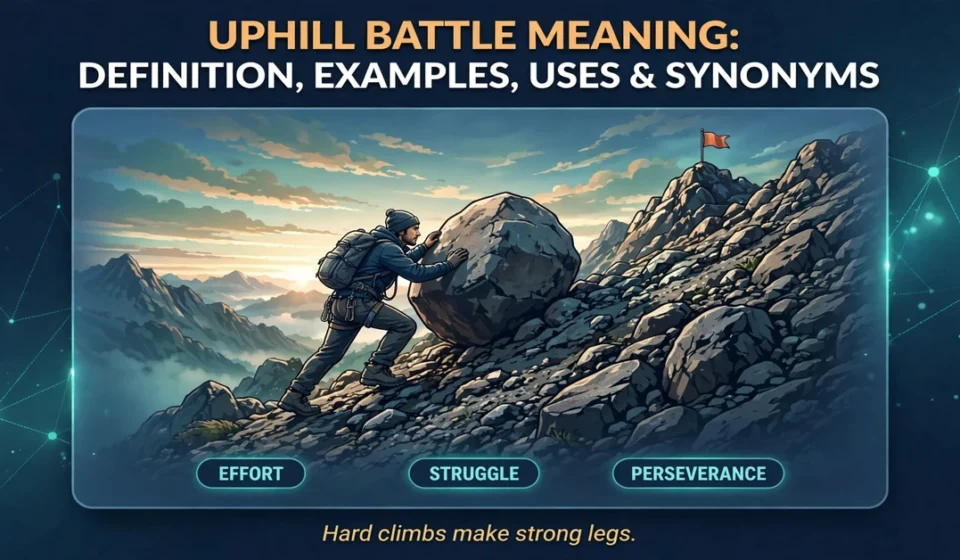

Some phrases describe a feeling so precisely that the moment you hear them, you already understand. "Uphill battle" is one of those phrases. Nobody has to explain that climbing a steep hill is exhausting; your legs already know. That is why this idiom has survived in English for centuries — it takes a physical sensation everyone understands and turns it into a shorthand for one of life's most common experiences: trying to achieve something when everything seems to be working against you.
Whether you came across the phrase in a sports commentary, a news report, or a conversation with a friend, this guide walks you through the uphill battle meaning in full: what the idiom actually means, where it came from, how to use it naturally with the right verb pairings, how it differs from lookalike phrases, and plenty of real-life examples.
By the end, you will know exactly when to reach for this idiom — and just as importantly, when a different phrase fits better. We will also clear up the mistakes that trip up English learners, from mixing it up with "a losing battle" to using it for struggles that are not uphill at all.

What Does "Uphill Battle" Mean?
An uphill battle means a difficult struggle or challenge that requires great effort, determination, and persistence — where success is possible but by no means guaranteed. The key idea is resistance: you are pushing against something, and every bit of progress costs you more than it would in normal circumstances.
Think about the literal image. Walking on flat ground is easy. Walking downhill is even easier. But walking uphill forces your body to work against gravity with every step. Your legs burn, your breathing quickens, and the top of the hill looks no closer even after minutes of effort. Now apply that feeling to a situation: studying for an exam after failing it twice, starting a small business in a market full of giants, or trying to convince a skeptical audience to change its mind. The effort feels the same — slow, draining, and stacked against you.
It is worth noting an important nuance. An uphill battle is hard, but it is not hopeless. Dictionaries like Collins point out that the phrase describes something that "requires a lot of effort and determination, but it should be possible to achieve it." That distinction matters. If a task is completely impossible, English has other phrases for that. An uphill battle is the hard fight you can still win.
Here are a few everyday sentences showing how the idiom works:
- "Getting her business loan approved was an uphill battle, but she finally got it after three applications."
- "The new coach faced an uphill battle turning the team's losing season around."
- "Learning English at forty is an uphill battle, though absolutely worth it."
- "After the scandal, the company had an uphill battle to win back its customers' trust."
In each case, notice the pattern: a worthy goal, serious obstacles, and the implication that the person keeps going anyway.
The Literal Image Behind the Idiom
Every idiom starts as a picture before it becomes a figure of speech, and this one is unusually vivid. The phrase draws on the universal human experience of climbing. Long before it meant anything figurative, "uphill" simply described movement against a slope — soldiers marching up a ridge, farmers hauling loads up a valley, travelers grinding their way over a pass.
Some explanations trace its imagery to ancient warfare. In hand-to-hand combat, the army fighting uphill was at a clear disadvantage: its soldiers tired faster, moved slower, and faced an enemy striking down from above. Generals avoided uphill attacks whenever they could — the high ground wins.
That physical picture is worth keeping in mind because it explains the idiom's emotional core. An uphill battle is not just any difficulty. A sudden crisis is not an uphill battle. A confusing problem is not an uphill battle. It is specifically a sustained, draining effort against resistance — the kind where progress is measured in small gains and quitting always looks tempting.
Origin and History of "Uphill Battle"
Unlike some idioms that can be traced to a single famous quote or a colorful anecdote, "uphill battle" has no dramatic origin story. It grew organically out of everyday speech, which is perhaps why it feels so natural.
According to idiom historians, the phrase dates back to the 1600s, when "uphill" was already used figuratively for difficult endeavors — people spoke of "uphill work" and "uphill struggles" long before the exact phrase settled into its modern form. It picked up real momentum in the late 1800s, appearing more frequently in newspapers, literature, and political speeches, and has been standard English ever since.
Close relatives developed alongside it. "Uphill struggle" and "uphill fight" carry the same meaning and are still used today — "uphill struggle" is arguably the more common form in British English. "Uphill task" and "uphill job" also exist, though they are less frequent. All share the same climbing metaphor.
Common Ways to Use It: Verb Pairings That Sound Natural
Idioms live or die by their collocations — the words they naturally pair with. Here are the pairings native speakers actually use.
Face an uphill battle. The most common pairing. It presents the difficulty as lying ahead: "The startup faces an uphill battle against established competitors."
Fight an uphill battle. Emphasizes the active struggle: "She fought an uphill battle for equal pay throughout her career."
Be in for an uphill battle / Have an uphill battle ahead. Both frame the difficulty as waiting in the future: "With the star player injured, they're in for an uphill battle in the playoffs."
It was an uphill battle (to do something). The plain descriptive form with an infinitive: "It was an uphill battle to convince the board."
A small grammar note for learners: the phrase almost always takes the indefinite article — an uphill battle, not "the uphill battle," unless the specific struggle was already mentioned. And while older texts sometimes hyphenate "up-hill," the modern standard is one word.
Real-Life Examples: Where You Hear "Uphill Battle"
Sports
Sports commentary is probably where you will hear this idiom most often. A team that loses its first three matches and must win every remaining game to qualify is facing an uphill battle. A tennis player coming back from two sets down is fighting one. The phrase captures that specific feeling: the scoreboard is against you, and every point from here on has to be earned twice.
Business and Startups
Starting a company in a crowded market is the classic business uphill battle — a new coffee shop opening next to three established chains, a small app competing with tech giants, a freelancer winning clients without a portfolio. The phrase also fits corporate turnarounds: a new CEO hired to rescue a failing company is universally described as facing an uphill battle.
Health and Recovery
Doctors, patients, and families use this idiom with particular gravity. Recovering from a serious injury, managing a chronic illness, or rebuilding fitness after years of inactivity — these are slow, grinding efforts where progress is measured in weeks and months. "His recovery was an uphill battle" says in five words what a medical report takes pages to convey: it was hard, it was long, and he kept going.
Education and Exams
Students know this feeling intimately. Preparing for competitive exams, learning a new language as an adult, or returning to education after a long break all fit the idiom. "Passing the bar exam on my third attempt was an uphill battle" tells you everything: repeated failure, sustained effort, and eventual persistence.
Everyday Life
The idiom works just as well for smaller struggles. Convincing a toddler to eat vegetables, saving money on a tight budget, getting a landlord to fix a leaking roof — any situation where you have to push and push for slow progress qualifies. That flexibility is a big part of why the phrase is so widely used.
Synonyms and Related Idioms
English is rich in expressions for difficulty, and knowing the alternatives helps you use "uphill battle" more precisely.
An uphill struggle. The nearest synonym — essentially interchangeable, and slightly more common in British English.
A tough fight / a hard fight. More general and more physical-sounding. A "tough fight" can be a single event (a boxing match, a court case), while an uphill battle usually describes a longer campaign.
A Herculean task. From the Greek hero Hercules and his twelve labors — a task requiring enormous strength or effort. It emphasizes the size of the task more than the resistance against you.
Swim against the tide (or swim upstream). Very close in spirit, sharing the image of pushing against a natural force. It often implies going against popular opinion, while "uphill battle" is broader.
A Sisyphean task. From the Greek myth of Sisyphus, condemned to roll a boulder uphill forever. Use this only for tasks that are not just hard but endless or futile — a much darker shade of meaning.
A losing battle. This is the one people confuse most with "uphill battle," and the difference matters. A losing battle is a struggle you are likely to lose — the outcome looks decided. An uphill battle is a struggle that is hard to win — but winning is still possible. "She knew keeping the old shop open was a losing battle" (defeat is expected) versus "She knew keeping the old shop open would be an uphill battle" (it's hard, but she might pull it off). Mixing these up changes the entire meaning of your sentence.
When to Use "Uphill Battle" — and When Not To
Use the idiom when three conditions hold: the goal matters, the obstacles are serious and sustained, and success remains possible. It fits long efforts — campaigns, recoveries, comebacks, turnarounds — better than sudden emergencies. "The fire spread quickly" is a crisis, not an uphill battle; "rebuilding the town after the fire" is.
Avoid it when the situation is genuinely hopeless (use "a losing battle" instead), when the difficulty is brief or trivial, or in very formal writing where a plainer word like "challenge" does the job without the color.
Tone-wise, the phrase is neutral to sympathetic. Calling something an uphill battle is a quiet way of acknowledging that the person is attempting something genuinely hard — which is why it appears so often in journalism and speeches: it grants dignity to the struggle without promising victory.
Frequently Asked Questions
What is the meaning of "uphill battle" in simple words?
In simple words, an uphill battle means a very difficult task or struggle where you have to work extremely hard against obstacles, but winning is still possible. It comes from the image of climbing a steep hill — every step takes extra effort. Example: "Finding a job in a new city was an uphill battle for him."
What is the origin of the phrase "uphill battle"?
The phrase has no single documented origin story. It developed naturally from the literal image of climbing or fighting on a slope, with early figurative uses of "uphill" for difficult tasks dating back to the 1600s. The full phrase "uphill battle" gained widespread use in the late 1800s through newspapers and literature, and close variants like "uphill struggle" and "uphill fight" emerged around the same time.
Is there a difference between "face an uphill battle" and "fight an uphill battle"?
Yes, a subtle one. "Face an uphill battle" describes a difficult challenge lying ahead of you — it looks forward. "Fight an uphill battle" describes being actively engaged in the struggle right now — it looks at the present effort. In practice they are often used interchangeably, but "face" suits predictions while "fight" suits ongoing efforts.
What is the difference between "uphill battle" and "losing battle"?
An uphill battle is difficult but winnable — it emphasizes effort against the odds. A losing battle is one you are expected to lose — it emphasizes a likely defeat. Saying "it's an uphill battle" encourages persistence; saying "it's a losing battle" suggests it may be time to stop. Choosing the wrong one completely changes your message.
What are some synonyms for "uphill battle"?
The closest synonyms are "uphill struggle," "tough fight," and "hard struggle." Related idioms include "swim against the tide," "a Herculean task," and "an uphill climb." For a darker, more hopeless shade of difficulty, "a Sisyphean task" or "a losing battle" fit better. The best choice depends on whether you want to stress effort, size, opposition, or futility.
Conclusion
The uphill battle meaning is simple at its core: a hard, grinding struggle against resistance, where every step forward costs more than it should — but the top of the hill is still reachable. That blend of difficulty and possibility is exactly why the phrase has lasted for centuries. It does not just describe hardship; it honors the determination required to push through it.
The next time you hear a commentator, a colleague, or a friend describe something as an uphill battle, you will know precisely what they mean — and you will have the full toolkit to use the idiom yourself: its history, its natural verb pairings, its synonyms, and the fine line that separates it from a losing battle. Few phrases earn their place in everyday English as thoroughly as this one has.