
You are mid-conversation with a friend when they reply to your plan with a single word: "lght." No emoji, no punctuation, just four consonants sitting there. You stare at it for a second. Is it a typo? Is it short for something? Are they agreeing with you, or did their keyboard give up halfway through a word?
LGHT is one of those slang spellings that looks broken but is completely intentional. It belongs to a family of vowel-dropping text abbreviations that trade a few letters for speed and style. Most of the time it is a casual, laid-back way of saying "light" or "alight" — sorry, "alright" — and once you know the trick, you will spot it everywhere from group chats to TikTok comments.
This guide unpacks the lght meaning in text completely: the two main readings, where the spelling came from, how people use it across chats and social media, how it compares to close cousins like "ight," when to use it and when to avoid it, and how to reply when it lands in your messages. Four letters, zero confusion by the end.

What Does LGHT Mean in Texting?
LGHT has two main meanings in texting, and they are related enough that context usually picks the right one instantly.
The first and most common is "light." LGHT is simply the word "light" with its vowels removed — the "i" dropped out to save keystrokes. People use it anywhere they would use the full word: describing weight ("this bag is so lght"), color ("I like the lght blue one"), mood ("let's keep things lght tonight"), or brightness ("can you make the room lght?"). It is textspeak in its purest form: same word, fewer letters, same understanding.
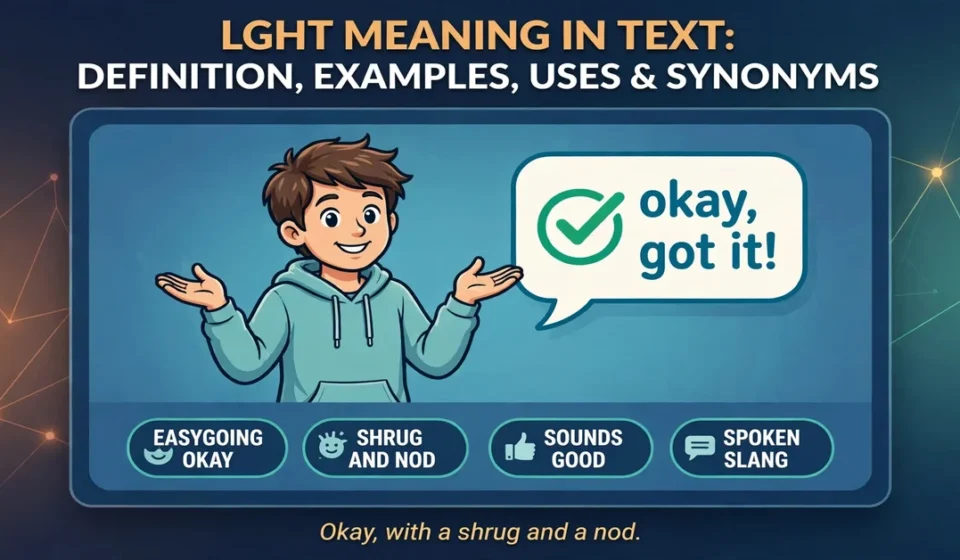
The second meaning is "alright" — or more precisely, "aight," the casual spoken shortening of "alright," with its own vowels trimmed further. In this reading, "lght" works as a relaxed acknowledgment: "we meeting at 7?" → "lght." It means "okay," "sounds good," or "got it," delivered with a shrug and a nod. This version carries the easygoing energy of spoken slang transplanted into text.
How do you tell them apart? Look at the sentence around it. If LGHT sits where an adjective would go — describing a thing — it means "light." If it stands alone as a complete reply to a plan, question, or statement, it almost always means "alright." "That jacket looks lght" is about the jacket. A solo "lght" after "see you at 8" is agreement. The grammar does the decoding for you.
Where LGHT Came From
LGHT does not have a dramatic origin story, and that is kind of the point. It emerged the way most textspeak does: gradually, practically, and without anyone declaring it.
The engine behind it is vowel-dropping, one of the oldest tricks in digital shorthand. Consonants carry most of a word's recognizable shape in English, so removing vowels often leaves a word perfectly readable: "txt" for text, "msg" for message, "pls" for please. "Light" minus its "i" becomes "lght," and the result is still instantly readable to anyone who texts regularly. Early SMS culture, with its 160-character limits and multi-tap keypads, rewarded exactly this kind of compression, and the habit stuck around long after the limits disappeared.
The "alright" reading has a second parent: spoken slang. "Aight" — the relaxed pronunciation of "alright" — has been part of casual American speech for decades, popularized through hip-hop, street culture, and regional dialects. When that spoken shortening moved into texting, people applied the same vowel-dropping instinct, and "aight" compressed toward "lght." So the abbreviation has two converging bloodlines: written textspeak and spoken slang meeting in the middle.
Neither meaning was decreed by a dictionary or launched by a viral moment. LGHT spread the boring, durable way: person to person, chat to chat, until it became part of the background vocabulary of casual texting. That grassroots path is why it feels natural rather than forced — nobody is trying to make "lght" happen; it just already happened.
How People Use LGHT in Real Conversations
In practice, LGHT shows up in a few recognizable patterns, and each one leans toward one of the two meanings.
The standalone acknowledgment is the "alright" version in its natural habitat. Plans get made, information gets shared, and "lght" lands as the confirmation: "I'll send the file later" → "lght." "Don't worry, I'll handle it" → "lght, thanks." It is the texting equivalent of a nod — minimal effort, clear meaning, conversation kept moving. This is probably the single most common use of LGHT overall, because quick acknowledgments are the most common thing people text.
The descriptive shortcut is the "light" version doing its job inside sentences. "This outfit is so lght and comfy" (weight or fabric), "let's keep the vibe lght" (mood), "I went for a lght jog" (easy effort). Here LGHT behaves exactly like the full word, just faster to type. Fashion chats, fitness check-ins, and planning conversations are full of these.
The comment-section reaction lives on TikTok, Instagram, and X. Under a feel-good video, "this is so lght 😌" praises the easy, breezy energy. As a reply to good news, a solo "lght" works like "nice" or "cool." Social media rewards brevity, and LGHT delivers a complete reaction in four keystrokes.
The tone-setter is subtler. Sometimes LGHT is less about its dictionary meaning and more about the vibe it creates. Dropping vowels signals casualness; a message written in full, careful English feels different from one peppered with "lght," "tbh," and "nvm." People use LGHT partly to say "this conversation is relaxed," the same way rolling up your sleeves says a meeting is informal. The medium becomes part of the message.
LGHT vs IGHT vs AIGHT: The Family Tree
LGHT has relatives, and they get mixed up constantly. Sorting out the family helps you use each one correctly.
Aight is the parent form of the "alright" reading — the phonetic spelling of how "alright" sounds in relaxed speech. It is the most explicit of the bunch: everyone recognizes it, it works in almost any casual context, and it carries a warm, agreeable tone. If LGHT feels too cryptic for your audience, "aight" is the safer choice.
Ight is the middle child: "alright" with the initial "a" dropped, a common next step in casual compression. It is extremely common in texting, arguably more widespread than LGHT itself. "Ight, see you then" is a sentence millions of people type weekly. Compared to LGHT, it is slightly more mainstream and slightly less stylized.
LGHT is the most compressed and the most ambiguous, since it also carries the "light" meaning. That ambiguity is its charm and its risk. Among people fluent in textspeak, it reads effortlessly. Among people who are not — parents, older colleagues, anyone outside the slang loop — it reads as a typo. The family rule of thumb: the more you compress, the more you depend on your audience being in on it.
There is also "lite," the deliberate misspelling of "light" used in branding and casual writing. It is a cousin rather than a sibling — same meaning, different mechanism — but it shows how flexible the word "light" is in informal English. People have been reshaping it for convenience for a long time; LGHT is just the texting generation's version.
When to Use LGHT (and When Not To)
LGHT is a casual-context word, and respecting its boundaries keeps you from sounding off.
Use it in casual chats with friends, in group threads where everyone texts loosely, in DMs with people your age, and in social media comments. It shines in quick acknowledgments — confirming plans, reacting to news, keeping a fast conversation flowing. It also works as a stylistic choice when you want your messages to feel relaxed and current. Among Gen Z and younger millennials, it is unremarkable in the best way: nobody notices it, which means it is doing its job.
Avoid it in anything professional. Do not "lght" your boss, your professor, or a client. The abbreviation signals informality so strongly that it can read as careless or disrespectful in work contexts, even when you mean it warmly. The same goes for formal writing, first messages to strangers, and conversations with people who have told you — directly or through their own careful texting style — that they prefer full words.
Be careful with older relatives and anyone outside the slang loop. To someone who does not text much, "lght" looks like a mistake, and explaining the joke costs more effort than typing "alright" would have. Match your abbreviation level to your audience: full words for grandparents, "aight" for mixed company, "lght" for friends who will read it without blinking.
A final caution: because LGHT is so minimal, it can read as curt in sensitive moments. Replying "lght" to good news is fine; replying "lght" to someone's vulnerable confession can feel dismissive. When the emotional stakes are high, spend the extra letters. Warmth is worth the keystrokes.
How to Reply When Someone Texts LGHT
Responding to LGHT is straightforward once you have decoded which version you received.
If it was the acknowledgment — a solo "lght" confirming your plan — no reply is usually needed. The conversation has done its job. If you want to be friendly, a simple emoji or "see you then 👍" closes the loop warmly. Over-explaining after a "lght" ("great! so I'll see you at 7 at the place near…") can feel like you did not trust the acknowledgment. Trust it.
If it was descriptive — "this is so lght" about something — respond to the thing, not the word. "Right? It's perfect for summer" keeps the conversation on track. Nobody needs you to comment on their abbreviation choices; just engage with the content like you would with any message.
If you genuinely cannot tell what they meant, context almost always resolves it within a message or two. But if you are stuck — maybe it was a bare "lght" in response to something ambiguous — it is fine to clarify lightly: "haha, lght as in sounds good?" Most people will laugh and confirm. Asking once is charming; building a habit of interrogating people's slang is not.
And if someone sends you LGHT and you have never used it yourself, there is no obligation to adopt it. Reply in your own style. Slang is contagious, but it is not mandatory, and nobody keeps score of who abbreviates what.
Frequently Asked Questions
What does LGHT mean in texting?
LGHT usually means "light" (with the vowels dropped) or "alright" (a further shortening of "aight"). As an adjective describing something, it means "light"; as a standalone reply, it means "okay" or "sounds good." Context tells you which one applies.
Is LGHT the same as IGHT?
They are similar but not identical. Both can mean "alright," but IGHT is more widely recognized while LGHT is more compressed and also carries the "light" meaning. LGHT feels a bit more stylized and depends more on the audience being familiar with textspeak.
What does LGHT mean from a guy?
It usually just signals a chill, casual attitude — agreement or acknowledgment without much emotional weight. A "lght" from a guy in response to plans most often means "sounds good." Read the rest of the conversation for emotional cues rather than overanalyzing the abbreviation itself.
Can I use LGHT in professional messages?
No — keep LGHT out of work emails, messages to your boss, and professional chats. It signals informality so strongly that it can read as careless. Use "sounds good," "got it," or "alright" instead.
Why do people drop vowels in words like LGHT?
Vowel-dropping is one of the oldest texting tricks: consonants carry most of a word's recognizable shape, so removing vowels keeps words readable while saving keystrokes. It started with SMS character limits and multi-tap keypads, and stuck around as a style marker of casual digital conversation.
Conclusion
The lght meaning in text comes down to two related ideas: "light," compressed by dropping its vowels, and "alright," compressed even further from "aight." One describes things, the other acknowledges them, and the sentence around it always tells you which job it is doing. It is textspeak at its most efficient — four letters doing the work of a nod, a description, or a whole easygoing attitude.
Use it where casualness is welcome, skip it where it is not, and spend the extra letters when feelings run high. Master that balance, and LGHT becomes what it was always meant to be: the smallest possible way to keep a conversation light.
Explore more on Celeb Snips.