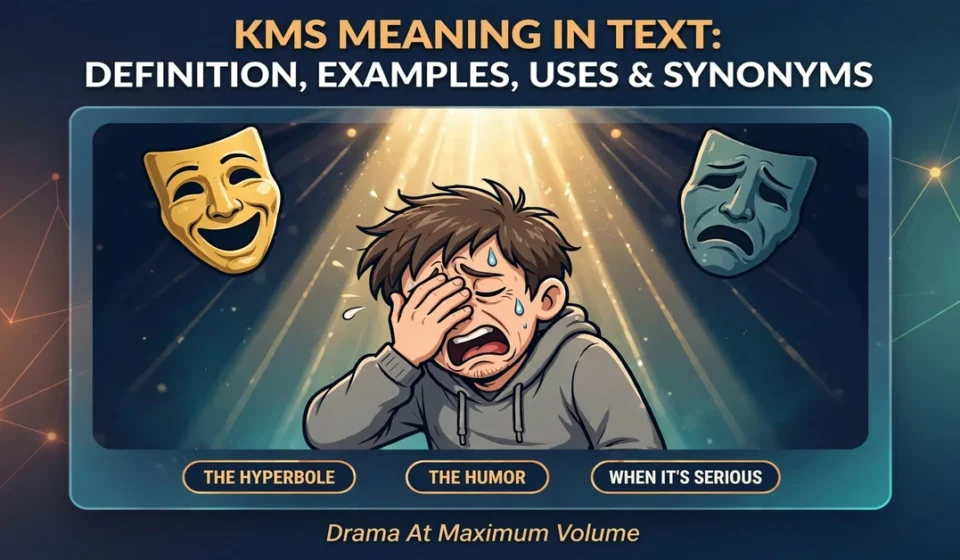

“KMS” is one of those abbreviations that hits different depending on who says it, where, and why. On the surface it is dark internet slang — the kind of thing friends type after failing an exam or missing a shot in a game. But those three letters carry a literal meaning that no amount of irony can fully erase, which is why KMS is also the one abbreviation in this entire series that comes with a serious safety note attached.
Let us be direct: KMS most commonly stands for “kill myself.” In the vast majority of texts, DMs, and comments, it is not a statement of intent — it is hyperbole, the internet’s way of saying “I am so embarrassed / frustrated / done with this.” It belongs to the same family as “I am dead 💀” and “I cannot even.” But unlike those, its literal reading is real enough that you cannot treat every instance as a joke.
In this guide, we will cover the complete kms meaning in text: what it literally stands for, how it became ironic slang, the difference between a joke KMS and one that needs a response, what to say when a friend types it, the other meanings (like “keep myself safe”), and answers to the questions people ask most.

What Does KMS Mean in Text?
The direct answer: KMS = “kill myself.” There is no way around the literal meaning, and this guide will not pretend otherwise. What varies is the intent behind it, and intent is everything here.
The hyperbolic/joking use (most common): This is dark humor as emotional punctuation. Examples:
- “I just failed my driving test kms”
- “that presentation went so badly kms 💀”
- “my crush saw my search history kms kms”
In these cases, KMS functions like “I am deceased” or “I cannot” — an exaggerated expression of embarrassment, frustration, or defeat. The sender is not in danger; they are performing a feeling at maximum volume because texting rewards exaggeration. The 💀 emoji, the casual context, and the trivial trigger (a test, a meme, a game) all mark it as hyperbole.
The serious use (rare but real): Sometimes KMS is not a joke. The difference is usually visible in the context: no humor framing, a real and heavy trigger (a breakup, bullying, isolation), flat or hopeless tone, withdrawal from normal conversation patterns. If you ever genuinely believe someone might hurt themselves, take it seriously every single time. Ask directly: “hey, are you okay? that sounded serious.” You will never regret checking; you might regret not checking.
The rule: default to reading KMS as hyperbole when the context is light (memes, fails, games, minor embarrassments), but never mock or dismiss someone for typing it, and if anything about the message feels heavy or out of character, treat it as real. Err on the side of caring.
How KMS Became Internet Slang
KMS traveled the same road as most dark internet humor: from early chatrooms and forums, through gaming culture, into the meme-soaked mainstream. In the late 1990s and 2000s, edgy humor was already the native language of places like IRC, early forums, and Xbox Live lobbies, where “kys” and “kms” circulated as trash talk and self-deprecating jokes.
The 2010s meme era normalized it further. Reaction images, fail compilations, and cringe compilations all needed captions, and “kms” became the standard caption for secondhand embarrassment — the text equivalent of covering your face with your hands. By the time TikTok arrived, KMS was fully domesticated as hyperbole: teens typed it under harmless videos the way their parents typed “LOL” under things that were not actually funny.
What is worth understanding is why dark hyperbole works as slang. Psychologically, exaggerating a small pain (“this embarrassment is killing me”) is a way of processing it — humor as a pressure valve. Saying “kms” after a fail is the digital version of a dramatic sigh: it acknowledges the feeling, blows it up to cartoon size, and lets it deflate. The problem, of course, is that the cartoon and the reality share the same three letters.
KMS vs. KYS: Know the Difference
KMS has an evil twin, and confusing them matters:
- KMS (“kill myself”) — self-directed. Even as a joke, it is about the sender’s own (exaggerated) suffering.
- KYS (“kill yourself”) — other-directed. Telling someone else to harm themselves, even “as a joke,” is harassment, full stop.
The line between them is the line between self-deprecating humor and cruelty. KMS-as-hyperbole is (mostly) harmless venting; KYS-as-anything is an attack. Never use KYS toward another person, not even jokingly, not even to a close friend — the “joke” framing does not neutralize it, and in many online communities it is a bannable offense.
When to Take KMS Seriously: Reading the Signs
This section matters more than the slang lesson. Here is how to tell the difference between hyperbolic KMS and a KMS that deserves a real response:
Probably hyperbole: trivial trigger (bad grade, game loss, awkward moment), humor framing (💀, “lmao,” memes), normal conversation otherwise, the person bounces back quickly.
Take it seriously: real trigger (breakup, bullying, grief, isolation), flat tone with no humor, the message is out of character, withdrawal or hopelessness in surrounding messages, repeated dark statements over time.
What to do if you are worried:
- Ask directly and kindly: “hey, are you doing okay? your message worried me a bit.”
- Listen without trying to fix everything. You do not need solutions; you need presence.
- Encourage talking to someone they trust — a friend, family member, counselor.
- If you believe someone is in immediate danger, contact local emergency services.
You are not a therapist and you do not need to be one. But you can be the person who noticed, who asked, who cared enough to check. That matters more than getting the slang exactly right.
Resources: if you or someone you know is struggling, the Find A Helpline directory connects you with crisis support worldwide, and in the US you can call or text 988.
What to Say Instead of KMS
Even as hyperbole, KMS makes some people uncomfortable — and in mixed company, classrooms, or professional-adjacent chats, it is worth having alternatives. The good news: the alternatives are often funnier anyway.
For embarrassment: “I am deceased 💀,” “I cannot show my face again,” “bury me,” “I am never recovering from this.”
For frustration: “I am done,” “I cannot even,” “this is the worst,” “I give up (not really).”
For dramatic effect: “RIP me,” “it is over for me,” “goodbye cruel world (jk),” “sending myself to the shadow realm.”
The pattern: keep the exaggeration, drop the literal self-harm language. You get the same comedic punch without the three letters that make some readers flinch — and without the risk that someone in the chat is quietly dealing with the real thing.
Other Meanings of KMS
Outside of slang, KMS has legitimate meanings worth knowing:
- Keep Myself Safe — the wholesome backronym some communities use as a deliberate alternative: same letters, opposite energy. If you see “kms” in a mental-health-positive space, this might be the intended reading.
- Key Management Service — in tech, Microsoft’s KMS handles Windows license activation, and AWS KMS manages encryption keys. In an IT chat, “the KMS server is down” is about infrastructure, not feelings.
- Kilometers — occasionally abbreviated in casual writing, though “km” is standard.
- Korea Meteorological Society / other organizations — institutional initials that share the letters.
Context disambiguates instantly: a DevOps channel and a group chat are not the same universe, and nobody has ever confused “rotate the KMS keys” with a cry for help.
Using KMS as a Joke: Reading the Room
If you are going to use KMS hyperbolically — and millions of people do — do it with awareness:
- Know your audience. Close friends who share your humor style: fine. Group chats with acquaintances, younger kids, or anyone who might be struggling: pick an alternative.
- Never aim it at a bad moment. Someone just shared real bad news? Not the time for “kms lol.” Read the emotional temperature first.
- Do not use it to fish for concern. Typing “kms” to test whether people care about you puts friends in an impossible position and trains them to ignore the signal — which is dangerous if you ever mean it.
- Know it is generational. Older relatives, teachers, and professional contacts will read KMS literally and may be genuinely alarmed. The hyperbole license is issued by your peer group, not by the language itself.
Dark humor is a legitimate coping style, and this guide is not here to police it. But the three letters have a literal meaning that does not disappear just because the context is light — using them well means knowing when the joke lands and when it does not.
You may also like: KYS
Frequently Asked Questions
What does KMS mean in texting?
KMS stands for “kill myself.” In most casual texting it is used as hyperbole — an exaggerated way to express embarrassment, frustration, or defeat (like “I am dead 💀”). It is rarely a literal statement, but the literal meaning means it should never be completely dismissed.
Is it okay to say KMS as a joke?
Among close friends who share dark-humor style, it is common and usually understood as hyperbole. But it makes many people uncomfortable, reads literally to older or unfamiliar audiences, and can be genuinely upsetting to anyone dealing with real struggles. Alternatives like “I am deceased 💀” get the same laugh without the risk.
When should I take KMS seriously?
Take it seriously when the context is heavy: a real trigger (breakup, bullying, grief), flat or hopeless tone, out-of-character messages, or repeated dark statements. If you are ever unsure, ask directly — “hey, are you okay?” You will never regret checking.
What is the difference between KMS and KYS?
KMS (“kill myself”) is self-directed — even as a joke it is about the sender’s own exaggerated suffering. KYS (“kill yourself”) is other-directed and is harassment even “as a joke.” Never send KYS to another person.
What can I say instead of KMS?
For embarrassment: “I am deceased 💀,” “bury me,” “never recovering from this.” For frustration: “I am done,” “I cannot even.” These keep the dramatic humor without the literal self-harm language.
Conclusion
The kms meaning in text is “kill myself” — three letters that live a double life as throwaway hyperbole and literal statement. In the group chat after a failed exam, it is a joke everyone understands. In a quiet DM at 2am after real bad news, it might not be. The slang did not create that ambiguity; it just gave it a very short spelling.
So learn the joke, use it wisely, and — more importantly — learn the difference. Default to laughter when the context is light, default to caring when it is not, and never be the person who scrolled past a KMS that needed an answer. Three letters, two meanings, one rule: pay attention.
Explore more on Celeb Snips.