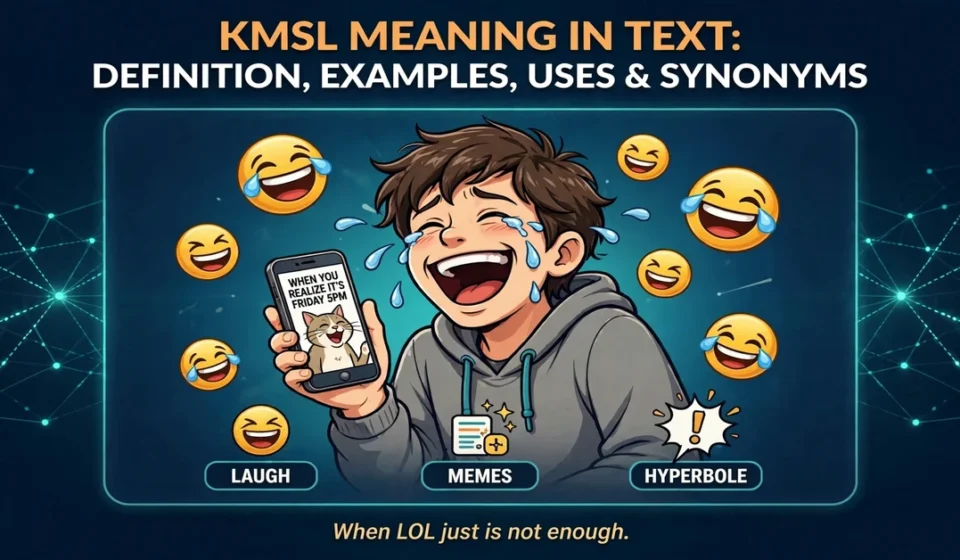

Your friend sends you a meme so unhinged that you snort-laugh in a quiet room. You want to react, but "lol" feels too weak and "hahaha" does not capture the near-death experience you just had. So you type four letters: kmsl. Somewhere across the internet, your friend nods. They understand exactly how hard you laughed.
KMSL stands for "killing myself laughing." It is the heavyweight cousin of LOL — a way to say something was so funny it nearly did you in. The phrase is pure exaggeration, of course. Nobody is actually in danger. But in the economy of texting reactions, where a single acronym has to carry the full weight of your amusement, "kmsl" hits harder than almost anything else in the laughter family.
In this guide, we will unpack the complete kmsl meaning in text: what the letters stand for, where the slang came from, how it compares to LOL and LMAO, when to use it (and when the joke lands wrong), and how to reply when someone drops it on you.
What Does "KMSL" Mean in Text?
KMSL = "Killing Myself Laughing." That is the one dominant meaning — the acronym is almost exclusively used to express extreme amusement. When someone texts "kmsl," they are telling you that whatever just happened was not merely funny, but hilariously funny: the kind of funny that makes you lose composure.
The key word is "killing." Like so many internet expressions, it is deliberate hyperbole — the same dramatic tradition that gave us "I'm dead," "I'm deceased," and "this killed me." The humor comes from the overstatement: the laugh was so powerful it was almost fatal. Nobody typing "kmsl" is describing a medical event. They are describing a meme that broke them.
Here is how the intensity ladder of laughter slang roughly stacks up, from mildest to wildest:
- hehe — a polite giggle. You smiled.
- lol — the classic. You laughed, or at least you want them to think you did.
- lmao — stronger. Something genuinely got you.
- rofl — you are picturing yourself on the floor.
- kmsl — the top shelf. You laughed so hard it felt dangerous.
Placement on this ladder is subjective — some people use "kmsl" casually the way others use "lol" — but the general understanding is that it sits near the top. It is a reaction word, almost always responding to something: a meme, a video, a story, an autocorrect disaster. You would rarely open a conversation with "kmsl." It is the punchline's applause, not the setup.
Why the dark wording?
If the phrase sounds a little morbid, that is part of the joke. Internet humor has always loved dramatic overstatement — "I'm screaming," "I'm crying," "this ended me." "Killing myself laughing" fits that tradition perfectly. It takes the oldest comedy cliché in the book ("that joke killed me") and compresses it into four efficient letters. The darkness is the comedy. Everyone understands it is not literal, which is exactly why it is funny.
Where Did KMSL Come From?
KMSL emerged from the great acronym boom of early-2000s internet culture, when AIM, MSN Messenger, and SMS texting trained a generation to compress every emotion into a few characters. "LOL" had been around since the 1980s, but as messaging got faster and funnier, people needed stronger reactions. "LMAO" arrived. Then "ROFL." Then, for the truly unhinged moments, "KMSL."
The exact birthday is murky — like most slang, it bubbled up in chats and forums rather than being coined in one place. What is clear is the trajectory: it gained real traction in the late 2000s and early 2010s as Twitter, Tumblr, and Facebook turned memes into a daily language. Those platforms rewarded big reactions, and "kmsl" was the biggest reaction you could type quickly.
There is also a distinctly British flavor to its history. Multiple slang trackers note that "kmsl" was especially popular in UK texting culture, where dramatic self-deprecation is practically a national sport. "I'm dead" and "I'm crying" were already staples of British group chats; "kmsl" slotted right in. From there it spread globally through the usual channels — viral tweets, reaction memes, and group chats that mixed friend circles across continents.
By the TikTok era, "kmsl" had become a standard-issue reaction. It shows up in comments under comedy sketches, in captions on fail videos, and in DMs everywhere. It never quite dethroned "lmao" as the default big laugh, but it carved out a loyal niche: the reaction you reach for when "lmao" does not feel like enough.
How KMSL Is Used Across Platforms
The kmsl meaning in text stays constant, but the flavor changes slightly depending on where you see it.
Texting and Group Chats
This is kmsl's natural habitat. In one-on-one texts, it is usually a direct reaction: "Did you see what Jake posted? kmsl." In group chats, it often arrives in waves — one person sends the funny thing, and three people reply "kmsl" within seconds, sometimes with crying-laughing emojis attached. The group-chat pile-on is where the acronym feels most alive: a shared moment of losing it together, expressed in four letters each.
TikTok, Instagram, and Snapchat
On social platforms, "kmsl" lives in comments and captions. Under a comedy video: "kmsl the way he just stood there 😭." In a DM reacting to a story: "kmsl I can't breathe." The visual platforms pair it naturally with emojis — 😂, 💀, 😭 — which act as intensity multipliers. "kmsl" alone is strong; "kmsl 💀💀💀" is a five-alarm laugh.
Twitter/X and Meme Pages
On Twitter, "kmsl" often introduces or punctuates a quote-tweet: "kmsl not the group chat exposing him like this." Meme pages use it in captions to prime the audience: if the page itself is "kmsl," you know the meme is supposed to destroy you. It functions as both reaction and recommendation — a signal that something is worth your laughter.
KMSL in Real Conversations: Examples
Here is what it looks like in the wild:
Example 1 — reacting to a meme:
Maya: [sends meme of a cat filing taxes]
Leo: KMSL why is he so serious about it 😭
Example 2 — the group chat pile-on:
Dev: just called my teacher "mom" in front of the whole class
Ana: KMSL
Sam: KMSL noooo
Priya: I'm crying kmsl
Example 3 — self-deprecating story:
Alex: tripped on absolutely nothing in front of my crush today
Alex: kmsl I want to disappear
Example 4 — commenting on a video:
Comment under a fail compilation: "kmsl the second one took me OUT"
KMSL vs. LOL, LMAO, and the Rest
The laughter-acronym family is big, and choosing the right one is a subtle art. Here is the field guide:
- LOL (laugh out loud) — the grandparent of them all. These days it often means "I acknowledge this is funny" rather than actual laughter. It is polite, universal, and heavily diluted from overuse.
- LMAO (laughing my a** off) — the standard big laugh. Stronger than LOL, widely understood, and the most common "real" laugh online. If LOL is a smile, LMAO is a genuine laugh.
- ROFL (rolling on the floor laughing) — the visual one. Slightly vintage now, more common with millennials, but still understood everywhere. It paints a picture.
- KMSL (killing myself laughing) — the dramatic one. Similar intensity to LMAO but with more theatrical flair. It feels slightly edgier and more expressive, which is why it skews younger.
- 💀 (skull emoji) — the Gen Z heir. "I'm dead" in a single character. Often paired with kmsl rather than replacing it: "kmsl 💀."
The honest truth is that most people use these interchangeably based on habit and vibe rather than a strict intensity scale. But if you want to be precise: reach for "kmsl" when something genuinely made you lose it — when "lmao" would be an understatement and you need the nuclear option.
Is KMSL stronger than LMAO?
Roughly, yes — or at least it reads stronger. "LMAO" has been around longer and suffered more dilution; people type it after mildly funny things out of habit. "KMSL" is less common, so it retains more of its punch. Think of it this way: "lmao" is what you type when you laughed; "kmsl" is what you type when you could not stop laughing. Your mileage may vary, but that is the general understanding.
When to Use KMSL (and When Not To)
Do use it when something genuinely cracks you up — memes, funny videos, great stories, well-timed jokes. Do use it in casual chats with friends, group messages, and social media comments. Do use it with emojis for extra flavor; the crying-laughing 😂 and skull 💀 emojis are its natural companions. Do use it self-deprecatingly about your own embarrassing moments — it shows you can laugh at yourself.
Do not use it in professional or formal messages. Your boss does not want a "kmsl" in response to the quarterly report, and a client email is no place for dramatic laughter acronyms. Do not use it in serious conversations — if someone is telling you something upsetting, "kmsl" is the worst possible reply. Do not overuse it. Like any strong reaction, it loses power with repetition. If everything is "kmsl," then nothing is. Save it for the moments that truly earn it, and it will keep its punch.
One more caution: because the phrase contains the word "killing," be thoughtful about who is reading. Among friends who share your humor, it is clearly hyperbole. But in mixed company, or with someone who does not know internet slang well, the wording can land oddly. Context is everything — when in doubt, "lmao" carries the same energy with less dramatic baggage.
How to Reply When Someone Sends You "KMSL"
Good news: this is the easiest reply in all of texting slang, because "kmsl" is a compliment. Someone just told you that you are hilarious. Your job is simply to accept the crown.
If you sent the funny thing, a modest "😂" or "glad you liked it" is plenty. If you want to keep the bit going, escalate playfully: "I aim to destroy." In a group chat, you can just let the "kmsl" wave roll — no reply needed; the pile-on is the conversation.
If someone sends "kmsl" about your embarrassing story — "tripped in front of everyone kmsl" — they are laughing with you, and the right move is to laugh along: "right?? I peaked in that moment." Getting defensive about a "kmsl" is like getting mad at applause. And if the "kmsl" was sarcastic — reacting to something miserable — skip the jokes and acknowledge the feeling: "yeah, it's been a day." Read the room, match the energy, and you will never go wrong.
Is KMSL rude or offensive?
Not inherently. It is not an insult and it is not directed at anyone — it is a reaction to something funny. The vast majority of uses are affectionate: you made me laugh so hard I am exaggerating my own demise. That said, the dramatic wording means it can feel intense to people unfamiliar with internet slang, and using it about someone's misfortune (rather than with them about it) can read as mocking. The rule is simple: laugh with people, not at them, and "kmsl" stays friendly.
Can I use KMSL at work or school?
In short: no. "Kmsl" is firmly casual slang — great for friends, group chats, and social media, but out of place in emails, assignments, Slack channels with your manager, or any message where professionalism matters. Even in a relaxed workplace, the dramatic phrasing ("killing myself") can raise eyebrows with HR in a way "lol" never would. Keep it in your personal chats where it belongs.
What's the difference between KMSL and "I'm dead"?
They are siblings from the same dramatic family. "I'm dead" (often just 💀) and "kmsl" both use exaggerated demise to express extreme laughter. "I'm dead" is slightly more versatile — it can react to shock, embarrassment, or awe as well as humor ("he said WHAT 💀"). "Kmsl" is more specifically about laughter. In practice, people often combine them: "kmsl I'm dead 💀" — the full theatrical production.
Is KMSL still popular or is it outdated?
It is still very much alive, especially in texting and TikTok comments, though it never became as universal as "lmao." Its usage peaked in the 2010s and settled into a steady niche: the strong, expressive laugh for people who find "lol" too weak but want something with more personality than "lmao." It skews younger and more online, which means it will probably outlive us all in one group chat or another.
Why do people say "killing myself" instead of just "laughing hard"?
Because the internet runs on exaggeration. "Laughing hard" is a report; "killing myself laughing" is a performance. The dramatic phrasing is funnier, more memorable, and more shareable — it turns a simple reaction into a tiny comedy sketch. This is the same instinct behind "I'm screaming," "I'm crying," and "this sent me." Online, understatement does not get quoted. Hyperbole does.
Conclusion
The kmsl meaning in text is simple — "killing myself laughing" — but it captures something essential about how we communicate online. In a medium with no facial expressions and no tone of voice, four dramatic letters have to do the work of a full-body laugh: the snort, the tears, the loss of composure. "Kmsl" does that work beautifully, which is why it has survived every wave of new slang since the group-chat era began.
Use it generously but genuinely: save it for the memes that actually break you, the stories that make you lose it, the moments that deserve the nuclear option. Because the day everything is "kmsl" is the day nothing is — and the internet needs its heavyweight laugh to stay heavy. Now go forth and find something worth nearly dying over. Your group chat is waiting.