
You are scrolling through comments when you see it: "this song is catchy asf." Or a friend texts you after a long day: "I'm tired asf." The sentence makes sense — you can feel what they mean — but those three letters sit there like a locked door. Is it an acronym? An abbreviation? A typo that everyone agreed to keep?
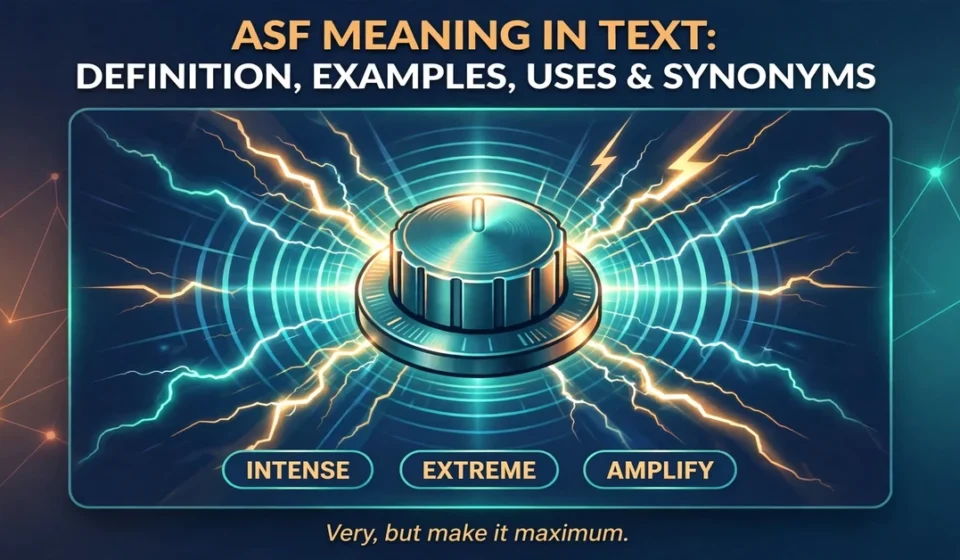
ASF stands for "as f***" — with the asterisks standing in for the profanity. It is an intensifier, a slang amplifier that takes whatever adjective came before it and cranks the volume to maximum. "Tired" is a feeling. "Tired asf" is a condition. In plain English, it means "very," "extremely," or "really" — just with considerably more attitude.
In this guide, we will break down the complete asf meaning in text: how the intensifier works grammatically, where it came from, the many contexts it appears in (and the alternate meanings that occasionally cause confusion), when it is fine to use, when it will get you in trouble, and what to say instead when the situation calls for cleaner language.

What Does "ASF" Mean in Text?
At its core, ASF is an intensifier. It attaches to an adjective (or sometimes a whole statement) and magnifies it. The formula is simple:
[adjective] + asf = [adjective] at maximum intensity
- "I'm bored asf" = I am extremely bored.
- "She's talented asf" = She is incredibly talented.
- "This line is long asf" = This line is ridiculously long.
It works for positive feelings ("happy asf," "lit asf"), negative ones ("mad asf," "broke asf"), and neutral observations ("tall asf," "loud asf"). The emotional charge comes from the adjective; ASF just turns up the dial. That flexibility is the whole reason it caught on — one tiny acronym that makes any feeling bigger.
Why "as f***" and not just "very"?
Because "very" is a cardigan and "asf" is a leather jacket. They cover the same body, but they send different signals. "Very tired" is a report. "Tired asf" is a performance — it tells you not just the intensity of the feeling but the personality of the person feeling it: casual, expressive, online, unbothered by formality. Slang intensifiers have always worked this way. Every generation invents its own way to say "extremely": "hella" in Northern California, "dead" in the UK ("dead tired"), "mad" in New York ("mad tired"). ASF is the internet generation's entry in that long tradition — born in group chats, raised on TikTok, and now fluent everywhere casual language lives.
The grammar of ASF
Linguistically, ASF behaves like an adverbial intensifier — the same job as "really," "so," or "incredibly." It almost always comes after the word it modifies, which is slightly unusual in English (we normally put intensifiers before: "really tired," not "tired really"). That post-position is part of its slang identity; it mirrors the spoken pattern "tired as hell" or "funny as shit," where the punch lands at the end of the sentence. You will also see it standing somewhat alone for emphasis — "asf 😭" as a complete reply — where context supplies the adjective. And in true internet fashion, capitalization is optional: "asf," "ASF," and "Asf" are all the same word wearing different outfits.
Where Did ASF Come From?
The phrase "as f***" as an intensifier predates the acronym by decades. It lived in spoken slang — locker rooms, comedy clubs, rap lyrics — long before anyone shortened it. The structure "[adjective] as [profanity]" is an old English pattern: "hot as hell," "dumb as shit," "tired as fuck" all follow the same template. What the internet did was compress it.
The compression happened in the 2010s, as texting and social media trained everyone to type faster. "Asf" started appearing in tweets, Tumblr posts, and group chats as the natural shorthand — three letters instead of a whole profane phrase, which had a bonus benefit: it was slightly more deniable. Typing the full phrase feels like swearing; typing "asf" feels like slang. Parents glancing at a phone screen might not even register it. That plausible deniability helped it spread through spaces where outright profanity would have been flagged, filtered, or frowned upon.
Hip-hop and meme culture accelerated everything. Rap lyrics had normalized the "[adjective] as fuck" construction for years; once the acronym form hit TikTok captions, Instagram comments, and Twitter replies, it became inescapable. By the 2020s, "asf" was standard equipment in Gen Z digital speech — as unremarkable as "lol" was to millennials, and just as likely to confuse anyone outside the demographic.
How ASF Is Used Across Platforms
Texting and Group Chats
The home turf. "I'm hungry asf, let's get food" is a complete, natural text. In group chats, ASF often appears in rapid-fire emotional reporting: "bored asf," "tired asf," "stressed asf" — the holy trinity of the modern group chat mood check. It is efficient emotional shorthand: three letters that say "I feel this strongly and I need you to know."
TikTok and Instagram
Captions and comments are ASF's second home. A TikTok caption reading "pov: you're lost asf in a new city" primes the viewer for relatable chaos. Instagram comments use it as praise with punch: "this fit is hard asf 🔥." The visual platforms love ASF because it adds voice to images — it makes a static photo sound like someone talking.
Twitter/X
On Twitter, ASF does argumentative work. "Y'all are loud asf about things that don't concern you" hits harder than "very loud" — the profanity-adjacent edge adds confrontation. It is also the backbone of the relatable tweet: "Mondays are ghetto asf" gets quoted because everyone feels it in their bones. The acronym's bluntness is native to a platform built on strong opinions in small spaces.
ASF in Real Conversations: Examples
Example 1 — the mood report:
Maya: how's the new job?
Leo: busy asf but I'm surviving lol
Example 2 — the compliment:
Dev: just posted my art
Ana: this is talented asf?? the shading 😍
Example 3 — the complaint:
Sam: it's hot asf outside today, I'm melting
Example 4 — the relatable post:
Tweet: "my sleep schedule is messed up asf and it's only Tuesday"
Example 5 — the hype:
Priya: the concert last night was lit asf, you missed out
The pattern is consistent: ASF never starts the thought — it finishes it. The adjective does the describing; ASF does the amplifying. Remove it and the sentence still works, just quieter. That is the test of an intensifier: it adds volume, not meaning.
Other Meanings of ASF (and Why They Rarely Matter)
ASF is one of those acronyms with a long tail of alternate definitions, and it is worth knowing them so you are never confused:
- And So Forth — the polite, formal expansion. You will essentially never see this in a text from a friend, but it exists in dictionaries.
- Advanced Systems Format / Advanced Streaming Format — a Microsoft media file format from the late 1990s. If you are reading a tech manual from 1999, this is your ASF.
- Air Safety Foundation — aviation context.
- Always Stay Fresh — a positive motto version some people use deliberately as a clean alternative.
Here is the practical rule: in casual conversation, ASF means "as f***" approximately 99% of the time. The alternate meanings only appear in specialized contexts — a tech document, an aviation forum — where the surrounding words make it obvious. If a friend texts you "I'm tired asf," they are not talking about file formats.
The "clean ASF" trend
Some friend groups and creators deliberately reinterpret ASF as "as heck," "as flip," or similar clean versions — same energy, no profanity-adjacent baggage. It is a wink everyone understands: the letters stay, the edge softens. If you like the rhythm of ASF but not the implications, this is your lane. Nobody will misunderstand you, and your group chat stays advertiser-friendly.
When to Use ASF (and When Not To)
Do use it with friends in casual texts, group chats, and social media — that is its native environment, and it will sound completely natural there. Do use it to add genuine emphasis when you really feel something strongly; that is literally its job. Do use it in creative contexts — captions, memes, lyrics — where expressive language is the point.
Do not use it in professional settings. Not in emails, not in Slack channels with your manager, not in job applications, not in messages to clients. The profanity-adjacent origin makes it a genuine liability at work, even in "casual" workplaces. Do not use it in school assignments or messages to teachers. Do not use it with people who might not know the slang — parents, grandparents, anyone who will read it literally and wonder why you are swearing at them. And do not use it when you are trying to be taken seriously about something important; intensifiers dilute credibility in formal contexts. "I am very concerned about this" lands in a way "I'm concerned asf about this" simply does not.
Reading your audience
The ASF test is simple: would you swear in front of this person? If yes, ASF is fine. If you would code-switch to cleaner language — at work, with elders, with strangers — then ASF needs to stay in your pocket too. It is not the worst profanity-adjacent slang out there, but it is profanity-adjacent, and that is enough to matter in the wrong room.
How to Reply When Someone Sends You "ASF"
ASF is almost never the point of a message — it is the seasoning. So your reply should respond to the main dish, not the seasoning. If a friend texts "I'm tired asf," they are telling you they are tired; reply to the tiredness ("go rest, you've earned it"), not the acronym. If someone comments "this is good asf" on your post, take the compliment ("thank you!! 🥹").
The one reply to avoid is acting shocked by the language itself. Nothing kills a casual conversation faster than "language!" under a friend's "bored asf." If the profanity-adjacent edge genuinely bothers you, that is a real conversation to have — but have it once, directly, not as a running commentary on their texts. And if you want to match their energy, ASF is easy to mirror: "fr, this week has been long asf." Matching intensifiers is how group chats bond.
Is ASF a bad word?
It is not a swear word itself, but it is short for a phrase containing one — which puts it in the gray zone. Most people treat it as mild: edgier than "very," tamer than typing the full profanity. Whether it counts as a "bad word" depends entirely on your audience. Among friends, it is nothing. In front of a strict parent, a teacher, or a professional contact, it reads as swearing-adjacent, and you should treat it accordingly. When in doubt, swap it out.
What can I say instead of ASF?
Plenty of options, depending on the register you need. For casual-but-clean: "so," "really," "super," "mad" ("I'm tired so bad" is clunky; "I'm so tired" is perfect). For expressive-but-clean: "hella," "dead" ("dead tired"), "lowkey/highkey." For formal: "very," "extremely," "incredibly," "remarkably." The clean versions lose a little attitude, but they work everywhere ASF cannot go — which is exactly the point.
Is ASF Gen Z slang or older?
The phrase "as fuck" as an intensifier is older — it has lived in spoken slang for decades. But the acronym "asf" is firmly a product of 2010s internet culture and is most associated with Gen Z and younger millennials. Older generations might recognize the full phrase but be baffled by the three-letter version. If your mom texts back "what's asf?", she is not alone — just translate and carry on.
Can ASF be positive?
Absolutely. ASF is emotionally neutral — it amplifies whatever it touches. "Happy asf," "proud asf," "beautiful asf," "lit asf" are all glowing. The acronym gets its reputation for edge from the profanity in its full form, not from negativity in its usage. Some of the warmest compliments on the internet are delivered via ASF: "you're talented asf" hits different from "you're talented" precisely because the intensifier carries genuine enthusiasm.
Why do people type "asf" instead of the full phrase?
Three reasons: speed (three letters vs. a whole phrase), softness (the acronym feels like slang, not swearing), and deniability (it slides past filters, parental glances, and autocorrect judgment). The abbreviation keeps 90% of the punch with 10% of the risk. That trade-off is the entire genius of internet slang: maximum expression, minimum characters, just enough cover to use it in the group chat your mom is also in.
Conclusion
The asf meaning in text is refreshingly straightforward — "as f***," an intensifier that makes any feeling bigger — but its success reveals something about how we talk now. We do not just want to be understood; we want to be felt. "Very tired" informs. "Tired asf" performs. In a world of flat screens and tiny keyboards, that extra jolt of personality is not decoration — it is communication doing its real job.
Use it where it belongs: with friends, in the group chat, under the memes, anywhere casual language lives. Retire it where it does not: the office, the classroom, anywhere the audience did not sign up for edge. Master that one distinction and ASF becomes what great slang always is — not a risk, but a tool. A three-letter volume knob for the feelings that "very" was never loud enough to hold.