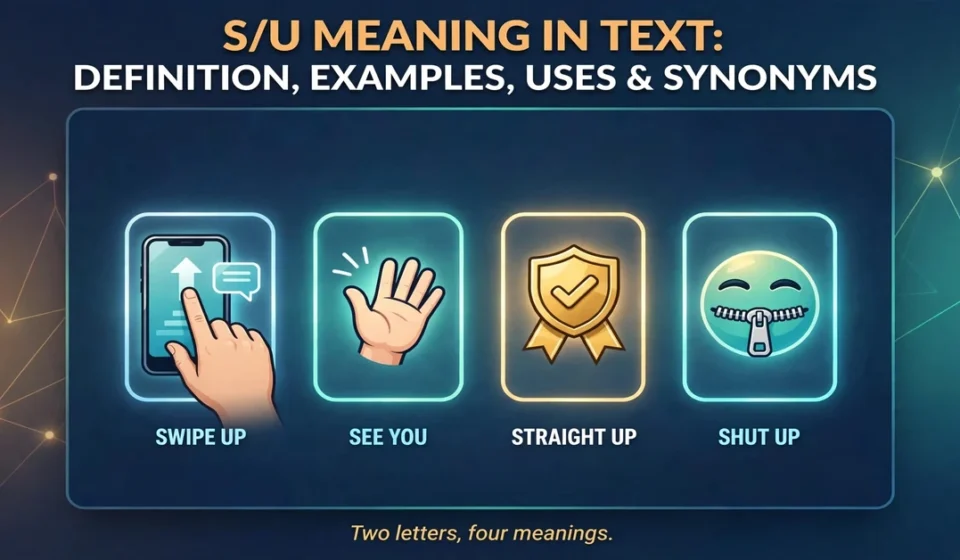

Two letters, one slash, at least four completely different meanings. Few pieces of texting slang are as context-dependent as S/U. On Snapchat, it is a call to action. In a group chat, it might be a joke. In a heated moment, it could be a shutdown. And in a goodbye text, it is just a friendly wave. The letters never change — everything around them does.
If you have ever stared at an "S/U" wondering which version you just received, you are not alone. It is one of the most searched ambiguous acronyms in texting slang, precisely because guessing wrong can be awkward: responding "bye!" to a "shut up" is a special kind of embarrassment. The good news is that the s u meaning in text is almost always obvious once you know the four candidates and where each one lives.
In this guide, we will decode every major meaning of S/U — shut up, swipe up, straight up, and see you — show you how to tell them apart instantly, walk through real examples from each context, and cover the etiquette of using the spicier versions without causing collateral damage.

The Four Meanings of S/U
Let us get the full lineup on the table first. When you see S/U (also written SU, s/u, or su), it almost always means one of these four things:
- Shut up — the slang classic. Blunt, versatile, and heavily tone-dependent: it can be a genuine telling-off, a playful tease, or an exclamation of disbelief ("S/U! No way!").
- Swipe up — the social media call-to-action. On Snapchat and Instagram stories, "S/U" tells viewers to swipe up on the screen to open a link, reply, or see more content.
- Straight up — the honesty marker. Meaning "truthfully" or "honestly," as in "S/U, that was the best pizza I've ever had." A sincerity stamp.
- See you — the casual goodbye. A quick sign-off: "Gotta run, S/U later!" Short for "see you later."
There are also minor, rarer uses — "send/upload" ("S/U the pics"), "show up," "sign up" — but the big four cover the overwhelming majority of real-world encounters. Your decoding job is to figure out which of the four fits the scene. Fortunately, each one has a natural habitat, and they rarely overlap.
Why one acronym has four meanings
S/U is a collision, not a conspiracy. "Shut up" and "straight up" are natural spoken shortenings that migrated to text. "Swipe up" was born from a specific phone gesture on Snapchat. "See you" is just fast typing. Four separate linguistic streams happened to produce the same two letters, and the internet — which loves efficiency more than clarity — never bothered to sort them out. Context became the sorting mechanism, and it works surprisingly well in practice.
Meaning #1: "Shut Up" — The Playful (or Not) Shutdown
The oldest texting meaning of S/U is "shut up," and it carries the widest emotional range of the four. At one end, it is genuinely rude — a blunt instruction to stop talking. At the other, it is pure affection — the thing you say when a friend tells you something so surprising or funny that "shut up" is the only possible response.
The playful version is far more common in everyday texting. "S/U, you did NOT meet him 😭" is not a command; it is an exclamation, closer to "no way!" or "oh my god!" in function. Between friends, it is a staple reaction to gossip, plot twists, and unbelievable stories. The teasing version — "ok s/u, nobody asked 😂" — is gentle roasting, the kind that only works inside a solid friendship.
The genuinely annoyed version exists too, and the tells are unmistakable: no laughing emoji, a tense conversation, maybe a period at the end. "S/U. I'm serious." When the playfulness drains out, the two letters revert to their literal meaning, and it stings exactly as much as the full phrase would. The acronym does not soften a real "shut up" — if anything, the curtness makes it colder.
Reading the tone
Three signals decode a "shut up" S/U instantly. Emojis: 😂, 😭, or 🙄 mean playful; no emoji in a tense chat means serious. Punctuation: "s/u!!" is excitement; "s/u." is ice. History: if you were just sharing gossip, it is delight; if you were just arguing, it is not. When all three point the same way, trust them.
Meaning #2: "Swipe Up" — The Social Media Call-to-Action
On Snapchat and Instagram, S/U is most often an instruction, not slang: "swipe up." Creators write "S/U for the link," "S/U to shop," or "S/U for more pics" on their stories, telling viewers to swipe upward on the screen to open whatever is attached — a product page, an article, a reply box, more photos.
This meaning is instantly recognizable by its habitat: it appears on stories and public posts, not in private conversations, and it is almost always followed by a purpose — "for the link," "to vote," "for part 2." Nobody texts their friend "S/U" alone to mean "swipe up"; the call-to-action needs its object. It is also the meaning most likely to appear with commercial intent — discount codes, affiliate links, new video announcements. If there is a product involved, it is "swipe up," full stop.
The gesture itself has history: Snapchat's swipe-up-to-open-links feature trained a generation of users in the motion, and "S/U" became the standard shorthand for prompting it. Even as platforms changed their interfaces over the years, the abbreviation stuck around in captions and stickers — a fossil of a specific touchscreen era that everyone still understands.
Meaning #3: "Straight Up" — The Honesty Stamp
"Straight up" is S/U in sincerity mode. It means "honestly," "truthfully," or "no lie," and it usually opens a statement: "S/U, I was nervous the whole time." It can also close one for emphasis: "That movie was amazing, s/u." Either way, its job is to certify what follows (or precedes) as the unvarnished truth.
This meaning has deep roots in spoken slang — "straight up" as an honesty marker predates texting by decades, especially in hip-hop and urban vernacular ("straight up, that was wack"). The texting abbreviation just compressed a phrase people were already saying. You will hear it most from people who also say "straight up" out loud; for them, "s/u" is simply the typed version of their own voice.
Distinguishing it is usually easy: it appears at the start of a sincere statement, often about opinions or confessions. "S/U I don't even like parties" cannot be "shut up" (there is a full sentence attached) or "swipe up" (there is no link). The sentence structure does the decoding for you.
Meaning #4: "See You" — The Quick Goodbye
The gentlest of the four: "see you," a breezy sign-off. "Gotta run, S/U!" It is "see you later" with the later implied, the kind of goodbye you type while already walking away. You will see it at the end of conversations, often paired with thanks or plans: "Had fun tonight, S/U soon!"
This is the least common of the big four in texting — most people just type "bye" or "later" — but it is well-established enough to cause real confusion when it appears. The classic mix-up: someone signs off with "S/U!" and the recipient, primed by the "shut up" meaning, reads it as hostility. Position is the giveaway: "shut up" S/U reacts to something just said; "see you" S/U closes the conversation. A goodbye-context "S/U" is almost never an insult.
S/U in Real Conversations: Examples
Example 1 — playful "shut up":
Maya: HE TEXTED ME BACK
Leo: S/U NO WAY 😭😭
Example 2 — serious "shut up":
Dev: you never listen to me
Ana: s/u. I'm done talking about this.
Example 3 — "swipe up" CTA:
Instagram story caption: "New vlog is live! S/U to watch 🎬"
Example 4 — "straight up":
Sam: s/u, that was the best concert I've ever been to
Example 5 — "see you" goodbye:
Priya: gotta run, talk later! S/U 👋
Each example is instantly decodable once you know the four habitats: reactions, stories, sentence-openers, and goodbyes. The ambiguity that makes S/U confusing in theory almost never survives contact with actual context.
When to Use S/U (and When Not To)
Do use "swipe up" S/U freely on stories and posts — it is standard creator language, universally understood in that habitat. Do use playful "shut up" S/U with close friends who know your tone; the 😭-flavored "S/U NO WAY" is a cornerstone of group-chat comedy. Do use "straight up" S/U when you want to add sincerity weight to a statement among people who speak the slang. Do use "see you" S/U as a quick sign-off if that is your texting style — though "later!" avoids all ambiguity.
Do not use "shut up" S/U with people who might read it literally: acquaintances, coworkers, anyone you are already tense with. The playful reading requires a relationship; without one, it is just rudeness in shorthand. Do not use a bare "s/u" in emotionally charged conversations unless you mean the shutdown — ambiguity is not your friend mid-argument. Do not use any S/U in professional or formal messages; every meaning of it is casual, and half of them are slang. And do not open with S/U to someone who does not text much — if they have to google your goodbye, the efficiency has failed.
How to Reply When Someone Sends You "S/U"
Match the habitat, not just the letters:
Playful "shut up" — "S/U NO WAY 😭" — the correct response is to keep the gossip coming or volley back: "I KNOW 😭" or "s/u yourself, it's true." This is excitement; feed it.
Serious "shut up" — "s/u. I'm done." — stop. A short "okay, I'll give you space" respects the boundary. Do not argue with a shutdown; you will not win, and trying proves their point.
"Swipe up" CTA — no reply needed. Either swipe or do not; the story is not a conversation. If a friend's story says "S/U for the link" and you want it, swipe. That is the entire interaction.
"Straight up" — respond to the statement, not the opener. "S/U, I was nervous" wants "you did great though" — the "s/u" was just a sincerity stamp, not a question.
"See you" — a simple "bye!" or "later!" closes the loop. Do not overthink a goodbye.
If you genuinely cannot tell which one it is — rare, but it happens — a light "lol which s/u is this" works with friends. With anyone else, read the last three messages again; the answer is almost always there.
Is S/U rude?
Only the "shut up" version, and only when it is meant that way. "Swipe up," "straight up," and "see you" are all neutral — one is marketing, one is honesty, one is a goodbye. Even "shut up" S/U is more often playful than hostile in real texting. The rudeness lives in the intent and the relationship, not the letters. That said, "shut up" is the default reading for many people, which means the other three meanings occasionally get misread as rude by accident. Senders: when in doubt, add the emoji.
What's the most common meaning of S/U?
It depends entirely on where you are. On Snapchat and Instagram stories, "swipe up" dominates — it is practically the only meaning in that habitat. In private texts and group chats, "shut up" (usually playful) is the most common. "Straight up" is common in spoken-influenced texting circles but rarer overall. "See you" is the least common of the four but still well-established. There is no single winner — which is exactly why this guide exists.
Is it S/U, SU, s/u, or su?
All four are the same thing. The slash is a style choice — some people type "S/U," others "SU" — and capitalization is pure personal preference. No version carries a different meaning. (The slash arguably helps distinguish it from the word "su," but in practice nobody is confused.) Use whichever your fingers prefer; your readers will understand all of them.
Can S/U mean "shut up" in a nice way?
Yes — and this is its most common texting use. The affectionate "shut up" is a reaction to delight: unbelievable news, hilarious gossip, a plot twist. "S/U, you're lying 😭" is a compliment wearing a costume — it means "this is so good I can't process it." The "nice" reading depends on emojis, exclamation marks, and friendship. Without those, it defaults to its literal meaning. With them, it is one of the warmest reactions in the texting vocabulary.
Why do creators write S/U instead of "swipe up"?
Habit, space, and culture. Story captions are small, attention is short, and "S/U" is the established shorthand that regular viewers decode instantly. It also signals insider status — using the abbreviation marks the creator as fluent in platform culture, the way "link in bio" does on Instagram. Everyone who spends time on Snapchat learned "S/U" the way drivers learn road signs: by seeing it a hundred times until it became automatic.
Conclusion
The s u meaning in text is never just one thing — it is four meanings sharing two letters, sorted by context every time. "Shut up" for the group chat, "swipe up" for the story, "straight up" for the honest moment, "see you" for the goodbye. Each one has its habitat, its tells, and its etiquette, and once you know the lineup, the ambiguity that makes S/U intimidating mostly evaporates.
The real lesson of S/U is bigger than two letters: in texting, context is not just helpful — it is the message. The same characters can be a joke, an instruction, a confession, or a farewell, and the difference lives entirely in where they appear and who sent them. So the next time "S/U" lands on your screen, do not just read the letters. Read the room around them. That is where the meaning has been hiding all along.