
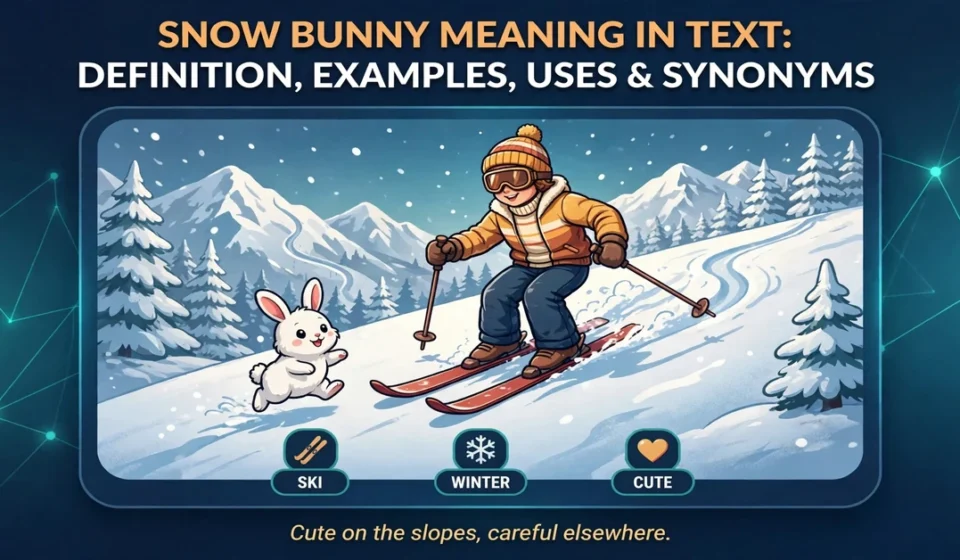

You see it in a caption under a ski-trip photo: “snow bunny mode activated ❄️.” Your friend calls her girlfriend “my little snow bunny” in a text. Then someone in a comment thread uses the same phrase and the replies get tense. Same two words — completely different energy. So which is it?
Here is the honest answer: “snow bunny” has more than one meaning, and they range from playful to genuinely offensive. The snow bunny meaning in text depends entirely on context — it can describe a ski enthusiast, a beginner on the slopes, a winter-fashion lover, a term of endearment… or, in some circles, carry racial and sexual connotations that make it a word to handle with care.
In this guide, we will walk through every meaning factually, trace where the term came from, show you how to read it in texts and captions, and — just as importantly — explain when not to use it.

What Does “Snow Bunny” Mean? The Quick Answer
At its core, “snow bunny” combines “snow” (winter, skiing, mountain resorts) with “bunny” (a long-standing slang suffix for someone cute, new, or playful — think “beach bunny” or “ski bunny”). The result is a term that usually describes a person — typically a young woman — associated with snow, skiing, or winter resort life.
But the details matter enormously:
- The ski-slope meaning — a woman who loves skiing/snowboarding and resort culture. Playful, usually harmless.
- The beginner meaning — someone learning to ski (from “bunny slope,” the gentle beginners’ hill). Friendly and teasing.
- The texting/social media meaning — a cute caption, a term of endearment, a winter aesthetic. Usually lighthearted.
- The dating-slang meaning — in some communities, a white woman, sometimes specifically one dating Black men. This is where it gets sensitive and potentially offensive.
- The drug-slang meaning — occasionally, a cocaine user (“snow” = cocaine). Rare, but documented in slang dictionaries.
Most everyday texts use meanings 1–3. But you need to know 4 and 5 exist so you can read the room — and so you never use the term in a way you will regret.
Meaning 1: The Ski-Slope Original
This is where “snow bunny” was born. The term dates back to the 1940s in American ski culture, describing women who frequented ski resorts — sometimes more for the social scene, the fashion, and the mountain-town atmosphere than for serious athletic competition. Dictionary definitions from the era describe “an attractive young woman who frequents ski slopes,” often one more interested in the resort lifestyle than in racing down black diamonds.
The “bunny” half has its own history. In ski slang, beginners learned on the bunny slope — the gentle, forgiving hill set aside for first-timers. “Bunny” became shorthand for newcomer, and it paired naturally with “beach bunny” (a woman who lives for the beach) as part of a whole family of lifestyle nicknames.
Over the decades, the ski-slope snow bunny became a cultural archetype: the stylish figure in a vintage one-piece suit, après-ski drink in hand, as much a part of resort imagery as the chairlift. Fashion brands still sell “snow bunny” aesthetics every winter — chunky knits, faux-fur boots, retro ski suits. In this lane, the term is nostalgic and commercial rather than cutting.
Meaning 2: Snow Bunny in Texting and Social Media
Online, “snow bunny” got a second life as caption slang and a term of endearment. This is the meaning you will meet most in texts:
As a caption: – “Snow bunny mode activated ❄️⛷️” – “Weekend with my favorite snow bunny #skiTrip”
As a pet name: – “Good morning, my little snow bunny 🐰❄️” – “Can’t wait to see my snow bunny this weekend”
As self-description: – “I’m such a snow bunny — I’d live on the mountain if I could”
In these uses, the tone is affectionate and wintry — closer to “cutie” than to anything loaded. Couples use it the way they might use “babe” or “sweetheart,” just with seasonal flavor. Friends use it to hype each other’s ski-trip photos. Nobody is thinking about dictionaries; they are thinking about snow.
This is also where related terms cluster: ski bunny, slope bunny, powder hound (the more hardcore skier), beach bunny (the summer equivalent), gym bunny (the fitness-obsessed). English loves its bunny compounds.
Meaning 3: The Dating-Slang Sense — Handle With Care
Here is the meaning that makes the term complicated. In some communities — particularly in African American Vernacular English and online dating discourse — “snow bunny” has been used to mean a white woman, sometimes specifically a white woman who dates or prefers Black partners.
Dictionaries mark this sense as “often disparaging and offensive.” Why? Because it reduces a person to race (and sometimes to sexual availability), and it is frequently used in a mocking or objectifying way — commenting on interracial dating rather than describing a person. What sounds like a compliment in one mouth can sound like a slur in another, which is exactly what makes it risky.
This does not mean every use of “snow bunny” carries this meaning — the ski-slope and caption senses are far more common in everyday texting. But it does mean:
- Do not use “snow bunny” to describe a stranger’s race or dating life. Ever.
- Be aware that in dating-discussion contexts, the term may land as offensive, even if you meant the ski-trip sense.
- If someone tells you the term bothers them, believe them. Intent does not override impact.
The rule is simple: keep “snow bunny” on the slopes. The moment it drifts toward describing someone’s race or relationships, put it down.
Other Meanings You Might Encounter
Two more senses exist, both worth a brief mention so nothing catches you off guard:
The beginner skier. Some dictionaries list “snow bunny” as simply “someone learning to ski” — a direct extension of the bunny slope. “This hill is for snow bunnies” means it is a beginner area. Friendly, instructional, zero drama.
The drug slang. In some slang dictionaries, “snow bunny” appears as a term for a cocaine user (“snow” being long-standing slang for cocaine). This usage is rare in everyday texting and mostly lives in older slang compilations. If you see it in a gritty TV drama or a song lyric, this may be the intended sense — but in a normal text conversation, it almost never is.
Snow Bunny in Pop Culture
The snow bunny archetype has been recycled by pop culture for decades. Ski-resort comedies of the 1960s through the 1990s made her a stock character — the glamorous figure more interested in the lodge than the lift. Fashion editorials return to her every winter: the retro one-piece, the oversized sunglasses, the fur-trimmed boots, all of it selling the fantasy that the mountain is as much a runway as a sports venue.
Music has used the term too, usually in the playful winter-lifestyle sense, and TikTok and Pinterest have given the “snow bunny aesthetic” a full mood-board revival — think cozy cabin content, matching ski sets, and hot chocolate with a view. In this lane, “snow bunny” is pure vibe: less a description of a person than of a whole winter fantasy.
What pop culture mostly avoids is the loaded dating-slang sense — mainstream movies and ads stick to the slopes. That split is telling: the entertainment industry knows exactly which meaning is safe for a billboard and which one is not. Take the hint.
The Bunny Family: Related Slang
“Snow bunny” is one member of a whole warren of bunny-based slang. Knowing the relatives helps you read the tone:
- Beach bunny — the summer twin: someone (usually a young woman) who lives for the beach, surfing, and tanning. The original lifestyle-bunny, dating back to 1960s surf culture.
- Ski bunny / slope bunny — near-synonyms of snow bunny, slightly more focused on the skiing itself.
- Gym bunny — someone devoted to working out, often with the implication that the social scene matters as much as the exercise.
- Powder hound — the snow bunny’s more hardcore cousin: a skier obsessed with fresh powder, up at dawn, first on the lift. Gender-neutral and purely about the sport.
- Bunny slope — the gentle beginners’ hill itself, and the source of the whole “bunny = newcomer” idea.
Notice the pattern: “bunny” softens whatever it touches, making the term affectionate but also a little dismissive — it is rarely used for the most serious practitioners of anything. That built-in lightness is exactly why “snow bunny” works as a pet name and exactly why it stings when aimed at someone’s identity.
When NOT to Use “Snow Bunny”
A quick safety checklist:
- Do not use it about someone’s race or dating preferences. This is the fastest way to offend.
- Do not use it for a coworker or stranger. Even the playful senses assume familiarity — it is a pet name, not a professional descriptor.
- Do not use it if you are unsure of the audience. In mixed company or public comments, the term’s multiple meanings make it a gamble.
- Do use it for your partner (if they like it), your friends’ ski-trip captions, and your own winter aesthetic posts. That is its happy home.
When in doubt, there are plenty of alternatives with zero baggage: “ski lover,” “snowboarder,” “winter enthusiast,” or just… their name.
Frequently Asked Questions
1. What does “snow bunny” mean in texting?
In most texts, “snow bunny” is playful slang for someone who loves skiing, snowboarding, or winter resort life — often used in captions (“snow bunny mode ❄️”) or as an affectionate nickname. However, in some contexts it carries racial/dating connotations that can be offensive, so context matters.
2. Is “snow bunny” offensive?
It can be. The ski-slope and caption senses are generally harmless, but the dating-slang sense — using it to mean a white woman, especially regarding interracial dating — is widely considered disparaging and offensive. Because the term carries both meanings, use it carefully and never to describe someone’s race or relationships.
3. Where did the term “snow bunny” come from?
“Snow bunny” originated in 1940s American ski culture, describing women who frequented ski resorts. The “bunny” element connects to the “bunny slope” (the beginners’ hill) and parallels terms like “beach bunny.” It later spread into general slang, social media captions, and dating discourse.
4. What is the difference between a snow bunny and a ski bunny?
There is barely one — the terms are near-synonyms. “Ski bunny” leans slightly more toward the activity of skiing itself, while “snow bunny” covers the broader winter-resort lifestyle (fashion, atmosphere, social scene). In practice, people use them interchangeably.
5. Can guys be snow bunnies?
Traditionally the term skews female, but language evolves — anyone who lives for winter mountain life can jokingly claim the title. That said, the term’s gendered history means it still reads as feminine to most people, so expect a raised eyebrow or a laugh if you apply it otherwise.
Conclusion
The snow bunny meaning in text is a reminder that slang is never just about words — it is about rooms. In a ski lodge group chat, “snow bunny” is a cozy compliment. In a caption, it is winter aesthetic in two words. In a dating thread, it can be something much uglier. Same phrase, different room, different meaning.
The smart move is the simple one: enjoy the playful senses where they belong — the slopes, the captions, the people who love you enough to be your snow bunny — and leave the loaded senses alone. Language gives you plenty of words. You do not need the risky ones.