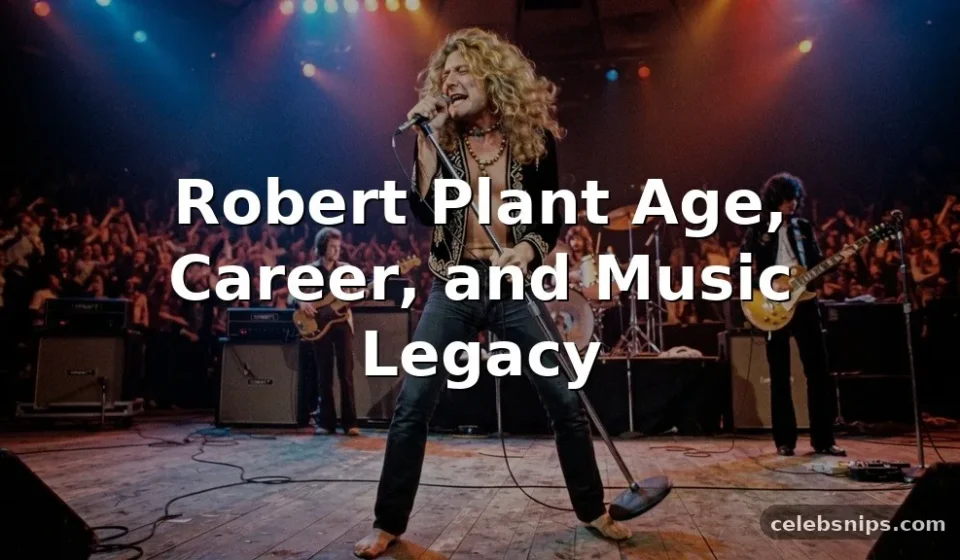

Robert Plant is the English singer best known as the voice of Led Zeppelin, the band that helped define hard rock through songs such as “Whole Lotta Love,” “Kashmir,” and “Stairway to Heaven.” Born on August 20, 1948, Plant is 77 years old as of March 2026, and his career has continued well beyond the band’s breakup.
Robert Plant’s age, career, and music legacy matter because his work stretches across blues, rock and roll, folk, world music, and Americana. The key story is not only his extraordinary Led Zeppelin years, but also the creative choices he made afterward as a solo artist and collaborator.
Robert Plant at a Glance
Plant’s public identity is closely tied to Led Zeppelin, but describing him only as a former rock frontman leaves out much of his later work. His career includes influential solo albums, a celebrated partnership with Alison Krauss, and a continuing interest in traditional music from Britain, North Africa, and the American South.
| Fact | Details |
|---|---|
| Full name | Robert Anthony Plant |
| Born | August 20, 1948 |
| Age | 77 as of March 2026 |
| Birthplace | West Bromwich, Staffordshire, England |
| Nationality | British |
| Profession | Singer, songwriter, and musician |
| Best known for | Led Zeppelin and his solo career |
| Years active | 1960s to the present, with periods of reduced public activity |
| Best-known collaborators | Jimmy Page, Alison Krauss, and members of Led Zeppelin |
Plant was born in West Bromwich and grew up in Kidderminster, Worcestershire. His birth name is Robert Anthony Plant, and “Robert Plant” is not a stage name created to conceal another identity.
His age changes each year, so age-based answers should always include a date. The most stable facts are his birth date, his role in Led Zeppelin, and the chronology of his recordings.
- Birth date: August 20, 1948.
- Signature band: Led Zeppelin, formed in 1968.
- Musical range: blues, hard rock, folk, traditional music, and Americana.
- Major later partnership: Alison Krauss, particularly on the album Raising Sand.
- Current public status: a living musician whose work remains connected to recording, collaboration, and selected performances.
Early Life and Musical Influences
Robert Plant was born during the postwar period in the English Midlands, a region with strong industrial and cultural connections. He grew up in Kidderminster, where he developed an early interest in American blues and the records of singers such as Robert Johnson, Howlin’ Wolf, and Willie Dixon.
Plant’s attraction to blues was more than a preference for a particular sound. He studied the vocal phrasing, imagery, and emotional intensity of blues singers, then brought those elements into a louder British rock setting. That combination became central to his identity before Led Zeppelin had released a single album.
As a teenager, Plant became involved with local bands and the emerging British blues scene. He performed with groups including the Crawling King Snakes, which also featured drummer John Bonham for a time, and later worked with the Band of Joy.
The Band of Joy name would become important again decades later, but its early use shows how Plant’s musical relationships developed before his international success. Bonham was not simply a later hire for Led Zeppelin; he was already part of Plant’s musical circle.
Plant also performed with the Birmingham-based group Listen, which recorded a version of the song “You Better Run.” Although these early projects did not create a major commercial career, they gave Plant practical experience as a frontman and helped him develop a distinctive vocal approach.
His early singing combined a high register with blues-based phrasing, but the voice was only part of the effect. Plant used pauses, cries, sustained notes, and changes in volume to make the vocal feel physical and dramatic.
There is no strong public evidence that Plant followed a conventional academic route into music. His path was built through live performance, local bands, record collecting, and contact with other musicians. That experience shaped the way he approached the studio later.
By the late 1960s, Plant had become known in British blues and rock circles, although he was still far from being a household name. His move into the group that became Led Zeppelin changed the scale of his career almost immediately.
How Led Zeppelin Changed His Career
Plant joined guitarist Jimmy Page, bassist and keyboard player John Paul Jones, and drummer John Bonham in 1968. The group initially emerged from the remains of the Yardbirds, the British band Page had inherited and then rebuilt after its earlier lineup dissolved.
Page already knew Plant and Bonham through the Birmingham music circuit. Their shared history helped explain why the new band could sound cohesive despite the enormous demands placed on each member.
Led Zeppelin’s first album, Led Zeppelin, was released in January 1969. It introduced a forceful blend of blues, heavy guitar, acoustic textures, and extended arrangements, while Plant’s voice gave the band an instantly recognizable focal point.
The second album, Led Zeppelin II, followed later in 1969 and pushed the group further into hard rock. “Whole Lotta Love” became one of its defining songs, built around Page’s guitar, Bonham’s drumming, Jones’s bass, and Plant’s commanding vocal.
Plant’s role in Led Zeppelin was not limited to singing melodies written by someone else. He contributed lyrics and helped shape the band’s imagery, drawing on blues traditions, mythology, fantasy literature, and personal themes.
The band’s catalog continued to develop rather than simply repeat the formula of its first records. Led Zeppelin III included a stronger acoustic and folk influence, while Led Zeppelin IV balanced heavy rock with quieter material such as “The Battle of Evermore” and “Going to California.”
“Stairway to Heaven,” from Led Zeppelin IV, became Plant’s most enduring association for many listeners. The song moves from acoustic guitar and restrained singing to a full rock climax, giving Plant space to change vocal intensity across a long arrangement.
Led Zeppelin’s later albums showed a willingness to move outside straightforward blues rock. Houses of the Holy, Physical Graffiti, Presence, and In Through the Out Door each presented different combinations of funk, folk, acoustic music, electronic keyboard textures, and heavy guitar.
The band ended after Bonham died in September 1980. Led Zeppelin formally announced its dissolution that December, and Plant then faced a difficult artistic question: how could he continue as a singer without simply reproducing the sound of his former band?
The Rock & Roll Hall of Fame’s Led Zeppelin profile provides useful institutional context for the band’s place in rock history. Plant’s own later work, however, shows that his legacy cannot be reduced to the group’s four members or its biggest songs.
Robert Plant’s Voice and Artistic Style
Plant’s singing is often described through its range, but range alone does not explain its impact. His most distinctive quality was the ability to move between a conversational blues delivery, a sharp high note, a controlled whisper, and a full-throated cry within the same performance.
That flexibility suited Led Zeppelin’s arrangements. Page’s guitar parts could shift from delicate acoustic figures to dense distortion, and Plant’s voice provided a human bridge between those contrasting sounds.
Plant also helped popularize a particular image of the rock singer: physically expressive, flamboyant, and capable of dominating a large stage without standing behind a guitar or keyboard. His appearance and movement became part of the band’s visual identity, especially during the early 1970s.
Yet his musical interests were broader than the stereotype of a hard-rock singer. Plant repeatedly returned to blues artists, English folk traditions, Celtic sounds, North African influences, and roots music from the United States.
His lyrics have sometimes been difficult to interpret because they combine direct emotional language with symbolic or mythic imagery. Some Led Zeppelin songs reflect old blues structures, while others use landscapes, legends, and dreamlike scenes rather than conventional storytelling.
Plant’s vocal approach also changed after the 1970s. In later recordings, he often favored texture and phrasing over the sustained high notes that had made him famous. That choice was partly artistic and partly practical, since a singer’s instrument changes across decades.
His career therefore offers an unusually clear example of reinvention. Plant did not attempt to freeze himself at the age he was when Led Zeppelin became famous; he adjusted his voice, repertoire, and collaborators as his interests changed.
The result is a musical style with several layers. The young Plant remains associated with hard rock and blues, while the older artist is equally connected with roots music, duet singing, traditional songs, and atmospheric solo records.
Solo Career After Led Zeppelin
Plant’s first major solo album, Pictures at Eleven, arrived in 1982. Released after Led Zeppelin’s breakup, it showed that he could lead a project without relying on the exact four-person structure that had defined his previous band.
The album included musicians such as Phil Collins and Cozy Powell, and it reached a strong commercial position in the United States and United Kingdom. Plant’s voice remained forceful, but the music was more clearly framed as a new chapter rather than a Led Zeppelin reunion by another name.
He followed it with The Principle of Moments in 1983. The album included “Big Log,” one of his best-known solo songs, and demonstrated his willingness to work with contemporary production techniques rather than remain tied to the recording sound of the early 1970s.
During the 1980s, Plant released albums including Shaken ’n’ Stirred and Now and Zen. The latter included “Tall Cool One” and brought some of the sonic character of his Led Zeppelin past into a modern solo setting.
“Tall Cool One” also included contributions from Jimmy Page, a reminder that Plant and Page continued to have a significant musical connection even when Led Zeppelin was no longer functioning as an active band.
Plant’s solo work became more exploratory in the early 1990s. Manic Nirvana appeared in 1990, followed by Fate of Nations in 1993, an album that leaned more openly into folk, roots, and atmospheric songwriting.
On Fate of Nations, Plant worked with musicians including guitarist Kevin Scott MacMichael and singer-songwriter Maire Brennan. The record helped establish that his post-Zeppelin identity was not simply a commercial extension of his old band.
The 2000s brought another shift. Dreamland arrived in 2002, and Mighty ReArranger followed in 2005 with the Strange Sensation, a group that allowed Plant to explore heavier and more experimental arrangements.
Plant’s solo catalog is not uniform, and that is part of its importance. Some albums court radio rock, others favor traditional material, and several treat production and atmosphere as seriously as the vocal melody.
Listeners searching for a single “Robert Plant sound” may be surprised by the range of these records. His career after Led Zeppelin is best understood as a sequence of deliberate changes rather than one fixed style.
Alison Krauss and Raising Sand
One of the most important later chapters in Plant’s career began with his collaboration with Alison Krauss. Krauss, an acclaimed bluegrass and country singer and musician, brought a very different vocal character to the partnership.
Their 2007 album, Raising Sand, was produced by T Bone Burnett. Rather than recreating the scale of Led Zeppelin, the record relied on close vocal interplay, spacious arrangements, and songs drawn from roots, country, folk, and soul traditions.
Plant and Krauss did not sing as if they were competing lead vocalists. Their voices worked through contrast: Plant’s weathered, high-reaching tone met Krauss’s precise and clear delivery, creating tension without requiring theatrical volume.
Raising Sand became a major critical and commercial success. At the 51st Grammy Awards in 2009, it won five awards, including Album of the Year, Record of the Year for “Please Read the Letter,” and Best Pop Collaboration with Vocals for “Rich Woman.”
The project changed how some audiences understood Plant. People who knew him mainly from “Immigrant Song” or “Black Dog” encountered an artist comfortable with restraint, acoustic instrumentation, and songs that drew from the American roots tradition.
Plant and Krauss toured together in support of the album, bringing the material to large audiences without turning every performance into a Led Zeppelin retrospective. Their shows highlighted the songs and the duet format rather than treating the partnership as a nostalgia event.
The pair later worked together again on Raise the Roof, released in 2021. The album continued their interest in older songs and roots-oriented arrangements, although it arrived many years after the first collaboration and under different cultural circumstances.
The Krauss partnership is central to Plant’s music legacy because it revealed a mature performer comfortable with collaboration. He did not need to dominate every arrangement; sometimes the most effective performance came from leaving space for another voice.
Important Albums, Songs, and Collaborations
Plant’s best-known work spans several distinct periods. Led Zeppelin supplied the songs that made him globally famous, while his solo albums and collaborations show how he reworked the musical ideas that had influenced him from the beginning.
Led Zeppelin highlights
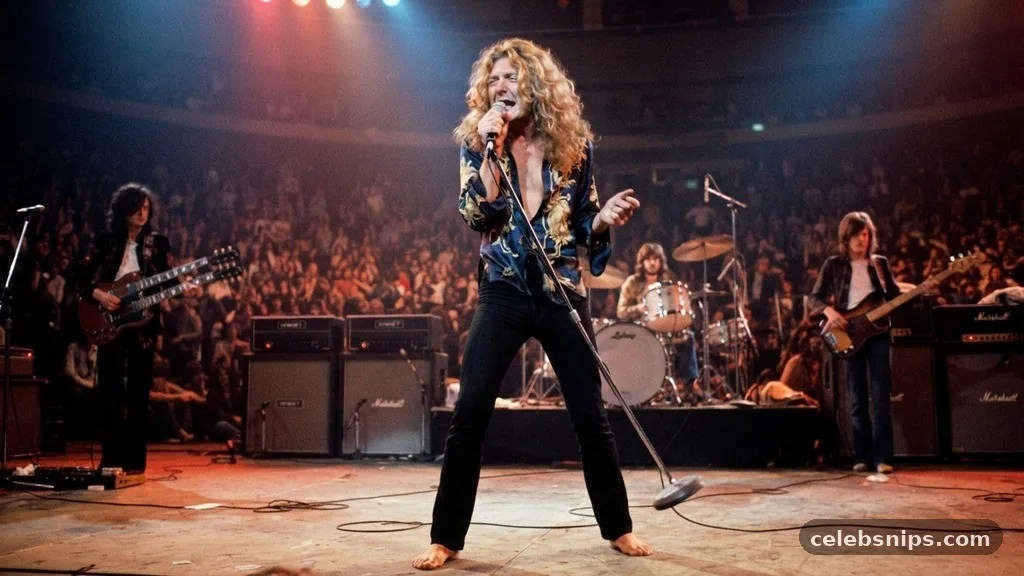
“Whole Lotta Love” remains one of the clearest examples of Plant’s blues-rooted hard-rock delivery. “Black Dog” uses shifting vocal and instrumental patterns, while “Rock and Roll” deliberately connects the band’s heavy sound to the older rock and roll tradition.
“Kashmir,” from Physical Graffiti, is another major Plant performance. Its arrangement is built around a repeating, expansive musical idea, and Plant’s vocal gives the song a sense of scale without relying on a conventional blues structure.
“The Rain Song,” “No Quarter,” “The Battle of Evermore,” and “Going to California” show a quieter side of his Led Zeppelin work. These recordings matter because they demonstrate that the band’s identity included acoustic instruments, unusual rhythms, layered keyboards, and folk influences.
Solo and roots recordings
Among Plant’s solo songs, “Big Log” is important because it achieved a distinct identity outside Led Zeppelin. Its polished 1980s production and reflective mood sound different from the guitar-heavy work that established Plant’s reputation.
“In the Mood,” “Other Arms,” “Ship of Fools,” “Heaven Knows,” and “Tall Cool One” represent different stages of his solo development. They show him moving between radio-friendly rock, electronic production, and more direct links to his earlier musical language.
Later recordings such as “29 Palms,” “Shine It All Around,” and “The Enchanter” reflect his interest in roots music and atmospheric songwriting. These songs are less concerned with repeating the sonic formulas of Led Zeppelin than with building a new setting for his voice.
Collaborations beyond Led Zeppelin
Plant’s work with Alison Krauss is the most commercially prominent later collaboration, but it is not the only one. He also maintained an important musical relationship with Jimmy Page through projects such as Page and Plant in the 1990s.
Page and Plant released No Quarter: Jimmy Page and Robert Plant Unledded in 1994. The project revisited Led Zeppelin material while incorporating orchestral players and musicians connected to North African and Middle Eastern traditions.
They followed with Walking into Clarksdale in 1998, which featured new material rather than relying entirely on familiar Led Zeppelin songs. The collaboration confirmed that Plant and Page could create together while still pursuing a different sound from their original band.
Plant’s later work with the Strange Sensation, Band of Joy, and Saving Grace further widened his musical circle. Each project gave him a different balance of electric instruments, acoustic textures, traditional songs, and original material.
Awards, Recognition, and Historical Importance
Plant’s achievements include both group honors and recognition for his individual work. Led Zeppelin was inducted into the Rock & Roll Hall of Fame in 1995, and the band received multiple Grammy-related honors across its later historical recognition.
Plant’s solo and collaborative career has also received major industry attention. The most significant example is the success of Raising Sand, whose five Grammy wins in 2009 placed his roots-oriented work at the center of the music industry conversation.
In 2011, Plant received the Kennedy Center Honors with the other surviving members of Led Zeppelin. The honor recognized the group’s broader cultural impact rather than simply its album sales or concert history.
Led Zeppelin received the Polar Music Prize in 2006. Plant’s contribution to the band was a major part of why its music continued to be treated as historically important decades after the original lineup had ended.
Recognition, however, does not fully explain Plant’s legacy. His influence can also be heard in the way later rock singers approach vocal range, stage presence, blues interpretation, and the balance between vulnerability and power.
Many singers copied aspects of his sound, particularly the high register and dramatic delivery. Fewer followed his later example of stepping away from the most obvious version of their own success.
Plant’s historical importance therefore has two parts. He helped establish the vocabulary of hard-rock singing during Led Zeppelin’s peak, and he later demonstrated that a famous singer could remain creatively credible by embracing unfamiliar material.
Personal Life, Family, and Public Questions
Plant was married to Maureen Wilson from 1968 until their divorce in 1983. The couple had three children: daughter Carmen Jane and sons Logan Romero and Karac Pendragon, who died in 1977 at the age of five.
Plant’s relationship with Wilson began before Led Zeppelin became internationally famous. Their marriage covered the period of the band’s rise, its intense touring years, and the personal tragedy that affected Plant and his family.
Public reports have linked Plant to later relationships, including his long-term partnership with singer Patty Griffin. Plant generally keeps his private life away from the center of his professional identity, and current relationship claims should not be treated as confirmed unless supported by a direct or highly reliable source.
Questions about whether Plant was faithful to his wife are personal claims that cannot be answered responsibly through internet speculation. Widely repeated stories about rock stars are not automatically verified evidence, and a biography should distinguish documented history from rumor.
Plant has spoken publicly over the years about spirituality, mythology, and religious imagery in music. That does not establish a simple answer to whether he “believed in God,” because his lyrics and interviews reflect a mixture of cultural references, personal reflection, and artistic language.
He is also sometimes asked whether he is nice in real life. No single public opinion can settle that question, although interviews and accounts from colleagues describe different sides of a personality shaped by fame, humor, strong artistic preferences, and a desire for privacy.
There is no reliable public reason to treat every viral anecdote about Plant as fact. The strongest biographical record concerns his music, public performances, and documented collaborations rather than private conversations or unverified stories.
Where Robert Plant Is Today
Robert Plant remains alive and active in music, although his schedule is more selective than it was during Led Zeppelin’s touring era. He has continued to appear through recordings, collaborations, festival performances, and projects centered on roots and traditional music.
His work with Saving Grace reflects this later phase. The group has been associated with acoustic and roots-oriented performances, and its repertoire connects British traditional music with American folk, blues, and gospel influences.
Plant has not treated age as a reason to imitate his younger self. Instead, his later performances generally emphasize phrasing, interpretation, ensemble interaction, and the character of a mature voice.
That approach matters because Plant’s early reputation was built on physical intensity. A singer who once performed extended high-register passages in arenas now has different artistic tools, and he has used them rather than pretending nothing has changed.
There is no confirmed public announcement that Led Zeppelin will reunite as a full performing band. Plant has repeatedly expressed reservations about a conventional reunion, while Page has periodically discussed the band’s catalog and unreleased material.
The surviving members have appeared together at selected events, most notably the 2007 Ahmet Ertegun Tribute Concert, where Plant, Page, and Jones performed with Jason Bonham on drums. That event did not lead to a continuing Led Zeppelin tour.
Plant’s current professional status is therefore best described as active but selective. He remains part of music news because his older work continues to be revisited, while his newer projects show that his artistic interests have not ended with Led Zeppelin.
Net Worth and Income Sources
Robert Plant’s exact net worth is not publicly established through audited personal financial records. Online figures vary considerably, and those estimates should not be presented as verified facts.
His likely career income has come from several identifiable areas. These include record sales, songwriting royalties, publishing, live performances, licensing, and work with Led Zeppelin, solo bands, and collaborators.
- Music royalties: income connected to songwriting, recording, publishing, and the continuing use of Led Zeppelin and solo material.
- Live performances: earnings from concerts, tours, festivals, and special appearances.
- Album releases: sales and licensing connected to studio albums, archival releases, and collaborative projects.
- Catalog licensing: authorized use of songs in films, television, advertising, and other media.
- Collaborations: revenue from projects such as Raising Sand, Page and Plant, and later ensemble work.
Private expenses, taxes, contractual terms, investments, property ownership, and royalty splits are not fully visible to the public. Those gaps make precise online calculations unreliable, even when a website presents a single number with confidence.
Plant’s financial significance is tied particularly to the long commercial life of Led Zeppelin’s catalog. Albums such as Led Zeppelin IV and songs such as “Stairway to Heaven” have remained commercially important across multiple generations.
That does not mean every dollar connected to a Led Zeppelin song goes directly to Plant. Royalties are divided according to songwriting and performance credits, publishing arrangements, record contracts, taxes, management agreements, and other business terms.
A responsible answer to the net-worth question is therefore simple: Plant is a highly successful musician with multiple long-term income sources, but no authoritative public document confirms an exact current total.
Frequently Asked Questions
How old is Robert Plant?
Robert Plant was born on August 20, 1948. He is 77 years old as of March 2026 and will turn 78 on August 20, 2026.
What is Robert Plant’s real name?
His full name is Robert Anthony Plant. Robert Plant is his professional name, not a shortened alias hiding a different legal identity.
Is Robert Plant still alive and performing?
Yes. Robert Plant is alive and continues to take part in music through selected performances, collaborations, and roots-oriented projects, although he no longer maintains the constant touring schedule associated with Led Zeppelin’s peak.
Who was Robert Plant’s wife?
Plant was married to Maureen Wilson from 1968 until 1983. They had three children, and their son Karac died in 1977. Plant’s current relationship status should not be stated as fact without a reliable current source.
What song did Robert Plant refuse to sing?
There is no single, universally established song that Plant has permanently refused to sing in every context. His choices about performing Led Zeppelin songs have changed over time, and some songs may be omitted because of vocal demands, arrangement, personal preference, or the type of performance.
Final Takeaway
Robert Plant’s age, career, and music legacy are best understood as a story in two broad movements. Led Zeppelin made him one of rock’s defining singers, but his later solo albums, work with Jimmy Page, partnership with Alison Krauss, and interest in traditional music gave his career a much wider shape.
At 77, Plant remains a living artist rather than only a historical figure. Exact financial figures and some personal claims remain unverified, but the central facts are clear: his voice helped define hard rock, his musical interests kept expanding, and his most lasting achievement may be the decision to keep changing after his greatest band had ended.