
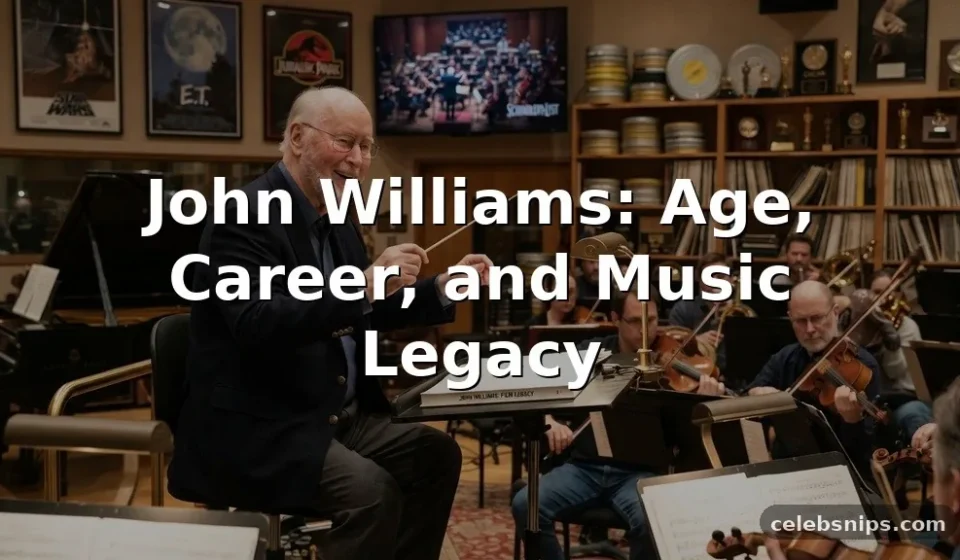

John Williams is the American composer behind some of the most recognizable film music ever written, including the scores for Star Wars, Jaws, Indiana Jones, Jurassic Park, and Harry Potter. Born on February 8, 1932, he turned 93 in 2025, although his age changes each February. His career spans jazz performance, television, concert music, conducting, and more than six decades of Hollywood scoring.
Searching for John Williams’ age, career, and music legacy usually means looking for more than a birthday. His importance comes from how he connected the sound of a symphony orchestra with modern blockbuster storytelling, creating themes that audiences can recognize after only a few notes.
John Williams at a Glance
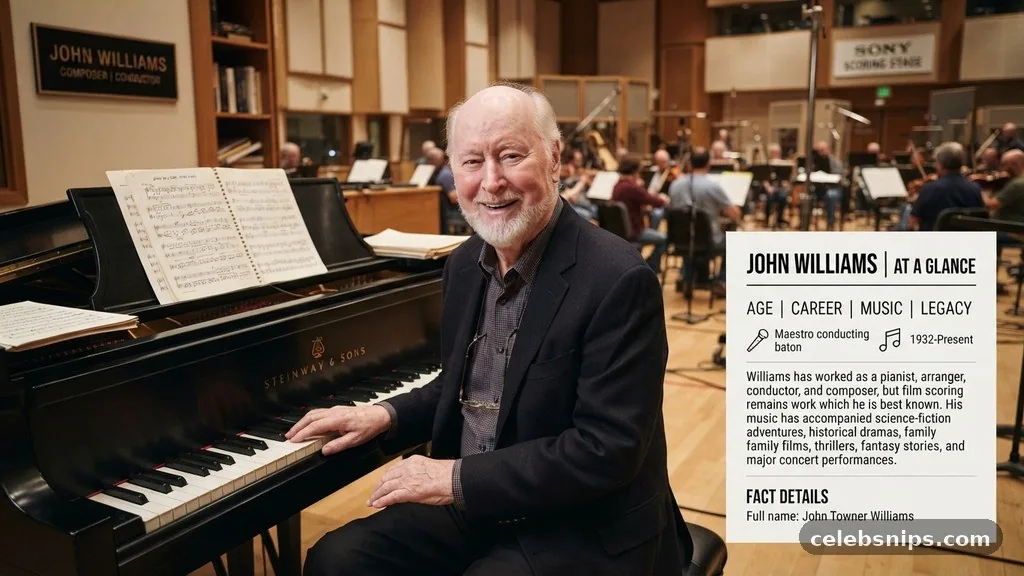
Williams has worked as a pianist, arranger, conductor, and composer, but film scoring remains the work for which he is best known. His music has accompanied science-fiction adventures, historical dramas, family films, thrillers, fantasy stories, and major concert performances.
| Fact | Details |
|---|---|
| Full name | John Towner Williams |
| Date of birth | February 8, 1932 |
| Age | 93 after February 8, 2025; he turns 94 on February 8, 2026 |
| Birthplace | Flushing, Queens, New York |
| Profession | Composer, conductor, pianist, and arranger |
| Known for | Film scores for Star Wars, Jaws, Indiana Jones, Jurassic Park, and Harry Potter |
| Years active | 1950s to the present in music, with film work beginning in the late 1950s |
| Academy Awards | Five wins, with more than 50 nominations |
The age listed above is calculated from Williams’ publicly documented birth date. It should not be confused with the age of another musician named John Williams, particularly the Australian classical guitarist John Williams, who was born in 1941.
Williams’ best-known professional identity is the American film composer associated with director Steven Spielberg, producer George Lucas, and the sound of large-scale orchestral cinema. His music is often described as symphonic, but that label covers a wide range of influences, from late-Romantic concert writing to jazz, military marches, modernist harmony, and musical theater.
Early Life and Musical Background
John Towner Williams was born in Flushing, Queens, New York, on February 8, 1932. His father, John Williams Sr., was a percussionist and jazz musician who performed with radio and studio ensembles, giving the younger Williams an early connection to professional music.
The family later moved to Los Angeles, where Williams grew up around the city’s expanding entertainment industry. He learned piano and developed abilities on other instruments, including trumpet and trombone. Those skills later helped him understand orchestration from the perspective of a performer rather than only from the page.
After graduating from high school, Williams attended the University of California, Los Angeles. His education was interrupted by military service in the United States Air Force, where he worked as a musician and conductor. That period gave him practical experience with arranging and ensemble performance.
After his military service, Williams studied piano at the Juilliard School in New York. He has spoken about studying with pianist Rosina Lhévinne, whose approach emphasized disciplined technique and serious interpretation. The training mattered because Williams’ later film work depended on both keyboard fluency and a deep understanding of the traditional orchestra.
His background was not limited to classical music. As a young professional, he worked as a jazz pianist and studio musician, including work in Los Angeles recording environments. He played on sessions for other artists and composers before becoming one of Hollywood’s most sought-after composers himself.
- New York roots: Williams was born in Flushing, Queens, and was raised in a musical household.
- Family influence: His father’s career as a percussionist introduced him to professional ensemble work.
- Military experience: Service in the Air Force expanded his practical experience as an arranger and conductor.
- Formal study: UCLA and Juilliard contributed to his development as a pianist and composer.
- Studio years: Jazz, television, and recording work prepared him for the demands of film production.
This combination of formal study and popular-music experience became one of Williams’ defining strengths. He could write for a full orchestra while also understanding rhythm, phrasing, recording logistics, and the dramatic timing demanded by commercial entertainment.
How John Williams Started His Music Career
Williams began his professional career as a pianist, arranger, and studio musician rather than immediately as a major film composer. In Los Angeles, he became part of the large pool of musicians who recorded for films, television programs, popular singers, and studio projects.
Those years were important because film scoring is collaborative work. A composer must respond to a director’s ideas, match music to edited images, write parts that musicians can perform efficiently, and revise material when a scene changes. Williams learned those pressures before he became famous for his own scores.
He also wrote and arranged music for television during the 1960s. The medium gave him repeated opportunities to compose under deadlines, develop memorable themes, and work across different genres. Television credits associated with his early career include programs such as Lost in Space and Land of the Giants.
Early film assignments helped him establish himself as a serious composer. His work during this period was often credited under the name Johnny Williams, a professional name he used before becoming widely known as John Williams. The early scores do not all resemble the heroic orchestral style that later defined his public image.
That point is easy to miss. Williams’ career was already developing before Star Wars, but his early work included comedy, drama, television, arrangements, and studio performance. His later success was built on a broad technical foundation, not on one sudden opportunity alone.
He received an Academy Award for his adaptation score for Fiddler on the Roof in 1972. That recognition came before his most influential collaborations with Spielberg and Lucas, showing that the industry had already recognized his arranging and scoring abilities.
The Breakthrough: Jaws and Star Wars
The decisive turning point came in the 1970s. Williams’ score for Spielberg’s Jaws, released in 1975, used a simple repeating two-note figure to create tension around the unseen shark. The motif is musically sparse, but its effect is powerful because it turns a small interval into a warning signal.
The Jaws score also demonstrates Williams’ ability to connect music with physical sensation. Low strings, brass, percussion, and shifting orchestral colors make the ocean feel threatening even when the creature is not visible. The music does not merely decorate the scene; it changes how the audience interprets silence, movement, and anticipation.
Two years later, Williams scored George Lucas’s Star Wars. The main title’s bold brass theme, fast string writing, and clear rhythmic profile immediately suggested adventure and scale. It sounded like a traditional cinematic fanfare, yet it was attached to a new science-fiction universe.
The success of Star Wars helped revive a large symphonic approach to movie scoring at a time when popular cinema often relied more heavily on songs, electronic textures, or smaller ensembles. Williams did not reject modern production methods, but he showed that a full orchestra could still define a contemporary blockbuster.
His Star Wars work also benefited from the use of recurring themes, often called leitmotifs. Characters, places, ideas, and conflicts receive musical identities that return in changed forms as the story develops. That technique gives the trilogy and later films a strong sense of memory and continuity.
The score earned Williams his third Academy Award. It also made film music more visible to the general public, turning a composer’s work into a major part of the audience’s experience rather than an element noticed only by specialists.
Major Film Scores and Collaborations
John Williams’ filmography includes many major collaborations, but his partnership with Steven Spielberg is especially important. Their work together began with The Sugarland Express in 1974 and continued across dramas, historical films, family adventures, and science-fiction productions.
Williams wrote the score for Close Encounters of the Third Kind, another Spielberg film released in 1977. Its five-note musical signal is central to the story, functioning almost like a language between humans and extraterrestrial visitors. The music is not simply a mood setter; it is part of the film’s plot.
For Raiders of the Lost Ark in 1981, Williams created the heroic “Raiders March,” a theme associated with Indiana Jones. Its bright brass writing, energetic rhythm, and clear melodic shape make it easy to remember and adaptable across action sequences, title cards, and quieter moments.
E.T. the Extra-Terrestrial brought a different kind of orchestral storytelling. The score moves between childlike wonder, emotional warmth, suspense, and exhilaration. Williams’ music for the bicycle flight sequence is particularly notable because the orchestra seems to lift the scene into a world beyond ordinary physical movement.
His collaboration with Spielberg continued through films such as Jurassic Park, Schindler’s List, Saving Private Ryan, Amistad, Catch Me If You Can, Munich, Lincoln, and The Fabelmans. These scores vary considerably in tone, which counters the idea that Williams writes only one kind of grand adventure music.
His partnership with George Lucas is most closely associated with Star Wars and the Indiana Jones films. He also composed for the first three Harry Potter films, introducing “Hedwig’s Theme,” a melody that became one of the most recognizable musical signatures of the wizarding world.
| Film or series | Musical contribution | Why it matters |
|---|---|---|
| Jaws | Two-note shark motif and suspense score | Demonstrated how minimal musical material could create intense fear |
| Star Wars | Main title and character themes | Helped return large symphonic scoring to blockbuster cinema |
| Indiana Jones | “Raiders March” and adventure scoring | Established an enduring musical identity for the character |
| Jurassic Park | Expansive themes for wonder and discovery | Used orchestral scale to express awe rather than only action |
| Harry Potter | “Hedwig’s Theme” and early series scores | Created a musical identity that continued beyond his own films |
| Schindler’s List | Restrained, mournful score featuring solo violin | Showed his ability to use intimacy and silence in historical drama |
Readers can consult the Academy of Motion Picture Arts and Sciences’ Oscars records for official information about his Academy recognition and nominated work.
What Makes His Film Music Distinctive
Williams’ style is often associated with strong melodies. Many film scores contain atmospheric textures that support a scene without producing a tune audiences can easily sing. Williams frequently does the opposite: he gives the audience a clear theme that can return, transform, and gather emotional meaning as the story progresses.
His orchestration is equally important. Brass instruments often provide energy and authority, while strings carry lyricism, motion, or emotional tension. Woodwinds can create humor and delicacy, and percussion helps establish danger, ceremony, or forward movement.
He also uses musical contrast effectively. The same composer who wrote the aggressive brass writing of Star Wars wrote the quiet solo violin music of Schindler’s List. The difference is not a change in competence; it reflects a willingness to match the musical language to the moral and emotional character of each film.
Williams’ scores often draw on older traditions without sounding like simple copies. His marches recall concert and military music, while his sweeping themes connect with late-Romantic composers such as Richard Strauss and Gustav Holst. The influence of classical music is audible, but the dramatic timing remains specific to cinema.
His music also depends on structure. Themes may appear in incomplete fragments, shift to minor harmonies, move between instruments, or return at a crucial moment with greater orchestral force. These changes allow the score to participate in storytelling rather than merely repeat a recognizable melody.
Leitmotifs and Musical Memory
A leitmotif is a recurring musical idea linked to a character, object, location, or concept. Williams uses this technique throughout Star Wars, Indiana Jones, and other film series, allowing the audience to recognize relationships even before the story explains them directly.
“The Imperial March,” for example, is associated with Darth Vader and the power of the Galactic Empire. The piece became famous outside the film because its rhythm, orchestration, and minor-key profile communicate menace with unusual clarity.
His approach has influenced generations of composers and helped audiences listen more closely to film music. A viewer may not know the term leitmotif, but they understand that a theme returning in a new context carries meaning.
Awards, Conducting, and Concert Music
John Williams has won five Academy Awards. His winning work includes the adaptation score for Fiddler on the Roof, the scores for Jaws, Star Wars, and E.T. the Extra-Terrestrial, and the score for Schindler’s List.
He has received more than 50 Academy Award nominations, making him one of the most nominated people in the history of the awards. The exact total can change when new nominations are added, so current award records are better treated as a living record rather than a permanent biographical statistic.
His honors also include multiple Grammy Awards, Golden Globe recognition, and major professional distinctions. He has received the Kennedy Center Honors and the National Medal of Arts, reflecting recognition beyond the film industry.
Williams became closely identified with the Boston Pops Orchestra after serving as its conductor from 1980 to 1993. During that period, he helped bring film themes and popular orchestral repertoire to large concert audiences while continuing his Hollywood work.
He later served as the orchestra’s laureate conductor. His concert appearances with the Boston Pops, Los Angeles Philharmonic, and other ensembles have helped preserve a public role for him beyond movie production.
Williams has also composed music specifically for the concert hall. His works include concertos, symphonic pieces, chamber music, and music for major public events. These compositions reveal interests that cannot be reduced to film scoring, even though his cinema work remains his most familiar contribution.
Conducting has been central to his professional identity. On a podium, Williams communicates not only his own compositions but also the broader orchestral tradition that shaped him. His public performances often place film music beside works from the classical canon.
John Williams’ Music Legacy
Williams’ legacy rests partly on recognition. His melodies have entered popular culture, and several are identifiable even by people who do not regularly listen to orchestral music. The main themes from Star Wars, Jaws, Indiana Jones, and Jurassic Park function almost like cultural symbols.
His deeper influence is found in the way he demonstrated that a score could be both artistically sophisticated and broadly accessible. He used complex orchestration, recurring themes, unusual harmonic movement, and careful dramatic timing, yet the central ideas often remained direct enough for audiences to remember.
He also changed expectations for the relationship between a director and a composer. Spielberg and Williams developed a long-running creative partnership in which music was discussed early, sometimes influencing the rhythm and emotional shape of a scene. Their collaboration became a model for how film composers can participate in a production’s artistic identity.
The influence of his work can be heard in modern franchise scoring, especially in superhero, fantasy, and science-fiction films. Many later composers use bold themes and leitmotifs partly because Williams showed that audiences respond to musical continuity across sequels and trilogies.
His music has also helped maintain the cultural status of the orchestra. Large symphonic forces can be expensive and difficult to record, but Williams’ scores proved that orchestral color could remain commercially powerful in a period dominated by electronic production and popular songs.
The legacy is not without complexity. Some listeners argue that his style has been imitated so often that its once-distinctive features became a Hollywood convention. That criticism still confirms his influence: a style becomes familiar partly because other creators adopt its techniques.
Williams’ importance is therefore not limited to a list of famous themes. He changed how many filmmakers, musicians, and audiences understand the narrative function of a movie score.
Is John Williams Still Composing?
Williams has continued to compose and conduct into his nineties. In interviews around the release of Indiana Jones and the Dial of Destiny, he indicated that he expected it to be his final major film score, while also making clear that he did not intend to stop making music altogether.
Public statements about retirement can evolve, particularly for a composer whose work includes concerts, recordings, special events, and arrangements as well as film projects. It is therefore more accurate to say that his film-scoring schedule has become more limited than to claim that he has stopped composing entirely.
He has continued to appear in connection with orchestral performances and special programs. His age means that public appearances may be less frequent than earlier in his career, but age alone does not establish a complete account of his health or daily activities.
Some online searches ask why Williams is in a wheelchair. Public images may show him seated or using assistance, but no reliable public source provides a definitive medical explanation that should be repeated as fact. Speculating about a private health matter would not improve an accurate biography.
The same caution applies to claims about his current residence, private finances, or detailed medical condition. Those subjects are often repeated online without authoritative documentation, while his professional record is well established through films, recordings, concert programs, and award archives.
Personal Life and Public Information
Williams has been married twice. His first marriage was to actress and singer Barbara Ruick, whom he married in 1956. They had three children, including musician Joseph Williams, who became known as the lead singer of the band Toto and as a composer and performer.
Barbara Ruick died in 1974. Williams later married Samantha Winslow in 1980. Public biographies generally identify Winslow as his spouse, but they do not provide a basis for detailed claims about the couple’s private routines or current personal circumstances.
Family details are relevant here because music continued across generations of the Williams family, but that should not be turned into a claim that John Williams’ career was simply inherited. His professional path involved formal study, military service, studio work, television assignments, film scoring, conducting, and decades of independent composition.
Williams is also sometimes confused with John Williams, the prominent Australian classical guitarist. They are different musicians with separate careers, national backgrounds, and repertoires. The film composer discussed here is the American musician born in New York in 1932.
Reliable public information about Williams’ height, weight, private residence, and personal wealth is not firmly established. Online biography pages may publish exact figures, but repetition does not turn an unsupported claim into a verified fact.
John Williams’ Net Worth and Income
There is no authoritative public figure that can establish John Williams’ current net worth with precision. Private contracts, royalties, publishing arrangements, taxes, investments, property, expenses, and the ownership of musical rights are not fully disclosed.
Online estimates should therefore be treated as speculative unless they are tied to documented financial records. A precise number presented without a verifiable source creates a false impression of certainty.
His professional income has likely come from several identifiable areas, although the value of each category is private:
- Film-composition fees for major studio productions.
- Royalties and publishing income from recorded and performed compositions.
- Arrangements, recordings, and music licensing.
- Conducting engagements and orchestra appointments.
- Concert works, albums, and special performances.
- Long-term value associated with recurring film franchises and soundtrack releases.
Popular themes can generate income over many years through theatrical reissues, home entertainment, streaming, soundtrack sales, concert performances, licensing, and educational arrangements. That does not reveal Williams’ personal earnings, but it explains why his catalog remains commercially significant long after an individual film’s release.
The safest conclusion is that Williams has had an exceptionally valuable and durable professional catalog, while his exact net worth remains unconfirmed. Financial estimates should never be presented alongside his five Academy Awards as though both are equally documented facts.
What Was John Williams’ Biggest Hit?
The answer depends on what “biggest hit” means. Williams is not primarily a pop recording artist whose success is measured by one chart-topping single, so his most important work is better evaluated through cultural recognition, film impact, awards, recordings, and continued performance.
If the question refers to the most famous film theme, the Star Wars main title is a strong candidate. It became one of the defining musical openings in cinema and established the sound of a franchise that continued across generations.
If the question refers to the most recognizable suspense motif, the two-note idea from Jaws may be the clearest answer. Its simplicity allowed it to become instantly associated with danger, even outside the original film.
“The Imperial March” is another likely choice because it became a standalone cultural reference. The theme is regularly performed in concert, used in popular media, and recognized as a musical symbol of Darth Vader and authoritarian power.
For emotional and family appeal, the themes from Jurassic Park, E.T. the Extra-Terrestrial, and Harry Potter are equally important. No single title fully represents his career because Williams created several generations of major themes rather than one isolated hit.
Frequently Asked Questions
How old is John Williams?
John Williams was born on February 8, 1932. He turned 93 on February 8, 2025, and will turn 94 on February 8, 2026.
When did John Williams start his music career?
His professional music career began in the 1950s through work as a pianist, arranger, and studio musician. He moved into television and film scoring during the late 1950s and 1960s before becoming internationally famous in the 1970s.
What is John Williams best known for?
He is best known for composing the scores for Star Wars, Jaws, Indiana Jones, Jurassic Park, Harry Potter, E.T. the Extra-Terrestrial, and many films directed by Steven Spielberg.
Is John Williams still alive and composing?
Yes, publicly available information identifies John Williams as alive and active in music at age 93. His film-scoring work has become more limited, but he has continued to compose, conduct, and participate in orchestral projects.
Why is John Williams sometimes shown in a wheelchair?
Public appearances may show Williams seated or receiving assistance, but no reliable public source establishes a definitive medical explanation. It is not responsible to speculate about his health beyond confirmed public information.
Final Takeaway
John Williams’ age explains the extraordinary span of his career, but it does not define his importance. From New York beginnings and studio-piano work to Star Wars, Spielberg collaborations, five Academy Awards, and concert-hall composition, his career reshaped the place of orchestral film music in popular culture.
The clearest view of John Williams’ age, career, and music legacy comes from separating verified facts from online speculation. His exact wealth and private health details remain uncertain, while his scores, awards, themes, and influence are extensively documented. His music continues to be performed, studied, recorded, and remembered, which is the strongest measure of his lasting contribution.