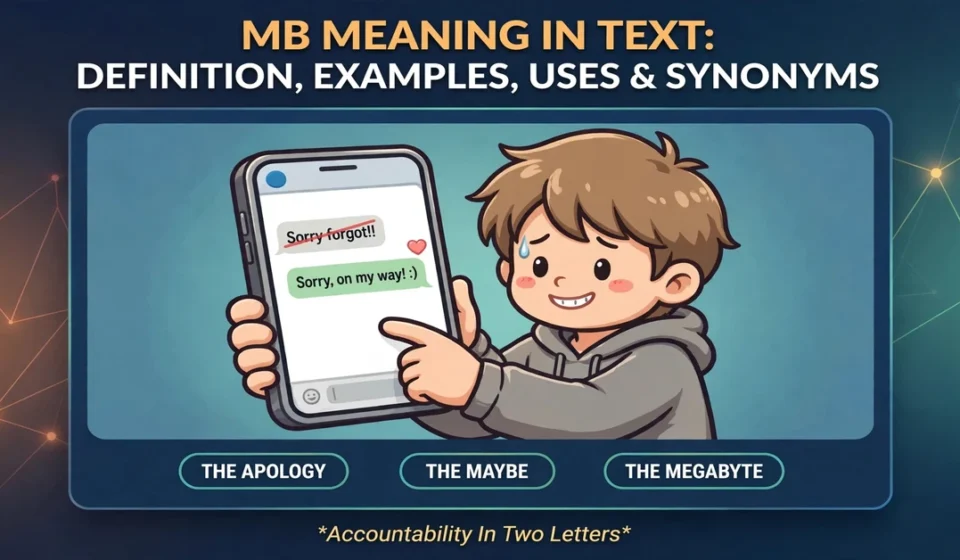

Two letters, one tiny apology, endless confusion. You send the wrong link to the group chat, realize your mistake, and type “mb” before anyone can even react. Your friend reads it and nods — no drama, no paragraph-long apology, just a quick “my bad” and everyone moves on. That is the entire magic of MB in texting: it shrinks accountability down to the smallest possible size without making it disappear.
But MB is sneakier than it looks. In most chats it means “my bad,” yet the same two letters can mean “maybe” when someone is dodging a plan, “megabyte” when someone is talking tech, and a handful of other things in the right corners of the internet. And because “mb” is so short, people read their own assumptions into it constantly.
This guide covers the complete mb meaning in text: the “my bad” default, the “maybe” mix-up, the tech lookalike, and how to use mb without accidentally sounding dismissive. You will get real examples from gaming chats, group threads, and DMs, plus the etiquette rules that keep a two-letter apology from backfiring.

What Does MB Mean in Texting?
In texting and social media, MB most commonly means “my bad” — a casual, shortened way to admit a small mistake or take light responsibility. It is the digital equivalent of a quick shrug and a sheepish grin.
The classic pattern looks like this: someone makes a minor slip, then drops “mb” either before or after the fix. “mb, sent that to the wrong chat.” “Wrong link, mb.” “mb guys, forgot we moved the meeting.” The apology is small because the mistake is small. Nobody writes a heartfelt paragraph over a typo, and mb is the socially agreed shortcut for saying “yeah, that was me, moving on.”
Tone is everything. A lowercase “mb” with a laughing or sweating emoji reads warm and self-aware. A bare, all-caps “MB” with nothing after it can read cold or even annoyed — the same two letters, but the punctuation turns an apology into a shrug. When you use mb, pairing it with a quick fix (“mb, here’s the right one”) makes it land twice as well, because you are not just admitting the mistake, you are repairing it.
MB as “Maybe”: The Mix-Up Nobody Talks About
Here is where MB gets interesting. The same two letters are also widely used as shorthand for “maybe” — and that creates some of the funniest misunderstandings in texting.
The “maybe” reading shows up when someone is being non-committal: “Are you coming tonight?” “Mb, depends if I finish this assignment.” In that sentence, MB clearly means “maybe” — the person is hedging, not apologizing. There is no mistake to own up to, so “my bad” would make no sense.
The problem is that both readings are plausible in a lot of real conversations. Imagine this exchange: “Can you cover my shift Friday?” “Mb.” Is that “my bad” (sorry, can’t) or “maybe” (possibly)? The sender knows what they meant; the reader gets to guess. Native texters resolve this with context and habit — they know which meaning their friends default to — but outsiders get tripped up constantly.
A good rule of thumb: if there was no mistake, it is probably “maybe.” If someone just messed something up, it is “my bad.” And when you are the one typing, a tiny bit of extra clarity saves everyone: “mb, maybe” is redundant but unambiguous, while spelling out the full word when it matters costs you two extra letters.
Where “My Bad” Came From
“My bad” did not start on a phone screen. The phrase is a piece of American street and sports slang that took off in the 1980s and 1990s, especially on basketball courts, where players would call out “my bad” after a bad pass or a missed play. It was quick, it was masculine-coded casual, and it spread through playgrounds, locker rooms, and sitcom dialogue until it was just part of how people talked.
Texting did what texting always does: it compressed it. “My bad” became “mb” sometime in the 2000s and 2010s as character limits, T9 keyboards, and then smartphone typing made every letter feel expensive. Gamers were early adopters — in fast-paced game chat, stopping to type “my bad, that team kill was my fault” gets you killed, but “mb” takes half a second.
The “maybe” shortening grew up in parallel, born from the same pressure to type less. Two different phrases, two different origins, one identical abbreviation. That is not a bug in texting slang; it is the whole aesthetic. Context does the work that letters used to do.
How People Actually Use MB: Real Examples
MB is a utility acronym — it shows up everywhere, doing small jobs in big conversations. Here are the patterns you will see most:
The quick apology in DMs. “mb, didn’t see your message until now.” “Oh mb, I thought you meant tomorrow.” This is the bread and butter of MB: small social frictions smoothed over in two letters. It works because the stakes are low and the relationship is warm.
The gaming slip-up. “mb team, missed the heal.” “mb for stealing that kill lol.” In games, MB is practically punctuation. Matches move too fast for real apologies, and a quick “mb” keeps team morale intact without breaking focus. Some servers even have running jokes where “mb” becomes a meme — typed sarcastically after something that was very obviously not an accident.
The group chat save. “mb guys, forgot to mute.” “mb, wrong screenshot.” Group chats are where MB does its heaviest lifting, because group chats are where the most minor mistakes happen in front of the most people. A fast “mb” stops a pile-on before it starts.
The soft “maybe.” “mb we can do Thursday?” “Idk, mb.” Here MB is doing the opposite job — not owning a mistake, but dodging a commitment. Notice how these sit at the end of sentences or stand alone, with no mistake in sight.
The fixed mistake. The gold-standard MB pairs the apology with the correction: “mb, here’s the actual link.” “mb — meant to send that to Sara.” This version never backfires, because the fix proves the apology was sincere.
When MB Goes Wrong: Tone and Etiquette
For all its usefulness, MB has a dark side: it can sound dismissive. Because “my bad” is inherently casual, using it after a real mistake — one that actually hurt someone or caused real trouble — can feel like you are minimizing what happened. “mb” after forgetting a friend’s birthday hits differently than “mb” after a typo.
The general rule: match the apology to the mistake. Small slip, small apology. If someone is genuinely upset, spell it out: “I’m really sorry, that was my fault.” Two extra seconds of typing buys a lot of goodwill.
There are also places MB simply does not belong. Work emails, messages to teachers or managers, apologies to people you have actually wronged, and any formal or emotional situation — in all of these, “mb” reads as careless. A useful test: if you would feel awkward saying “my bad” out loud to this person’s face, do not type “mb” to them either.
Watch out for the apology spiral too. Typing “mb” five times in a row after repeated mistakes stops sounding like accountability and starts sounding like a reflex. If you keep needing to apologize for the same thing, the abbreviation is not the problem — the pattern is. Fix the pattern, and you will not need the shortcut.
MB vs Megabyte and Other Lookalikes
Outside of casual texting, MB has a completely different and extremely common meaning: megabyte, the unit of digital storage. “This file is 250 MB.” “You’ve used 3 MB of data.” If someone is talking about downloads, phone storage, or internet plans, MB is a measurement, not an apology. (Tech pedants will note that MB is megabyte while Mb is megabit — capitalization matters in that world, unlike in texting.)
A few other MBs worth knowing: in weather reports, mb means millibar, a unit of air pressure (“pressure dropped to 950 mb”). In volleyball, MB stands for middle blocker, a player position. On shipping addresses, MB is Manitoba, the Canadian province. And in some corners of social media, people stretch MB to mean “mind blown” — though that reading is rare enough that you should not assume it without strong context.
The good news is that these worlds almost never collide with texting. Nobody confuses a weather report with a group chat. The only MB mix-up that actually matters in daily life is “my bad” versus “maybe,” and you already know how to handle that one.
MB vs Similar Slang: Quick Comparisons
MB lives in a neighborhood of tiny apology and hedging acronyms. Here is how it relates to the neighbors:
MB vs “sry”: “Sry” is just “sorry” shortened, and it carries slightly more warmth than “mb.” “Sry about that” feels a touch more sincere than “mb about that.” They are interchangeable in most chats, but “sry” is the safer pick when someone seems actually bothered.
MB vs “oops”: “Oops” admits something happened without taking blame — it is an exclamation, not an apology. “Mb” takes ownership. “Oops, wrong chat” says a mistake occurred; “mb, wrong chat” says the mistake was mine.
MB vs “idk”: “Idk” (“I don’t know”) dodges knowledge; “mb” as “maybe” dodges commitment. They often appear together in non-committal replies: “idk, mb.” If your friend types that, do not hold your breath for firm plans.
MB vs “ngl/tbh“: These introduce honest statements, while MB closes out mistakes. Different jobs, same casual register. You will often see them stacked: “tbh mb, I forgot” — honesty plus apology in four letters.
Frequently Asked Questions
What does MB mean in texting?
In texting, MB most commonly means “my bad,” a casual way to admit a small mistake or apologize lightly. Less commonly, it means “maybe” when someone is being non-committal about plans. Context decides: if a mistake just happened, it is “my bad”; if someone is hedging on a question, it is “maybe.”
Is MB rude?
Not usually. “MB” is neutral to friendly in casual conversation — it is a quick, low-drama apology. But it can feel dismissive if used for a serious mistake or in a formal setting. A bare “MB” with no follow-up can also read as cold. Pair it with a fix or a fuller apology when the situation actually matters.
What does MB mean on Snapchat?
On Snapchat, MB almost always means “my bad.” It shows up as a quick apology for a wrong snap, a missed message, a mistaken streak, or a misunderstood reply. Because Snapchat conversations are fast and visual, the two-letter apology fits the pace — nobody is writing paragraphs between snaps.
Can MB mean “maybe”?
Yes. “MB” is widely used as shorthand for “maybe,” especially in replies to invitations or questions: “You free Friday?” “Mb, gotta check.” This is the main source of MB confusion, since “my bad” and “maybe” can both plausibly fit the same short reply. When in doubt, look for a mistake — no mistake usually means “maybe.”
What is the difference between MB and megabyte?
In texting, MB means “my bad” (or “maybe”). In technology, MB means megabyte, a unit of digital data equal to about one million bytes. The setting makes it obvious: chats and DMs mean the slang, while file sizes, storage, and data plans mean the measurement. In tech writing, MB (megabyte) is also distinct from Mb (megabit).
Conclusion
MB is small slang doing a big job. As “my bad,” it keeps friendships smooth by making tiny apologies frictionless; as “maybe,” it gives people a soft way to hedge without committing. Both jobs run on the same fuel — context — and once you learn to read it, the two letters stop being confusing and start being useful.
Use it for the small stuff, spell things out for the big stuff, and remember the golden pairing: “mb” plus a quick fix is the politest two-letter message you can send. Your group chats will thank you.
Explore more on Celeb Snips.