
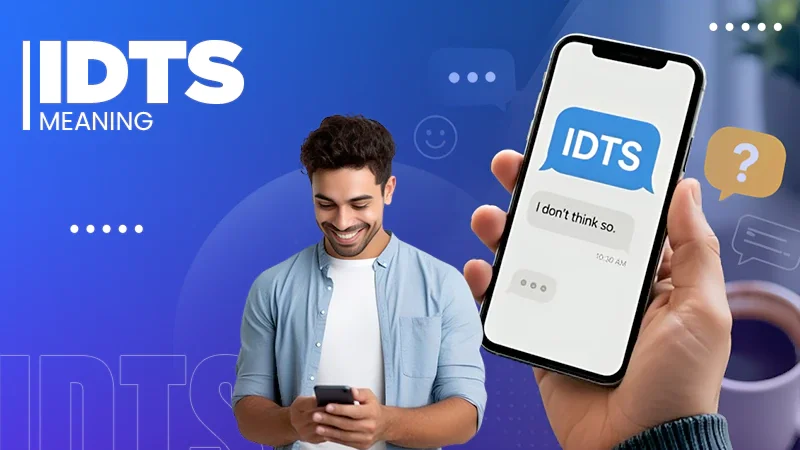

If a friend texts you, “Do you think we’ll get tickets before they sell out?” and you reply, “IDTS,” you have shared your opinion in just four letters. You think it probably will not happen. Instead of typing the full phrase, you use a short form that fits the fast pace of online conversations.
The IDTS meaning in text is “I don’t think so.” People use it when they doubt something, disagree with an opinion, or believe an event is unlikely. It can be a simple answer to a question, a reaction to a surprising claim, or a casual way to say that they are not convinced.
However, IDTS does not always sound the same. It may feel friendly, playful, doubtful, or slightly dismissive depending on the conversation. The words around it, the punctuation, and any emojis can all affect how the message feels. Understanding these details can help you read IDTS correctly and use it without sending the wrong message.
What Does IDTS Mean in Text?
IDTS stands for “I don’t think so.” It is an informal abbreviation used in text messages, social media comments, direct messages, and online chats.
The phrase usually communicates a negative opinion, but it does not always mean a firm “no.” Instead, it often suggests that something is unlikely or that the sender does not believe a statement is true.
For example:
Person A: “Do you think Ben will come to the party tonight?”
Person B: “IDTS. He said he has work.”
Person B believes Ben probably will not attend. The answer is based on what Ben said, but it does not claim complete certainty.
Here is another example:
Person A: “This is the best movie of the year.”
Person B: “IDTS 😂”
In this case, Person B disagrees with the opinion. The laughing emoji may make the disagreement feel playful rather than serious.
What Does Each Letter in IDTS Stand For?
Each letter in IDTS represents a word in the original phrase.
| Letter | Word |
| I | I |
| D | Don’t |
| T | Think |
| S | So |
Put together, the letters form “I don’t think so.”
IDTS is mainly a written abbreviation. People use it to save time when typing rather than as a phrase they commonly say aloud by spelling out each letter.
Is IDTS the Same as “Probably Not”?
The two expressions are similar, but they are not always identical.
“Probably not” directly suggests that something is unlikely to happen or be true. “I don’t think so” can express the same idea, but it can also show disagreement with someone’s opinion.
For example:
“Will the shop be open after midnight?” — “IDTS.” This suggests that the shop probably will not be open.
“That was an easy test.” — “IDTS.” This shows that the sender does not agree.
The surrounding message helps you understand which meaning fits best.
What Does IDTS Mean in Slang?
In texting slang, IDTS is a short way to express doubt or push back against something someone has said. It belongs to the wider group of internet abbreviations that make everyday digital conversations quicker.
People may use it when they want to:
- Say that something probably will not happen.
- Show that they do not believe a claim.
- Disagree with a friend’s opinion.
- Respond to a suggestion they are unsure about.
- Give a negative answer without sounding too forceful.
For example:
Friend: “I can finish this entire project in ten minutes.”
You: “IDTS 😭”
Your reply suggests that you doubt your friend can finish so quickly. The emoji may add humor or exaggeration.
IDTS is not a secret code with a completely different meaning in every app. In ordinary English texting, “I don’t think so” is the main meaning to understand. The exact tone, however, depends on the situation.
IDTS as a Way to Express Doubt
One common use of IDTS is to show that you are not sure a prediction will come true.
Example:
A: “Do you think we’ll win the game?”
B: “IDTS. Our best player is injured.”
B expects the team may lose, but the response is still an opinion rather than a guaranteed fact.
You might also see it in conversations about the weather, plans, deadlines, travel, or other everyday situations.
IDTS as a Way to Disagree
IDTS can also be used when another person makes a statement you do not agree with.
Example:
A: “Everyone loved that new song.”
B: “IDTS. A lot of people said they didn’t like it.”
Here, B challenges the claim. The abbreviation is a quick way to say, “I don’t think that is true.”
If the topic is sensitive, it may be better to explain your view instead of sending only IDTS. A short explanation can make the disagreement easier to understand.
How People Use IDTS in Everyday Text Messages
IDTS works in several types of casual conversation. The meaning stays close to “I don’t think so,” but the purpose can change with the topic.
Talking About Plans
Friends often use IDTS when discussing whether a plan will happen.
Example:
A: “Are we still going to the beach tomorrow?”
B: “IDTS. The forecast says it might storm.”
The sender doubts the plan will go ahead and gives a reason.
Another example:
A: “Do you think Mia will be here by six?”
B: “idts, she’s still across town.”
Lowercase letters are common in casual typing. They do not change the meaning.
Reacting to a Bold Claim
IDTS can show that you are not convinced by a surprising statement.
Example:
A: “I just watched all three seasons in one day.”
B: “IDTS 😂”
The reply shows disbelief, possibly in a joking way.
You could also write:
“IDTS, that sounds impossible.”
Adding a few words makes your meaning clearer and helps avoid confusion.
Disagreeing With an Opinion
People may use IDTS when sharing different tastes or preferences.
Example:
A: “Pineapple is the only good pizza topping.”
B: “IDTS lol.”
This is a casual disagreement about food. It is unlikely to be taken seriously if both people are joking.
For a more thoughtful response, you could say:
“IDTS. I like mushrooms better.”
That version explains your preference rather than leaving the other person to guess.
Responding to a Prediction
IDTS is useful when someone predicts what will happen next.
Example:
A: “Prices will definitely go down next month.”
B: “IDTS. Everything has been getting more expensive.”
The sender does not believe the prediction is likely.
Remember that IDTS does not prove the other person is wrong. It simply shares the sender’s view.
Replying in a Group Chat
In group chats, IDTS can be a quick way to respond to an idea or suggestion.
Example:
Friend 1: “Let’s leave home five minutes before the concert starts.”
Friend 2: “IDTS, traffic will be terrible.”
The reply challenges the plan and gives a reason. This is more useful than simply saying “no,” because it explains the concern.
Does IDTS Sound Rude?
IDTS is not automatically rude. It can be a normal, casual way to disagree. However, it may sound blunt when it appears by itself, especially if the other person expected a detailed answer.
Consider these examples:
Friendly:
“IDTS 😂 but we’ll see!”
The emoji and extra words make the reply sound lighthearted.
Neutral:
“IDTS. The store closes at eight.”
The sender gives a practical reason for the answer.
Potentially dismissive:
“IDTS.”
This short response may feel cold if the other person has shared something important or asked a serious question.
There is no universal rule that a period makes IDTS rude. Some people use periods in every message. Others may read a very short reply as distant. The relationship between the people and the earlier conversation matter more than punctuation alone.
How to Make IDTS Sound Friendlier
If you want to disagree without upsetting someone, you can add context or soften the message.
Instead of:
“IDTS.”
Try:
- “IDTS, but I could be wrong.”
- “Hmm, IDTS. Let’s see what happens.”
- “IDTS lol, I hope I’m wrong though.”
- “I don’t think so, but maybe!”
- “IDTS because I heard something different.”
These versions show that you are sharing an opinion rather than attacking the other person’s idea.
When a Full Sentence Is Better
If the conversation is serious, a complete sentence is often more helpful than an abbreviation.
For example, if a friend asks whether you believe their plan is realistic, replying only “IDTS” might sound harsh. You could instead write:
“I don’t think the timing will work because we still have a lot to finish.”
This gives the other person something useful to consider. It also makes your concern clearer.
What Does IDTS Mean on Snapchat, Instagram, TikTok, and WhatsApp?
The basic IDTS meaning usually stays the same across social platforms: “I don’t think so.” The app does not normally change the definition, but the style of conversation can affect how it is understood.
IDTS on Snapchat
On Snapchat, IDTS may appear in a quick reply to a friend, a private chat, or a reaction to a picture or claim.
Example:
A: “Bet you can’t guess where I am.”
B: “IDTS 😂”
Depending on the context, B may be jokingly doubtful or responding to a guess that seems unlikely.
IDTS on Instagram
On Instagram, people may use IDTS in direct messages, comment threads, or replies to stories.
Example:
Post: “This is the greatest album ever made.”
Comment: “IDTS, but it’s still good.”
The commenter disagrees while acknowledging that the album may still be enjoyable.
IDTS on TikTok
On TikTok, IDTS can appear in comment sections when people respond to a prediction, opinion, or bold statement in a video.
Example:
Video claim: “This trick works every single time.”
Comment: “IDTS. It didn’t work for me.”
Here, the user is expressing doubt based on personal experience.
IDTS on WhatsApp
On WhatsApp, IDTS is often used in everyday conversations with friends, relatives, and groups.
Example:
A: “Will everyone reach the restaurant by seven?”
B: “IDTS. Two people are still on the way.”
The reply is a quick prediction about the group’s arrival time.
Across these apps, the safest approach is to read the surrounding messages instead of assuming the abbreviation has a platform-specific meaning.
IDTS vs. IDK, IDC, IMO, and TBH
IDTS can look similar to other short texting expressions, but each one serves a different purpose. Choosing the wrong abbreviation can change the message you send.
| Abbreviation | Full Form | Main Meaning |
| IDTS | I don’t think so | Doubt or disagreement |
| IDK | I don’t know | Lack of knowledge |
| IDC | I don’t care | Lack of interest or concern |
| IMO | In my opinion | Introducing a personal view |
| IMHO | In my humble opinion | Sharing a view, often informally |
| TBH | To be honest | Introducing a candid thought |
IDTS vs. IDK
IDTS and IDK are easy to mix up, but they express different ideas.
- IDTS: You think the answer is probably no.
- IDK: You do not know the answer.
Example:
Question: “Will Sam come to dinner?”
Reply 1: “IDTS. He said he was busy.”
This means you believe Sam probably will not come.
Reply 2: “IDK. I haven’t talked to him.”
This means you do not have enough information to answer.
Use IDTS when you have a doubtful opinion. Use IDK when you genuinely do not know.
IDTS vs. IDC
IDC means “I don’t care.” It expresses a lack of concern or interest, while IDTS expresses doubt or disagreement.
Example:
A: “Do you think the movie will be good?”
B: “IDTS.”
B does not expect the movie to be good.
Now compare:
A: “Do you want to watch the movie?”
B: “IDC.”
B is saying that the choice does not matter to them. Depending on the situation, this can sound uninterested or blunt.
These abbreviations are not interchangeable. IDTS gives an opinion about something, while IDC says the issue is not important to the sender.
IDTS vs. IMO and IMHO
IMO means “in my opinion.” IMHO means “in my humble opinion.” Both can introduce a personal view.
Example:
“IMO, the second movie was better.”
This shares a preference.
“IDTS. I think the first movie was better.”
This directly disagrees with a claim or opinion.
You can even combine them naturally:
“IMO, IDTS will work without more planning.”
However, it may sound clearer to write, “IMO, I don’t think it will work without more planning.”
IDTS vs. TBH
TBH means “to be honest.” It often introduces a direct or personal statement.
Example:
“TBH, IDTS. The plan seems too expensive.”
The sender is being open about their doubts. TBH does not mean the same thing as IDTS; it simply sets up the opinion that follows.
IDTS vs. Other Ways to Say No
IDTS is just one option for expressing a negative answer. The best phrase depends on how certain you are and how formal the conversation needs to be.
| Expression | What It Communicates | Typical Tone |
| IDTS | I don’t think so | Casual, doubtful |
| Probably not | Something seems unlikely | Neutral |
| I doubt it | Stronger skepticism | Direct |
| No | A clear negative answer | Direct |
| I don’t believe so | Doubt in a more formal style | Polite or formal |
| I don’t think that will work | Disagreement with a plan | Clear and explanatory |
For casual conversations, IDTS is short and convenient. For serious decisions, the full phrase or a clear explanation is often better.
For example, if someone asks whether you can attend an event, “IDTS” might be unclear. They may not know whether you mean you cannot attend or you are simply unsure. A more direct reply would be:
“I don’t think I can make it, but I’ll confirm later.”
The extra words remove the guesswork.
How to Reply When Someone Texts You IDTS
Your response should depend on what the other person is discussing and how their message sounds. You do not need to treat every IDTS as an argument.
If They Are Joking
If your friend is playfully doubting you, you can answer with humor.
Them: “You can’t finish that game tonight. IDTS 😂”
You: “Just wait. I’ll prove you wrong!”
This keeps the conversation light.
If They Have a Reason for Disagreeing
If the other person explains their opinion, respond to the reason rather than focusing only on the abbreviation.
Them: “IDTS. The restaurant is usually full on Saturdays.”
You: “Fair point. I’ll try to book a table.”
You acknowledge the concern and move the conversation forward.
If They Are Unsure About a Plan
You can ask a follow-up question to understand their concern.
Them: “IDTS.”
You: “What makes you think it won’t happen?”
This is useful when you need more information.
If They Are Declining an Invitation
If IDTS appears to mean that someone probably cannot join you, give them room to explain.
You: “Want to come shopping tomorrow?”
Them: “IDTS, I have a lot of work.”
You: “No worries. Maybe another day!”
This response is friendly and does not pressure them.
If Their Reply Feels Cold
A short IDTS may feel dismissive, but it is not always meant that way. Before assuming someone is upset, consider the context and their usual texting style.
If the matter is important, you can ask politely:
“Do you mean you disagree, or are you not sure yet?”
That question gives them a chance to explain without starting an argument.
When Should You Use IDTS?
IDTS is most useful when you are chatting informally and want to express doubt without typing a full sentence.
You can use it when:
- Talking with friends or people who know your texting style.
- Replying to a prediction you think is unlikely.
- Disagreeing with a casual opinion.
- Reacting to an exaggerated or unbelievable claim.
- Participating in relaxed group chats or online discussions.
- Making a lighthearted joke with someone who understands your humor.
For example:
“Think we’ll get front-row seats?”
“IDTS, we arrived too late.”
The abbreviation fits because the conversation is casual and the meaning is easy to understand.
When Should You Avoid IDTS?
There are situations where writing out the phrase is a better choice.
Avoid relying on IDTS when:
- Sending a formal email to a manager or client.
- Writing an academic assignment.
- Discussing a serious disagreement.
- Giving important information that needs to be clear.
- Talking to someone who may not know common texting abbreviations.
- Responding to a sensitive personal message that deserves care.
In these cases, use a complete sentence.
Instead of writing:
“IDTS.”
You might say:
“I don’t think that approach will work because we have limited time.”
This version explains your concern and sounds more considered.
Is IDTS Used by Both Girls and Guys?
Yes. IDTS is not limited to a particular gender. Anyone who uses casual texting language may use it to express doubt or disagreement.
If a girl or a guy sends you IDTS, the basic meaning is usually still “I don’t think so.” The message alone does not tell you whether the sender is flirting, angry, joking, or uninterested.
For example:
A: “Do you think we’ll hang out this weekend?”
B: “IDTS, I’m busy Saturday.”
The response suggests that the plan may not happen. It does not automatically mean the sender dislikes the other person.
Look at the full conversation and any explanation they provide. Avoid reading a romantic or emotional meaning into the abbreviation without other signs.
Does Capitalization Change the Meaning of IDTS?
Usually, no. IDTS, idts, and Idts generally mean the same thing.
The difference is mainly in writing style:
- IDTS: All capital letters can make the abbreviation stand out or feel more emphatic.
- idts: Lowercase letters often fit a relaxed, quick texting style.
- Idts: Capitalizing only the first letter may simply reflect a person’s usual typing habits.
Capitalization alone does not reliably tell you how the sender feels. One person may type every abbreviation in lowercase, while another may prefer capital letters.
Context remains more important than letter case.
Tips for Using IDTS Without Causing Confusion
Although IDTS is short, a little care can help you use it effectively.
- Check the question first. If someone asks whether an event will happen, IDTS probably means that you think it will not. If they share an opinion, it may mean you disagree.
- Add a reason when it matters. “IDTS, because the store closes early” is clearer than a one-word reply.
- Use emojis only when they fit. A laughing emoji can signal a joke, but it may be inappropriate during a serious conversation.
- Do not use it when you mean “I don’t know.” If you have no information, IDK is more accurate.
- Think about your audience. A close friend may understand IDTS immediately. Someone unfamiliar with texting slang may need the full phrase.
- Be clear about important decisions. If your answer affects plans, work, or other people, explain what you mean rather than leaving them to guess.
These small habits make your messages easier to understand and reduce the chance of accidental misunderstandings.
Frequently Asked Questions
What does IDTS mean in text?
IDTS means “I don’t think so.” It is an informal abbreviation used to express doubt, disagreement, or the belief that something is unlikely. The exact tone depends on the conversation and any extra words or emojis.
What does IDTS stand for in texting?
IDTS stands for “I Don’t Think So.” The letters come from the first letters of the words in that phrase. People use it in casual messages and online conversations as a shorter way to share a doubtful or negative opinion.
Is IDTS rude or disrespectful?
Not necessarily. IDTS can be a neutral or friendly way to disagree. However, a reply containing only “IDTS” may sound blunt in a serious conversation. Adding a reason or using a complete sentence can make your meaning clearer and more considerate.
What is the difference between IDTS and IDK?
IDTS means “I don’t think so,” while IDK means “I don’t know.” IDTS expresses a doubtful opinion or a likely negative answer. IDK means the sender does not know the answer. Use the one that best matches what you want to communicate.
What does IDTS mean on Snapchat, TikTok, Instagram, or WhatsApp?
On these platforms, IDTS usually means “I don’t think so.” It can be used in direct messages, comments, story replies, and group chats to show doubt or disagreement. The platform does not normally change the meaning, but the conversation helps determine the tone.
Conclusion
The IDTS meaning in text is simple: “I don’t think so.” People use this abbreviation in casual messages and online conversations to express doubt, disagree with an opinion, or suggest that something probably will not happen. It is short, flexible, and useful when the context makes the sender’s meaning clear. Depending on the situation, IDTS can sound playful, neutral, doubtful, or dismissive.
The key is to understand what you mean before using it. IDTS is not the same as IDK, which means “I don’t know,” or IDC, which means “I don’t care.” Use IDTS when you have a doubtful opinion, and add a reason when the topic matters. In formal or sensitive conversations, writing a complete sentence is usually the clearest option. Once you understand the meaning and tone, you can recognize IDTS easily and use it naturally in everyday texting.
Explore more on Celeb Snips.