
Imagine you are reading a group chat when someone suddenly sends “tsts.” There is no explanation, no emoji, and no other words to help you understand it. Are they teasing someone? Are they annoyed? Or is it an inside joke you have missed? If you have wondered about the TSTS meaning in text, you are not alone. These four letters can be confusing because they do not have one universally accepted definition.
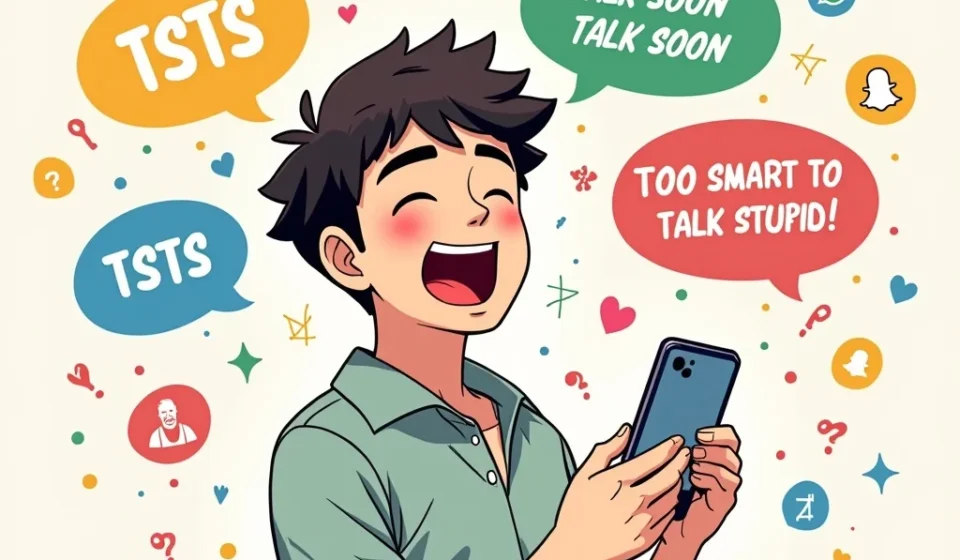
One possible interpretation is “too smart to talk stupid.” In this use, the sender is saying they do not want to waste time on pointless arguments, gossip, or drama. Another interpretation is a written version of “tsk tsk,” the tongue-click sound people make to show playful disapproval. Some online communities also use TSTS in other ways, including as a casual reaction or a phrase connected with gossip.
The key is to read the message around TSTS rather than rely on the letters alone. A friend admitting a silly mistake may be inviting a playful scolding. Someone trying to pull you into an argument may receive a sharp dismissal instead. TikTok comments can have their own meanings, too. This guide explains the main interpretations, realistic examples, possible tones, and ways to reply without misunderstanding the sender.
What Does TSTS Mean in Text?
TSTS is an informal online expression with several possible meanings. It is not as standardized as abbreviations such as LOL, IDK, or BRB. Different people and online communities may use the same letters differently.
In the examples covered in this guide, TSTS may be used in these ways:
| Possible meaning | What it communicates | Typical context |
| Too Smart to Talk Stupid | Refusing to join a pointless argument or discussion | Drama, gossip, or online disagreements |
| “Tsk tsk” tongue-click | Playful disapproval, teasing, or mild disappointment | A friend’s silly mistake or confession |
| That’s the Tea, Sis | A reaction to gossip or interesting news | Some social media or gossip-focused communities |
| Other community-specific uses | Agreement, humor, or a private meaning | Friend groups and niche online communities |
These meanings should not be treated as equally established or universally understood. Online slang references document different interpretations of TSTS, including a “tsk tsk” reaction and “type shit, type shit.” User-submitted slang listings also show that the letters can have different meanings in different communities.
When you receive TSTS, focus on what happened immediately before it. The conversation’s topic, the sender’s usual style, punctuation, and emojis often tell you more than the abbreviation itself.
1. TSTS Meaning “Too Smart to Talk Stupid”
In one slang interpretation, TSTS stands for “too smart to talk stupid.” It expresses a confident refusal to take part in a pointless conversation. The sender may feel that the discussion is going nowhere, that someone is spreading gossip, or that replying would only create more drama.
Think of it as saying, “I’m not wasting my time on this.” The tone can be funny, bold, sarcastic, or dismissive. Among close friends, it might be a playful way to step out of a silly debate. During a heated argument with someone unfamiliar, it can sound insulting because it suggests the other person is talking nonsense.
Examples of TSTS as a Dismissal
- “TSTS, I’m not doing this today.” — The sender does not want to continue an argument.
- “You two can keep arguing. TSTS.” — The sender is choosing not to join the debate.
- “TSTS 😂 I know where this conversation is going.” — The sender is stepping away with a joking or confident tone.
- “TSTS.” — After a tense exchange, this short reply could feel cold or dismissive.
In this use, TSTS can work like a verbal shrug. It communicates that the sender does not think the conversation deserves more attention. It may be funnier than simply going quiet, but it can also come across as arrogant.
When Does This Meaning Fit?
Look for a conversation that involves drama, an unproductive debate, or pressure to take sides. If someone is trying to pull you into a disagreement and you reply with TSTS, you may be using the “too smart to talk stupid” interpretation.
Still, this expansion is not a universal definition. If the sender’s message does not fit the situation, do not assume they are calling someone stupid. They may be using TSTS as a sound effect or following a different slang trend.
2. TSTS as a “Tsk Tsk” Tongue-Click
Another possible use of lowercase “tsts” is as a written version of “tsk tsk.” People use “tsk tsk” to represent a tongue-click that shows mild disapproval, disappointment, or teasing. It is less like a normal acronym and more like a sound effect written in a message.
Imagine a parent catching a child with a hand in the cookie jar. The parent might click their tongue and say, “Tsk tsk!” In a chat, the same expression can gently call out a friend’s behavior without turning it into a serious criticism.
Examples of Playful TSTS
- Friend: “I ate the leftovers you saved.” / You: “Tsts 😂” — This is playful disapproval.
- Friend: “I forgot about our group chat again.” / You: “Tsts, you’re impossible 😭” — This lightly teases your friend for forgetting.
- Friend: “I’m late for the third time this week.” / You: “Tsts 🙄” — This suggests mock disappointment.
- Friend: “I bought another pair of shoes even though I promised not to.” / You: “Tsts 😂 you did it again.” — This adds a playful scolding tone.
In these examples, TSTS does not need to stand for four separate words. It represents an expression or sound that readers recognize from everyday speech. Similar written reactions include “ugh,” “hmm,” “pfft,” and “tsk tsk.”
When Is the Tongue-Click Meaning Likely?
Look at what the person said just before TSTS. If they admitted to something silly, harmless, or mildly embarrassing, the sender may be teasing them. The expression is especially likely to feel playful when it appears with a laughing emoji, a crying emoji, or a friendly follow-up.
However, even a tongue-click can feel judgmental. If someone shares painful news or admits to a genuine mistake, responding with bare “tsts” may sound unkind. The sound is not automatically affectionate; the relationship and situation determine the tone.
3. What Does TSTS Mean on TikTok?
TikTok slang can develop quickly in specific communities, so an abbreviation may mean something different in a comment section than it does in a private message. One interpretation associated with gossip-focused content is “That’s the tea, sis.” In this phrase, “tea” means gossip or interesting information, while “sis” adds a friendly, familiar tone.
This expansion is context-specific rather than a confirmed universal meaning of TSTS on TikTok. Do not assume every TikTok user will understand it that way. It is most plausible when the conversation is already about secrets, a dramatic story, a confession, or an interesting update.
Examples in Gossip and Storytime Comments
- Creator: “Wait until you hear what happened after the party.” / Comment: “TSTS 👀” — The commenter may be encouraging the creator to share the gossip.
- Friend: “She really said that in front of everyone.” / Reply: “TSTS, tell me everything.” — The reply signals interest in the story.
- Creator: “Part two has the details you missed.” / Comment: “TSTS 👀🍵” — The commenter is reacting to the promise of more information.
In gossip culture, phrases such as “spill the tea” encourage someone to share the details. A TSTS comment used in this way can act as a reaction of interest or approval. But if the video is about a silly mistake rather than gossip, the tongue-click interpretation may fit better.
Another Possible Social Media Interpretation
Some slang explanations also suggest “too sassy to stomach” for a bold or outspoken person. This is a niche interpretation, not a standard meaning. It may make sense in commentary about attitude, sharp comebacks, or someone who refuses to be quiet. Use the video and comment thread to judge whether this meaning fits instead of assuming it applies across TikTok.
4. How to Tell Which TSTS Meaning Fits
Since TSTS has several possible interpretations, the best way to decode it is to look at the trigger: what happened immediately before the message? That often reveals the sender’s intention.
| What happened before TSTS? | Likely interpretation | Possible tone |
| A friend admits to a silly mistake | “Tsk tsk” | Playful scolding |
| Someone tries to start an argument | “Too smart to talk stupid” | Dismissive or sarcastic |
| A creator shares dramatic gossip | Possibly “That’s the tea, sis” | Interested or encouraging |
| A friend shares an inside joke | Could be a personal meaning | Depends on the group |
| A stranger sends only “TSTS” | Unclear | Ask for context |
Check the Punctuation and Emojis
Punctuation can change how a short message feels. Compare “tsts 😂” with “tsts.” The laughing emoji suggests that the sender may be joking. A period after a tense conversation can make the same letters feel more final or dismissive. Still, punctuation is only a clue. Some people use periods in every message, and not everyone uses emojis the same way.
Consider Your Relationship With the Sender
Close friends often tease one another in ways that would sound rude from strangers. A friend who knows your humor may use TSTS to make you laugh. Someone you barely know may use it to show genuine disapproval. Do not read an entire relationship into four letters, especially if you have little context.
Ask Instead of Guessing
If the message matters and the meaning is unclear, it is completely fine to ask, “What do you mean by TSTS here?” You can also ask, “Are you teasing me or saying you don’t want to argue?” A simple question is usually better than reacting defensively to a meaning the sender may not have intended.
5. Is TSTS Rude or Playful?
TSTS can sit on the line between playful and rude. The same expression can make one friend laugh and make another person feel insulted. Its tone depends on the intended meaning, the relationship, the subject, and the situation.
When TSTS Sounds Playful
- It follows a harmless confession or silly mistake.
- The sender adds a laughing or playful emoji.
- You and the sender regularly joke with each other.
- The sender follows up with a friendly comment.
For example, “Tsts 😂 you’re a mess” may be affectionate teasing between close friends. The extra words and emoji help show that the sender is not seriously angry.
When TSTS Sounds Rude
- It appears during a serious argument.
- The sender uses it to shut someone down or mock their opinion.
- It follows a personal or vulnerable confession.
- There is no friendly context, and the sender is not someone you know well.
For example, replying “TSTS.” after someone shares bad news may sound cold. Using the “too smart to talk stupid” expansion against a stranger can also imply that the other person is foolish. Even if the sender thinks the expression is funny, the recipient may not take it that way.
A Simple Rule Before You Send It
Ask yourself: “Would I say the full phrase out loud to this person in this situation?” If the answer is no, choose a clearer and kinder message. TSTS is best kept to informal conversations where both people are likely to understand the joke. Avoid it in professional settings, formal messages, or sensitive discussions.
6. Where Is TSTS Used?
TSTS may appear in text messages, group chats, direct messages, comments, and other informal online conversations. Its meaning is not fixed to one platform. The surrounding topic is more useful than the app itself.
Group Chats and Private Messages
In a group chat, TSTS may be a quick reaction to a joke, a confession, or a pointless debate. A friend who admits to eating everyone else’s snacks might get a playful “tsts.” If two people are arguing about something unimportant, one person may use TSTS to signal that they are done participating.
TikTok and Instagram Comments
In social media comments, short expressions often rely on shared context. A gossip-related video may make a “That’s the tea, sis” interpretation plausible, while a clip showing someone making a silly mistake may invite a “tsk tsk” reaction. A confident dismissal may fit a debate or drama thread. These are possible readings, not guaranteed platform rules.
Who Uses TSTS?
You may encounter TSTS among people who enjoy informal online language, including younger users and members of particular social media communities. However, it is not reliable to say that everyone in a certain age group knows or uses it. TSTS is less standardized than common abbreviations such as LOL, IDK, and BRB, and its meanings can vary between groups.
For that reason, avoid using TSTS with older relatives, new contacts, or professional colleagues unless you know they understand it. A short, plain-language reply is usually safer when the audience is unfamiliar with the expression.
7. Where Did TSTS Come From?
There is no well-established record identifying one creator or exact date for the modern texting uses of TSTS. It is better to treat its history as uncertain than to claim it began on a particular platform or in a specific year.
The “tsk tsk” connection is easy to understand because written language often imitates sounds. People use forms such as “haha,” “ugh,” and “tsk tsk” to express emotion without writing a full sentence. A version such as “tsts” can serve a similar purpose in some conversations, although the exact path from the older sound expression to this spelling is not firmly documented.
Other meanings can grow inside particular online communities. An abbreviation may be given a new expansion, reused as an inside joke, or picked up by people who saw it in a comment thread. TikTok and other social platforms can help a phrase travel, but that does not mean every community uses it in the same way.
Online slang dictionaries and user-submitted listings show several interpretations for TSTS. Such listings can show how people use a term, but they are not proof of one official definition or a single origin story.
8. How to Reply to TSTS
Your best reply depends on what the sender seems to mean. You do not have to match the abbreviation exactly. Respond to the message’s tone and purpose instead.
If It Is a Playful Tongue-Click
If your friend is mock-scolding you, you can play along:
- “I know, I’m terrible 😂”
- “Judge me all you want.”
- “Okay, okay, I’ll behave.”
- “Don’t act like you wouldn’t do the same.”
These replies work when you know the other person is joking. If they seem genuinely upset, respond to the concern rather than making fun of it.
If It Means “Too Smart to Talk Stupid”
If the sender is stepping away from a pointless argument, you can acknowledge their choice without escalating the discussion:
- “Fair enough.”
- “No worries, let’s leave it there.”
- “Okay, we can talk about something else.”
- “All good. I’m not trying to argue.”
If the message feels condescending, you do not need to argue over four letters. You can change the subject, stop replying, or calmly explain that you would prefer a respectful conversation.
If It Is a Gossip Reaction
If the context suggests “That’s the tea, sis,” the person may want to hear more. You could continue the story, share the next detail, or ask what they want to know. For example, “Wait until you hear what happened next 👀” keeps the conversation going.
If You Have No Idea What They Mean
There is nothing wrong with asking for clarification. Try “What does TSTS mean here?” or “Are you teasing me?” This is especially useful if the sender is a new contact or the conversation is serious. Clear communication is better than guessing and accidentally taking a joke as an insult.
9. Is TSTS Suitable for Work or Formal Messages?
TSTS is best treated as informal slang. Because it has multiple possible meanings, it can create confusion in a workplace or formal conversation. Even if you intend a playful tongue-click, a colleague may interpret it as sarcasm or disrespect.
Instead of writing “TSTS” after a colleague makes a mistake, explain what you mean in plain language. You might say, “No problem, mistakes happen,” or “Let’s find a way to fix it.” If you want to leave a debate, write, “I don’t think this discussion is productive, so let’s move on.” These responses are clearer and more professional.
Use TSTS only when you are confident that the other person understands the intended meaning and tone. In sensitive conversations, official messages, schoolwork, and business writing, choose words that cannot easily be misread.
Frequently Asked Questions
What does TSTS mean in texting?
TSTS has no single, universally accepted meaning in texting. It may stand for “too smart to talk stupid,” work as a written “tsk tsk” reaction, or have another community-specific meaning. Read the surrounding conversation to work out what the sender likely intends.
What does TSTS mean on TikTok?
On TikTok, TSTS may be used as a reaction to a story, a joke, a mistake, or online drama. Some users may interpret it as “That’s the tea, sis” in gossip-related discussions, but this is not a universal TikTok definition. The video and comment thread provide the best clues.
Is TSTS rude or playful?
It can be either. A friend may use TSTS to tease you about a harmless mistake, while someone in an argument may use it to dismiss your opinion. Emojis, punctuation, the topic, and your relationship with the sender help you judge the tone.
How do you pronounce TSTS?
If you are referring to the letters as an abbreviation, you can say each letter separately: “tee-ess-tee-ess.” If the sender is using it as a written version of “tsk tsk,” the intended sound is a tongue-click rather than the spoken name of each letter. There is no single pronunciation that fits every use.
What should I reply when someone sends TSTS?
Match your reply to the context. If it is friendly teasing, you can joke back. If the person is ending an argument, acknowledge their choice or move on. If the message seems related to gossip, continue the story if you want to. When you cannot tell what they mean, ask them directly.
Conclusion
The TSTS meaning in text does not fit into one fixed definition. In some chats, it stands for “too smart to talk stupid,” a confident way to avoid pointless drama. In others, lowercase “tsts” acts like a written tongue-click, similar to “tsk tsk,” and expresses playful disapproval. In some gossip-focused social media conversations, people may also use it to mean “That’s the tea, sis.” These interpretations vary, and none should be assumed without context.
To understand TSTS, read the room around the letters. A funny confession may call for playful scolding, a pointless argument may call for a stylish exit, and a dramatic story may invite a request for more details. Look at the message, the relationship, and the tone before replying. When the meaning is still unclear, simply ask. Four letters can carry several different attitudes, but a little context can make the message much easier to understand.
Explore more on Celeb Snips.