
Tony Hawk is an American professional skateboarder, entrepreneur, and philanthropist best known for landing the first documented 900-degree aerial maneuver in skateboarding history and for starring in the hugely successful Tony Hawk’s Pro Skater video game series. His career also includes Birdhouse Skateboards, major sponsorships, film and television appearances, and The Skatepark Project.
Estimates of Tony Hawk’s net worth often place it near $140 million, but no audited public statement confirms an exact figure. The number reflects decades of skateboarding earnings, licensing, business ownership, endorsements, game royalties, and other ventures rather than competition prize money alone.
The Short Answer: Who Is Tony Hawk?
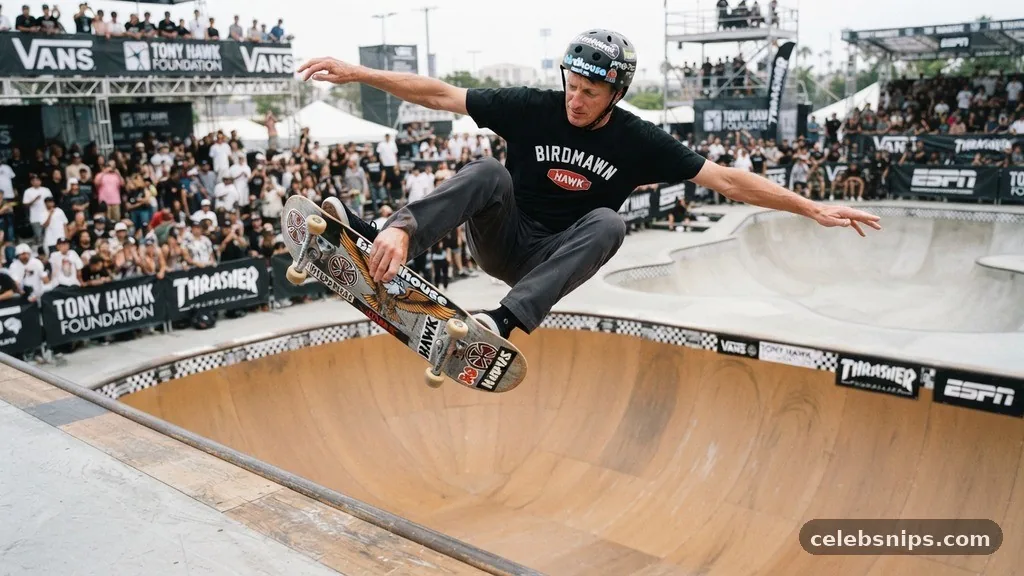
Tony Hawk became one of the most recognizable skateboarders in the world because he combined elite technical ability with unusual consistency, showmanship, and business judgment. He turned professional as a teenager, won major contests during skateboarding’s vert era, and helped move the sport from a niche youth activity into mainstream sports and entertainment.
His biggest athletic milestone came on June 27, 1999, at the X Games in San Francisco. At age 31, Hawk landed a 900, meaning two and a half rotations in the air, after many failed attempts. The trick became the defining image of his competitive career.
Hawk’s public profile grew even further through the Tony Hawk’s Pro Skater games. The first title arrived in 1999 and became a major success on the PlayStation and other platforms. Its soundtrack, level design, create-a-skater features, and accessible controls introduced skateboarding culture to millions of players who had never stepped on a skateboard.
There is no single verified public document that establishes Hawk’s personal net worth. Financial websites publish estimates, often around $140 million, but those figures should be treated as approximate because his private investments, taxes, expenses, contracts, and ownership arrangements are not fully disclosed.
At a Glance
| Fact | Details |
|---|---|
| Full name | Anthony Frank Hawk |
| Professional name | Tony Hawk |
| Born | May 12, 1968 |
| Birthplace | Carlsbad, California, United States |
| Profession | Professional skateboarder, entrepreneur, philanthropist, and media personality |
| Known for | Vert skateboarding, the 900, Birdhouse Skateboards, and the Tony Hawk’s Pro Skater game series |
| Professional career | Beginning in the early 1980s |
| Estimated net worth | Often reported near $140 million; not independently verified |
| Foundation | The Skatepark Project, formerly the Tony Hawk Foundation |
Hawk was born in Carlsbad, California, and grew up in nearby San Diego County. He is American, and his professional identity has remained closely tied to Southern California’s skateboarding scene, even as his work later took him around the world.
The table separates established biographical information from the financial estimate. His birth details, career, and public projects are well documented, while the net-worth figure is an industry and media estimate rather than a confirmed balance sheet.
- Signature athletic achievement: landing the first documented 900 in a skateboarding competition setting.
- Major business: co-founding Birdhouse Skateboards with Per Welinder.
- Major entertainment property: the Tony Hawk’s Pro Skater game franchise.
- Public-service work: helping fund and support public skateparks through The Skatepark Project.
- Long-term influence: connecting professional skateboarding with games, television, film, and mainstream sports culture.
Early Life and the Start of Skateboarding
Tony Hawk was born on May 12, 1968, in Carlsbad, California. His parents were Nancy and Frank Hawk, and public biographies commonly describe his father as a retired Navy officer who later worked in various civic and professional roles.
As a child, Hawk was energetic and competitive, but he did not immediately fit the image of a naturally effortless athlete. Accounts of his early years often describe frustration, strong self-criticism, and an unusually intense desire to master difficult movements.
He received his first skateboard from his older brother Steve when he was nine. That gift gave Hawk a way to channel his energy, and he quickly became absorbed in learning how boards responded to weight shifts, spins, ramps, and aerial movement.
Hawk’s early development happened during a period when skateboarding was evolving rapidly. Vert skating, performed on large ramps and half-pipes, rewarded riders who could generate speed, rise high above the coping, and land increasingly complex tricks.
By his early teenage years, Hawk was competing against older and more experienced riders. He turned professional at age 14, a sign that sponsors and contest organizers already recognized his unusual ability.
School remained part of his life while skateboarding accelerated. Hawk attended Torrey Pines High School, but his professional schedule increasingly revolved around demonstrations, contests, travel, and training rather than a conventional teenage routine.
His early success was not built on one trick. Hawk developed a broad technical vocabulary that included aerials, spins, grabs, and combinations performed at speed. That variety made him difficult to beat and gave sponsors a reason to support him beyond a single signature maneuver.
Professional Career and Competitive Success
Hawk’s professional career began during skateboarding’s early-1980s boom. He became associated with Powell Peralta’s Bones Brigade, one of the most influential teams in the sport’s history, alongside skaters such as Steve Caballero, Lance Mountain, Rodney Mullen, and Stacy Peralta.
The Bones Brigade videos helped change how skateboarding was presented. Rather than showing only short contest clips, the productions gave individual skaters distinct identities and emphasized style, creativity, and technical progression.
Hawk won numerous contests during the 1980s and became especially dominant in vert competition. His approach combined speed with controlled aerials, allowing him to perform difficult maneuvers while maintaining enough height and momentum to continue a run.
In the late 1980s, skateboarding’s popularity declined, and many professional riders faced reduced sponsorship opportunities. Hawk’s career also became financially difficult during that downturn, which makes his later business growth especially important to understanding his net worth.
Rather than leaving the sport, Hawk continued competing and developing his approach. He also began thinking more seriously about the business side of skateboarding, including equipment, team structure, branding, and the need for companies controlled by skaters.
In 1992, Hawk co-founded Birdhouse Skateboards with fellow professional Per Welinder. Birdhouse became a significant skateboard company, producing decks and related products while building a team that included prominent riders from different generations.
The company mattered because it represented a shift in Hawk’s role. He was no longer earning only as an athlete or sponsored personality; he had become a brand owner and team builder with an interest in developing the next wave of skateboarders.
Hawk continued competing after many of his peers had retired. His longevity came partly from technical adaptation. He worked on new maneuvers, maintained his vert skills, and treated practice as a continuing part of professional performance rather than something that ended after his first major victories.
The 900 and the Moment That Changed His Legacy
The 900 is a 900-degree aerial rotation. Because a full rotation is 360 degrees, the maneuver requires a skater to complete two and a half turns before landing back on the ramp.
Hawk had attempted the trick many times before succeeding. The movement demanded enough height for the rotation, precise control over the board, and the ability to identify the landing while still moving quickly through the air.
At the 1999 X Games, Hawk finally landed the 900 in competition. The achievement became one of the most important moments in modern skateboarding and helped demonstrate that professional vert skating still had room for major technical breakthroughs.
The event also arrived at a crucial time for Hawk. He was already an accomplished professional, but the 900 gave him a simple, recognizable achievement that could be understood by people who knew little about skateboarding.
Hawk later became known for continuing to attempt the trick in demonstrations and special events. His willingness to revisit it helped turn the 900 from a contest result into a lasting symbol of persistence and technical progress.
The maneuver did not make Hawk the first person ever to rotate 900 degrees on a skateboard in every possible context. Other skaters had attempted or reportedly landed similar rotations in different settings, and claims about “firsts” can depend on whether the standard is practice, a filmed session, or a judged competition.
The careful description is therefore important: Hawk is widely credited with the first documented successful 900 in a major competition context. That is the achievement most closely associated with his public legacy.
The 900 also strengthened his appeal outside traditional skateboarding media. News programs, sports broadcasts, and mainstream entertainment outlets could explain the accomplishment quickly, helping Hawk reach audiences far beyond skate shops and skate videos.
Birdhouse, Sponsorships, and Business Development
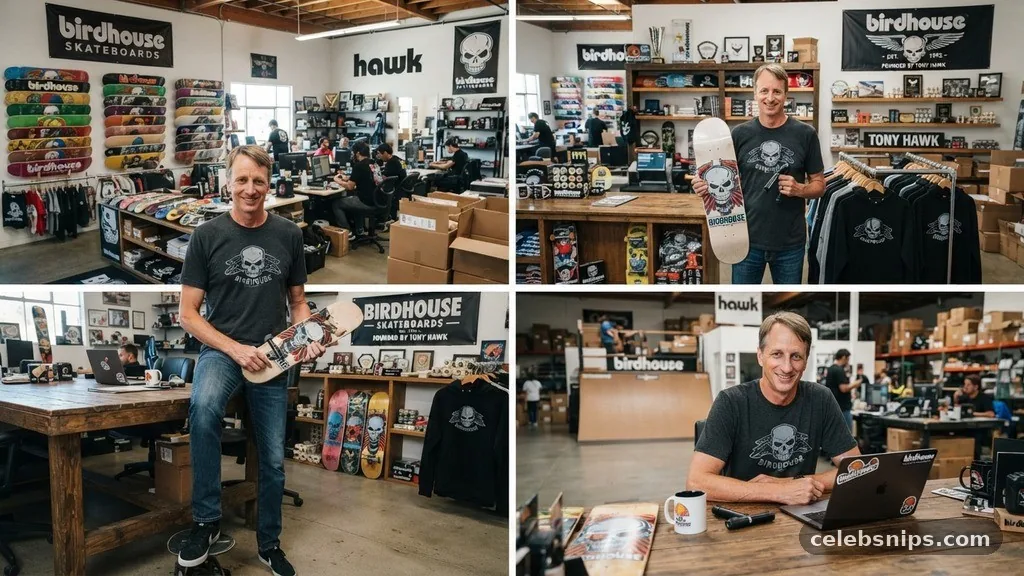
Birdhouse Skateboards became one of the central parts of Tony Hawk’s business career. The company sells skateboard decks, completes, apparel, and accessories, while also supporting a professional and amateur team.
Hawk’s involvement has not been limited to putting his name on a product. His public role has included helping shape the team, appearing in promotional material, supporting younger riders, and representing the company’s connection to high-level skateboarding.
His business income has also included sponsorships and licensing. Over the years, Hawk has worked with major brands in sports, footwear, apparel, food, technology, and entertainment, although the terms of individual contracts are generally private.
Endorsement revenue can be significant for a famous athlete, but it should not be confused with a guaranteed annual salary. Sponsorships may involve cash payments, product rights, appearances, equity, royalties, or a combination of arrangements.
Hawk’s business strategy benefited from his broad recognition. A professional skater might earn from contests and board sales, while Hawk could also participate in television campaigns, film projects, game licensing, speaking appearances, and family-oriented entertainment.
He also founded Hawk Clothing, a brand associated with youth apparel during the 1990s. Like many consumer brands, its commercial importance changed over time, and public information does not provide a complete accounting of its revenue or ownership structure.
The business lesson in Hawk’s career is not simply that he endorsed many products. It is that he developed several connected income sources around a central identity: an active skater, a trusted expert, a company owner, and a recognizable entertainment figure.
That diversification helped him remain financially relevant even after the most intensive years of contest competition ended. It also reduced his dependence on prize money, which has historically been a limited source of wealth for professional skateboarders.
Tony Hawk’s Pro Skater Games and Pop-Culture Reach
The first Tony Hawk’s Pro Skater game was released in 1999. Developed by Neversoft and published by Activision, it gave players a fast, trick-focused skateboarding experience built around ramps, street obstacles, combos, goals, and collectible items.
The game became successful because it was accessible without being shallow. New players could perform basic tricks quickly, while experienced players could spend hours learning level layouts, linking manuals, maximizing scores, and finding efficient lines through each environment.
The soundtrack was another major part of the franchise’s identity. Punk, alternative rock, hip-hop, and other genres introduced players to music that became closely associated with skateboarding culture and late-1990s youth entertainment.
Hawk’s name was central to the marketing, but the games featured a larger professional roster. Characters such as Kareem Campbell, Bucky Lasek, Bob Burnquist, Elissa Steamer, Chad Muska, and many others gave the series a broader connection to the professional skateboarding community.
The franchise expanded across multiple platforms and received several sequels. Later releases introduced new locations, characters, tricks, story elements, and online features, while the basic appeal remained the same: control a skateboarder and build increasingly elaborate combinations.
Tony Hawk’s Pro Skater 1 + 2, released in 2020, remastered the first two games for modern audiences. Vicarious Visions developed the collection, which combined updated visuals and controls with the structure and music that longtime players remembered.
Game licensing became one of the most important commercial extensions of Hawk’s career. The games did not merely advertise skateboarding; they created a separate entertainment product with its own sales, merchandise, soundtrack exposure, and cultural influence.
Hawk’s appearances in films, television programs, advertisements, and sports broadcasts reinforced that reach. He often played himself or a version of his public persona, which allowed audiences to connect the athlete, the game character, and the real-world skateboarder.
For context on the sport’s place in modern competition, the Olympic skateboarding overview from the International Olympic Committee provides a useful reference. Hawk helped popularize skateboarding long before its Olympic debut at Tokyo 2020, but his career belongs primarily to the sport’s pre-Olympic professional era.
Style, Influence, and Importance to Skateboarding
Tony Hawk’s influence comes from more than the 900. His career helped show that skateboarding could reward technical difficulty, individual style, business leadership, and long-term participation at the same time.
In vert skating, Hawk was known for generating substantial speed and height. He could attack a ramp aggressively while keeping enough control to complete complicated aerials and return to the transition cleanly.
His competitive style also reflected the rapid development of skateboarding during the 1980s and 1990s. As the sport became more technical, riders had to combine older foundational moves with higher, faster, and more complex variations.
Hawk’s influence reached younger skaters through videos and contests, but it also reached people who did not participate in the sport. The games provided a low-cost way for a broad audience to experience the vocabulary of skateboarding: ollies, grabs, grinds, manuals, transfers, and combo scoring.
He has also supported the idea that skateboarding facilities should be designed as public spaces rather than treated only as commercial attractions. That position became central to his philanthropic work and helped communities seek funding for permanent skateparks.
Hawk’s role is sometimes described as single-handedly making skateboarding mainstream. That is too simple. The sport’s growth depended on thousands of riders, photographers, videographers, shop owners, contest organizers, designers, and other professionals.
His particular contribution was visibility. He gave mainstream audiences a clear entry point, while his business and charitable work helped create infrastructure around the sport.
Hawk’s influence also includes longevity. He kept skating publicly after his peak competitive years and continued to collaborate with younger athletes. That helped present skateboarding as a lifelong practice rather than an activity limited to adolescence.
The Skatepark Project and Philanthropic Work
Tony Hawk founded the Tony Hawk Foundation in 2002 to help underserved communities build public skateparks. The organization later became known as The Skatepark Project, reflecting a broader focus on skatepark development and youth access.
Public skateparks can be expensive to plan and construct. Communities may need land, engineering, insurance, public approval, design expertise, and construction funding before a project can move from an idea to a usable facility.
The Skatepark Project has supported communities by providing grants, technical assistance, and advocacy. Its work has focused especially on places where young people have limited access to safe, supervised recreational spaces.
The organization’s importance is practical. A public skatepark gives young people a place to practice without relying on private facilities, improvised street spots, or areas where skating may create conflicts with property owners.
Hawk has used demonstrations, fundraising appearances, media exposure, and his professional network to bring attention to the cause. His celebrity helps local projects attract donors and public interest that might otherwise be difficult to secure.
His philanthropic work also reflects a broader change in how skateboarding is presented. A skatepark is not only a sports venue; it can function as a community gathering place, a youth program setting, and a visible investment in public recreation.
People interested in Hawk’s charitable legacy should distinguish between money personally donated by Hawk and funds raised or distributed by an organization associated with him. Public nonprofit activity may involve grants, donations, sponsorships, and administrative costs, so it cannot automatically be treated as a direct personal expense.
Still, the long-running skatepark initiative is one of the clearest examples of Hawk using his public platform for a purpose beyond commercial promotion. It has become a major part of how his post-competition career is understood.
Personal Life, Family, and Current Public Role
Tony Hawk has been married four times. His marriages include Cindy Dunbar, Erin Lee, Lhotse Merriam, and Catherine Goodman, whom he married in 2015 according to widely reported biographical information.
He has four children: Riley, Spencer, Keegan, and Kadence. Riley Hawk became a professional skateboarder, creating a clear connection between Tony Hawk’s family life and the sport that shaped his career.
Hawk has generally kept much of his family’s private life away from the center of his public work. Publicly available information should not be stretched into assumptions about current family arrangements, private residences, or day-to-day relationships.
He continues to appear at skateboarding events, demonstrations, charity activities, brand campaigns, and media projects. His exact competition schedule is not the same as it was during his professional peak, but he has remained visibly involved with skating.
Questions about whether Hawk still skates have a straightforward answer: he has continued to skate recreationally and publicly, although age, injuries, and the demands of his work naturally affect how often and how intensely he rides.
Hawk has also spoken publicly about injuries and the physical risks of long-term skateboarding. Those experiences are a reminder that professional success in the sport comes with repeated impact, falls, and strain rather than only polished video clips.
There is no reliable basis for treating online claims about his IQ as established fact. Hawk is often described as highly driven and technically intelligent, but no authoritative public record establishes a specific IQ score.
Tony Hawk’s Net Worth and Income Sources
Online estimates commonly place Tony Hawk’s net worth at approximately $140 million. That figure is not an audited public fact, and different websites may publish different totals depending on which businesses, assets, royalties, and contracts they assume are included.
The estimate is plausible as a broad media valuation because Hawk has earned money from several major areas over several decades. His income has not depended on one contest win or one endorsement.
Likely income categories connected to his career include:
- Skateboard companies: ownership and commercial involvement with Birdhouse Skateboards.
- Video games: licensing, name rights, promotional work, and possible royalty arrangements connected to the Tony Hawk’s Pro Skater franchise.
- Endorsements: sponsorships and advertising campaigns with consumer and sports brands.
- Media work: film, television, appearances, interviews, and promotional projects.
- Merchandise and licensing: products using Hawk’s name, image, or professional identity.
- Speaking and appearances: public events, demonstrations, charity functions, and business engagements.
Competition earnings were important to his reputation but probably represent only one part of his lifetime financial picture. In skateboarding, the largest long-term opportunities often come from sponsorships, product ownership, licensing, and media exposure.
It is also difficult to estimate the value of private assets. Property, investments, business equity, royalties, and tax obligations can materially change a person’s net worth, yet those details are not necessarily disclosed publicly.
The comparison between Rob Dyrdek and Tony Hawk cannot be answered with certainty using internet net-worth lists alone. Dyrdek has built major ventures in television and business, while Hawk’s wealth is tied to skateboarding, Birdhouse, games, endorsements, and licensing; neither person’s complete financial position is publicly audited.
The safest conclusion is that Tony Hawk is a multimillionaire whose wealth was created through a long, diversified career. The frequently repeated $140 million figure should be read as an estimate, not as a verified statement of cash or total personal assets.
What Made Tony Hawk’s Career Endure?
Hawk’s career endured because he remained useful to skateboarding in several different roles. He was first a contest rider, then a video personality, a company founder, a game name, a philanthropist, and a mentor to younger athletes.
Timing also mattered. His first professional success came during the rise of skate videos and specialist magazines, while his later mainstream breakthrough coincided with the expansion of cable sports coverage, video games, and youth-oriented entertainment.
The 900 gave the public a memorable athletic story, but Hawk’s business decisions gave that story staying power. Birdhouse connected him to equipment and team development, while the video games connected his name to a global audience.
He also avoided being locked into a single era. The tricks, clothing, music, and technology changed, but Hawk continued to appear in forms that made sense for each generation of fans.
That adaptability is especially significant in skateboarding, where professional careers can be short and companies often rise or disappear quickly. Hawk maintained relevance by continuing to participate rather than treating his historic achievements as the end of his involvement.
His legacy is therefore both athletic and commercial. He helped push the limits of what a skateboarder could do on a ramp, then helped expand what a skateboarder could build around the sport.
Frequently Asked Questions
How old is Tony Hawk?
Tony Hawk was born on May 12, 1968. His age changes each year, so the most reliable way to calculate it is from that birth date rather than relying on old biography pages.
What is Tony Hawk’s net worth?
Many online estimates place Tony Hawk’s net worth near $140 million. No authoritative public financial statement verifies that exact amount, so it should be treated as an estimate based on his companies, endorsements, game licensing, media work, and other income.
Did Tony Hawk really land a 900?
Yes. Hawk landed the first widely documented successful 900 in a major competition context at the 1999 X Games. The maneuver involved two and a half aerial rotations.
How many wives has Tony Hawk had?
Tony Hawk has been married four times. His reported marriages were to Cindy Dunbar, Erin Lee, Lhotse Merriam, and Catherine Goodman.
Does Tony Hawk still skateboard?
Yes. He has continued to skate in demonstrations, personal sessions, and public appearances, although his activity is different from the demands of his peak professional competition years.
Final Takeaway
Tony Hawk’s career is larger than one trick or one video game. He became a professional skateboarding champion, landed the landmark 900, co-founded Birdhouse, helped create one of the most influential sports game franchises, and supported public skateparks through The Skatepark Project.
The frequently reported figure for Tony Hawk’s net worth is about $140 million, but it remains an estimate rather than a verified total. His lasting success comes from combining athletic achievement with ownership, licensing, media, and philanthropy, making Tony Hawk’s net worth, career, and skateboarding success closely connected parts of the same long-running story.