
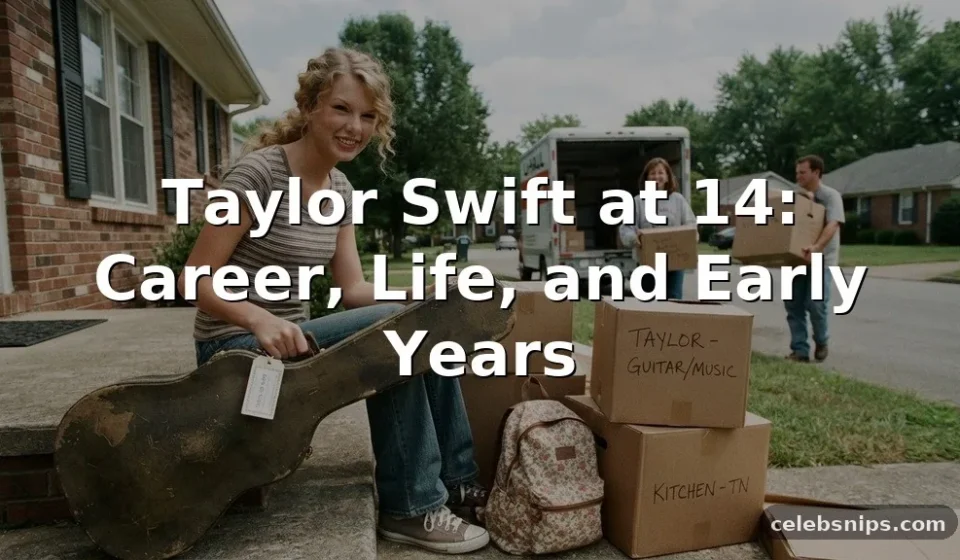

Taylor Swift at 14 was already treating songwriting as a serious profession, not merely a school-age hobby. Born on December 13, 1989, Swift spent much of that period performing around Nashville, developing original songs, and pursuing opportunities in country music before her recording career had begun.
That year matters because it connects the Pennsylvania-born teenager’s early ambition with the career that followed. Her work with Sony/ATV, Nashville performances, publishing opportunities, and persistence with record labels help explain how Swift moved from writing songs in adolescence to releasing her first album at 16.
Taylor Swift at 14: The Direct Answer
Taylor Swift was 14 years old during most of 2004. She turned 15 on December 13, 2004, and was living in the Nashville area after her family relocated from Wyomissing, Pennsylvania, to support her ambitions in country music.
At that age, Swift was not yet a chart-topping recording artist. She was a developing songwriter and performer who had secured an important publishing opportunity with Sony/ATV Music Publishing, performed at Nashville venues, and continued writing songs while trying to obtain a record contract.
One of the most important facts about Taylor Swift at 14 is that her professional progress came through songwriting first. She was building a catalog, meeting music-industry professionals, and learning how country publishing worked before she released a commercially successful single.
Her first studio album, Taylor Swift, did not arrive until 2006, when she was 16. The album’s lead single, “Tim McGraw,” was released in 2006, so it should not be described as a song she released at 14.
Quick Facts About Taylor Swift at 14
The following table separates established biographical information from details that are often overstated online. Age is tied to the calendar date because Swift’s age changed during 2004.
| Fact | Information |
|---|---|
| Full name | Taylor Alison Swift |
| Date of birth | December 13, 1989 |
| Age in 2004 | 14 until December 13; 15 afterward |
| Birthplace | West Reading, Pennsylvania, United States |
| Where she was building her career | Nashville, Tennessee, after her family moved from Pennsylvania |
| Professional focus at 14 | Songwriting, live performance, demos, and publishing |
| Known publishing opportunity | Sony/ATV Music Publishing songwriting deal, reported in 2004 |
| First album | Taylor Swift, released in 2006 |
| First major single | “Tim McGraw,” released in 2006 |
| Height at 14 | No authoritative public measurement confirms her height at that age |
Swift’s childhood background is often compressed into a simple “small-town girl becomes famous” story, but the timeline was more specific. Her family moved to the Nashville suburb of Hendersonville, and she began pursuing the local songwriting and performance network while still a teenager.
For a broader overview of her recorded work and honors, readers can consult the Recording Academy’s Taylor Swift artist biography. The key distinction remains that her professional preparation began before her first album, but album-era fame came later.
Early Life Before She Turned 14
Taylor Alison Swift was born in West Reading, Pennsylvania, and grew up in the nearby Wyomissing area. Her father, Scott Swift, worked in finance, while her mother, Andrea Swift, was involved in the family’s support of Taylor’s early ambitions. Her younger brother, Austin Swift, later entered the entertainment industry as an actor and producer.
Swift’s early interest in music developed before she had a public recording career. She has spoken about being drawn to country music and about traveling to Nashville to pursue songwriting opportunities. At age 11, she reportedly made an early trip to Music Row, the Nashville district associated with country music publishing and record companies.
That first visit did not immediately produce a record deal. The result was more practical: Swift learned that simply singing other people’s songs would not distinguish her from the many young performers seeking attention. She began emphasizing original songwriting as a central part of her identity.
She also learned guitar as a young teenager. The instrument became closely associated with her early public performances, particularly as she played country-pop songs in settings where a young singer-songwriter needed to create a personal connection with the audience.
The family move to Tennessee

Swift’s family moved to Hendersonville, Tennessee, around 2003, when she was 13. The relocation placed her closer to Nashville’s professional songwriting community and made it easier for her to attend writing sessions, perform locally, and meet industry figures.
The move did not guarantee success. Nashville had long attracted aspiring singers, writers, musicians, and producers, so Swift still had to demonstrate that she had a distinctive point of view and could write commercially useful material.
By the time she was 14, Swift had a clear advantage over many young performers: she was not presenting herself only as a vocalist. She was also bringing original songs to the room, which gave publishers and executives something concrete to evaluate.
What Taylor Swift Did at Age 14
At 14, Swift worked on the professional foundations of her career. She wrote songs, performed in Nashville, recorded or prepared demo material, met with music-industry professionals, and developed relationships within the country music community.
She also became one of the youngest songwriters associated with Sony/ATV Music Publishing. Reports about the agreement describe Swift as the company’s youngest signing as a staff songwriter at the time, although the exact wording used in different accounts can vary. The important point is that the deal recognized her songwriting potential before she had released an album.
A publishing deal is not the same as a record contract. A music publisher helps develop and exploit songs, while a record label finances, distributes, and markets recordings. Swift’s publishing opportunity gave her professional writing experience, but it did not make her a famous recording artist overnight.
Her work at 14 included writing with more experienced Nashville songwriters. Those sessions taught her how to shape a personal idea into a complete song, how to revise lyrics, and how to write within the structure expected by country radio and publishers.
- Songwriting: Swift continued creating original material instead of relying only on cover songs.
- Live performance: She appeared in Nashville-area venues and songwriter settings, including the Bluebird Cafe.
- Publishing: Her reported Sony/ATV agreement gave her an early professional connection to Music Row.
- Industry development: She met writers, producers, publishers, and label representatives while refining her sound.
- Long-term preparation: She built the skills and material that later supported her first record deal and album.
Swift’s age matters here because the opportunity came while she was still a minor and before the public knew her name. Her later success can make this stage look inevitable, but in 2004 she was still competing for attention and learning which parts of the industry matched her strengths.
Her Nashville Career Beginnings
Nashville was the central setting for Swift’s career development at 14. The city’s songwriting culture gave her access to writers who understood the relationship between lyrics, melody, publishing, radio, and commercial country music.
She performed at the Bluebird Cafe, a small Nashville venue known for intimate songwriter showcases. The venue was especially important because artists often perform original material there rather than relying on elaborate production. For a young writer, that format made the songs themselves the main evidence of ability.
Swift’s appearances in Nashville helped her develop a reputation among people who could influence her career. She was not yet headlining a tour or appearing on major award stages. Her opportunity came through repeated exposure to professionals who could see how her writing and performance developed over time.
Her work also reflected the structure of country music at the time. Country artists commonly moved through publishing relationships, demo sessions, local showcases, label meetings, and radio development before earning a national audience. Swift followed that path, though she would later expand beyond country into mainstream pop.
The importance of original songs
Swift’s songwriting was a practical career tool. A teenager who could write songs that sounded emotionally specific had something more durable to offer than a performance based only on vocal imitation.
Her early material drew on recognizable subjects such as school, friendship, attraction, disappointment, and growing up. Those topics were familiar, but Swift’s writing focused on details and first-person storytelling. That approach later became one of the defining features of her public identity as an artist.
It is difficult to identify every song Swift wrote at 14 because many early compositions were never officially released. Online lists sometimes present titles or dates with more certainty than the available record supports. A song’s appearance in a fan archive or unofficial recording does not automatically establish when it was written.
Education and Teenage Life
Swift attended school while developing her music career. Public accounts place her in the Hendersonville, Tennessee, area during the period when she was beginning to work professionally in Nashville.
As her music commitments increased, her education became more flexible. Later in her teenage years, she completed school through homeschooling while touring and promoting her debut album. That arrangement is associated with the period after her first record gained attention, not necessarily with every month when she was 14.
Claims about Swift’s teenage school life should be handled carefully. Public discussions often turn ordinary adolescent experiences into dramatic stories, including broad claims that she was bullied or socially isolated. Swift has discussed difficult school experiences and feeling excluded at different points, but a precise account of every event at age 14 is not publicly established.
The available record shows a teenager balancing school, family support, songwriting sessions, and performance opportunities. That combination was unusual, but it was also demanding. She was learning how to function in a professional environment while still completing the ordinary responsibilities of adolescence.
What is not known
No reliable public source establishes Taylor Swift’s exact height at 14. Adult height figures commonly repeated online should not be presented as a measured fact from that specific year, because teenagers can continue growing and many celebrity measurements are self-reported or estimated.
Her private friendships, daily routine, and detailed school experiences are also not fully documented. Responsible biography should distinguish between what Swift has publicly described, what reputable reporting has confirmed, and what fans have inferred from later songs.
Career Turning Points Between 14 and 16
The period after Swift turned 14 brought several changes. Her publishing experience gave her greater confidence as a writer, while her performances helped her become more visible to record-label representatives and producers.
Swift signed a development deal with RCA Records as a teenager, according to widely reported accounts, but she did not remain with the company for a conventional album release. The development period allowed her to record and learn, yet she wanted to make and release music on a timetable that suited her artistic direction.
In 2005, when she was 15, Swift attracted the attention of Scott Borchetta, who was establishing Big Machine Records. She became one of the label’s earliest signings. This was a decisive step because Big Machine would become the label behind her debut album and early rise in country music.
Swift co-wrote “Tim McGraw” with Liz Rose, and the song became the lead single from her debut album. The title referred to a country artist and a specific memory, which connected Swift’s personal songwriting style with the traditions of country radio.
Taylor Swift was released in October 2006, when Swift was 16. That album’s arrival is the correct milestone for the beginning of her public recording career, while age 14 represents the development and publishing stage that made the release possible.
| Year | Swift’s age | Career milestone |
|---|---|---|
| 2001 | 11 | Early trip to Nashville to pursue songwriting opportunities |
| 2003 | 13 | Family moved to the Nashville area |
| 2004 | 14 for most of the year | Publishing opportunity, Nashville performances, and songwriting development |
| 2005 | 15 | Signed with Big Machine Records |
| 2006 | 16 | Released debut album and “Tim McGraw” |
This timeline shows why the question about Taylor Swift at 14 is really a question about preparation. The decisive public milestones came at 15 and 16, but the work that positioned her for those milestones was already underway.
Music, Genre, and Early Artistic Style
Swift’s early career was rooted in country music, though her writing already had qualities that could later translate into pop. She used narrative lyrics, clear hooks, conversational phrasing, and emotionally specific scenes rather than relying only on vocal display.
Her first album combined country instrumentation with accessible melodies and teenage subject matter. The songs were shaped for country radio, but they also appealed to listeners who connected with diary-like storytelling and recurring themes of love, rejection, friendship, and self-definition.
At 14, Swift was still developing the sound that would eventually support multiple eras of her career. It would be inaccurate to describe her as a fully formed pop artist at that age. She was a young country songwriter whose later influence across pop music could not yet be predicted from her early professional profile alone.
The difference between “song” and “single” is useful here. Swift may have written many songs before 2006, but a single is a commercially released recording promoted to radio, streaming audiences, or the broader market. Her first major single, “Tim McGraw,” belongs to the 2006 album era, not her 14-year-old period.
Why her writing stood out
Swift’s early writing stood out because it made a young performer sound observant without pretending to have adult experience she did not possess. She wrote from the perspective of a teenager, using familiar situations but giving them a strong sense of place and emotional detail.
That directness helped her connect with a young audience. It also gave publishers and producers material that could be developed without erasing her identity. The writing was central, not decorative.
Her early country background also gave her a useful understanding of song structure. Verses moved stories forward, choruses provided memorable emotional statements, and bridges added a change in perspective or intensity. Those tools remained visible even after Swift moved further into mainstream pop.
Recognition, Awards, and Public Breakthrough
Swift did not receive the major awards associated with her later career at age 14. Most early recognition came through professional opportunities, local performances, publishing connections, and the growing attention surrounding her songwriting.
Her breakthrough followed the release of her debut album. “Tim McGraw” entered the country music market, and Taylor Swift established her as a young artist with commercial potential. The album remained on the charts for an unusually long period, helping create momentum beyond a single release.
The early success also changed the scale of her work. Swift moved from local songwriter showcases to radio appearances, opening slots, promotional performances, and eventually her own tours. The progression was gradual, even though later retrospectives often compress it into one dramatic discovery moment.
Later awards recognized Swift’s songwriting, albums, performances, and impact across country and pop. Those honors belong to the larger arc of her career rather than to the period when she was 14.
A useful way to understand the sequence is to separate three kinds of recognition:
- Industry recognition: publishers and Nashville professionals saw potential in her songwriting.
- Commercial recognition: her 2006 single and album reached a national audience.
- Critical and awards recognition: later albums, songs, and performances earned major nominations and wins.
This distinction prevents anachronism. Taylor Swift at 14 was promising and professionally active, but she was not yet the global celebrity associated with sold-out stadium tours and top awards.
Family Support and Personal Life at 14
Swift’s family played a significant practical role in her early career. Moving from Pennsylvania to Tennessee required a major family decision, and the relocation made it possible for her to spend more time in Nashville’s songwriting and music-business environment.
Her parents’ support has been discussed publicly in relation to travel, career planning, and early performances. That does not mean every private family detail is known or appropriate to reconstruct. Public biography should focus on the documented effect of the move rather than speculate about private household decisions.
Swift was a minor during the period in question, so claims about dating, private friendships, or personal conflicts should receive particular caution. There is no reliable basis for turning fan theories, later lyrics, or unsourced social-media posts into confirmed facts about her life at 14.
Questions about whether she was married, had children, or had a current partner do not apply to that teenage period. Those subjects concern later adult life and should not be projected backward into an early biography.
Bullying and social experiences
Some readers search for whether Swift was bullied growing up. Swift has publicly described experiences of exclusion and criticism, but a complete, independently verified account of bullying specifically at age 14 is not available.
It is safer to say that adolescence was a recurring subject in her songwriting and public storytelling. A song can express an emotional truth without serving as a dated legal or historical record of one specific event.
What Taylor Swift at 14 Means for Her Later Career
The age-14 period matters because it reveals the mechanisms behind Swift’s later success. She was already learning that a sustainable career required more than a good voice. It required songs, performance discipline, professional relationships, and the ability to revise material after receiving criticism.
Her early publishing experience also taught her how songs function as intellectual property. A songwriter’s work can generate income through recordings, performances, licensing, mechanical royalties, and publishing rights. Swift’s later business decisions cannot all be explained by her teenage years, but the importance of owning and controlling creative work was present in the professional environment she entered early.
Her Nashville training influenced the way she approached albums. Even after moving toward pop, she continued to think in terms of complete projects, narrative sequencing, memorable hooks, and lyrical detail. The genre changed, but the songwriter’s discipline remained.
The early timeline also explains why “When did Taylor Swift become famous?” has more than one reasonable answer. She began attracting industry attention at 14, became a nationally recognized recording artist after her 2006 debut, and reached much larger levels of global fame through later albums, tours, and awards.
That gradual progression is more accurate than assigning her entire career to one age. At 14, she had a foundation.
At 16, she had a debut. Later, she became one of the most commercially and culturally significant artists of her generation.
Frequently Asked Questions
How old was Taylor Swift in 2004?
Taylor Swift was 14 years old from January 1 through December 12, 2004. She turned 15 on December 13, 2004.
What did Taylor Swift do at age 14?
She wrote songs, performed in the Nashville area, developed professional relationships, and pursued publishing and recording opportunities. She was also associated with a reported Sony/ATV songwriting deal during this period.
Was Taylor Swift already famous at 14?
No. She was gaining recognition among Nashville music professionals, but she was not yet a nationally famous recording artist. Her first album and first major single arrived in 2006, when she was 16.
Did Taylor Swift release a song at age 14?
Her officially released debut-era recordings came later. Some songs may have been written or demoed while she was 14, but “Tim McGraw,” her first major single, was released in 2006 rather than 2004.
Where did Taylor Swift live when she was 14?
Her family lived in the Hendersonville, Tennessee, area after moving from Pennsylvania. That location placed her near Nashville’s country music and songwriting community.
How tall was Taylor Swift at 14?
No authoritative public source confirms her exact height at 14. Adult height figures found online should not be treated as a verified measurement from that year.
Was Taylor Swift bullied growing up?
Swift has discussed feeling excluded and having difficult social experiences, but the precise details and timing of every event are not publicly established. It is not responsible to present every online story about her teenage years as confirmed.
When did Taylor Swift become famous?
She began attracting professional attention as a teenager, especially after moving to the Nashville area. Her national recording breakthrough came after the 2006 release of her debut album and “Tim McGraw.”
What was Taylor Swift’s first album?
Her first album was Taylor Swift, released in 2006. It introduced her as a country artist and songwriter and included “Tim McGraw.”
Final Takeaway
Taylor Swift at 14 was a developing Nashville songwriter and performer, not yet the global pop star known from later album eras. Her key achievements at that age were professional preparation: moving closer to Nashville, writing original material, performing locally, and securing an early publishing opportunity.
The clearest timeline places her debut album and first major single at age 16, while the groundwork was laid two years earlier. Understanding that distinction makes her early years more accurate and more interesting. If you compare future milestones with the 2004 starting point, the scale of Taylor Swift’s growth becomes easier to see.