
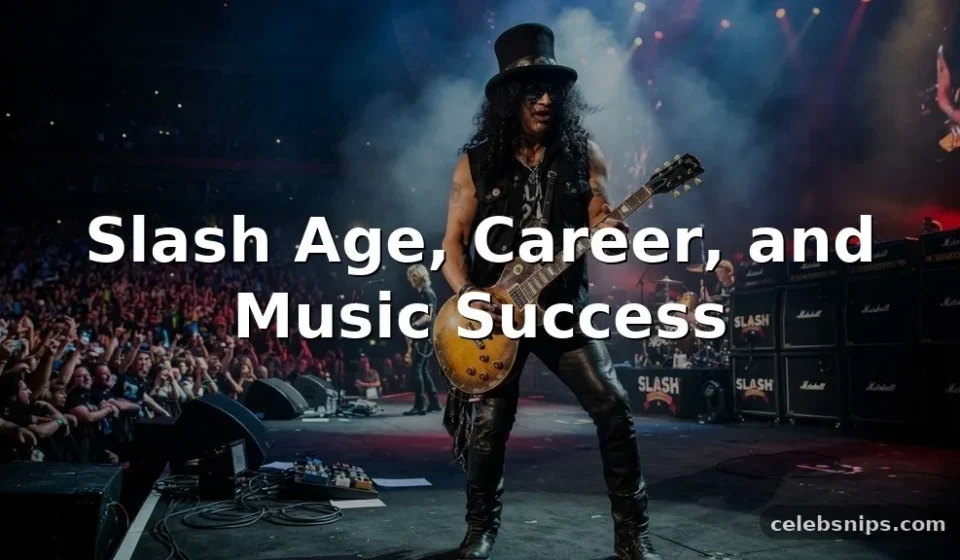

Slash is the stage name of Saul Hudson, the British-American guitarist best known for helping define Guns N’ Roses’ hard-rock sound. Born on July 23, 1965, he turned 60 in 2025, and his career has stretched from Los Angeles club stages to arena tours around the world.
Interest in Slash’s age, nationality, parents, wife, net worth, and current music career remains strong because his work has continued across several major bands and solo projects. His signature top hat, Les Paul guitar, blues-based phrasing, and memorable solos made him one of rock’s most recognizable musicians, but his success is broader than Guns N’ Roses alone.
Slash at a Glance
Slash was born Saul Hudson in Hampstead, London, England. His mother, Ola J. Hudson, worked as a costume designer, while his father, Anthony Hudson, was an artist who created album artwork and other visual designs.
Although he was born in England, Slash was raised primarily in Los Angeles, California. That connection to both Britain and the United States explains why biography pages sometimes describe his nationality differently, although “British-American” is the most useful description.
| Detail | Information |
|---|---|
| Real name | Saul Hudson |
| Stage name | Slash |
| Date of birth | July 23, 1965 |
| Age | 60 as of 2025 |
| Birthplace | Hampstead, London, England |
| Nationality | British-American |
| Profession | Guitarist, songwriter, and recording artist |
| Best known for | Guns N’ Roses, Velvet Revolver, and solo work |
| Years active | 1980s to the present |
Slash’s age is straightforward to calculate from his publicly established birth date, but online pages sometimes display outdated numbers because they are not updated after his birthday. His professional status is more fluid because he has worked with Guns N’ Roses, solo bands, guest artists, and other projects at different points in his career.
- Real name: Saul Hudson
- Primary instrument: Electric guitar
- Main musical identity: Blues-influenced hard rock
- Most famous band: Guns N’ Roses
- Other major group: Velvet Revolver
- Frequent collaborator: Myles Kennedy
Early Life and Family Background
Slash was born into a creative family rather than a conventional music-industry household. His father, Anthony Hudson, worked in visual art, and his mother, Ola Hudson, designed clothes for performers and public figures. Her work connected the family to Los Angeles fashion, film, and music circles.
Slash moved to Los Angeles with his mother when he was young. The city became the setting for his adolescence and early career, placing him close to the emerging hard-rock scene that later produced Guns N’ Roses and many of the bands associated with the Sunset Strip.
His mixed cultural background also shaped his public identity. Slash has discussed having English and African-American heritage, and his family history has often been mentioned in profiles because it differs from the image many listeners initially assumed from his appearance and name.
Slash did not become known because of formal conservatory training. His development came largely through listening, practice, friendships with other musicians, and immersion in Los Angeles rock. He became especially interested in the electric guitar after hearing players whose sound combined technical skill with strong melodic feeling.
How the Guitar Became Central
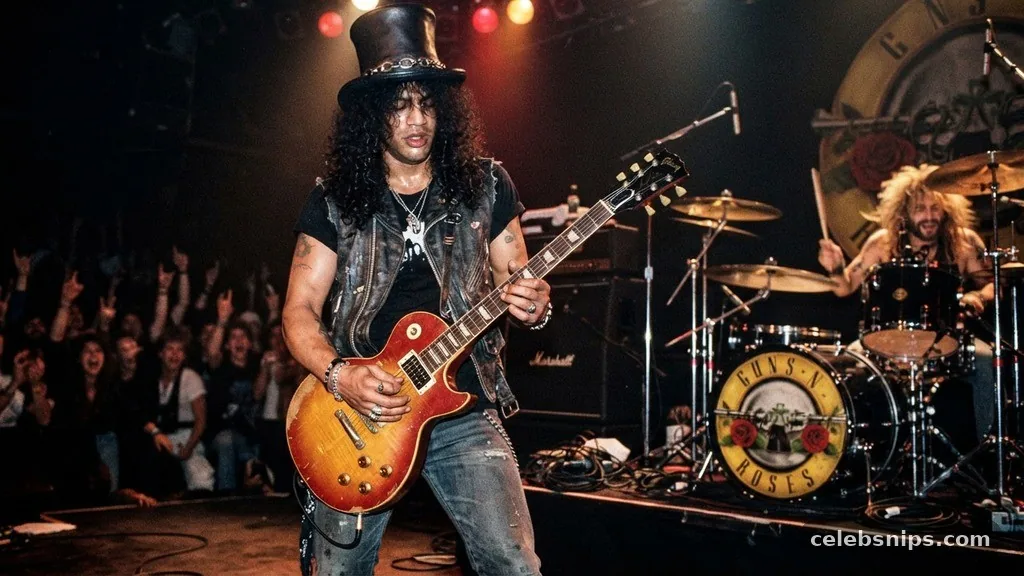
Slash began playing guitar as a teenager and quickly treated the instrument as more than a rhythm tool. He studied the phrasing of blues and rock players, then adapted those influences into bends, sustained notes, fast runs, and dramatic solos.
A key early partnership was his friendship with drummer Steven Adler. The two eventually became part of the early Guns N’ Roses lineup, and that connection helped move Slash from a young Los Angeles musician into a working band environment.
The guitarist’s playing was shaped by artists such as Jimi Hendrix, Jeff Beck, Jimmy Page, Eric Clapton, and Aerosmith’s Joe Perry. He did not simply reproduce their styles, though. His best-known work uses blues vocabulary inside songs that are louder, faster, and more theatrical than traditional blues.
Career Beginnings Before Guns N’ Roses
Before Guns N’ Roses became a global band, Slash played in local groups and developed experience in the Los Angeles club circuit. One important early band was Tidus Sloan, followed by Black Sheep, a group connected to the local rock scene during the early 1980s.
Slash later formed Road Crew with Steven Adler. The group did not release a major album, but it gave the musicians an opportunity to rehearse seriously and build the partnership that would matter after the formation of Guns N’ Roses.
Slash also played in Hollywood Rose, an early group associated with Axl Rose and Izzy Stradlin. Hollywood Rose and another band, L.A. Guns, eventually contributed members and connections to the lineup that became Guns N’ Roses.
These early stages matter because Slash was not an unknown guitarist who appeared fully formed on the band’s first album. He had already spent years learning how to write parts, perform in clubs, and work within a loud, unpredictable rock ensemble.
Joining Guns N’ Roses
Slash joined Guns N’ Roses in 1985, when the band was building its lineup and reputation in Los Angeles. The group combined members of Hollywood Rose, L.A. Guns, and other local projects, producing a raw sound that was more aggressive than polished pop-metal.
The classic lineup included Axl Rose, Slash, Izzy Stradlin, Duff McKagan, and Steven Adler. Each member contributed a different element: Rose supplied a distinctive voice and dramatic stage presence, while Slash and Stradlin created the band’s two-guitar framework.
Guns N’ Roses quickly became associated with the Sunset Strip, but its appeal was not limited to local nightlife. The band’s songs brought punk energy, blues guitar, heavy-rock volume, and unusually direct lyrics into a package that reached a mass audience.
Guns N’ Roses and the Breakthrough Years
Guns N’ Roses released Appetite for Destruction in 1987. The album initially grew slowly, but songs such as “Welcome to the Jungle,” “Sweet Child o’ Mine,” and “Paradise City” helped it become one of the most successful hard-rock debuts ever recorded.
Slash’s guitar work was central to that success. The opening riff of “Sweet Child o’ Mine” became one of the most recognizable guitar figures in mainstream rock, while the solos on “November Rain” and “Estranged” showed that the band could build long, emotional arrangements rather than relying only on speed and distortion.
Appetite for Destruction eventually sold tens of millions of copies worldwide, although exact totals vary by certification and market. The album’s success transformed the band from a Los Angeles club act into an international headliner.
The band followed its debut with the 1988 release G N’ R Lies. The record combined live material with acoustic and studio songs, including “Patience,” which highlighted a softer side of the group and showed that Slash’s playing could work effectively without a wall of electric-guitar distortion.
Use Your Illusion and International Fame
Guns N’ Roses released Use Your Illusion I and Use Your Illusion II simultaneously in 1991. The albums expanded the band’s sound with piano-led ballads, orchestral arrangements, extended tracks, and more ambitious songwriting.
Slash played major guitar parts on “November Rain,” “Don’t Cry,” “Civil War,” “You Could Be Mine,” and “Live and Let Die.” His work on the Use Your Illusion albums showed a guitarist moving between compact riffs, layered harmonies, blues solos, and large arena arrangements.
The accompanying Use Your Illusion Tour became one of the defining concert events of early-1990s rock. It lasted for more than two years and visited venues across North America, Europe, Asia, Oceania, and South America.
That period also exposed tensions inside Guns N’ Roses. The band’s demanding touring schedule, creative disagreements, substance-use problems, and lineup changes made its future uncertain. Slash remained one of its most visible members, but the group’s internal direction increasingly moved away from the classic balance that had defined its first records.
Why Slash Left Guns N’ Roses
Slash’s relationship with Guns N’ Roses became increasingly strained during the 1990s. The guitarist ultimately left the band in 1996 after disagreements with Axl Rose over musical direction, working methods, and the future of the group.
It is important to separate confirmed history from simplified online narratives. Slash’s departure was not the result of one isolated incident; it followed years of tension, lineup instability, and differences over how the band should record and operate.
After his departure, Guns N’ Roses continued under Rose’s leadership and eventually released Chinese Democracy in 2008. Slash pursued several projects that allowed him to return to a more guitar-centered band format.
For many years, the absence of Slash and Duff McKagan from Guns N’ Roses was one of rock’s most discussed lineup divisions. That changed when the musicians began appearing together again in the mid-2010s.
Velvet Revolver and the Next Chapter
Slash formed Slash’s Snakepit during the 1990s, creating a band that gave him more direct control over the music. The group released It’s Five O’Clock Somewhere in 1995 and Ain’t Life Grand in 2001, both of which reflected his preference for guitar-led rock songs.
In 2002, Slash, Duff McKagan, and Matt Sorum formed Velvet Revolver with Stone Temple Pilots singer Scott Weiland and guitarist Dave Kushner. The combination joined members of the Guns N’ Roses era with a new vocalist and a harder, modernized band sound.
Velvet Revolver’s first album, Contraband, was released in 2004. It debuted at number one on the Billboard 200 and produced the successful single “Slither,” which won the Grammy Award for Best Hard Rock Performance in 2005.
The band released its second album, Libertad, in 2007. Velvet Revolver later separated from Weiland, and the group never released a third studio album with a replacement singer.
Velvet Revolver was significant because it proved Slash could lead a commercially successful rock project outside Guns N’ Roses. The band also gave him a new creative setting after years of uncertainty surrounding his former group.
Solo Career and Work With Myles Kennedy
Slash released his first self-titled solo album in 2010. The record used a rotating cast of vocalists, including Ozzy Osbourne, Chris Cornell, Iggy Pop, Fergie, and Myles Kennedy, rather than presenting one permanent singer across the entire album.
The project allowed Slash to make the guitar the consistent center while changing the vocal color from song to song. “Beautiful Dangerous,” featuring Fergie, and “Back from Cali,” featuring Myles Kennedy, showed two different sides of the album’s design.
Slash then formed a long-running touring and recording partnership with Myles Kennedy and the Conspirators. Their first album together, Apocalyptic Love, was released in 2012 and was followed by World on Fire in 2014, Living the Dream in 2018, and 4 in 2022.
Unlike the guest-heavy format of the first solo record, the Conspirators albums presented a more stable band identity. Kennedy handled lead vocals, while Slash, bassist Todd Kerns, and drummer Brent Fitz provided a consistent live and studio unit.
The Conspirators’ Musical Approach
The Conspirators’ songs generally favor compact hard-rock structures, prominent guitar hooks, and large choruses. The records are less sprawling than some Guns N’ Roses material, but they retain Slash’s preference for expressive solos and blues-based bends.
World on Fire was especially expansive, with a long track list and a production style built for both radio play and live performance. Living the Dream continued that approach, while 4 was recorded with a stronger emphasis on direct, energetic rock songs.
Slash and Kennedy have also toured extensively together. Their partnership gave Slash a reliable platform for performing solo material while still allowing him to play classic Guns N’ Roses songs for audiences around the world.
Guns N’ Roses Reunion and Current Work
Slash returned to Guns N’ Roses for major performances beginning in 2016. The reunion included Axl Rose, Duff McKagan, and Slash, with additional musicians supporting the touring lineup.
The reunion led to the Not in This Lifetime… Tour, which became one of the highest-grossing concert tours in music history. The tour’s success confirmed that the audience for the classic Guns N’ Roses lineup had remained enormous decades after Appetite for Destruction.
Slash has continued to balance Guns N’ Roses commitments with his solo work. That dual career explains why searches for “Slash now” can produce different answers depending on whether the reader means the band’s touring activity, his Conspirators projects, or his newer blues recordings.
In 2024, Slash released Orgy of the Damned, a blues album made with a separate group of collaborators. The album focused on interpretations of blues standards and related songs, giving him space to move closer to the musical roots that influenced his guitar playing.
The project included guest vocalists and musicians rather than functioning as another standard Guns N’ Roses or Conspirators album. Its release reinforced an important point about Slash’s career: hard rock made him famous, but blues has always been a major foundation of his musical identity.
Slash’s Guitar Style and Influence
Slash’s sound is built around the electric guitar’s ability to sing, sustain, and respond emotionally. He often uses wide bends, vibrato, double-stop phrases, blues scales, and melodic repetition instead of filling every bar with technical notes.
His playing is also highly identifiable in rhythm parts. Riffs such as “Sweet Child o’ Mine” and “Welcome to the Jungle” are direct enough to remain memorable, yet they contain unusual note choices and rhythmic movement that make them more distinctive than generic hard-rock patterns.
The Les Paul guitar and Marshall amplifier combination became closely associated with his stage sound. Slash has used several guitars and equipment setups over the years, so it would be inaccurate to reduce his entire tone to one exact instrument or amplifier.
His influence reaches beyond the solos most often used in tribute videos. Young guitarists study how he builds an intro, leaves space around a vocal, places a solo inside a song, and turns a simple melody into a dramatic live moment.
- Melodic phrasing: Solos often sound like extensions of the vocal line.
- Blues vocabulary: Bends and pentatonic ideas remain central to his style.
- Strong riff writing: His most famous parts work as memorable song hooks.
- Dynamic control: He can move from restrained notes to explosive passages.
- Live identity: His silhouette, top hat, guitar, and stage movement form a recognizable performance image.
Slash’s influence is sometimes described only through his appearance, but the music explains his longevity. He can play a technically demanding solo without making the song feel like a demonstration, which is one reason his work continues to appeal to both casual listeners and guitar-focused audiences.
Awards, Recognition, and Cultural Importance
Slash has received major recognition as a member of Guns N’ Roses and Velvet Revolver. Guns N’ Roses was inducted into the Rock and Roll Hall of Fame in 2012, with Slash participating in the ceremony even though the classic lineup did not reunite for the event.
Velvet Revolver won the Grammy Award for Best Hard Rock Performance for “Slither” in 2005. The award recognized a specific song and performance rather than treating the band’s success as merely a continuation of Guns N’ Roses.
Guns N’ Roses’ catalog has also received extensive commercial and institutional recognition. Appetite for Destruction remains one of the most successful debut albums in popular music, while “Sweet Child o’ Mine” and “November Rain” remain regular reference points in discussions of classic-rock songwriting and guitar work.
The Rock & Roll Hall of Fame’s Guns N’ Roses profile provides an established institutional reference for the band’s place in rock history. Slash’s contribution is inseparable from that history because his riffs and solos are embedded in the group’s most recognized recordings.
His cultural importance also comes from longevity. Many musicians associated with the late-1980s rock boom disappeared from the mainstream after changing trends, while Slash continued recording, touring, collaborating, and appearing in new musical settings.
Personal Life, Parents, and Relationships
Slash’s parents were Anthony Hudson and Ola J. Hudson. His mother’s career as a designer brought her into contact with the entertainment industry, while his father’s visual-art work gave the family another connection to music and popular culture.
Slash was married to Perla Ferrar. The couple had two sons, London and Cash, and their marriage later ended in divorce. Public reporting has covered the relationship and family history, but details about his children’s private lives should not be treated as part of his professional biography.
He has also spoken publicly over the years about addiction and recovery. Those experiences became relevant to his career because substance use affected the environment around Guns N’ Roses and shaped the way he later discussed survival, work, and long-term musicianship.
Slash’s public image is carefully recognizable, but that does not make every personal claim online reliable. Rumors about current relationships, private residences, or family matters should not be presented as fact unless supported by a direct statement or a reputable report.
Slash Net Worth and Income Sources
No single authoritative public source verifies Slash’s current net worth. Websites that publish exact estimates often use different assumptions about touring income, royalties, taxes, management costs, investments, and private assets, so their figures should be treated as estimates rather than confirmed facts.
Slash’s established income sources include album royalties, songwriting and publishing revenue, live performances, music-related merchandise, recording work, and collaborations. His participation in Guns N’ Roses tours is especially important because major arena tours can generate substantial gross revenue, although gross ticket sales are not the same as an artist’s personal earnings.
His catalog also creates long-term value. Songs recorded with Guns N’ Roses, Velvet Revolver, and his solo bands may continue generating income through streaming, licensing, physical reissues, radio play, and use in film, television, advertising, and games.
Equipment endorsements and signature guitar products may contribute additional revenue, but the precise terms of those arrangements are generally private. It would be misleading to attach a specific dollar amount to any single endorsement without reliable financial documentation.
The safest answer to the net-worth question is therefore simple: Slash is a highly successful recording and touring musician, but his exact wealth has not been publicly verified. Any precise online number should be labeled as an outlet’s estimate.
What Makes Slash’s Success Last?
Slash’s career has lasted because his identity is connected to a recognizable musical language rather than one short-lived trend. His guitar sound can fit a Guns N’ Roses anthem, a Velvet Revolver track, a Conspirators song, or a traditional blues arrangement without becoming unrecognizable.
He also understands the difference between being a famous former band member and remaining an active musician. After leaving Guns N’ Roses, he did not rely only on old recordings; he formed new bands, released new albums, toured with different singers, and continued developing his repertoire.
His collaborations with Myles Kennedy are a clear example. Kennedy’s vocal range gives the material a modern hard-rock edge, while Slash’s guitar keeps the songs connected to the blues and classic-rock traditions that shaped his earliest work.
The return to Guns N’ Roses added another dimension. It allowed Slash to revisit the catalog that established him while preserving a separate creative identity outside the band.
That balance is unusual. Some musicians become defined entirely by one classic lineup, while others move so far away from their original sound that fans lose the connection. Slash has maintained both continuity and change.
Frequently Asked Questions About Slash
How old is Slash?
Slash was born on July 23, 1965, so he turned 60 in 2025. His age changes each year after his birthday, which is why older biography pages may show an outdated number.
What is Slash’s real name?
Slash’s real name is Saul Hudson. “Slash” is the professional name he has used since his early years in the Los Angeles rock scene.
Where was Slash born, and what is his nationality?
He was born in Hampstead, London, England, and was raised largely in Los Angeles. He is commonly described as British-American because of his English birth and American upbringing and career.
What band made Slash famous?
Guns N’ Roses made Slash famous, especially through the albums Appetite for Destruction, Use Your Illusion I, and Use Your Illusion II. He later gained further recognition with Velvet Revolver and his solo work with Myles Kennedy and the Conspirators.
Is Slash married, and does he have children?
Slash was married to Perla Ferrar, and they have two sons, London and Cash. His marriage ended in divorce, while current claims about his private relationships should be treated cautiously unless confirmed by reliable reporting.
Final Takeaway
Slash’s age is easy to verify, but his career is much bigger than a single number. Born Saul Hudson in London and raised in Los Angeles, he became a defining Guns N’ Roses guitarist, helped form Velvet Revolver, built a successful solo catalog, and continued recording with Myles Kennedy and other collaborators.
The most reliable view of Slash Age, Career, and Music Success is a career built on identifiable work rather than unsupported net-worth claims or rumors. His next projects may change, but his place in rock is secure through the songs, albums, tours, and guitar performances that made his name globally recognized.