

Some phrases stick around for centuries because they say something we all need to hear. "Silver lining" is one of them. You have probably heard it in the full proverb — "every cloud has a silver lining" — but what does it actually mean, and why has a line written nearly 400 years ago survived into everyday texting, movies, and song lyrics?
The silver lining meaning is simple: it is the hopeful, comforting, or positive aspect hiding inside an otherwise bad situation. When someone says, "There is a silver lining to losing my job," they mean that even though it hurts, something good may come out of it. The phrase does not deny the pain of the cloud; it just points to the light at its edges.
But this saying has layers. There is a beautiful literary origin behind it, a vivid image from nature, and — something people rarely talk about — a point where saying it to someone can actually make things worse. In this guide, we will unpack the full silver lining meaning, trace its journey from a 17th-century poem to modern pop culture, show you how to use it naturally in conversation and texts, and help you know when to say it and when to hold back.

The Silver Lining Meaning Explained Simply
Strip away the poetry and the silver lining meaning is this: a small good thing found inside a bad situation. Dictionaries define it as "a hopeful or comforting prospect in the midst of difficulty" — a consolation, not a solution.
Think of it this way. The "cloud" is whatever is going wrong: a breakup, a cancelled trip, a failed exam, a layoff. The "silver lining" is the unexpected benefit tucked inside it: the breakup that taught you what you want in a partner, the cancelled trip that saved you from a storm you did not know was coming, the failed exam that pushed you toward a subject you love more.
Notice what the phrase is not saying. It is not saying the bad thing was good, or that you should be grateful for pain. It is saying that even in darkness, there can be an edge of light. That distinction matters, and we will come back to it when we talk about toxic positivity.
The phrase is almost always used in one of two forms:
- "The silver lining" — naming the specific good thing: "The silver lining of the lockdown was that I finally learned to cook."
- "Every cloud has a silver lining" — the full proverb, used as general reassurance: "Don't despair. Every cloud has a silver lining."
Both forms work in formal writing and casual chat alike. It is one of those idioms that feels equally at home in a motivational speech, a condolence-adjacent conversation, and a late-night text between friends.
The Visual Behind the Words
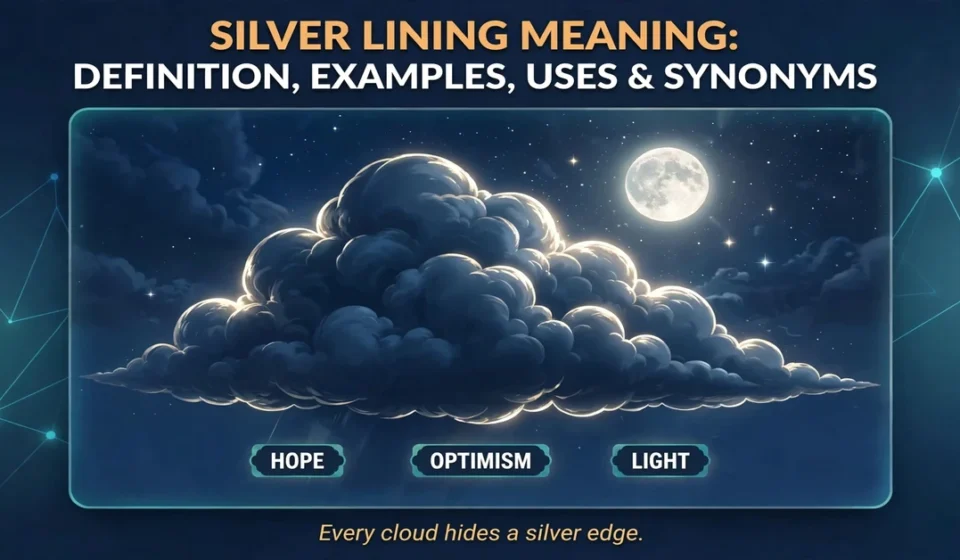
The metaphor comes from something you may have actually seen: when a dark storm cloud passes in front of the sun or the moon, its edges catch the light and glow with a bright, silvery rim — while the middle stays dark and heavy. That glowing rim is the literal silver lining. The image is beautiful because it is honest: the cloud does not stop being dark; the light is only at the edges. Optimism, this phrase suggests, is not about pretending the sky is clear. It is about noticing the bright rim around a genuinely dark cloud.
The Origin of "Silver Lining": From John Milton to Modern English
The silver lining meaning did not begin as a folksy proverb — it began as poetry. The phrase was coined by the English poet John Milton in his 1634 masque Comus. In the poem, a character lost in a dark forest at night looks up and says:
"Was I deceiv'd, or did a sable cloud / Turn forth her silver lining on the night?"
"Sable" here means black. Milton was describing a real sight — a black cloud edged with moonlight — and using it as a symbol of hope in darkness. Clouds with glowing edges are still sometimes called "Milton's clouds" in his honor.
How the Proverb Took Shape
Milton's phrase floated through English literature for two centuries before the Victorian era turned it into the proverb we know. The first clear appearance came in 1840 in The Dublin Magazine: "There's a silver lining to every cloud that sails about the heavens if we could only see it." Then, in 1849, a misprint in The New Monthly Belle Assemblée accidentally produced the modern wording: "Every cloud has a silver lining." The misprint stuck — and the proverb was born.
How People Use "Silver Lining" in Everyday Conversation
Here is how it sounds in real life:
After a job loss:
- A: "I got laid off yesterday."
- B: "That's rough. But maybe there's a silver lining — you always said that job was burning you out."
After a breakup:
- A: "We broke up last month."
- B: "I'm sorry. If there's a silver lining, it's that you learned what you actually need in a relationship."
Notice the pattern: the phrase almost always follows an acknowledgement of the bad news. Nobody leads with the silver lining. The natural rhythm is empathy first, optimism second — and that is the difference between sounding caring and sounding dismissive.
Silver Lining in Texting and Social Media
In texts and DMs, the phrase gets shortened: "silver lining though 👀," "trying to find the silver lining," or just "every cloud…" It is also a popular caption format: "Silver lining: I finally got a weekend off" under a photo of a cancelled trip.
The tone in texting is usually lighter and self-directed — people use it on themselves more than on others, which is often the wisest way to use it.
Common Variations You'll Hear
- "Look for the silver lining" — an encouraging nudge to focus on potential positives during a crisis.
- "Find the silver lining" — usually said about the past: "It took years, but I found the silver lining."
- "Every cloud has a silver lining" — the full proverb, used as general reassurance.
- "No silver lining" — the pessimistic flip: "There was no silver lining to that week at all."
Real-Life Examples of Silver Linings
Sometimes the concept clicks best through stories. Here are classic scenarios people genuinely describe as silver linings:
- Losing a job — painful and scary, but it pushed many people to start businesses, switch careers, or finally take the break they were too afraid to take. "Losing that job was the push I needed."
- A breakup — heartbreak that eventually leads to self-knowledge and better relationships. "The silver lining was that I learned to be happy alone first."
- An illness or injury — forced rest that reconnects people with their health, family, or priorities. Many patients say recovery taught them what actually matters.
- A cancelled trip or event — saved money, avoided bad weather, or discovered something better close to home. "The rain ruined our picnic, but the silver lining was discovering that café."
- Failing an exam or interview — redirection toward a better-fit path. Countless successful people credit an early rejection with saving them from the wrong road.
The key word in all of these is unexpected. A silver lining is rarely the thing you were aiming for. It is the thing you notice only after the plan fell apart.
When to Use It — and When It Can Sound Dismissive (Toxic Positivity)
Here is the part most meaning-articles skip: "Every cloud has a silver lining" can hurt people when said at the wrong time. Psychologists call the overuse of forced optimism toxic positivity — pressure to look on the bright side before someone is ready, which can make them feel unheard or even ashamed of their grief.
Imagine someone has just lost a loved one, and a friend says, "Well, every cloud has a silver lining." The grieving person hears "stop being sad," not optimism. The same applies to serious illness, trauma, or any fresh wound.
A Simple Rule: Read the Room
Use the phrase freely when talking about yourself (finding your own silver lining is healthy reframing), when the sting has faded (months or years later it feels like wisdom, not dismissal), when the stakes are low (cancelled plans, bad weather, minor setbacks), or when the other person invites it ("I'm trying to see the bright side").
Hold back when the wound is fresh — lead with empathy instead: "I'm so sorry. That sounds awful." Hold back when the loss is profound — grief, serious diagnosis, or trauma need space, not slogans. And hold back when you catch yourself minimizing — if your real motive is to end an uncomfortable conversation, do not dress it up as optimism.
Said with timing and care, the phrase is a gift. Said too soon, it is a door closing in someone's face. The silver lining meaning includes hope — but hope offered at the wrong moment stops feeling like hope.
Related Phrases, Synonyms, and Alternatives
Here are the closest relatives of silver lining, and when each fits best:
Synonyms and Near-Meanings
- Blessing in disguise — the closest cousin. A good thing that initially appeared to be bad. "Losing that client was a blessing in disguise."
- Look on the bright side — a gentle nudge toward optimism, usually said to someone else.
- Light at the end of the tunnel — hope that a long, hard period will eventually end. More about the future than a hidden benefit of the present.
- On the plus side — casual and conversational: "On the plus side, at least the food was good."
- Every silver lining has a cloud — the cynical twist on the original, meaning even good things have downsides.
Alternatives for Sensitive Moments
When the full proverb feels too chirpy, these carry the same spirit more gently: "Something good may come out of this." / "This might open a door you didn't expect." / "It's okay to feel bad about this and still hope for what's next."
Choosing a softer alternative is not abandoning optimism. It is optimism with manners.
Silver Lining in Songs, Movies, and Pop Culture
Few idioms have been recycled by pop culture as often as this one:
- "Silver Lining (Crazy 'Bout You)" — the upbeat anthem from Silver Linings Playbook (2012), a film whose very title is built on the idiom. The movie follows two people rebuilding their lives after personal crises, and the phrase becomes its central philosophy: finding hope after heartbreak.
- Judy Garland's "Look for the Silver Lining" (from the 1920 musical Sally) carried the phrase through the golden age of Hollywood.
- Literature and speeches — from Victorian moral essays to modern self-help books and commencement addresses, "every cloud has a silver lining" remains the go-to line for resilience.
Pop culture keeps the phrase alive, but it also softens it. In songs and movies, the silver lining usually arrives neatly by the final chorus. In real life, it often takes years to spot — and that is worth remembering when the phrase feels too easy.
Frequently Asked Questions
1. What is the silver lining meaning in simple words?
It is the small good thing hidden inside a bad situation — the idea that even difficult times can contain hope, opportunity, or an unexpected benefit. For example: "The silver lining of the power outage was that we had a candlelit family dinner."
2. Where did the phrase "silver lining" come from?
The phrase was coined by the English poet John Milton in his 1634 poem Comus. The full proverb "every cloud has a silver lining" emerged in the Victorian era, first appearing in print in 1840 and in its modern wording in 1849.
3. What is the difference between "silver lining" and "blessing in disguise"?
A blessing in disguise is a good thing that looked bad at first — the "bad" part turns out to have been good all along. A silver lining is a good thing found alongside something that stays bad — the cloud is still a cloud, but there is light at its edges.
4. Is it rude to say "every cloud has a silver lining" to someone who is upset?
It can be, depending on timing. Said too soon after serious bad news — a death, a diagnosis, a trauma — it can sound dismissive and fall into toxic positivity. The kind approach is to acknowledge their feelings first ("I'm so sorry, that sounds really hard") and save the optimism for later.
5. How do you use "silver lining" in a sentence?
"There was a silver lining to the breakup — I learned what I truly want." / "The silver lining of working from home is no commute." The phrase works in both spoken and written English, formal and casual.
Conclusion
The silver lining meaning has survived nearly four centuries because it captures something deeply human: our refusal to believe that darkness is the whole story. From Milton's moonlit cloud in 1634 to a friend's reassuring text today, the image carries the same quiet promise — that even the heaviest cloud has edges where the light gets in.
But the phrase is at its best when used with wisdom: a lens for reframing your own setbacks, gentle reassurance for low-stakes troubles, a philosophy for the long arc of a hard year — never a bandage pressed onto someone else's fresh grief. Knowing the difference is what turns a cliché into genuine comfort.
So the next time life hands you a cloud, look for the silver lining — in your own time, on your own terms. The light at the edges has been there since Milton first noticed it, and sometimes you just have to look up to see it.