

You are texting with a friend who drops a single word into the chat: "rojo." No context. No emoji. Just… red? Are they talking about a color? Are they broke? Are they calling something out? Or is this one of those internet words that means something completely different from what the dictionary says?
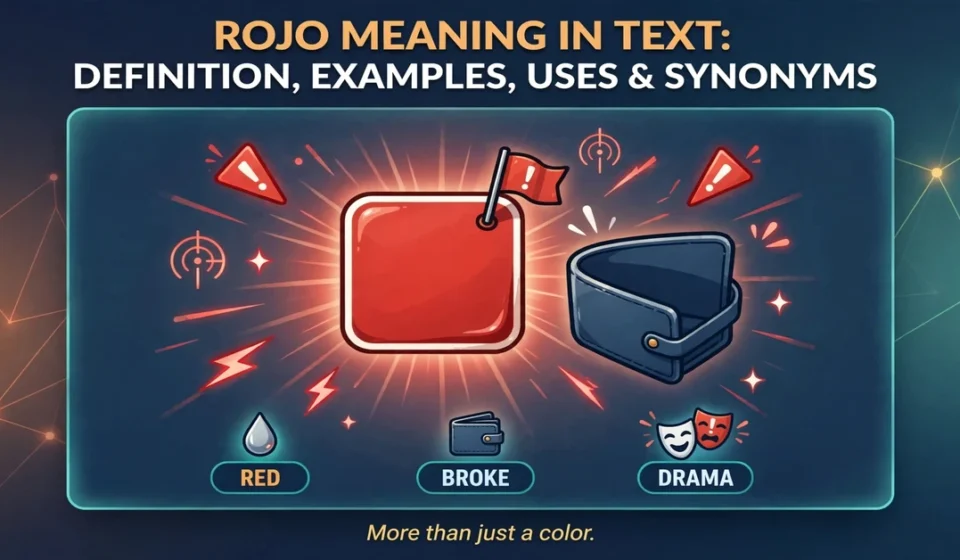
The short answer: "rojo" is the Spanish word for "red" — but in texting and online slang, it has picked up extra lives. In Mexican slang, "andar rojo" means being broke. In meme culture, "rojo" signals intensity, drama, or red-flag energy — the social equivalent of a warning light. And sometimes, it is just the color, doing its normal job in a Spanish sentence.
In this guide, we will unpack every layer of the rojo meaning in text: the literal Spanish definition, the Mexican "broke" slang, the internet's dramatic reinterpretation, how to tell which one you are looking at, and how to use each version without confusing everyone in the chat.

What Does "Rojo" Mean? The Literal Foundation
Start with the dictionary: rojo (pronounced ROH-hoh) is the Spanish adjective for red — the color. El coche rojo (the red car), la rosa roja (the red rose; note the feminine form roja). It comes from the Latin rubeus, meaning reddish, and it has been doing its color job in Spanish for over a thousand years.
But "red" is never just a color in any language. Across cultures, red carries a loaded symbolic freight: passion and love, danger and warning, anger and embarrassment, luck and celebration. That symbolic weight is the raw material for every slang meaning that follows. When the internet borrowed "rojo," it was not borrowing a color — it was borrowing everything red feels like: intense, urgent, impossible to ignore.
This matters because it explains why "rojo" works as slang at all. A borrowed word needs a hook — some quality that makes it more expressive than the native equivalent. "Rojo" has two: it sounds punchy (that rolled R, that decisive ending), and it means something visceral. English already has the word "red," but "red" is furniture. "Rojo" is a statement.
Rojo vs. roja — a quick grammar note
Spanish adjectives change with gender: rojo (masculine), roja (feminine). In slang use, people overwhelmingly stick with "rojo" regardless — meme slang does not conjugate. If you see "roja" in a text, it is more likely literal Spanish ("la cara roja" — the red face) than slang. This is a useful tell: slang "rojo" is frozen in its masculine form; grammatical "roja" is usually just Spanish being Spanish.
The Mexican Slang Meaning: "Broke"
Here is the slang meaning with the deepest real-world roots: in Mexican Spanish, "andar rojo" or "estar rojo" — literally "to walk red" / "to be red" — means to be broke, out of money. "Ando rojo esta semana" = "I'm broke this week." "Me quedé rojo después de pagar la renta" = "I ended up broke after paying rent."
The metaphor is financial, and English has its own version: "in the red." Accountants have used red ink for losses and black ink for profits for centuries, and the imagery crossed into everyday speech on both sides of the border. Being "rojo" is being in the red — your balance has gone the wrong color. It is vivid, instantly understandable, and just self-deprecating enough to be funny: announcing your poverty with a color metaphor takes some of the sting out.
This usage is strongly regional. It is very common in Mexico — among friends, classmates, coworkers, family — but it does not travel well. In Spain, "estar rojo" will get you blank stares (or assumptions about sunburn). In most of the rest of Latin America, people will hear the color, not the slang. Among Mexican-American communities in the United States, "andar rojo" is widely understood in casual conversation. So if a Mexican friend texts you "ando rojo 😅", they are not describing their complexion — they are telling you their wallet is empty, probably with a laugh, possibly angling for you to cover lunch.
The Internet Slang Meaning: Intensity, Drama, Red-Flag Energy
Separate from the Mexican "broke" meaning, English-language internet culture has built its own "rojo" — and this one runs on the color's symbolic power. In memes, group chats, and comment sections, "rojo" signals something intense, dramatic, heated, or red-flag-adjacent: the social equivalent of a warning light going off.
The logic is pure color psychology. Red means stop, danger, alert — so "rojo" became shorthand for moments that feel red: the cringe confession, the messy drama, the spicy gossip, the decision everyone knows is a bad idea. "Bro told his crush he likes her over text… that's so rojo 😭" — the word does the work of three sentences about secondhand embarrassment. "That whole situation is rojo" means it is giving red flags, it is heated, it is a mess — pick your translation, the energy is the same.
This usage grew out of the same internet instinct that borrows foreign words for flavor: je ne sais quoi, schadenfreude, deja vu. English speakers love a loanword with punch, and "rojo" delivers — it is more dramatic than "red," funnier than "intense," and just exotic enough to feel like an in-joke. TikTok comments, Twitter quote-tweets, and Discord chats are its natural habitat: "rojo behavior," "that's rojo asf," "100% rojo energy."
Rojo in Real Conversations: Examples
Example 1 — the Mexican "broke" (Spanish context):
Maya: vamos al cine este finde?
Leo: ando rojo 😅 la próxima semana?
(Want to hit the movies this weekend? / I'm broke 😅 next week?)
Example 2 — red-flag energy (meme slang):
Dev: he said "I'm not like other guys" on the first date
Ana: that's so rojo I'm crying 😭
Example 3 — the embarrassment report:
Sam: waved back at someone who wasn't waving at me
Priya: ROJO 💀
Example 4 — the heated drama:
Comment under a messy reality-TV clip: "this whole episode is rojo asf 🔥"
Notice how the habitat sorts them: Spanish-language conversation about money → broke. English-language meme context about drama → red-flag energy. Embarrassing story → blushing. The word never travels alone; its entourage always gives it away.
Rojo vs. Similar Slang
The "intensity/danger" sense of rojo has neighbors worth distinguishing:
- Red flag — the direct English equivalent of rojo's warning sense. "That's a red flag" and "that's so rojo" are near-synonyms; "rojo" is just the meme-flavored, punchier version. Use "red flag" when you want clarity; use "rojo" when you want comedy.
- Spicy — overlaps with rojo's "heated drama" sense ("spicy gossip"). "Spicy" leans fun and tantalizing; "rojo" leans warning and chaotic. Spicy drama you enjoy watching; rojo drama you watch through your fingers.
- Sus (suspicious) — the gaming-born cousin. "Sus" flags something as off; "rojo" flags it as intense. A sus text makes you narrow your eyes; a rojo text makes you grab popcorn.
- "In the red" — the English financial cousin of "andar rojo." Same accounting metaphor, same meaning (broke/losing money), zero meme energy. "In the red" is what your accountant says; "ando rojo" is what your friend says.
How to Tell Which "Rojo" You Are Looking At
Three questions decode it every time:
1. What language is the conversation in? Spanish + money topic → the Mexican "broke" meaning. English + meme context → the intensity/drama meaning. Either language + grammar (roja, el rojo coche) → literal color.
2. Who sent it? A Mexican friend texting in Spanglish about weekend plans → probably broke. A chronically-online friend reacting to drama → probably red-flag energy. Your Spanish teacher → definitely the color.
3. What is the emotional temperature? Self-deprecating + 😅 → broke. Gleeful + 😭💀 → drama/embarrassment. Neutral/descriptive → color.
When all three point the same way — and they almost always do — you have your answer. The genuinely ambiguous cases are rare: they require a bilingual friend, a money-and-drama situation, and no emojis. In those cases, just ask. "Rojo how — broke rojo or drama rojo?" is a perfectly good text, and bilingual friends are used to it.
When to Use Rojo (and When Not To)
Do use the meme "rojo" with friends who share the context — reacting to drama, calling out red-flag behavior, reporting your own embarrassment. It is fun, expressive, and harmless in the right crowd. Do use "andar rojo" if you speak Mexican Spanish or hang out in those circles — it is authentic, everyday slang, and using it correctly earns you insider points.
Do not use "andar rojo" with Spanish speakers from outside Mexico unless you are ready to explain it — the regional gap is real, and "estoy rojo" in Madrid means something is wrong with your skin. Do not use meme "rojo" in formal, professional, or cross-generational contexts; it will read as random Spanish, not as slang. Do not use it to describe actual financial distress to people who need clarity — "ando rojo" is charming among friends, but your landlord wants numbers, not color metaphors. And do not overuse it: like all meme slang, "rojo" is seasoning. A chat where everything is rojo is a chat where nothing is.
How to Reply When Someone Sends You "Rojo"
The "broke" rojo — "ando rojo esta semana 😅" — the correct response is solidarity, possibly with a plan adjustment: "lol same, cheap tacos instead of the movies?" Do not offer a lecture on budgeting; do offer cheaper plans. If you are close, "I got you this time" is kindness. If you are not, "next week then!" keeps it light.
The drama rojo — "that's so rojo 😭" — match the entertainment energy: "I KNOW, I can't look away" or "rojo is an understatement." This rojo is a spectator sport; spectate together.
The embarrassment rojo — "waved at the wrong person… rojo" — laugh with them: "NOOOO 😭 we've all been there." The sender is already mortified; your job is absolution through shared cringe.
The literal color — "me compré una chamarra roja" — respond to the content ("nice, send pics!"), not the word. There is no slang to decode here, just Spanish happening.
If you cannot tell which rojo it is — ask with humor: "broke rojo or drama rojo?" Bilingual and meme-fluent friends will appreciate that you know there is a difference. That question alone marks you as someone who gets it.
Is rojo offensive?
No — in any of its meanings. It is a color, a self-deprecating money joke, and a meme word for drama. None of the uses target anyone or punch down. The only caution is the regional one: using "estar rojo" to mean "broke" outside Mexico will confuse people, not offend them. As slang goes, rojo is about as safe as it gets — which is part of why it spread so easily.
Can I use rojo if I don't speak Spanish?
For the meme meaning, yes — that is how most English speakers encountered it, and the meme context does not require Spanish fluency. (Half the people typing "that's so rojo" could not conjugate a verb to save their lives, and the meme does not care.) For "andar rojo" specifically, it helps to actually move in Mexican-Spanish-speaking circles; dropping it cold into an English conversation will just confuse people. Borrow the meme freely; borrow the regional slang only if you have the relationships to support it.
What's the difference between rojo and red flag?
They overlap heavily in the "warning" sense, but the register differs. "Red flag" is direct, analytical, widely understood — it says this is a warning sign clearly. "Rojo" is the meme version — funnier, punchier, more dramatic, and slightly less precise. "That's a red flag" is an observation; "that's so rojo" is a reaction. In practice, people often use both: the red flag for the analysis, the rojo for the group-chat comedy. They are teammates, not competitors.
Why did English speakers adopt a Spanish word for this?
Three reasons: sound, novelty, and the internet's magpie instinct. "Rojo" sounds more dramatic than "red" — the rolled R and hard ending give it punch that the flat English word lacks. It is novel enough to feel like an in-joke but familiar enough (thanks to shared Latin roots and endless cultural exposure) to be instantly guessable. And the internet has always collected shiny foreign words — schadenfreude, je ne sais quoi, déjà vu — deploying them where the native equivalent feels boring. "Rojo" is simply the latest acquisition, and its color-symbolism made it unusually versatile.
Does rojo mean anything else I should know?
In niche contexts: Rojo is also a proper name and appears in brand names, place names, and surnames across the Spanish-speaking world. In some gaming and fandom communities, it is used as a username or team name purely for its punchy sound. None of these are "meanings" in the slang sense — they are just the word living its normal life as a name. If you see "Rojo" capitalized mid-sentence referring to a person, it is a name. Context, as always, does the work.
Conclusion
The rojo meaning in text turns out to be three meanings sharing one punchy word: the Spanish color red, doing its thousand-year-old job; the Mexican slang for broke, painting poverty in vivid color; and the internet's all-purpose signal for drama, intensity, and red-flag energy. Each one has its habitat, its tells, and its charm — and once you know the lineup, the ambiguity dissolves on contact with context.
That is the deeper pleasure of a word like "rojo": it is a tiny map of how language travels. From Latin roots to Mexican streets to TikTok comments, it picked up new lives without losing the old ones — color, cash, and chaos, all in four letters. So the next time "rojo" lands in your chat, do not just read the word. Read the journey. And then reply appropriately — preferably with cheaper plans, shared laughter, or popcorn, depending on which red showed up.