
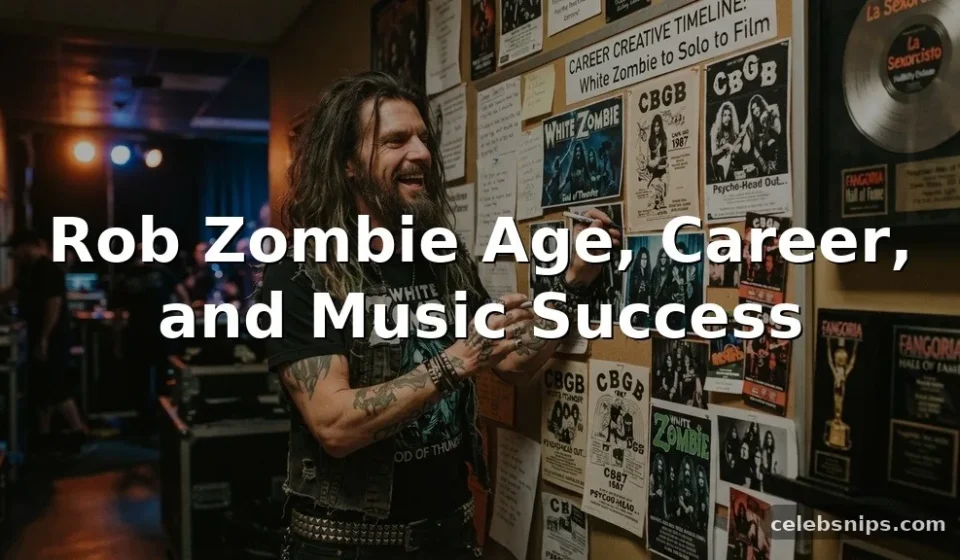

Rob Zombie’s age, career, and music success remain closely connected because he has built a rare career across heavy metal, industrial rock, horror films, and visual art. Born Robert Bartleh Cummings on January 12, 1965, he became known first as the frontman of White Zombie and later as a solo artist, filmmaker, screenwriter, and producer.
Rob Zombie is 60 years old as of January 12, 2025, and turns 61 on January 12, 2026. His best-known milestones include the White Zombie albums La Sexorcisto: Devil Music Volume One and Astro-Creep: 2000, the solo album Hellbilly Deluxe, the song “Dragula,” and films such as House of 1000 Corpses and the 2007 remake of Halloween.
Rob Zombie at a Glance
Rob Zombie is an American musician and filmmaker whose work combines heavy metal, hard rock, industrial music, exploitation cinema, comic-book imagery, and classic horror references. His stage name became a permanent professional identity, although his birth name is Robert Bartleh Cummings.
His career has two major musical chapters. White Zombie established him in the 1990s, while his solo work expanded his audience after the band ended. He then developed a parallel film career that made him a recognizable name even outside the music industry.
| Fact | Information |
|---|---|
| Birth name | Robert Bartleh Cummings |
| Professional name | Rob Zombie |
| Date of birth | January 12, 1965 |
| Age | 60 as of January 12, 2025; age changes each January 12 |
| Birthplace | Haverhill, Massachusetts, United States |
| Profession | Musician, singer, songwriter, filmmaker, screenwriter, and producer |
| Known for | White Zombie, “Dragula,” Hellbilly Deluxe, and horror films |
| Genres | Heavy metal, industrial metal, hard rock, and alternative metal |
| Years active | Professional work beginning in the 1980s and continuing into the 2020s |
| Spouse | Sheri Moon Zombie, married since 2002 |
Some online biographies publish exact figures for Rob Zombie’s net worth, height, or annual income. Those numbers are not consistently supported by audited public records, so they should be treated as estimates rather than confirmed facts.
- Music identity: Founder and former lead vocalist of White Zombie, followed by a long solo career.
- Signature solo release: Hellbilly Deluxe, released in 1998.
- Best-known song: “Dragula,” one of his defining solo tracks.
- Film breakthrough: House of 1000 Corpses, released in 2003.
- Commercial film milestone: The 2007 version of Halloween.
Early Life and the Origin of Rob Zombie
Rob Zombie was born Robert Bartleh Cummings in Haverhill, Massachusetts. Public biographies identify January 12, 1965, as his birth date, and he later grew up in a family that moved around during his childhood before he became established in New York.
His family background included work connected to traveling entertainment, a detail that has often been discussed alongside his later interest in spectacle and theatrical presentation. That connection does not explain his entire career, but it helps provide context for why his work has always involved costumes, stage characters, visual symbolism, and exaggerated horror imagery.
As a young man, Cummings became interested in drawing, design, music, horror films, and underground culture. He studied at Parsons School of Design in New York, where he met Sean Yseult. The two later became the creative foundation of White Zombie.
The name Rob Zombie was influenced by horror culture, particularly the 1932 film White Zombie, starring Bela Lugosi. It was not simply a nickname attached to a singer after he became famous. The name formed part of the larger artistic identity that he used across music, artwork, videos, merchandise, and film.
His early influences were broad rather than limited to one metal subgenre. Heavy rock bands, punk, horror movies, exploitation cinema, comic books, and vintage television all contributed to a style that valued strong images as much as conventional songwriting.
Education and Early Creative Work
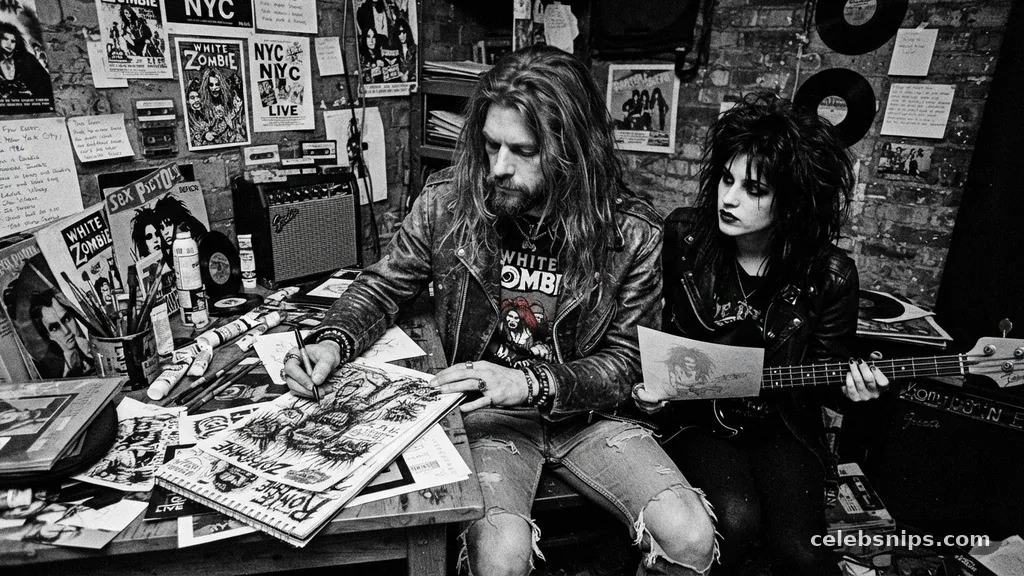
Rob Zombie’s education at Parsons helped him develop skills in illustration and visual presentation, but his professional path was not a straightforward design career. He and Yseult became involved in the New York music scene, where they began developing the sound and look that would define White Zombie.
Before the band’s commercial breakthrough, White Zombie released independent recordings and built an audience through underground performances. The group’s early work was rougher and more experimental than the polished music that later reached mainstream rock radio.
There is limited reliable public information about many private details of his childhood, including a complete account of his family life and daily experiences. Responsible biographies should avoid presenting unsourced claims about his parents, siblings, or early personal history as established fact.
White Zombie and the First Major Music Breakthrough
White Zombie formed in New York in the mid-1980s, with Rob Zombie as vocalist and Sean Yseult as bassist. The band’s lineup changed over time, but guitarist Jay Yuenger and drummer John Tempesta were important contributors during its best-known commercial period.
The group’s early releases included the EPs Gods on Voodoo Moon and Thou? Lesser God, followed by the album Make Them Die Slowly in 1989. White Zombie’s sound developed from noisy, underground metal into a more structured blend of groove metal, industrial textures, samples, and horror-inspired presentation.
The major turning point came with La Sexorcisto: Devil Music Volume One, released in 1992. The album was supported by the song “Thunder Kiss ’65,” whose video and radio exposure introduced White Zombie to a much wider audience.
“Thunder Kiss ’65” was particularly important because it showed how White Zombie could combine aggressive guitar riffs with memorable rhythmic hooks. The group did not abandon its underground image, but its production became more accessible to listeners who were also hearing alternative metal and hard rock on mainstream channels.
White Zombie’s second major studio album, Astro-Creep: 2000, arrived in 1995. It included “More Human than Human,” another signature track, and reached a higher level of commercial success than the band’s earlier work.
The album’s production and programmed elements made the band sound larger and more mechanical. Rather than treating samples and studio effects as decoration, White Zombie used them to create an identifiable environment around the riffs, vocals, and rhythm section.
Why White Zombie Mattered
White Zombie helped connect several audiences that did not always overlap. Metal listeners responded to the weight of the guitars, alternative-rock audiences heard catchy hooks, and horror fans recognized the visual references running through the band’s music videos and artwork.
The band also understood the importance of presentation during the music-video era. Its videos used edited film clips, pulpy characters, retro imagery, and surreal stage imagery, giving the songs a recognizable world instead of presenting them as ordinary performance recordings.
White Zombie broke up in the late 1990s after releasing two major-label studio albums and establishing a durable catalog. The group’s career was relatively short compared with Rob Zombie’s later solo run, but it supplied the foundation for his public identity and musical vocabulary.
Rob Zombie’s Solo Music Career
Rob Zombie began building his solo career while White Zombie was still active. He contributed the song “Hands of Death (Burn Baby Burn)” with Alice Cooper to the soundtrack for The X-Files film, a collaboration that earned Grammy recognition and demonstrated that his songwriting could function outside the band.
His first solo studio album, Hellbilly Deluxe: 13 Tales of Cadaverous Cavorting Inside the Spookshow International, was released in 1998. The album became a major commercial success and established a sound that was related to White Zombie but more directly centered on his name and creative control.
“Dragula” became the album’s most recognizable song. Its heavy guitar, electronic programming, repeated vocal phrases, and horror-themed lyrics made it especially effective for radio, music television, film soundtracks, and video games.
Other important tracks from Hellbilly Deluxe included “Living Dead Girl” and “Superbeast.” Together, the songs showed how Zombie could turn dense metal production into concise, highly visual singles without removing the theatrical edge of his work.
His second solo album, The Sinister Urge, arrived in 2001. It included “Never Gonna Stop (The Red, Red Kroovy),” a track that drew on glam-rock energy while retaining the industrial metal production associated with his catalog.
Zombie continued releasing albums throughout the 2000s and 2010s, including Educated Horses, Hellbilly Deluxe 2, Venomous Rat Regeneration Vendor, and The Electric Warlock Acid Witch Satanic Orgy Celebration Dispenser. These releases varied in emphasis, but they kept returning to his core combination of metal riffs, electronic textures, horror imagery, and oversized choruses.
His later albums include The Lunar Injection Kool Aid Eclipse Conspiracy, released in 2021. The album reached the top position on Billboard’s Top Rock Albums chart, giving Zombie a notable late-career chart achievement decades after his first major success with White Zombie.
Music Style and Live Performance
Rob Zombie’s music is often described as industrial metal or heavy rock, although those labels do not capture every element of his sound. His songs may include blues-based guitar patterns, electronic loops, shouted vocals, spoken samples, danceable grooves, and references to horror or exploitation films.
The live shows extend that approach through large visual productions. Costumes, video screens, fire effects, oversized props, and horror-inspired characters are not side details; they are part of how Zombie presents the songs to an audience.
His concert career has also included major festival appearances and tours with established metal acts. The exact lineup around him has changed repeatedly, but his stage identity has remained consistent: a frontman who treats a rock concert as a combination of performance, cinema, and spectacle.
Rob Zombie’s Most Important Songs and Albums
Rob Zombie’s discography is extensive, but several releases are especially important for understanding his career. The White Zombie albums explain his first breakthrough, while the solo records show how he translated that success into a longer personal brand.
| Release | Year | Why it matters |
|---|---|---|
| La Sexorcisto: Devil Music Volume One | 1992 | White Zombie’s breakthrough album, featuring “Thunder Kiss ’65” |
| Astro-Creep: 2000 | 1995 | White Zombie’s major follow-up, featuring “More Human than Human” |
| Hellbilly Deluxe | 1998 | Successful solo debut featuring “Dragula” and “Superbeast” |
| The Sinister Urge | 2001 | Expanded his solo sound with “Never Gonna Stop” |
| Educated Horses | 2006 | Continued his solo career during his transition into filmmaking |
| Hellbilly Deluxe 2 | 2010 | Returned to the title and aesthetic of his influential solo debut |
| The Lunar Injection Kool Aid Eclipse Conspiracy | 2021 | Reached No. 1 on Billboard’s Top Rock Albums chart |
“Dragula” remains the song most closely associated with Rob Zombie’s solo career, but its importance is partly connected to its long afterlife. The track has appeared in film, television, games, sports settings, and online fan culture, allowing it to reach listeners who may not follow metal albums closely.
“Living Dead Girl” and “Superbeast” also helped define the visual language of his first solo era. Both songs were built for memorable music videos and live performance, which mattered at a time when television exposure and soundtrack placements could substantially extend a single’s audience.
His songs often rely on repetition, but the repetition is deliberate. A short vocal phrase, a recognizable guitar figure, or a film sample can function like a logo, making the track identifiable within seconds.
That quality has helped Zombie’s work remain commercially useful across different formats. His music can operate as an album experience, a concert anthem, a soundtrack placement, or an introduction to the broader world of his films.
Rob Zombie’s Film Career
Rob Zombie’s move into filmmaking was not a complete departure from music. He had already built a visual world around horror, exploitation cinema, and theatrical characters, so directing allowed him to expand those ideas into full-length stories.
His first feature film, House of 1000 Corpses, was released in 2003 after a difficult production and distribution process. The film follows a group of young travelers who encounter the violent Firefly family, and it uses imagery drawn from 1970s horror, grindhouse cinema, and disturbing road-movie traditions.
The film introduced characters played by Sid Haig, Bill Moseley, Sheri Moon Zombie, Karen Black, and others. Captain Spaulding, played by Haig, became one of the most recognizable figures associated with Zombie’s film work.
Zombie followed it with The Devil’s Rejects in 2005. The film continued the story of the Firefly family but shifted toward a road-film structure and a harsher, more character-driven tone.
Critics often regard The Devil’s Rejects as his strongest film because it places more emphasis on the relationships and behavior of its central characters. It was also more restrained in its use of surreal editing than House of 1000 Corpses, even though the violence and subject matter remained extreme.
In 2007, Zombie directed a new version of John Carpenter’s Halloween. The film explored Michael Myers’ childhood and later return to Haddonfield, Illinois, rather than simply reproducing Carpenter’s 1978 film.
Among Rob Zombie’s films, Halloween was his largest commercial success at the box office. Public box-office records commonly place its worldwide gross at roughly $80 million, though the exact figure can vary by database and reporting method.
He later directed Halloween II, The Lords of Salem, 31, and 3 from Hell. These films show different parts of his approach, from supernatural horror and psychological imagery to survival horror and the continued story of the Firefly family.
For a reference point on his acting and directing credits, readers can consult the Rob Zombie filmography and credits listing. Film databases are useful for cataloging credits, but reviews and box-office figures may differ between sources.
What Is Rob Zombie’s Most Successful Movie?
Commercially, the 2007 Halloween is generally considered Rob Zombie’s most successful movie. It opened strongly in the United States and earned substantially more worldwide than his other features.
Commercial success and critical reputation are different measures. The Devil’s Rejects is often more highly regarded by supporters and critics who prefer its stripped-down storytelling, while Halloween had the larger mainstream audience and box-office return.
His films are not designed as conventional studio horror. They often use graphic violence, abrasive editing, grotesque humor, and damaged characters, which explains both the loyalty of his audience and the sharply divided critical response.
Visual Identity, Horror Influences, and Cultural Reach
Rob Zombie’s work is recognizable because the music and film projects share a common visual system. Vintage horror posters, circus imagery, occult symbols, monster makeup, exploitation-film typography, and old television textures appear repeatedly across album covers, videos, stage sets, and movies.
He has also used references to directors and performers from earlier horror cinema. Those references are not always direct adaptations. Often, they appear as visual echoes that place a new song or film inside a longer history of pulp entertainment.
The combination of heavy music and horror imagery helped Zombie reach audiences beyond traditional metal. A listener might discover him through a soundtrack, a video game, a horror convention, a film, or a festival lineup rather than through a rock radio station.
That cross-media reach is one reason his stage name has remained commercially valuable for decades. His identity is not tied to one album cycle. It can appear on a record, a film poster, a concert tour, a clothing line, or a collectible design and still remain recognizable.
His approach also influenced how some rock musicians think about presentation. The music is important, but Zombie has consistently treated artwork, costumes, video editing, set design, and character creation as connected parts of the same project.
There is a practical reason this matters. A strong visual identity gives individual songs a longer life because fans remember the setting and imagery around the track, not only its chorus.
Recognition and Career Milestones
Rob Zombie has received Grammy nominations during his music career, including recognition connected to his collaborations and recordings. He has also achieved multiple successful albums and singles across White Zombie and his solo catalog.
White Zombie earned substantial mainstream exposure through MTV-era videos, radio play, major tours, and soundtrack placements. The band’s success helped make industrial-leaning metal more visible to a broad rock audience in the 1990s.
As a solo artist, Zombie has maintained a touring career for more than two decades. His 2021 album reaching No. 1 on Billboard’s Top Rock Albums chart demonstrated that his audience remained active well after his initial breakthrough.
His recognition is not limited to conventional music awards. His importance is also visible in the continued use of “Dragula,” “Superbeast,” “Thunder Kiss ’65,” and “More Human than Human” in popular culture.
Personal Life, Marriage, and Public Information
Rob Zombie married actress and frequent creative collaborator Sheri Moon Zombie in 2002. She has appeared in several of his films, including House of 1000 Corpses, The Devil’s Rejects, Halloween, The Lords of Salem, and 31.
Their professional partnership is unusually visible because she has played major roles in his filmography and has also appeared in music-related projects. Her presence in his work should not be confused with an assumption that every project is autobiographical.
Publicly available information indicates that Rob Zombie and Sheri Moon Zombie do not have children. Claims about additional family details, private residences, or personal routines should be treated cautiously because neither has made every aspect of their private life public.
Zombie has generally kept the focus of interviews on music, movies, visual culture, and touring rather than providing extensive personal commentary. That makes some common biography fields, such as detailed family history and private finances, difficult to verify.
His public image is deliberately theatrical, but the stage persona should not be treated as a complete description of his private personality. The makeup, horror references, and aggressive performance style are components of an artistic brand.
Net Worth, Income Sources, and Online Presence
No authoritative public filing establishes Rob Zombie’s exact net worth. Online estimates differ because they may use incomplete assumptions about record royalties, touring income, film payments, publishing rights, taxes, production costs, private investments, and personal expenses.
His established professional income sources include recorded music, songwriting and publishing, live performances, film directing, screenwriting, producing, acting, soundtrack licensing, merchandise, and related entertainment projects. The amount earned from each category is not publicly itemized.
Music royalties can continue long after an album is released, especially when songs are licensed for films, games, advertising, television, or digital platforms. That does not mean every stream produces a large payment, because revenue is divided among rights holders, distributors, labels, publishers, and other parties.
Touring is another important part of the business. Ticket revenue must cover promoters, venues, crew, transportation, equipment, production, insurance, and management before an artist receives personal earnings.
Rob Zombie maintains a public-facing online presence connected to his music, movies, merchandise, and touring activity. Readers should verify account authenticity through his official website, verified platform profiles, or links from established professional channels rather than assuming that every account using his name is genuine.
Follower totals and social-media statistics change constantly, so they are not useful as permanent biography facts. The more reliable point is that his online activity functions mainly as a channel for announcing releases, concert dates, film projects, artwork, and merchandise.
Rob Zombie’s Current Career and Lasting Importance
Rob Zombie’s career has continued across music and film rather than settling into one role. His later albums show that he remains interested in studio experimentation, while his touring work keeps the older White Zombie and solo songs in active circulation.
His importance comes from the way he connected several forms of entertainment without treating them as separate careers. The same horror vocabulary appears in his songs, album art, stage production, screenwriting, directing, and merchandising.
He also illustrates how an artist can build a durable career from a clearly defined identity. “Dragula” is not only a song, and House of 1000 Corpses is not only a film. Each fits into a larger creative world that audiences can recognize immediately.
That world has limits. His graphic imagery and confrontational humor are not designed for every viewer, and his films have produced sharply divided reactions. Yet the consistency of the work is difficult to miss.
For new listeners, the clearest entry points are La Sexorcisto: Devil Music Volume One, Astro-Creep: 2000, and Hellbilly Deluxe. For film viewers, The Devil’s Rejects and Halloween show two different sides of his directing career.
His catalogue remains useful for understanding the overlap between rock music, horror cinema, visual branding, and live spectacle. Few performers have maintained such a recognizable identity across all four areas for as long.
Frequently Asked Questions
How old is Rob Zombie?
Rob Zombie was born on January 12, 1965. He is 60 years old as of January 12, 2025, and will turn 61 on January 12, 2026.
What is Rob Zombie’s real name?
His birth name is Robert Bartleh Cummings. He performs and works professionally under the name Rob Zombie, which was influenced by classic horror culture.
When did Rob Zombie start making music?
He began making music professionally in the 1980s after forming White Zombie in New York with Sean Yseult. White Zombie later became widely known through the 1992 album La Sexorcisto: Devil Music Volume One.
What is Rob Zombie’s most successful movie?
The 2007 remake of Halloween is generally considered his most commercially successful film. The Devil’s Rejects is often regarded as one of his strongest films by critics and longtime horror fans, but it earned less at the box office.
Is Rob Zombie married?
Yes. Rob Zombie married actress Sheri Moon Zombie in 2002. She has appeared in several of his films and has been a prominent creative collaborator throughout his directing career.
Final Takeaway
Rob Zombie’s age, career, and music success make sense as one connected story rather than three separate subjects. He moved from White Zombie’s 1990s metal breakthrough to a successful solo career, then carried the same horror-driven visual identity into films such as House of 1000 Corpses, The Devil’s Rejects, and Halloween.
The strongest verified facts are his January 12, 1965 birth date, his birth name Robert Bartleh Cummings, his marriage to Sheri Moon Zombie, and his long record of work in music and film. Exact net-worth figures and some private biographical details remain unconfirmed, so they should not be presented as fact. For a starting point, listen to the two major White Zombie albums and Hellbilly Deluxe, then compare his most successful movie with the film his fans consider his best.