

Rick Ross is the stage name of William Leonard Roberts II, the Miami rapper known for his deep-voiced delivery, luxury-focused lyrics, and the Maybach Music Group label. Born on January 28, 1976, he is 50 years old as of March 2026, and his career has stretched from the release of “Hustlin’” to major albums, business ventures, and high-profile real-estate purchases.
Questions about Rick Ross’s age, career, and net worth usually mix confirmed facts with estimates. His music catalog and public businesses are well documented, but no audited public statement establishes his exact wealth. The clearest picture comes from separating his verified career milestones from reported property values, brand income, and celebrity net-worth estimates.
Rick Ross at a Glance
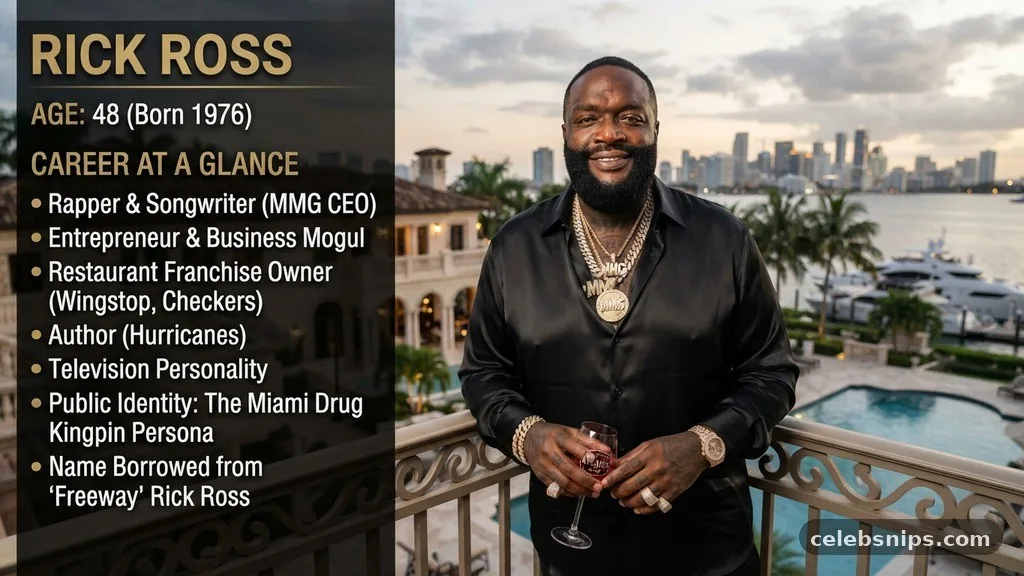
Rick Ross built his public identity around the persona of a powerful Miami drug kingpin, but his professional life has included far more than recording music. He has been a rapper, record-label executive, entrepreneur, restaurant franchise owner, author, and television personality.
The name “Rick Ross” was borrowed from “Freeway” Rick Ross, a former Los Angeles drug trafficker. William Roberts later acknowledged that his stage name was connected to that figure, although the rapper’s own life and career should not be confused with the other man’s criminal history.
| Detail | Information |
|---|---|
| Professional name | Rick Ross |
| Birth name | William Leonard Roberts II |
| Date of birth | January 28, 1976 |
| Age | 50 as of March 2026 |
| Birthplace | Clarksdale, Mississippi; raised in Carol City, Florida |
| Profession | Rapper, record executive, entrepreneur, and author |
| Record label | Maybach Music Group, commonly abbreviated as MMG |
| Major-label debut | Port of Miami, released in 2006 |
| Known for | “Hustlin’,” Trilla, Deeper Than Rap, and the Maybach Music Group roster |
| Estimated net worth | Not officially verified; online estimates commonly place it in the nine-figure range |
Some profiles list Clarksdale as Ross’s birthplace, while most accounts describe Carol City, Florida, as the community where he grew up and developed his connection to Miami hip-hop. That distinction explains why both Mississippi and Miami appear in biographies about him.
Early Life and Miami Background
William Leonard Roberts II was born in Clarksdale, Mississippi, on January 28, 1976. His family moved to Florida, and he was raised in Carol City, a Miami-area community that has been closely associated with the development of Southern rap.
Ross has often connected his artistic identity to Miami’s streets, cars, nightlife, and regional sound. His music drew from the booming bass, sharp hi-hats, and larger-than-life storytelling that had shaped Southern hip-hop before he released his first major-label album.
Public biographies generally identify him as a graduate of Miami Carol City Senior High School. He later attended Albany State University in Georgia on a football scholarship, although detailed information about his academic experience is limited in the public record.
Before music became his full-time career, Roberts worked as a correctional officer in Florida. The job became a major point of discussion after his rap career began because the authoritative “boss” persona in his lyrics appeared very different from his earlier employment.
Photographs and employment records connected Roberts to that correctional-officer role, and he did not maintain that part of his biography as a secret indefinitely. The contrast gave critics material to question his stage persona, while Ross treated the experience as one part of the path that preceded his record deal.
His early history matters because Rick Ross did not emerge from an established entertainment family or a previously famous acting career. His route was local and gradual: school, work, independent recordings, regional recognition, and then a major-label opportunity built around one highly effective single.
How Rick Ross Started Rapping
Ross began recording and performing before his mainstream breakthrough, initially using the name Teflon Da Don. During the 1990s and early 2000s, he appeared on regional projects and worked to build credibility in Florida’s competitive rap scene.
His early recordings were not immediate national hits. Like many rappers, he spent years developing a voice, a visual identity, and relationships with producers and artists before the wider industry had a reason to pay attention.
The turning point came with “Hustlin’,” a song built around a repetitive, instantly recognizable hook and a forceful delivery. The track presented Ross as a confident street entrepreneur and gave labels a clear commercial image to market.
Def Jam Recordings signed Ross after “Hustlin’” attracted major attention. Jay-Z, who was then serving as Def Jam’s president, was involved in the label environment surrounding the signing, and the deal moved Ross from regional promise to national release.
The song’s central refrain became a marketing asset as much as a musical one. It was easy to remember, easy to quote, and strong enough to anchor radio promotion, club play, and the campaign for Ross’s first album.
His early success also reflected timing. Southern rap had become a dominant commercial force by the middle of the 2000s, and artists from Florida could reach national audiences without abandoning regional slang, production styles, or local identity.
Ross’s story was therefore not simply about being discovered overnight. “Hustlin’” was the breakthrough, but it worked because he had already developed a consistent vocal style and a persona that could support a full album and a long-term commercial career.
Breakthrough With Port of Miami
Port of Miami was released in August 2006 through Def Jam Recordings. The album debuted at number one on the Billboard 200, a major achievement for a new rapper making his first national album campaign.
The project included “Hustlin’,” “Push It,” and “Pushing Me Away,” among other tracks. Its production connected Ross with established names such as The Runners, DJ Khaled, and other figures from the Southern rap ecosystem.
The album’s title tied the rapper directly to Miami’s geography and culture. Rather than presenting him as a generic national star, the project used the city’s port, luxury imagery, and street mythology as part of its identity.
The success of Port of Miami gave Ross a reliable platform for future releases. It also established the formula that would define much of his work: heavy production, repeated luxury references, vivid food and car imagery, and a voice that sounded deliberately imposing.
His debut was commercially important because it changed how the industry viewed him. He was no longer simply a rapper with a viral regional song; he was an album artist with enough audience interest to lead a national release.
Readers interested in his chart history can compare major releases through Billboard’s Rick Ross artist page. Chart positions are useful context, although they do not measure every part of an artist’s influence or financial success.
The album also introduced a tension that continued throughout Ross’s career. The more successful he became, the more attention critics paid to the difference between William Roberts’s documented background and the fictionalized “Rick Ross” character in his music.
Albums, Singles, and Musical Style
After his debut, Ross released Trilla in 2008. The album reached number one on the Billboard 200, extending the momentum of Port of Miami and confirming that his first success was not a one-album event.
Trilla included “The Boss” and “Here I Am,” tracks that reinforced Ross’s preference for grand production and commanding themes. The album title referenced his nickname and also nodded to the influence of Southern rap’s larger-than-life presentation.
His next major project, Deeper Than Rap, arrived in 2009. It included “Magnificent,” “Maybach Music 2,” and “Usual Suspects,” and it showed Ross working with a wider group of collaborators while refining the polished sound associated with his brand.
Ross continued releasing substantial studio albums rather than relying only on singles. Later projects included Teflon Don, God Forgives, I Don’t, Mastermind, Hood Billionaire, Black Market, Rather You Than Me, Port of Miami 2, and Richer Than I’ve Ever Been.
Several releases received major chart recognition. God Forgives, I Don’t, released in 2012, became another number-one album in the United States and earned a Grammy nomination for Best Rap Album.
His catalog has included collaborations with Jay-Z, Kanye West, Drake, Lil Wayne, T-Pain, Ne-Yo, Nas, Meek Mill, Wale, and DJ Khaled. These collaborations helped him move between traditional street rap, radio singles, luxury-themed anthems, and more reflective records.
- “Hustlin’”: the 2006 breakout single that introduced Ross to a national audience.
- Port of Miami: his number-one major-label debut.
- Trilla: the 2008 album that also opened at number one.
- Deeper Than Rap: a 2009 project that expanded his luxury-rap presentation.
- God Forgives, I Don’t: a 2012 number-one album and Grammy-nominated release.
- Port of Miami 2: a 2019 sequel that returned to the setting and identity of his debut.
Ross’s vocal style is central to his appeal. His low register allows even a simple line to sound weighty, while his repeated references to Maybach automobiles, expensive watches, food, property, and business ownership create a consistent world across his albums.
He has also used spoken openings, producer tags, and carefully placed guest verses to make individual songs feel like events. The approach is less about technical speed than presence, atmosphere, and the ability to make a record feel expensive.
Maybach Music Group and Business Expansion
Maybach Music Group, usually called MMG, became one of the most important parts of Ross’s career after his solo breakthrough. The label gave him a way to develop artists, release collaborative projects, and build a business identity that extended beyond his own albums.
MMG became associated with artists including Meek Mill, Wale, Stalley, Gunplay, and Omarion at different points in its history. The roster changed over time, but the label’s compilation albums helped create a recognizable collective sound and brand.
The label released projects such as Self Made Vol. 1, Self Made Vol.
2, and later installments. These compilations placed several rappers under the same commercial umbrella and allowed Ross to function as both a performer and an executive.
His role at MMG also changed the economics of his career. A solo artist may earn from recordings and performances, but a label founder can potentially participate in a broader set of activities, including artist agreements, project releases, licensing, touring, and brand partnerships.
Those opportunities are not automatically the same as personal profit. Record labels carry marketing costs, production expenses, distribution arrangements, advances, and contractual obligations, so the existence of a label does not prove a specific level of income.
Ross also expanded into food and consumer business. He became closely associated with Wingstop franchise ownership and has publicly discussed owning multiple locations, though exact figures and current ownership arrangements can change and should not be treated as a permanent public inventory.
The Wingstop connection became part of his public image because he mentioned the restaurants in songs and interviews long before many fans understood that he had a business interest in the chain. It linked his musical branding to an ordinary consumer product with recognizable locations and recurring sales.
He has also promoted other ventures, including liquor and lifestyle-related products. Public discussions often list these businesses as reasons his wealth may exceed his recording income, but private ownership percentages, debts, taxes, and operating profits are not fully disclosed.
That distinction is important. A company associated with Rick Ross may generate revenue without sending all of that revenue directly to him, and a franchise location may have costs that substantially reduce the owner’s final profit.
Rick Ross Real Estate and Luxury Image
Real estate is one of the most visible parts of Rick Ross’s public lifestyle. His properties have appeared in music videos, interviews, social-media posts, and news coverage, making houses a central part of how audiences understand his wealth.
His best-known property is a large estate in Fayetteville, Georgia, outside Atlanta. Ross purchased the property in 2014 after it had been associated with boxer Evander Holyfield, and public reports have described the mansion as unusually large, with more than 100 rooms.
The estate became widely known as the “Promise Land.” Reports have highlighted its expansive grounds, swimming pool, dining areas, guest rooms, and grand interior spaces, although descriptions of the room count and square footage have varied across media accounts.
He has also owned or been associated with property in the Miami area, including residences connected to the city’s luxury real-estate market. Exact current holdings are difficult to establish because property ownership can be held through companies, can change after a sale, and is not always presented in one public list.
Real estate can support a celebrity’s image while also creating significant expenses. Property taxes, insurance, security, maintenance, utilities, staff, renovations, and financing costs all affect the actual financial value of a mansion.
Ross’s houses are important to his career because they are not merely private residences in his public storytelling. They appear as symbols of the success described in his lyrics, especially his emphasis on land, rooms, cars, pools, and entertaining.
His luxury image has remained consistent even when his projects have explored more personal subjects. A Maybach, a mansion, or a large dinner scene can function as a recurring visual signature, just as much as his deep voice or the MMG label.
Still, a property’s estimated market value is not the same as liquid cash. Someone can own a valuable mansion and have substantial wealth tied up in it while carrying equally significant borrowing, maintenance, or tax obligations.
Rick Ross Net Worth and Income Sources
Rick Ross’s exact net worth is not publicly verified. Online celebrity-finance publications frequently publish estimates around $150 million, but that figure should be treated as an estimate rather than an audited fact from Ross, his accountant, or a public financial filing.
Net-worth estimates differ because no complete public balance sheet shows his assets, liabilities, ownership stakes, royalties, taxes, or annual spending. One outlet may count a property at a headline market value, while another may use a lower value or exclude debt connected to that property.
His potential income sources include several distinct categories:
- Music sales and streaming: royalties from albums, singles, publishing, and recordings.
- Live performances: appearance fees, concerts, festivals, and private events.
- Maybach Music Group: revenue connected to label activity and artist projects, subject to contracts and expenses.
- Brand partnerships: paid promotions and commercial collaborations.
- Franchise ownership: reported interests in Wingstop locations and their operating profits.
- Real estate: property appreciation, sales, and the value of owned residences or land.
- Books and media: income from publishing, interviews, television, and other appearances.
Music remains the foundation. A successful catalog can produce several kinds of royalties over time, including sound-recording income, publishing income, performance royalties, and licensing payments.
Streaming revenue is also complicated. The amount paid to an artist depends on the platform, territory, rights ownership, distributor, label contract, co-writers, producers, and the number of parties sharing the recording’s income.
Live appearances can be lucrative for a rapper with a large catalog, but fees vary by event, location, travel demands, production, management commissions, and the artist’s availability. Publicly reported booking figures are not proof of annual take-home pay.
Ross’s businesses may be just as important as his albums in explaining why estimates place him in the millionaire or multimillionaire range. Even so, the responsible answer to “Is Rick Ross a billionaire?” is no verified public evidence establishes billionaire status.
The comparison with 50 Cent is also more complicated than a single internet number. Both men have music catalogs, business interests, property, brand relationships, debts, taxes, and changing valuations, so online rankings can shift without revealing either artist’s complete financial position.
A more defensible conclusion is that Ross is widely regarded as a multimillionaire with several income streams. His exact net worth remains unconfirmed, and readers should be skeptical of any page that presents a precise figure as official without identifying a credible financial source.
Personal Life, Family, and Public Image
Rick Ross has children, but he generally keeps much of his family life outside the detailed public record. Reports have identified several children, yet information about their private lives should not be expanded beyond what Ross or reputable reporting has made public.
He has been publicly linked to several women over the years, including model and entrepreneur Lastonia Leviston, who is the mother of one of his children. He was also publicly engaged to Lira Galore in 2015, but that engagement ended before marriage.
Ross has not been publicly established as currently married. Search results sometimes use the word “wife” loosely, but a past relationship, engagement, or co-parenting arrangement does not prove a current marriage.
His health has also received public attention. In 2018, Ross experienced a serious health emergency and later discussed lifestyle changes, exercise, and diet in interviews and social-media content.
That experience influenced the way he spoke about longevity and daily habits, although claims about his current medical condition should not be inferred from photographs or isolated posts. A public figure’s appearance is not a reliable medical record.
The rapper’s public persona is deliberately larger than ordinary life. He uses luxury cars, large meals, designer clothing, elaborate homes, and entrepreneurial language to create a character who appears to have complete control over money and status.
That persona has attracted both admiration and criticism. Supporters point to his longevity, catalog, and business development, while critics have questioned the authenticity of the character and the gap between the lyrics and Roberts’s documented background.
The stage name itself produced one of the most persistent identity discussions in his career. Freeway Rick Ross criticized the rapper for using the name, while the artist continued to perform under it and built a separate entertainment identity that is now internationally recognized.
Controversies and Career Challenges
Ross’s correctional-officer history became controversial because it conflicted with the street-focused image he used in his lyrics. The issue did not end his career, but it became a recurring subject in interviews, commentary, and disputes with other artists.
Another major issue involved copyright and identity concerns raised by Freeway Rick Ross. The former drug trafficker sued William Roberts over the use of the name, but the legal dispute did not prevent the rapper from continuing to use “Rick Ross” commercially.
The rapper has also faced public disputes with other performers. Some conflicts were expressed through diss records or interviews rather than court findings, and they should be understood as parts of hip-hop rivalry rather than automatically treated as proven allegations.
In 2013, Ross was involved in a legal case relating to a kidnapping and assault incident in Georgia. He and a co-defendant later entered guilty pleas to charges connected with the incident and received probation, according to contemporary reporting.
That case is different from a rumor because it involved a criminal court proceeding. Even so, a responsible biography should describe the legal outcome accurately rather than sensationalize the incident or attach unrelated allegations to it.
Ross’s career has also had ordinary business challenges. A franchise owner can face operating costs, staffing problems, lease obligations, and changing consumer conditions, while a recording artist can face label disputes, delayed releases, and shifting streaming economics.
These complications help explain why public images of effortless wealth can be misleading. Celebrity businesses may be real and valuable while still requiring management, capital, legal oversight, and ongoing work.
Current Career and Lasting Influence
Rick Ross remains associated with recording, touring, collaborations, MMG, and business promotion. His career has lasted nearly two decades since Port of Miami, which is a significant period in an industry where many artists struggle to maintain visibility after an initial breakout.
His influence is strongest in the way he combined Southern rap’s regional identity with luxury branding. The result was a commercial persona that could work on radio, in clubs, on album covers, and in advertisements without losing its Miami connection.
Ross also helped make the record-label executive role part of his public identity. Through Maybach Music Group, he was not only competing for chart positions but also presenting a roster, organizing collaborations, and giving younger rappers a larger platform.
His album strategy favored consistency and volume. Rather than disappearing for long periods, he released projects, guest verses, singles, and collaborative music that kept his voice in circulation.
At the same time, his work has not depended solely on current chart performance. A catalog with recognizable songs can continue producing value through streaming, playlists, touring, licensing, and nostalgia-driven audience demand.
The name Rick Ross has also become a brand separate from any single song. Maybach references, MMG logos, Wingstop discussions, mansion videos, and motivational business talk all reinforce the same public narrative of expansion and wealth.
That narrative explains why readers search not only for his albums but also for his houses, businesses, age, relationships, and net worth. His career has been built across entertainment and commerce, so no single category tells the whole story.
His lasting significance is therefore not limited to record sales. Ross represents a model of the modern rapper as artist, executive, franchise owner, property investor, media personality, and lifestyle brand, even though the exact financial results of each activity remain private.
Frequently Asked Questions
How old is Rick Ross?
Rick Ross was born on January 28, 1976. He is 50 years old as of March 2026; his age will change after each January 28 birthday.
What is Rick Ross’s real name?
His birth name is William Leonard Roberts II. He performs under the professional name Rick Ross, which he adopted before becoming a nationally known rapper.
Where is Rick Ross from?
He was born in Clarksdale, Mississippi, and raised in Carol City, Florida. His music and public identity are strongly associated with Miami, especially the Carol City area.
When did Rick Ross start rapping?
Ross recorded and performed before his major-label debut, initially using the name Teflon Da Don. His national breakthrough came in 2006 with “Hustlin’,” followed by the release of Port of Miami.
Is Rick Ross married?
No current marriage has been reliably established in the public record. He has had publicly reported relationships and was engaged to Lira Galore in 2015, but the engagement ended before a wedding.
Does Rick Ross have children?
Yes. Public reporting has identified multiple children, but details about their private lives should be handled carefully because they are not public figures in the same way he is.
What is Rick Ross’s net worth?
There is no officially verified public figure. Online estimates often place his wealth near $150 million, but that number is an estimate that may include property, business interests, music income, and other assets without fully accounting for debt or expenses.
Is Rick Ross a billionaire?
No credible public evidence confirms that Rick Ross is a billionaire. He is widely regarded as a multimillionaire, but private ownership details and liabilities make a precise calculation impossible.
How many houses does Rick Ross own?
The exact number of homes he currently owns has not been reliably established. His best-known property is the large Promise Land estate in Fayetteville, Georgia, while other reported residences and investments may have changed over time.
What businesses does Rick Ross own?
He is associated with Maybach Music Group and has publicly discussed ownership of multiple Wingstop franchises. He has also participated in brand partnerships and other ventures, but the precise ownership structure and current value of every business are not fully public.
Final Takeaway
Rick Ross is a 50-year-old rapper and entrepreneur whose career began in Miami-area hip-hop and broke nationally with “Hustlin’” and Port of Miami. His later work expanded through number-one albums, Maybach Music Group, franchise interests, real estate, and a carefully maintained luxury persona.
The strongest answer about Rick Ross’s age, career, and net worth separates documented milestones from financial estimates. His multimillionaire status is widely accepted, but no authoritative public record proves an exact net-worth figure. For the clearest picture, treat chart results, property reports, business claims, and online estimates as different kinds of evidence rather than one official balance sheet.