
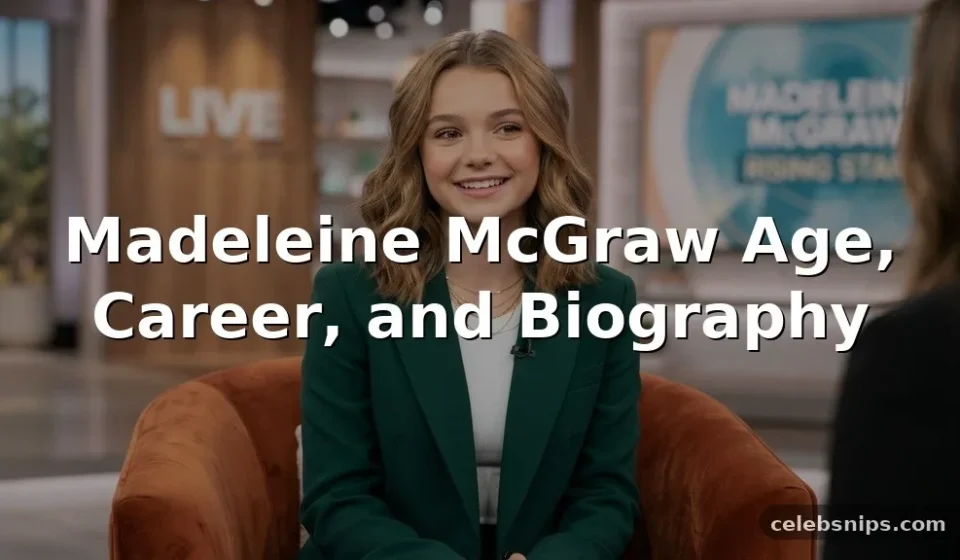

Madeleine McGraw is an American actress known for playing Gwen Shaw in the horror film The Black Phone and Zoey Campbell in the Disney Channel series Secrets of Sulphur Springs. Born in December 2008, she is 17 years old as of March 2026. Her career began when she was a child, with early credits in television, film, and voice work before she took on larger dramatic roles.
Interest in Madeleine McGraw’s age, career, and biography has grown because her work spans family entertainment, science fiction, supernatural drama, and horror. The most useful way to understand her career is to follow that progression: early screen appearances, recognizable supporting roles, her breakthrough in The Black Phone, and the television performance that introduced her to a younger Disney audience.
Madeleine McGraw at a Glance

Madeleine McGraw was born in the United States on December 22, 2008, according to widely published biographical information. Her exact birthplace and detailed family background have not been consistently documented by authoritative public sources, so those details should not be treated as confirmed.
| Category | Publicly reported information |
|---|---|
| Full name | Madeleine McGraw |
| Birthday | December 22, 2008 |
| Age | 17 as of March 2026 |
| Nationality | American |
| Profession | Actress and voice actress |
| Years active | Publicly credited since the mid-2010s |
| Best known for | The Black Phone and Secrets of Sulphur Springs |
| Notable early film credit | Ant-Man and the Wasp as young Hope van Dyne |
| Parents | Names are not reliably established in major public sources |
| Height | No consistently verified public measurement |
The table separates established career information from details that are often repeated without dependable confirmation. Online biography pages frequently publish a height, hometown, or net-worth figure, but repetition alone does not make a claim reliable.
- Age in 2026: 17, based on the reported December 22, 2008 birthday.
- Primary fields: live-action acting and voice acting.
- Major audience groups: horror fans, Disney Channel viewers, and families familiar with Marvel films.
- Most recognized role: Gwen Shaw in The Black Phone.
- Most prominent television role: Zoey Campbell in Secrets of Sulphur Springs.
Madeleine McGraw’s Age and Birthday
Madeleine McGraw is 17 years old in 2026. She turned 17 on December 22, 2025, and will turn 18 on December 22, 2026. Age calculations should always be tied to a date because the answer changes each year.
Her December birthday is one of the most frequently searched details about her. Some entertainment pages display only the year of birth, while others list the full date, but the December 22 date is the commonly reported biographical detail across public entertainment databases and profile pages.
Her age also helps explain the shape of her filmography. She entered the industry as a young performer and appeared in projects made for very different audiences, including Marvel superhero films, family television, and the mature horror genre.
It would be misleading, however, to use her age as a measure of experience. By the time she appeared in The Black Phone, McGraw had already accumulated years of credited work in front of cameras and in voice booths.
Her public biography should still be kept separate from personal assumptions. A birth date does not establish a birthplace, educational history, residence, or private family circumstances, and no reliable source should be used to fill those gaps with guesses.
Early Life and Family Background
Public information about McGraw’s early life is limited compared with the amount of attention given to her acting credits. She was born in the United States and began working professionally while she was young, but detailed accounts of her childhood outside acting have not been broadly documented by authoritative sources.
McGraw is part of a family with more than one young performer. Her sister, Violet McGraw, is also an actress and is known for roles including young Nadia in M3GAN. That shared professional connection is publicly visible, but it should not be expanded into unsupported claims about how the family manages its private life.
Names and occupations attributed online to McGraw’s parents are not consistently confirmed through strong primary or major journalistic sources. For that reason, the responsible answer to questions about her parents is that some family information is publicly discussed, but the identities and personal details of her parents are not firmly established in the public record.
The same caution applies to questions about siblings. Violet McGraw’s career is well documented, while broader lists of alleged siblings can vary from one profile to another. A biography should identify the confirmed sibling connection without presenting every online family list as fact.
There is also no dependable public account showing that McGraw followed a particular formal acting school or university path. Since she began acting as a child, professional auditions and on-set experience appear to have been more visible parts of her development than a documented traditional training biography.
How Her Acting Career Began
McGraw’s early career developed through short television appearances, films, and voice roles. This is a common route for child actors, because voice work can offer a different performance environment from live-action production while still requiring timing, emotional clarity, and careful direction.
One early screen credit connected her to the Marvel Cinematic Universe. In Ant-Man and the Wasp, she played young Hope van Dyne, the younger version of the character later played by Evangeline Lilly. The part was brief, but it placed McGraw in a major studio production with a global audience.
The Marvel credit is sometimes described in searches as “Ant-Man Wasp” or “Ant-Man and the Wasp young Hope.” The precise character matters because McGraw did not play the adult Wasp; she portrayed Hope van Dyne in a flashback sequence.
McGraw also appeared in projects outside superhero storytelling. Her early credits included work in film and television, giving her experience with different production styles before her best-known roles arrived.
That early variety became important later. A performer working in children’s television must often sustain a clear, energetic rhythm, while a horror film demands controlled fear, silence, and reactions that feel believable without becoming exaggerated.
Voice acting brought another set of requirements. In a recording booth, an actor may need to create a character without costumes, sets, or another performer physically present, relying on vocal choices and direction to communicate the scene.
Breakthrough Role in The Black Phone
McGraw’s major breakthrough came with The Black Phone, Scott Derrickson’s 2021 horror film based on Joe Hill’s short story. She played Gwen Shaw, the sister of Finney Shaw, the boy at the center of the story, played by Mason Thames.
Gwen is not simply a supporting child character. She has a strong connection to the film’s supernatural mystery, and her dreams provide information that helps move the investigation forward. That makes the role unusually important to the story’s structure.
The film follows Finney after he is abducted by a killer known as the Grabber. While he is held in a soundproof basement, a disconnected black telephone begins receiving calls from victims of the same criminal. Gwen’s dreams and determination outside the basement create a parallel strand of suspense.
McGraw’s performance required her to balance a child’s vulnerability with moments of forceful certainty. Gwen is frightened, but she is not passive, and the character’s urgency gives the film some of its most direct emotional movement.
Her work also benefited from the film’s restrained approach to horror. Rather than relying only on loud reactions, the performance uses pauses, facial responses, confusion, and sudden shifts in confidence. Those details help Gwen feel like a person dealing with something she cannot easily explain.
The film became a significant theatrical horror release, and McGraw’s performance drew attention from genre audiences and awards organizations. Readers can find basic production information through the official Universal Pictures page for The Black Phone.
Some searches connect McGraw with a “Saturn Award” because she received recognition in the younger-performer category for her work in the film’s awards cycle. Award listings can differ depending on whether they refer to a nomination, a win, or a particular year’s ceremony, so individual claims should be checked against the official award record rather than repeated from celebrity profile pages.
Secrets of Sulphur Springs and Disney Work
McGraw reached an even wider family audience through the Disney Channel series Secrets of Sulphur Springs. She played Zoey Campbell, a character connected to the show’s group of young protagonists and its mystery-driven story.
The series combines time travel, school friendships, family tension, and supernatural elements. Its central setting is a Louisiana hotel with a history linked to the disappearance of a girl, and the story uses secrets from the past to affect the lives of children in the present.
For McGraw, the role called for a different tone from The Black Phone. The Disney Channel production is designed for a younger audience, so the performances need to carry mystery and emotional stakes without the grim intensity of an adult horror film.
Her work on the series also placed her within an ensemble rather than making her character the sole dramatic focus. Ensemble television requires performers to build believable relationships across episodes, maintain continuity, and support storylines that may shift between mystery, comedy, and family drama.
The title is sometimes shortened in searches to “Secrets Sulphur Springs,” but the full series title is Secrets of Sulphur Springs. The show’s connection to Disney makes it one of the clearest reasons parents and younger viewers may search for McGraw separately from horror audiences.
The series also demonstrated the breadth of her screen work. A performer can move from a disturbing film such as The Black Phone to a supernatural adventure series without those projects serving the same audience or requiring the same emotional register.
Other Films, Voice Roles, and Screen Credits
Although The Black Phone and Secrets of Sulphur Springs are her most searchable credits, McGraw’s biography is not limited to those two titles. Her filmography includes early live-action work, voice performances, and parts connected to established entertainment franchises.
Her role as young Hope van Dyne in Ant-Man and the Wasp is particularly useful for understanding how her career developed. It came before her horror breakthrough and showed that she could work within a large-scale production with extensive visual effects and a pre-existing fictional universe.
McGraw also appeared in the science-fiction film Pacific Rim: Uprising. The movie expanded the giant-monster and giant-robot world introduced by the earlier Pacific Rim film, giving her another connection to a major studio genre production.
Her voice work deserves separate attention because animation is not simply live-action acting without a camera. Voice performers have to communicate age, attitude, fear, humor, and relationships through sound, often while recording lines out of sequence.
Search results sometimes associate Madeleine McGraw with The Mitchells vs. the Machines. That title should not automatically be treated as one of her confirmed principal credits, because online cast lists and name-based search results can create confusion. A careful filmography should rely on a verified credit for the specific title rather than assuming that every matching search result identifies the same performer.
She has also been connected with projects aimed at younger audiences, where the performance style is generally more accessible and direct. Those credits matter because they show that her career was not built around one genre alone.
A useful way to read her filmography is by performance type:
- Live-action drama: scenes that depend on facial reactions, physical presence, and interaction with other actors.
- Horror: controlled fear, tension, suspense, and emotional reactions to threats that may not be visible on screen.
- Family and children’s television: clear ensemble work with mystery, humor, and accessible emotional stakes.
- Voice acting: vocal characterization and timing without relying on costume or physical setting.
- Franchise productions: work within established worlds such as Marvel and science-fiction action films.
Performance Style and Professional Development
McGraw’s career is notable for the contrast between her roles rather than for one fixed screen persona. Gwen Shaw in The Black Phone is urgent and emotionally exposed, while Zoey Campbell belongs to a lighter, serialized mystery environment designed for a younger audience.
That contrast shows why a child actor’s professional development cannot be judged only by the number of credits. The demands of a horror film, a Disney Channel series, a Marvel flashback, and an animated recording session are different even when the performer is the same age.
In The Black Phone, McGraw’s character often has to react to information that other people do not accept immediately. The performance works because Gwen’s certainty is paired with visible fear, allowing the audience to understand that bravery does not mean the absence of panic.
Television requires a different kind of consistency. In a series such as Secrets of Sulphur Springs, a performer must preserve the character’s relationships and emotional history across multiple episodes while responding to new twists in the mystery.
Her professional path also illustrates the value of early genre range. A young actor who works only in one format may become strongly associated with that format, but McGraw’s credits have allowed audiences to see her in grounded family scenes, supernatural storytelling, horror, action, and voice work.
It is too early to make definitive claims about the direction of her adult career. Publicly available information supports a description of her as an established young performer with experience across several genres, not a prediction about which industry path she will choose next.
Awards, Recognition, and Public Profile
McGraw’s recognition has been connected most strongly to The Black Phone. The film placed her in conversations about young performers in horror, a category that often requires actors to carry unusually demanding emotional material.
References to a Saturn Award appear in searches about her career because the Saturn Awards recognize science fiction, fantasy, and horror work, including performances by younger actors. Readers should distinguish between an award nomination and a win, since entertainment pages sometimes use “award-winning” loosely or fail to name the exact ceremony.
The phrase “best performance by a younger actor” may refer to the title of an awards category rather than a general description of her acting. Any claim that she won a specific award should be checked against the organization’s published results for the relevant year.
Her recognition also comes from audience visibility. Marvel introduced her to franchise-film viewers, Disney Channel gave her recurring television exposure, and The Black Phone connected her with horror audiences who may not have seen her earlier work.
That combination is more informative than an unsupported ranking or popularity claim. It shows how separate entertainment markets can contribute to the recognition of one performer without proving that every online metric is current or comparable.
There is no reliable public basis for assigning McGraw a precise net worth. Celebrity websites often publish exact dollar figures, but private contracts, taxes, representation fees, household expenses, savings, and other assets are not publicly available in a way that would support a verified calculation.
Her likely professional income sources are acting fees and related entertainment work, but the amounts and terms of her contracts are not public. Any net-worth estimate should therefore be labeled speculative, not reported as an established fact.
Personal Life, Social Media, and Privacy
McGraw’s public identity is primarily professional. She has discussed or appeared publicly in connection with acting projects, but detailed information about her private relationships, daily life, residence, and long-term plans is not reliably established.
There is no dependable public evidence that she is married or has children. She is also still a minor as of March 2026, which makes unsupported speculation about dating or private relationships especially inappropriate.
Her sister Violet McGraw is a publicly known actress, but the existence of a sibling in the entertainment industry does not justify assumptions about family finances, management arrangements, or private household decisions. Those matters have not been documented sufficiently for a responsible biography.
Social-media searches can create another source of confusion. Accounts using an actor’s name are not automatically official, and usernames, follower totals, and platform activity can change quickly. Unless an account is clearly attributable through a verified profile or a trusted official channel, it should not be presented as McGraw’s confirmed account.
The same caution applies to height. No consistently verified public measurement establishes Madeleine McGraw’s exact height, and figures copied between celebrity websites should not be treated as authoritative simply because they match.
For readers researching her current career, official production announcements and established entertainment reporting are more dependable than anonymous biography pages. A current role, casting announcement, or release date should be checked against a source connected to the production before being presented as confirmed.
What Madeleine McGraw Is Known For Today
Madeleine McGraw is best known for three connected parts of her career: Gwen Shaw in The Black Phone, Zoey Campbell in Secrets of Sulphur Springs, and young Hope van Dyne in Ant-Man and the Wasp. Together, those roles explain why searches for her include horror, Disney, Marvel, age, family, and filmography questions.
Her work is also notable because it reaches different age groups. Younger viewers may know her from Disney Channel, Marvel fans may recognize her from the Ant-Man film, and horror audiences are more likely to identify her with Gwen’s role in The Black Phone.
There is no need to exaggerate her status to explain her importance. She has a documented career that began young, includes recognizable productions, and shows a range of performance settings. Claims about future projects, awards, wealth, or adult career direction should remain separate from those confirmed facts.
Her next career stage will likely receive attention because she is moving from child roles toward older-teen and adult parts. Still, unless a new project has been officially announced, it is better to describe her current status through her established filmography than through predictions.
Frequently Asked Questions
How old is Madeleine McGraw in 2026?
Madeleine McGraw is 17 years old as of March 2026. Her reported birthday is December 22, 2008, so she will turn 18 on December 22, 2026.
What is Madeleine McGraw famous for?
She is best known for playing Gwen Shaw in the horror film The Black Phone and Zoey Campbell in the Disney Channel series Secrets of Sulphur Springs. She also played young Hope van Dyne in Ant-Man and the Wasp.
Who are Madeleine McGraw’s parents?
The names and personal details of Madeleine McGraw’s parents are not reliably established in major public sources. Her sister Violet McGraw is a publicly known actress, but broader family claims should be treated cautiously unless independently confirmed.
Is Madeleine McGraw related to Violet McGraw?
Yes. Madeleine McGraw and Violet McGraw are sisters, and both have worked as actresses. Violet is known for roles including young Nadia in M3GAN.
What is Madeleine McGraw’s net worth?
No authoritative public source verifies Madeleine McGraw’s net worth. Online estimates may differ, but they generally lack access to her contracts, taxes, expenses, savings, and private assets, so an exact figure should not be treated as fact.
Final Takeaway
Madeleine McGraw’s career has developed from early child-actor and voice roles into recognizable work across Marvel, Disney Channel television, science fiction, and horror. Her most important public credits are Gwen Shaw in The Black Phone, Zoey Campbell in Secrets of Sulphur Springs, and young Hope van Dyne in Ant-Man and the Wasp.
The clearest account of Madeleine McGraw’s age, career, and biography is also the most careful one: her December 22, 2008 birthday and major acting credits are widely reported, while her height, net worth, parents’ identities, and private relationships are not firmly established. For future updates, rely on verified production announcements and official award records rather than unsupported celebrity-profile claims.