
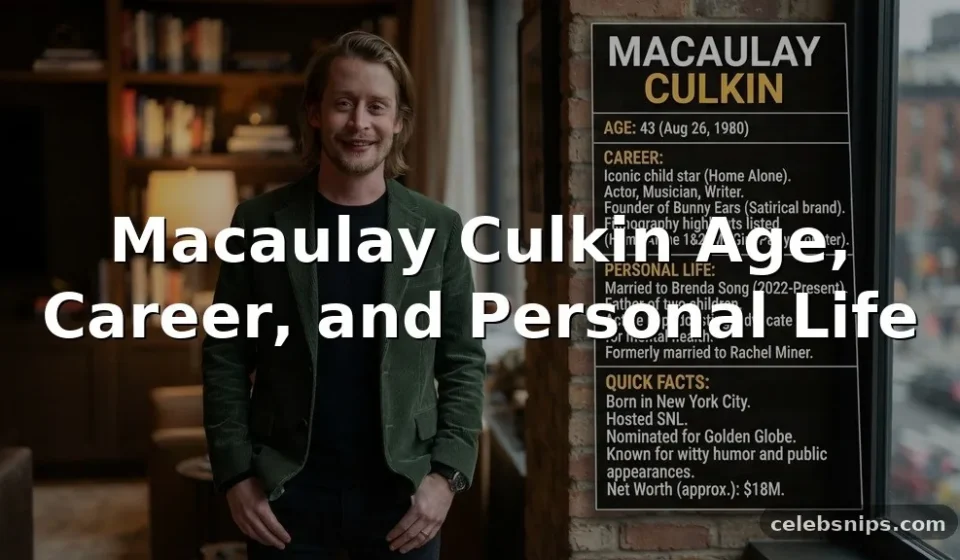

Macaulay Culkin is an American actor best known for playing Kevin McCallister in Home Alone and Home Alone 2: Lost in New York. Born on August 26, 1980, he turned 45 in August 2025, making his age one of the most searched facts about a performer who became famous unusually young.
His story extends well beyond one Christmas comedy. Macaulay Culkin’s career includes major films, a long break from mainstream acting, independent projects, music, podcasting, and a private family life with actor Brenda Song. The details below separate confirmed information from estimates, old reports, and claims that have not been reliably established.
Quick Facts About Macaulay Culkin
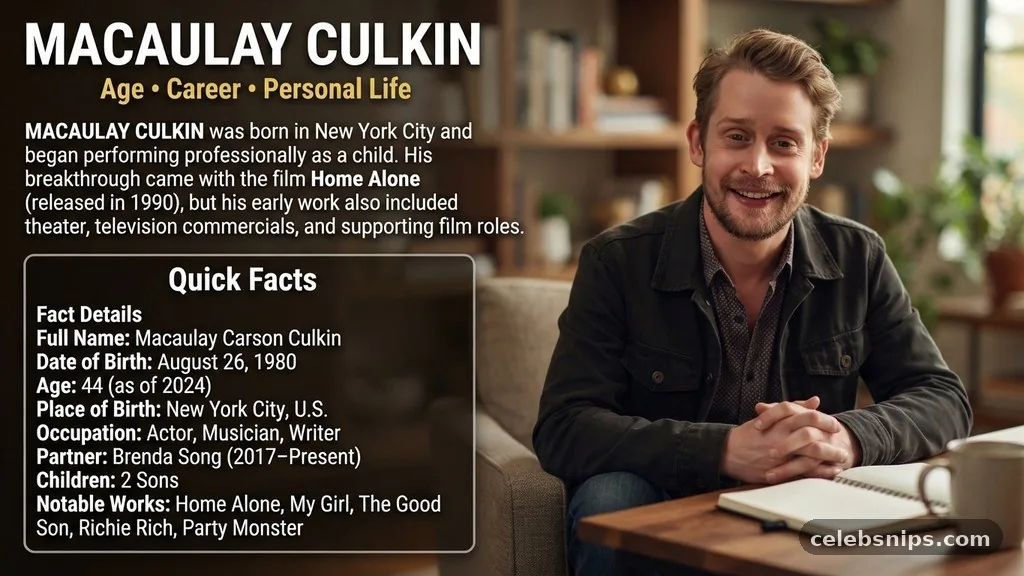
Macaulay Culkin was born in New York City and began performing professionally as a child. His breakthrough came with Home Alone, released in 1990, but his early work also included theater, television, commercials, and supporting film roles.
| Fact | Details |
|---|---|
| Full name | Macaulay Carson Culkin |
| Date of birth | August 26, 1980 |
| Age | 45 as of August 26, 2025 |
| Birthplace | New York City, New York, United States |
| Nationality | American |
| Profession | Actor, musician, writer, and media entrepreneur |
| Best known for | Kevin McCallister in the Home Alone films |
| Years active | 1985–present, with periods of reduced acting activity |
| Partner | Brenda Song |
| Children | Two children have been publicly reported |
Some biography websites publish exact figures for Culkin’s height, net worth, or current assets. Those numbers are not consistently verified through authoritative public records, so they should not be treated as established facts.
- His childhood breakthrough was Home Alone in 1990.
- He followed it with My Girl, Home Alone 2, The Good Son, and Richie Rich.
- He stepped back from major studio acting during much of the late 1990s and 2000s.
- He later appeared in independent films, television series, and selected guest roles.
- He created the Bunny Ears media brand and performed with the comedy band The Pizza Underground.
Early Life and Family Background
Macaulay Carson Culkin was born in New York City on August 26, 1980. His father, Christopher “Kit” Culkin, had worked as an actor, while his mother, Patricia Brentrup, supported the family during a period when the children were growing up in difficult financial circumstances.
Culkin was one of several siblings. His brothers Kieran Culkin and Rory Culkin also became actors, creating a family connection that later became especially visible as Kieran built his own career in television and film.
The family’s circumstances changed quickly after Macaulay began booking professional work. He was performing in stage productions and commercials before becoming a familiar face in movies, and that rapid transition placed adult financial and career decisions around a child performer.
His parents separated while he was still young. Public accounts of the family period differ in emphasis, particularly over parental control and money earned from acting, so it is better to describe the situation cautiously rather than present every later claim as settled fact.
At about age 14, Culkin sought legal emancipation from his parents. Reports at the time connected the decision to disputes over control of his earnings and career, although public summaries often simplify a complicated family and financial situation.
That period remains central to discussions of his childhood. Culkin became one of the highest-profile young performers in American cinema, yet the legal and family pressures surrounding his success were far removed from the playful image created by Kevin McCallister.
For a concise reference account of his early life and major credits, readers can consult Encyclopaedia Britannica’s biography of Macaulay Culkin.
How Macaulay Culkin Began Acting
Culkin started working as a performer before he was old enough to be associated with a single defining movie. His early experience included stage work, television appearances, and commercials, which helped him develop timing and confidence in front of cameras.
One important early credit was the 1989 comedy Uncle Buck, directed by John Hughes. Culkin played Miles Russell, a sharp and observant child whose scenes with John Candy gave audiences an early indication of the young actor’s ability to deliver dry comic reactions.
Uncle Buck mattered because it placed Culkin in a successful John Hughes production before Home Alone. Hughes later wrote the screenplay for Home Alone, and the earlier film helped demonstrate that Culkin could carry memorable moments even when he was not the central character.
His next major opportunity came through Home Alone, directed by Chris Columbus and produced by Hughes. The casting decision paired Culkin’s expressive face and controlled comic timing with a role that required both physical comedy and emotional reactions to being left alone.
That combination suited him. Kevin McCallister had to appear resourceful enough to design elaborate traps, frightened enough to make the danger credible, and mischievous enough to keep a family audience engaged.
Culkin’s early acting therefore was not limited to delivering cute lines. He had to control rhythm, respond to adult performers, handle demanding physical sequences, and sustain a feature film from beginning to end.
Home Alone and the Breakthrough Role
Home Alone was released in November 1990 and became the defining motion picture of Culkin’s career. He played Kevin, an eight-year-old accidentally left behind when his family travels for Christmas, who then defends his house against burglars Harry and Marv, played by Joe Pesci and Daniel Stern.
The film combined American comedy, holiday sentiment, slapstick violence, and a child-centered adventure. Culkin’s performance connected those elements because he could shift from an exaggerated scream to a quiet moment of fear without losing the character’s point of view.
The movie became a major box-office success and remained culturally visible through repeated holiday broadcasts. Its popularity also made Culkin one of the most recognizable child stars of the early 1990s, not merely a successful young actor with one well-received film.
In 1991, he appeared in My Girl, a coming-of-age drama directed by Howard Zieff. His role as Thomas J. Sennett required a different kind of performance from Kevin McCallister, with less reliance on elaborate comic action and more attention to friendship, vulnerability, and grief.
My Girl showed why Culkin was taken seriously beyond slapstick. His chemistry with Anna Chlumsky helped the film reach a broad audience, while the story’s emotional ending demonstrated that his appeal was not based only on physical comedy.
He returned as Kevin in Home Alone 2: Lost in New York in 1992. The sequel repeated the basic premise but moved the action from a suburban house to a New York hotel and commercial district, allowing the film to use Culkin’s familiarity with the character while expanding the scale of the production.
The second film was commercially successful, although its critical reputation has generally remained below that of the original. It still added several lasting images to the character, including Kevin’s stay at the Plaza Hotel and his renewed conflict with Harry and Marv.
Culkin’s work in these films also generated awards attention. He received recognition from young-performer organizations and earned MTV Movie Award attention, including nominations and wins connected to his child-star performances, although award categories and results are sometimes listed inconsistently across online biography pages.
Major Films and Career Development
After Home Alone 2, Culkin chose projects that moved away from straightforward family comedy. In 1993, he starred in The Good Son, a psychological thriller in which he played Henry Evans, a child whose disturbing behavior challenges the audience’s assumptions about the actor associated with Kevin.
The role was a sharp departure. Rather than asking viewers to identify with an inventive child protecting his home, the film required Culkin to suggest menace and emotional instability. It also placed him opposite Elijah Wood, who played the cousin attempting to understand Henry’s behavior.
Culkin then appeared in The Pagemaster and Richie Rich, both released in 1994. The Pagemaster combined live action with animation, while Richie Rich cast him as the world’s wealthiest child, giving him another family-oriented lead before he stepped away from the center of mainstream film culture.
His child-star period created an unusual career pattern. Within only a few years, he had played a comic hero, a grieving friend, a sequel protagonist, a possible villain, an animated-adventure lead, and a wealthy child in a studio comedy.
After the mid-1990s, Culkin took a less visible path. He was no longer appearing in a regular stream of major studio releases, and the gap led to widespread public curiosity about what had happened to him after his childhood success.
His later work included the independent film Party Monster, released in 2003. Culkin played Michael Alig, a New York club figure whose story was based on real events, in a performance that deliberately rejected the clean family image associated with his earlier work.
In 2004, he appeared in Saved!, a satirical comedy about religion, social pressure, and teenage life at a Christian high school. He played Roland, a wheelchair user and outsider whose perspective helped complicate the film’s otherwise ensemble-driven story.
Additional credits included Sex and Breakfast, the film Changeland, and selected television appearances. These projects were generally smaller or more independent than the films that had made him famous, but they reflected a preference for unusual material rather than a simple attempt to recreate his childhood success.
Television, Music, and Bunny Ears
Culkin’s later career has not been limited to traditional film acting. He made appearances in television projects, including the comedy series The Jim Gaffigan Show, where he had a recurring role during the show’s run.
He also appeared in the 2021 season of American Horror Story, subtitled Double Feature. The role placed him in a darker television anthology and showed that his professional identity could extend into adult genre material rather than remaining tied to family entertainment.
Music became another part of his public work. Culkin was associated with The Pizza Underground, a comedy-oriented band that reworked Velvet Underground song titles and themes around pizza. The project was intentionally playful and should be understood as a performance concept rather than a conventional attempt to compete as a mainstream recording artist.
He later developed Bunny Ears, a media and lifestyle brand built around comedy, unusual interviews, articles, and online content. The brand’s tone used parody and absurdity, giving Culkin a way to participate in media production without depending on a standard movie-star publicity cycle.
Bunny Ears also reflected a broader shift in how established actors could communicate with audiences. Instead of relying only on studio press tours, Culkin used digital publishing and podcast-style formats to shape a more self-directed public persona.
His work in music and online media is useful context for understanding his career after childhood fame. He did not simply disappear from public life; he moved between acting, comedy, writing, performance, and internet-based projects that allowed him greater control over tone and subject matter.
That independence has also made his career harder to summarize through a standard filmography. A conventional biography may list his movies, but it can miss the significance of the creative projects he developed outside the major studio system.
Acting Style and Public Significance
Culkin’s early performances were marked by fast comic timing and unusually clear facial reactions. In Home Alone, much of the humor depends on how quickly he moves from confidence to alarm, especially during scenes involving the traps prepared for the burglars.
He also had a practical understanding of screen rhythm. His best-known roles required him to react to adult actors, props, camera effects, and physical gags, often while carrying scenes in which other performers were absent from the immediate action.
The contrast between Kevin McCallister and Henry Evans in The Good Son demonstrated that Culkin could play against audience expectations. The performance did not erase his earlier image, but it made clear that the child actor associated with a family comedy was capable of darker dramatic choices.
His later work was often more selective and less commercially visible. That does not mean he stopped working entirely, and it would be inaccurate to describe his career as a complete disappearance after Richie Rich.
Instead, Culkin reduced his exposure and chose projects that did not always offer the scale or broad audience of his childhood films. His career is therefore better understood as a transition from intense early visibility to more controlled adult participation.
His cultural significance also comes from the unusual durability of Home Alone. The film remains associated with holiday viewing, and Kevin’s face is instantly recognizable to multiple generations of viewers who may know little about Culkin’s later work.
That recognition can be both an advantage and a limitation. It gives him a role that remains commercially and culturally powerful, but it also means that every later performance is often viewed against an image formed when he was still a child.
Personal Life and Relationships
Macaulay Culkin has generally kept his personal life more private than many long-established celebrities. Publicly reported information does confirm his long-term relationship with actor Brenda Song, whom he met through the film Changeland.
Culkin and Song have two children, according to public reports. Their first child, a daughter, was born in 2021, and a second child was later reported. The couple has shared some family-related information publicly, but they have not made every detail of their home life part of their public work.
Reports sometimes describe Song as Culkin’s wife, but a publicly confirmed marriage date or formal announcement has not been consistently established through authoritative sources. The safer description is that Song is his partner and the mother of his children.
Culkin was previously married to actress Rachel Miner. They married in 1998 when both were teenagers and separated in 2000; their divorce was finalized later. He also had a highly publicized relationship with actress Mila Kunis during the 2000s.
Those earlier relationships are historical facts, not evidence of his current relationship status. Online pages sometimes recycle old photographs or outdated descriptions, which can make his personal life appear less current than it is.
His family background remains part of public biography discussions because several siblings also entered entertainment. Kieran Culkin became widely known for Succession, while Rory Culkin developed a separate film and television career.
Culkin’s sister Dakota died in a traffic accident in 2008. The family has generally treated the loss privately, and responsible coverage should avoid turning a personal tragedy into unnecessary speculation.
Net Worth, Earnings, and Financial Questions
Online estimates of Macaulay Culkin’s net worth vary considerably. No authoritative public filing provides a definitive current total for his assets, taxes, investments, royalties, property, and business interests, so exact figures should be labeled as estimates rather than fact.
His early film earnings were substantial by child-actor standards. The success of Home Alone and its sequel gave him significant negotiating power, but public reports about his contracts, later payments, and financial arrangements are not a complete audited record.
Potential income sources connected to his career include film salaries, television work, residuals, licensing, media projects, appearances, and business activity. The importance of each source cannot be measured publicly because contracts and private ownership structures are not fully disclosed.
The enduring popularity of Home Alone may support continuing commercial value through licensing and distribution, but that does not automatically reveal how much money reaches Culkin personally. A film’s box-office performance, broadcast rights, streaming agreements, and an actor’s contract are separate financial questions.
Some websites claim a precise multi-million-dollar net worth. Those estimates may be based on old reporting, assumptions about royalties, or repeated figures that originated without documentation.
A more responsible answer is that Culkin became wealthy through unusually successful childhood acting work and continued earning through later entertainment projects, but his current net worth has not been independently verified in a single authoritative figure.
Public Image, Awards, and Current Career
Culkin’s public image has changed several times. He was first marketed as a gifted young actor, later became associated with a difficult transition away from child stardom, and eventually built a more self-aware identity through independent performances and comedy projects.
His awards history is strongest in the area of young-performer recognition. He received nominations and wins connected to Home Alone, and his work attracted attention from organizations that honored young artists in film.
He also received MTV Movie Award recognition during the early 1990s. Search results may mention a movie award, comedy award, or best villain category, but individual lists sometimes combine nominations with wins or mislabel the year, so award claims should be checked against the relevant organization’s records.
His role in The Good Son is frequently discussed in connection with a villain award because it placed him in an unusually dark character role. That performance was important less because it permanently changed his career than because it challenged the assumption that he could only play an appealing comic child.
In later years, Culkin has appeared selectively rather than maintaining the release schedule of a conventional leading actor. His presence in television, independent film, digital media, and public events suggests that he remains active, but he does not appear to pursue constant mainstream visibility.
He also received a star on the Hollywood Walk of Fame in 2023. The ceremony recognized his long-standing impact on popular entertainment, especially the enduring place of Home Alone in American film culture.
For readers searching for “Macaulay Culkin now,” the clearest answer is that he is an established former child star who continues to work selectively across acting and media. He is not defined solely by retirement, and he is not regularly producing the same volume of studio movies he made as a child.
Frequently Asked Questions
How old is Macaulay Culkin?
Macaulay Culkin was born on August 26, 1980. He turned 45 on August 26, 2025; his age changes annually, so future references should be calculated from that birth date.
What is Macaulay Culkin best known for?
He is best known for playing Kevin McCallister in Home Alone and Home Alone 2: Lost in New York. He also appeared in My Girl, The Good Son, Richie Rich, Party Monster, and Saved!.
Who is Macaulay Culkin’s partner?
His partner is actor Brenda Song. They have two children, but the couple keeps much of their family life private, and online claims about a formal marriage should not be treated as confirmed without a reliable announcement.
How many marriages has Macaulay Culkin had?
Culkin had one publicly documented marriage, to actress Rachel Miner. They married in 1998, separated in 2000, and later divorced.
Is Macaulay Culkin still wealthy?
He is widely understood to have earned substantial money from his childhood film career and later projects. However, there is no authoritative public figure confirming his current net worth, so exact online estimates should be treated cautiously.
Final Takeaway
Macaulay Culkin’s age, career, and personal life reflect a path that began with extraordinary childhood fame and later became more selective and self-directed. His lasting place in film comes from Kevin McCallister, but his work in independent movies, television, music, and digital media shows a broader career than Home Alone alone suggests.
The most reliable facts are his August 26, 1980 birth date, his major early film roles, his continuing connection with Brenda Song, and his selective return to acting. Claims about exact wealth, marriage status, and private family details require more caution, so readers should treat Macaulay Culkin’s biography as a mix of well-documented career history and intentionally private personal information.