
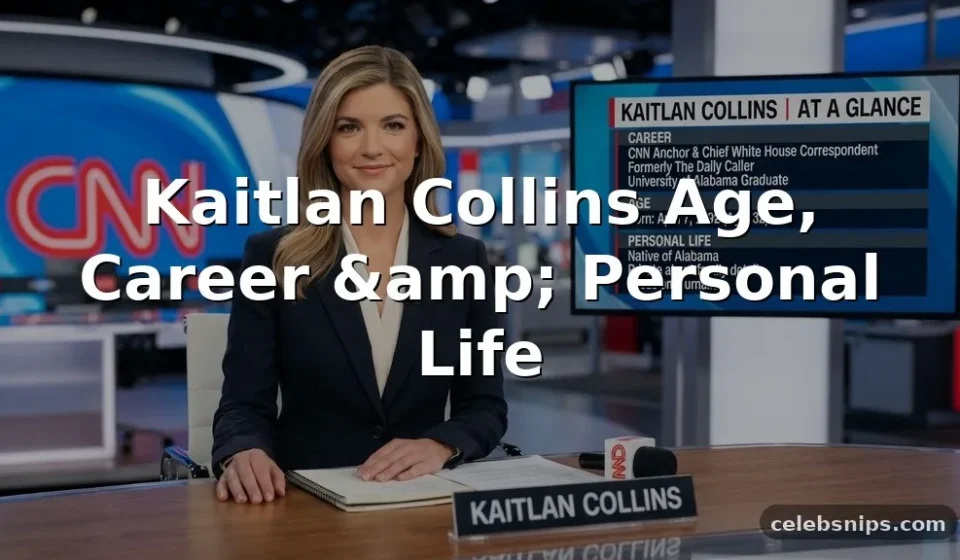

Kaitlan Collins is an American journalist and CNN anchor best known for covering the White House, challenging presidents and senior officials at press briefings, and hosting the network’s evening program The Source. Searches for “Kaitlan Collins Age, Career, and Personal Life” usually reflect interest in more than her birthday: readers also want to understand how an Alabama journalist moved from the Daily Caller to one of CNN’s most visible political roles.
She was born on April 7, 1992, in Prattville, Alabama, and built her reputation through political reporting rather than entertainment coverage. Her professional record is well documented, while details about her romantic life, salary, height, weight, and finances are either private or based on estimates that should not be treated as confirmed facts.
Kaitlan Collins at a Glance
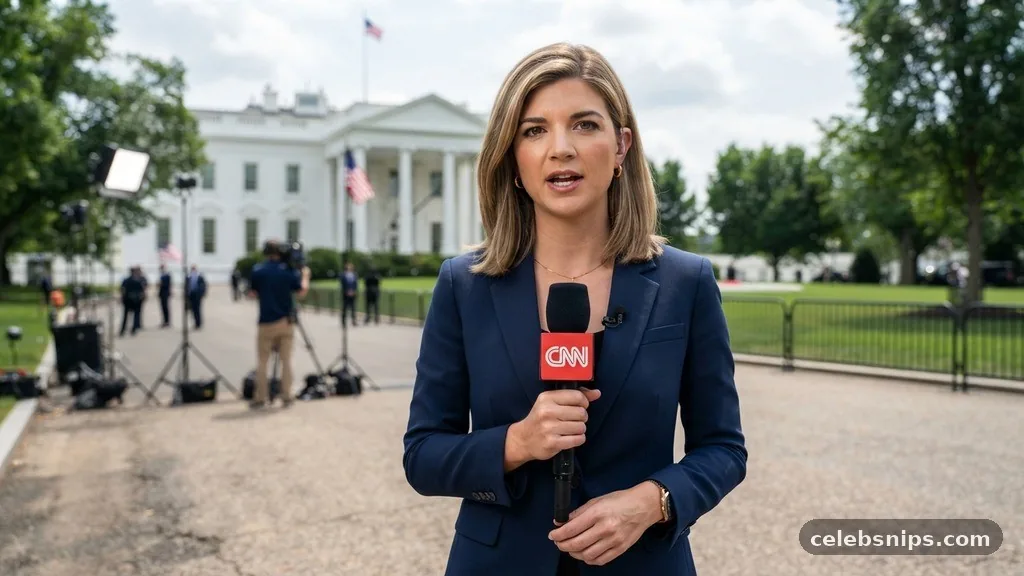
Kaitlan Collins is a television journalist whose work has centered on American politics, presidential administrations, and the White House press corps. She became particularly recognizable during Donald Trump’s presidency, when her questions and exchanges at briefings were frequently reported by other news organizations.
| Detail | Publicly available information |
|---|---|
| Full name | Kaitlan Collins |
| Date of birth | April 7, 1992 |
| Age | 33 as of March 2026; she turns 34 on April 7, 2026 |
| Birthplace | Prattville, Alabama, United States |
| Nationality | American |
| Profession | Journalist, television anchor, and political correspondent |
| Education | University of Alabama |
| Known for | White House reporting, CNN political coverage, and The Source |
| Current public role | CNN anchor and political journalist |
The age listed above is tied to a specific date because it changes every April. Some online biography pages display different ages because they were published in different years or repeat outdated information.
Several commonly searched details are not reliably established in public records. CNN and reputable news coverage identify Collins as a journalist and anchor, but they do not provide a verified public figure for her salary, net worth, height, or weight.
Early Life and Alabama Background
Collins was born and raised in Prattville, a city near Montgomery, Alabama. Her Alabama background is part of her public biography, although she has generally kept extensive details about her family and childhood away from the spotlight.
She attended the University of Alabama, where she studied journalism and political science. That combination gave her both reporting training and a direct academic connection to government, elections, institutions, and political history.
Her educational path mattered because political journalism requires more than familiarity with public figures. Reporters must understand how executive authority, congressional oversight, elections, federal agencies, and the press operate together, particularly during fast-moving news events.
Public sources do not establish a detailed account of Collins’s parents, siblings, or family occupations. A number of biography pages repeat personal claims without identifying reliable sourcing, so those details should not be presented as confirmed.
What is known about her education?
Collins graduated from the University of Alabama in 2014. She has spoken publicly about her route into journalism, but the available record does not support a dramatic story involving a famous mentor, political family, or inherited media connection.
That distinction is useful. Collins’s rise is primarily documented through newsroom jobs and reporting assignments, not through an entertainment-industry background or a family relationship with a prominent politician.
Her Start at the Daily Caller
After college, Collins began working for the Daily Caller, a Washington-based political news website. She joined the organization in 2014 and covered politics during a period when digital outlets were expanding their presence around Capitol Hill and the presidential campaign trail.
Her early work included reporting on the 2016 presidential campaign. Covering a national campaign places a reporter in a demanding cycle of rallies, interviews, policy announcements, travel, rapid publication, and constant verification. It also gives journalists direct access to candidates and campaign staff.
Collins became the Daily Caller’s White House correspondent after Donald Trump took office in January 2017. The role put her inside the daily press operation, where reporters question officials, attend briefings, and compete to establish the news agenda.
Her work at the White House was not simply a title change. It moved her from campaign reporting into sustained coverage of the executive branch, including presidential statements, administration policy, personnel decisions, and confrontations with the press.
At that stage, Collins was still early in her career. Her visibility grew because White House reporting rewards preparation and persistence: reporters need to know what officials said previously, identify contradictions, and ask questions that produce usable answers for a live news audience.
Why the White House role mattered
The White House correspondent position is one of the most important reporting assignments in American political journalism. A correspondent must follow both public events and behind-the-scenes policy developments, often filing stories on a deadline while preparing for the next briefing.
Collins’s assignment also placed her in the middle of the changing relationship between the Trump administration and the press. Questions about access, credibility, public criticism, and the role of cable news were part of the wider news environment surrounding her reporting.
Move to CNN and National Recognition
Collins joined CNN in 2017, shortly after beginning her White House reporting career. The move brought her from a digital political publication to a major international television network with a large Washington bureau and a global audience.
At CNN, she continued covering the Trump administration and appeared regularly on the network’s news programming. Her responsibilities included reporting from the White House, explaining political developments, and participating in live coverage when official announcements or press briefings generated major news.
Her public profile increased through exchanges with Trump and members of his administration. The most widely discussed moments involved questions at press events, where Collins pressed officials on topics including policy decisions, presidential statements, and the administration’s treatment of the news media.
In July 2018, Collins was removed from a White House event involving the president and the European Commission president after asking questions about Trump’s relationship with Russia and former attorney Michael Cohen. The White House disputed the characterization of the incident, while CNN said she had been barred after asking questions officials considered inappropriate for the event.
The episode became a national media story because it raised broader questions about press access and the treatment of journalists at presidential events. Collins’s status as a White House reporter meant that a dispute over one press appearance quickly became part of the national conversation about the White House press corps.
Her career did not depend on that single incident. She continued reporting for CNN, including during later stages of the Trump administration and the transition to the Biden administration.
Chief White House Correspondent and CNN Leadership
In 2021, Collins became CNN’s chief White House correspondent. The appointment reflected her experience covering the executive branch and gave her a senior role in the network’s Washington operation during President Joe Biden’s administration.
A chief White House correspondent coordinates a large amount of political reporting. The job can involve daily briefings, presidential travel, administration interviews, policy coverage, breaking news, and collaboration with correspondents who cover Congress, national security, courts, and campaigns.
Collins’s reporting during this period included coverage of the Biden White House, the administration’s policy agenda, presidential travel, and the political disputes surrounding the 2022 midterm elections. She also reported on the evolving Republican presidential field and Donald Trump’s continued influence over the Republican Party.
The role required her to move between television reporting and longer-form political journalism. A television correspondent has to explain complicated developments quickly, while a written report may provide more room for sourcing, chronology, and institutional context.
Her work also appeared during a period of major change at CNN. The network dealt with leadership transitions, debates about political coverage, and changes to its programming strategy. Those developments shaped the environment in which Collins moved from correspondent to anchor.
From correspondent to anchor
In 2023, Collins began hosting The Source with Kaitlan Collins, a CNN program focused on major political and national news stories. The move expanded her responsibilities from reporting on events to setting the tone and structure of a nightly program.
As an anchor, Collins interviews politicians, journalists, analysts, and other newsmakers. She also introduces segments, frames breaking developments, and helps audiences understand why a Washington event matters beyond the immediate headline.
Her transition illustrates a common path in television news: a reporter builds authority through field assignments, develops an identifiable interviewing style, and then takes on a larger role in the studio. The work remains journalism, but the daily demands change significantly.
Reporting Style and Professional Significance
Collins is known for direct questioning and a relatively controlled on-air style. Her interviews tend to focus on specific claims, prior statements, and accountability rather than relying only on broad invitations for a guest to explain a position.
That approach is especially visible in political interviews. A reporter may ask a senator about a vote, then follow up with the consequences of that vote or compare it with an earlier public statement. The value lies in the documented record, not in the volume of the exchange.
Her reporting also reflects the distinctive pressure of live news. A correspondent may have only a short time to describe an announcement before moving to a question-and-answer segment, and a host has to correct or clarify information without losing the audience’s understanding of the larger story.
Collins became a recognizable figure in political journalism partly because she worked during an unusually confrontational period between the White House and the press. Her questions were often discussed not only for their content but also for what they revealed about access, transparency, and the role of journalists in a polarized political environment.
Her professional significance should not be reduced to viral clips. The more substantial measure is the continuity of her work: campaign coverage, White House reporting, chief correspondent duties, and a regular CNN anchor position over several years.
- Campaign reporting: She covered national politics before moving into a senior television role.
- White House expertise: She reported from the White House during both the Trump and Biden administrations.
- Press briefings: Her questions and access disputes made her a visible member of the Washington press corps.
- Television leadership: She became the host of The Source after serving as a CNN correspondent.
- Interviewing: Her work often centers on accountability questions tied to public records and current events.
Major Career Milestones
Collins’s career can be understood as a sequence of increasingly prominent political reporting assignments. Each stage involved a different level of responsibility, from digital reporting to national television and then to program leadership.
| Period | Milestone | Why it mattered |
|---|---|---|
| 2014 | Joined the Daily Caller | Entered professional political journalism after graduating from Alabama |
| 2016 | Covered the presidential campaign | Built experience in national campaign reporting |
| 2017 | Became a White House correspondent and joined CNN | Moved into executive-branch reporting and major-network journalism |
| 2018 | Received national attention after a White House event dispute | Put press access and presidential-media relations at the center of discussion |
| 2021 | Became CNN chief White House correspondent | Took on a senior role covering the Biden administration |
| 2023 | Started hosting The Source | Expanded from correspondent work into a regular anchor position |
The dates show why a simple description such as “CNN reporter” misses much of her career. Collins has worked in digital political media, campaign reporting, White House coverage, network correspondence, and evening news anchoring.
Her most important achievement is the progression itself. She moved into increasingly visible positions without relying on a single television appearance or one political news cycle to define her professional identity.
Personal Life, Relationships, and Family
Collins has kept much of her personal life private. Publicly available reporting has linked her romantically to Will Douglas, a physician and political figure from Texas, but the details and current status of that relationship should not be overstated.
Some entertainment and biography pages describe Collins as married or identify a husband, but no reliable public record confirms that she is married. A reported relationship is not the same as a confirmed marriage, and there is no well-supported public information establishing that she has children.
Questions about a partner’s nationality or race are also not appropriate to answer through speculation. Public sources do not establish a verified basis for assigning those details, and a person’s appearance or surname cannot prove them.
Collins has not publicly built her brand around family life, pregnancy announcements, wedding coverage, or domestic details. Her public identity is professional, centered on journalism and political news.
There is likewise no reliable public evidence supporting claims about her religion. Unless Collins chooses to discuss that subject directly in a credible interview or public statement, it should be treated as private or unknown.
What about pregnancy rumors?
Online searches have sometimes connected Collins with pregnancy speculation, but there is no reliable public confirmation that would justify presenting such claims as fact. Appearance-based guesses are not evidence, and private health or family matters should not be inferred from photographs or television appearances.
Salary, Net Worth, and Other Personal Details
CNN does not publicly disclose Collins’s individual salary, and no authoritative source establishes her net worth. Online figures may differ widely because they are usually estimates based on assumed television contracts, public visibility, or general industry comparisons rather than verified financial documents.
Her likely professional income would be connected to her CNN employment as an anchor and journalist. That does not establish a specific annual salary, because compensation can include base pay, contract terms, bonuses, benefits, and arrangements that are not publicly available.
Net-worth estimates are even less reliable. A calculation would need information about taxes, savings, property, investments, debts, spending, and contractual income, none of which is fully public for Collins.
The same caution applies to claims about her home, cars, investments, or private assets. No credible public source provides a complete financial inventory, so an exact net-worth number should not be presented as fact.
Her height and weight are also frequently searched, but there is no consistently verified public measurement from Collins or CNN. Photographs, camera angles, and comparisons with other people cannot establish accurate physical statistics.
Social Media and Public Presence
Collins has a public presence connected to her journalism, television appearances, and political reporting. Her posts and interviews generally relate to current events, CNN programming, political developments, and moments from the White House or campaign trail.
Social-media information changes quickly. Usernames can be copied, accounts can be renamed, and follower counts fluctuate, so an account should not be treated as official solely because it uses her name or photograph.
The safest way to verify current professional information is through CNN’s own newsroom and programming pages. CNN’s official Kaitlan Collins profile provides a more dependable reference for her network role than unattributed biography pages.
Readers should also distinguish between an account used for reporting and a personal account. A journalist’s public post about a political event does not necessarily reveal private views, family circumstances, or relationships beyond what the journalist has chosen to publish.
Why Kaitlan Collins Remains a Closely Searched Journalist
Interest in Collins comes from the intersection of age, visibility, and political access. She reached a senior television position in her early thirties after covering some of the most intensely scrutinized administrations in recent American history.
Her career also sits at the center of several public debates: how journalists question presidents, how television networks cover Donald Trump, how White House access is managed, and how political news is presented during live broadcasts.
That context explains why searches often combine unrelated subjects such as salary, husband, children, wedding photos, height, and career. The available evidence is much stronger for her professional history than for private details.
For readers trying to assess her public record, the clearest facts are her Alabama upbringing, University of Alabama education, early work at the Daily Caller, CNN appointment in 2017, chief White House correspondent role in 2021, and The Source anchor position beginning in 2023.
Her status may change as CNN adjusts its programming and as political events create new assignments. Career information should therefore be checked against current CNN announcements rather than older pages that continue to list former titles.
Frequently Asked Questions
How old is Kaitlan Collins?
Kaitlan Collins was born on April 7, 1992. She is 33 as of March 2026 and turns 34 on April 7, 2026.
Where was Kaitlan Collins born?
She was born in Prattville, Alabama, United States. She later attended the University of Alabama.
What is Kaitlan Collins known for?
She is known for political journalism, White House reporting, CNN’s coverage of the Trump and Biden administrations, and hosting The Source with Kaitlan Collins.
Is Kaitlan Collins married, and does she have children?
No reliable public source confirms that Collins is married or has children. She has been publicly linked to Will Douglas, but the current status and details of that relationship are not fully established.
What is Kaitlan Collins’s salary or net worth?
Neither her CNN salary nor her net worth has been authoritatively disclosed. Online figures are estimates and should not be treated as verified financial facts.
Final Takeaway
Kaitlan Collins’s documented career runs from the Daily Caller and national campaign reporting to CNN’s White House bureau, the chief White House correspondent role, and her work as the host of The Source. She was born in Alabama on April 7, 1992, but the strongest public record concerns her journalism rather than her private life.
That distinction is central to understanding Kaitlan Collins Age, Career, and Personal Life. Her age and professional milestones can be verified, while claims about salary, net worth, marriage, children, height, and family should be treated cautiously unless supported by a direct and reputable source.