
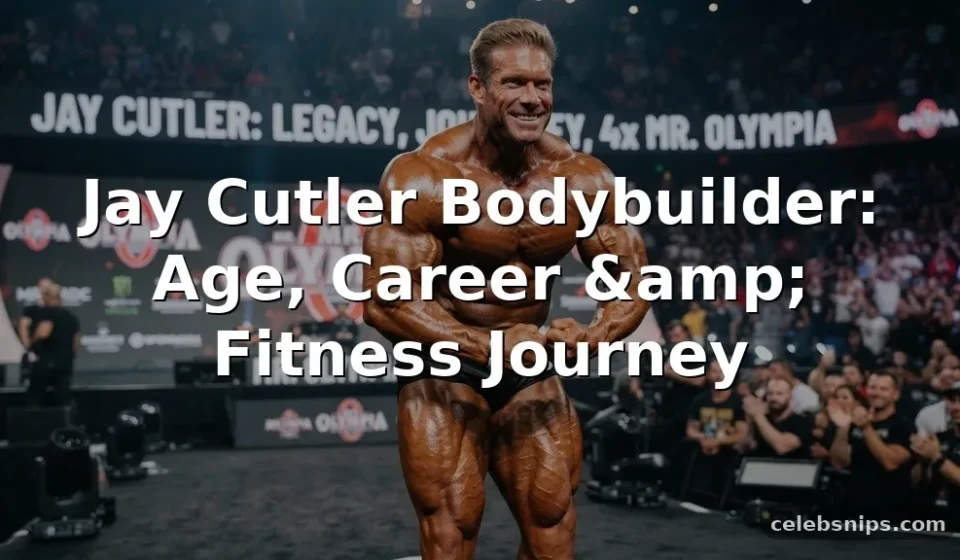

Jay Cutler is a retired American IFBB Pro League bodybuilder best known for winning the Mr. Olympia title four times and defeating Ronnie Coleman in 2006.
Born on August 3, 1973, Cutler is 52 years old as of August 3, 2025. His career also includes three Arnold Classic victories, several major Grand Prix appearances, and a long-running role as a fitness educator and entrepreneur.
Interest in Jay Cutler’s age, career, and fitness journey remains strong because his rise from a Massachusetts teenager to one of bodybuilding‘s defining champions was unusually well documented. His training methods, rivalry with Coleman, competitive comeback after injury, and post-retirement work continue to influence bodybuilders around the world.
Jay Cutler at a Glance
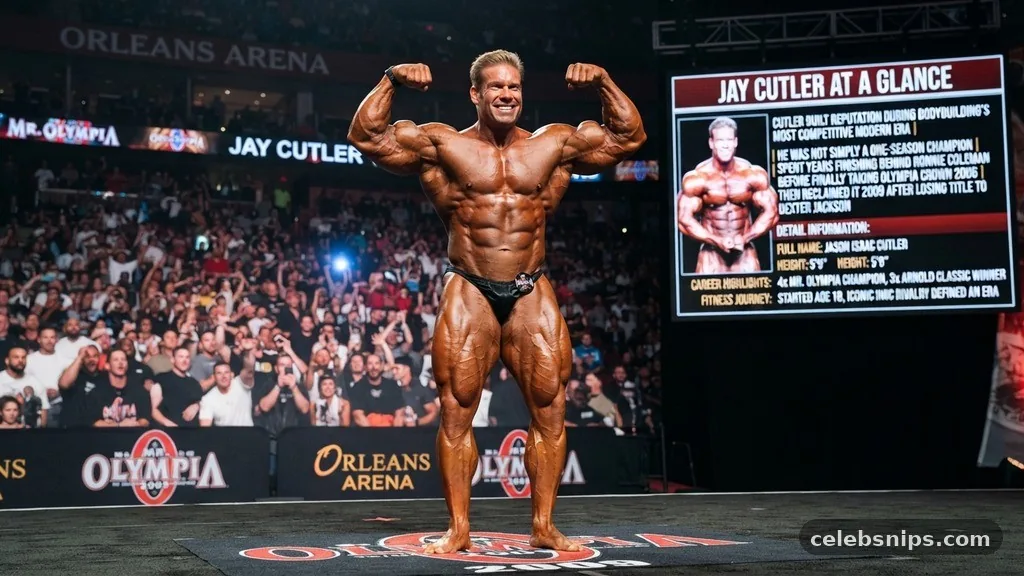
Cutler built his reputation during bodybuilding’s most competitive modern era. He was not simply a one-season champion: he spent years finishing behind Ronnie Coleman before finally taking the Olympia crown in 2006, then reclaimed it in 2009 after losing the title to Dexter Jackson.
| Detail | Information |
|---|---|
| Full name | Jason Isaac Cutler |
| Professional name | Jay Cutler |
| Date of birth | August 3, 1973 |
| Age | 52 as of August 3, 2025 |
| Birthplace | Worcester, Massachusetts, United States |
| Profession | Retired professional bodybuilder, fitness educator, and entrepreneur |
| Major title | Four-time Mr. Olympia |
| Mr. Olympia wins | 2006, 2007, 2009, and 2010 |
| Arnold Classic wins | 2002, 2003, and 2004 |
| Height | Commonly listed at approximately 5 feet 9 inches; public listings vary |
| Competitive status | Retired from professional bodybuilding |
Some physical statistics associated with Cutler, including his exact height and contest weight, vary across interviews and promotional profiles. His championship record is much easier to verify than those measurements, so they should be treated as commonly reported figures rather than fixed official data.
- Four-time Mr. Olympia: Cutler won the title in 2006, 2007, 2009, and 2010.
- Three-time Arnold Classic champion: He won the event three years in a row from 2002 through 2004.
- Historic rivalry: He defeated Ronnie Coleman at the 2006 Olympia after placing second to him four times.
- Comeback achievement: He regained the Olympia title in 2009 after Dexter Jackson won in 2008.
- Long public career: Cutler remained active in fitness media, education, appearances, and business after leaving the stage.
Early Life and Entry into Bodybuilding
Jay Cutler was born Jason Isaac Cutler in Worcester, Massachusetts, and grew up in nearby Sterling. His early life was connected to physical work: as a teenager, he worked in his family’s concrete business. That background gave him regular exposure to demanding labor before bodybuilding became his profession.
Cutler began lifting weights at 18 years old. He attended Quinsigamond Community College, where he studied criminal justice, but bodybuilding increasingly became the central focus of his life. Unlike athletes who enter the sport through a major college program, Cutler developed through local gyms, regional contests, and the amateur National Physique Committee circuit.
His early training took place in an era when bodybuilding magazines, gym culture, and videotaped training footage were major sources of information. Cutler studied the physiques and methods of established professionals, including Arnold Schwarzenegger and other champions whose careers helped define the sport for a wider audience.
Cutler’s first competitive years were not marked by immediate international fame. He had to build muscle, improve his presentation, and learn how to bring a complete physique to the stage. Those improvements mattered because professional bodybuilding judges assess more than size: symmetry, conditioning, muscular detail, proportions, posing, and overall presentation all affect the result.
He became an NPC competitor in the early 1990s and earned recognition as a serious amateur prospect. His amateur progress eventually led to professional qualification, giving him access to the IFBB Pro League and larger contests. The transition was important because the professional field included established champions with far more experience and publicity.
There is no reliable public evidence that Cutler’s education or early employment directly caused his bodybuilding success. What is clear is that his initial path combined physical work, consistent gym training, and competition experience rather than a conventional athletic scholarship or mainstream sports career.
Professional Career and First Major Breakthroughs
Cutler’s professional career developed through repeated appearances rather than one instant breakthrough. He competed against elite bodybuilders while refining the dense, broad, heavily muscled look that later became his trademark. His size was especially noticeable through his shoulders, legs, back, and overall stage width.
One of his early major victories came at the 2000 Night of Champions, a significant professional contest at the time. That win helped establish Cutler as more than a promising newcomer. He was now a credible threat at the highest level of the sport.
The Arnold Classic became another major platform for his career. Cutler won the contest in 2002, 2003, and 2004, joining a short list of athletes able to dominate one of bodybuilding’s most respected events across several consecutive years.
Those Arnold Classic victories were especially valuable because the contest attracted top professionals and carried the name of Arnold Schwarzenegger, one of the most influential figures in bodybuilding history. Winning the event repeatedly demonstrated that Cutler could defeat deep lineups, not merely collect titles in smaller shows.
Cutler also appeared in other major professional contests, including Grand Prix events and Olympia qualifying competitions. His performance record during this period showed a consistent pattern: he had the muscle mass to challenge the best athletes, while his conditioning and presentation improved from season to season.
Professional bodybuilding careers are often shaped by timing. Cutler entered his prime during Ronnie Coleman’s reign, when Coleman had already established himself as the dominant Mr.
Olympia. As a result, Cutler’s career was initially defined by high finishes without the sport’s top title.
The period also helped create Cutler’s public identity. He became known for a disciplined, direct training style and for openly discussing food, recovery, contest preparation, and the practical demands of professional bodybuilding. His visibility expanded beyond contest results.
The Ronnie Coleman Rivalry and Mr. Olympia
Jay Cutler finished as runner-up to Ronnie Coleman at the Mr. Olympia contest in 2001, 2002, 2003, 2004, and 2005. Five consecutive second-place finishes made Cutler one of the most successful bodybuilders never to win the title during that stretch, but they also created one of the sport’s most recognizable rivalries.
Coleman brought extraordinary thickness, conditioning, and lower-body development to the stage. Cutler presented a different but equally formidable package, with broad shoulders, powerful legs, a wide back, and a polished ability to display his physique under contest lighting.
The rivalry was not simply about personality. It reflected a genuine judging debate over two elite physiques. Coleman held the championship, while Cutler continued to improve and remained close enough to make every Olympia appearance meaningful.
Cutler finally won the Mr. Olympia title in 2006.
The victory ended Coleman’s eight-year reign and immediately became one of the defining moments in modern bodybuilding. Cutler won again in 2007, confirming that the first title was not an isolated result.
His 2006 victory also changed the way many fans understood persistence in professional bodybuilding. Repeated runner-up finishes can damage a competitor’s confidence or public standing, but Cutler used the experience to adjust his preparation and continue competing at the highest level.
In 2008, Dexter Jackson won the Olympia title, while Cutler placed second. Cutler returned in 2009 and defeated Jackson to regain the championship.
That made him the first Mr. Olympia competitor to reclaim the title after losing it, a distinction that remains central to his legacy.
Cutler won his fourth Olympia title in 2010. He later competed at the 2011 Olympia, where he placed second to Phil Heath.
Injuries affected his preparation, and he did not return to win another Olympia crown. His professional stage career ended after his final competitive period in 2013.
The official Mr. Olympia history and results provide the clearest reference point for understanding the title sequence and the champions Cutler competed against.
Training Style, Physique, and Fitness Philosophy
Cutler’s training image was built around high-volume bodybuilding workouts, heavy resistance training, and deliberate attention to individual muscle groups. He was known for training with intensity while maintaining a strong focus on controlled repetitions, exercise selection, and the visual result of each muscle.
His physique was often associated with substantial leg development, wide shoulders, thick arms, and a dense back. Cutler’s legs were particularly important to his competitive identity because bodybuilding judges compare the entire physique, and lower-body size can determine whether a bodybuilder appears complete from the front and rear.
Cutler commonly discussed split routines in which different body parts were trained on separate days. A typical professional routine might divide sessions among chest, back, shoulders, arms, and legs, although his actual schedule changed during different phases of preparation.
He also emphasized consistency over novelty. That does not mean every workout was identical. It means Cutler’s approach relied on repeating effective training patterns, tracking progress, eating enough to support growth, and making changes when a particular muscle group or contest phase required them.
Nutrition was another major part of his public fitness message. Competitive bodybuilders often eat multiple meals daily during mass-gaining and contest-preparation phases, with protein, carbohydrates, fats, hydration, and meal timing adjusted according to bodyweight and training demands.
Cutler’s professional diet should not be treated as a universal plan. A champion preparing for an Olympia has goals, resources, recovery demands, and medical supervision needs that differ sharply from those of a recreational lifter. Copying a professional’s food quantity or training volume without individual guidance can create unnecessary health risks.
His training videos and seminars helped make advanced bodybuilding more understandable to general audiences. Cutler frequently explained why he selected an exercise, how he approached intensity, and how he adjusted workouts near a contest. That practical style contributed to his influence after retirement.
He also helped popularize a less romantic view of elite bodybuilding. The sport requires years of repetitive work, strict nutrition, posing practice, recovery, and competition planning. The visible stage appearance is only the final product of that process.
Age, Measurements, and Competitive Condition
Jay Cutler was born on August 3, 1973, making him 52 years old as of August 3, 2025. His age changes every August, so readers should use the birth date rather than relying on an old biography page that may not have been updated.
Cutler is commonly listed at approximately 5 feet 9 inches, although bodybuilding profiles do not always agree on exact height. Contest weight also varied depending on preparation, condition, and the specific season.
Public descriptions often place his Olympia-era stage weight in the mid- to upper-200-pound range, but those figures are not consistently documented through a single official record. A bodybuilder’s weight can also shift during the final days before a show, making casual online comparisons unreliable.
More important than any single number was Cutler’s competitive structure. His width, leg mass, shoulder development, and overall muscle density allowed him to present a complete package against athletes with different strengths.
Bodybuilding measurements can also be misleading outside context. A larger bodyweight does not automatically indicate better conditioning or superior proportions, and an impressive arm measurement cannot explain a judge’s decision across all mandatory poses.
Cutler’s success came from combining size with stage presentation. Judges evaluate poses such as the front double biceps, side chest, rear lat spread, and most muscular, so a competitor must maintain control and visual balance from multiple angles.
His age is now more relevant to fans studying longevity than to competitive predictions. Cutler is no longer an active Olympia competitor, and his current public role centers on fitness education, business, media, and personal branding rather than preparing for another championship.
Life After Competitive Bodybuilding
After leaving the professional stage, Cutler remained active in the fitness industry. He continued producing training content, appearing at bodybuilding events, speaking with athletes, and discussing the experience of competing at the highest level.
His post-competition work reflects how modern bodybuilders build careers beyond contest winnings. A retired champion can earn attention through seminars, sponsorships, digital video, product partnerships, appearances, and educational content, although individual contracts and earnings are usually private.
Cutler has also maintained a visible presence through online fitness media. His content often includes workout demonstrations, bodybuilding commentary, contest analysis, and reflections on his time competing against Coleman, Jackson, Heath, and other major professionals.
That media role allows him to address both serious competitors and ordinary gym members. A professional bodybuilder’s advice still needs to be adapted to the viewer’s experience, but Cutler’s explanations can provide useful context about exercise technique, training structure, and contest preparation.
He has also remained connected to bodybuilding’s major events. Former champions are frequently invited to appear at expos, meet fans, participate in panels, and comment on current competitors. Cutler’s four Olympia titles give him particular authority when discussing the pressure of that contest.
His business activities are often discussed online, but exact ownership structures, contract values, and personal income are not fully public. Claims about his net worth should therefore be treated as estimates rather than verified financial statements.
Cutler’s post-retirement influence is significant because he belongs to a generation that helped move bodybuilding content from magazines and DVDs into the digital era. His videos made training discussions more accessible and preserved detailed records of how a top professional approached the sport.
Personal Life, Relationships, and Public Information
Cutler’s personal life has attracted regular search interest, particularly questions about his wife, ex-wife, children, and current relationships. Public biographies commonly report that he was married to Kerry Cutler, but details about the relationship and its timeline are not presented consistently across every online source.
Some reports describe the marriage as ending in divorce in 2009. Because personal records and private relationship details are not comprehensively documented through official public sources, that timeline should be treated as reported rather than as a complete account of his private life.
There is no responsible basis for filling gaps with rumors about a current spouse or partner. Public appearances and social-media photographs do not, by themselves, establish a person’s relationship status.
Similar caution applies to questions about children and extended family. Cutler has discussed his family background in broad terms, including growing up in Massachusetts and working in the family concrete business, but detailed claims about relatives should not be repeated unless they come from a reliable public source.
Searches about a “Jay Cutler conviction” also require identity clarification. The bodybuilder is not the same person as other public figures named Jay Cutler, including the former NFL quarterback, and no reliable source establishes that the professional bodybuilder was convicted of a crime.
The diagnosis-related searches are similarly ambiguous. Public search results can mix information about different people with the same name, while injuries or health discussions involving the bodybuilder should not be described as a formal diagnosis unless Cutler or a reliable report clearly documented it.
Separating the bodybuilder from other Jay Cutlers is essential. Shared names can produce incorrect claims about sports careers, legal matters, medical history, and personal relationships.
Net Worth, Income, and Business Claims
Jay Cutler’s exact net worth is not publicly verified. Online figures often present a precise dollar amount, but those estimates rarely show complete information about taxes, expenses, investments, property, contract terms, business ownership, or private earnings.
The most defensible way to discuss his finances is to identify likely professional income categories without assigning unsupported totals. His career has included several potential sources of revenue:
- Professional bodybuilding contest winnings and appearance fees.
- Fitness sponsorships and product partnerships.
- Training videos, seminars, and educational appearances.
- Digital media, interviews, and online content.
- Fitness-related business activity and merchandise.
- Guest appearances at bodybuilding expos and industry events.
Contest winnings alone do not explain the finances of a champion with a career spanning multiple decades. Sponsorships, licensing, appearances, and business arrangements can continue producing income after an athlete stops competing, but the value of those agreements is usually confidential.
Cutler’s four Mr. Olympia victories and three Arnold Classic titles likely improved his commercial value, yet commercial value is not the same as a confirmed net-worth figure. Revenue also does not equal profit after staff, travel, production, taxes, business expenses, and other costs.
Readers should be cautious with websites that list a precise net worth without naming documents or credible reporting. Unless Cutler releases financial information or a reputable publication documents it with evidence, the exact number remains unknown.
Legacy and Influence on Bodybuilding
Cutler’s legacy rests first on his record: four Mr. Olympia victories, three Arnold Classic wins, and a historic comeback after losing the Olympia title. Those results place him among the most accomplished bodybuilders of the modern professional era.
His career also changed the meaning of repeated second-place finishes. Losing to Ronnie Coleman several times could have become the defining endpoint of his story, but Cutler continued improving until he defeated the reigning champion in 2006.
The 2009 title reclaiming was equally important. Dexter Jackson had won the 2008 Olympia, yet Cutler returned the following year and regained the championship. That achievement distinguishes him from champions whose reign ended permanently after one defeat.
Cutler’s influence is not limited to trophies. He became one of the most recognizable educators in bodybuilding because he explained training and preparation in a direct, accessible way. His videos showed exercises, gym routines, and contest-related decisions rather than presenting success as a mystery.
He also represented a particular stage of the sport’s development. Cutler competed during the transition from traditional bodybuilding magazines and DVDs to online video, social platforms, and direct communication between athletes and fans.
For younger bodybuilders, his career offers several practical lessons. Progress can take years, a rival can dominate for a long period, and a setback does not necessarily end a championship pursuit. At the same time, his career shows how demanding professional bodybuilding is and why elite routines should not be copied without appropriate expertise.
Cutler’s name remains connected to the Olympia because his victories are tied to major changes in the sport’s competitive hierarchy. He defeated Coleman, reclaimed the title after Jackson’s win, and competed against the generation that followed him.
Frequently Asked Questions
How old is Jay Cutler the bodybuilder?
Jay Cutler was born on August 3, 1973. He is 52 years old as of August 3, 2025, and his age increases each year on that date.
How many times did Jay Cutler win Mr. Olympia?
Cutler won Mr. Olympia four times, in 2006, 2007, 2009, and 2010. He also placed second to Ronnie Coleman five consecutive times from 2001 through 2005.
How tall is Jay Cutler?
Jay Cutler is commonly listed at approximately 5 feet 9 inches. Public bodybuilding profiles differ, so that measurement should be treated as a commonly reported figure rather than a universally confirmed official statistic.
How much could Jay Cutler bench press?
There is no single reliably documented official maximum bench-press record that can be presented as Cutler’s definitive number. Claims about a particular one-repetition maximum often come from informal gym accounts or old discussions and should not be treated as verified career statistics.
Was Jay Cutler the bodybuilder convicted of a crime?
No reliable public source establishes that the professional bodybuilder Jay Cutler was convicted of a crime. Search results may confuse him with another person named Jay Cutler, including the former NFL quarterback or other public figures.
Final Takeaway
Jay Cutler’s age, career, and fitness journey are best understood through his documented competitive record: four Mr. Olympia titles, three Arnold Classic victories, years of runner-up finishes, and a rare return to the top after losing the championship. His progression from a young Massachusetts lifter to an internationally known professional bodybuilder explains why his career still matters.
Exact details about his net worth, current relationships, private finances, and some measurements are not publicly confirmed, so they should not be treated as fact. For a clearer picture of Jay Cutler today, focus on verified contest history, his continuing fitness education, and the training principles he shares through public appearances and media.