

Jackie Patterson is a U.S. climate-justice advocate, strategist, and nonprofit leader known for connecting environmental policy with racial justice, public health, and community power. She is best known for leading the NAACP Environmental and Climate Justice Program before founding the Chisholm Legacy Project, an organization focused on supporting Black-led movements for climate and social justice.
Searches for Jackie Patterson’s net worth, career, and personal life often mix her with a different professional who uses the nickname “The Fly Lawyer.” The available public record does not establish a reliable net-worth figure, age, spouse, or detailed family biography for the climate-justice leader, so those gaps should not be filled with online speculation.
Who Is Jackie Patterson?
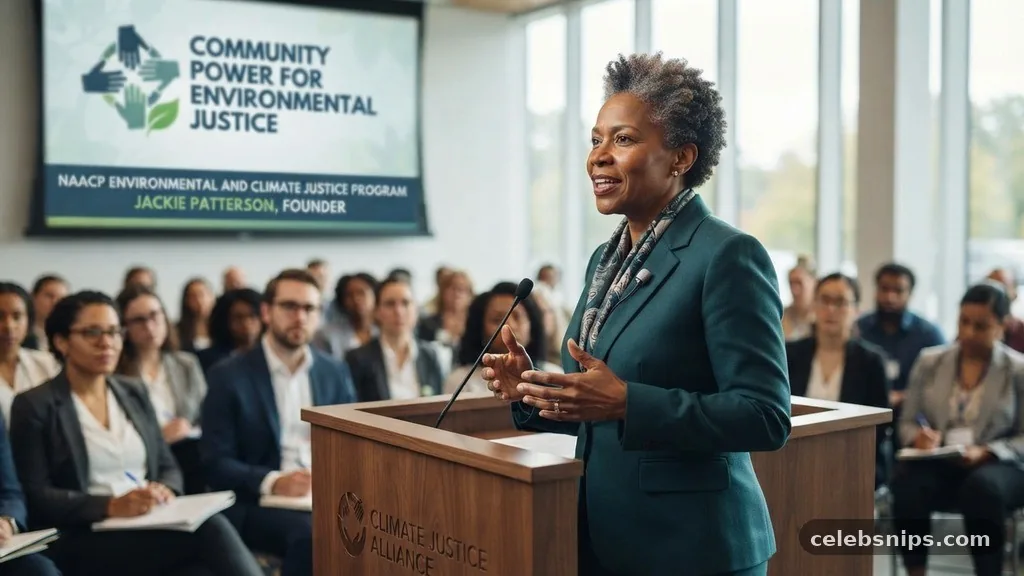
Jackie Patterson is a prominent environmental and climate-justice organizer whose professional work sits at the intersection of policy, advocacy, philanthropy, and movement building. Her public profile grew substantially through her leadership of the NAACP’s Environmental and Climate Justice Program, where she helped frame climate change as a civil-rights and public-health issue rather than only a scientific or conservation concern.
Her work has focused especially on communities that face disproportionate exposure to pollution, extreme weather, energy insecurity, displacement, and weak infrastructure. That approach treats climate policy as a question of who receives protection, who bears the costs, and who has a meaningful voice in decisions affecting their neighborhoods.
After leaving the NAACP program, Patterson became associated with the Chisholm Legacy Project. The organization honors the political legacy of Shirley Chisholm by supporting Black-led efforts that address climate change, racial inequality, economic fairness, and democratic participation.
The most defensible answer to the net-worth question is simple: no authoritative public source establishes Jackie Patterson’s personal net worth. Estimates that appear on entertainment or celebrity-finance websites should not be treated as verified financial records.
Jackie Patterson at a Glance
The following summary separates established professional information from details that are not reliably documented in widely available public sources. It is deliberately shorter than many biography tables because adding unsupported fields would create a misleading impression of certainty.
| Category | Publicly available information |
|---|---|
| Full name | Jackie Patterson |
| Known for | Climate justice, environmental justice, racial justice, public health, and nonprofit leadership |
| Major former role | Senior leadership of the NAACP Environmental and Climate Justice Program |
| Current or later professional association | Founder and leader of the Chisholm Legacy Project |
| Profession | Climate-justice advocate, strategist, speaker, and nonprofit leader |
| Date of birth | Not reliably established in authoritative public biographies |
| Age | Not reliably established; online claims should be treated cautiously |
| Spouse or partner | No reliably documented public information located |
| Children | No reliably documented public information located |
| Net worth | Not publicly verified |
Patterson’s public identity is primarily professional. Unlike film stars, recording artists, or publicly traded-company executives, nonprofit advocates usually do not have compensation, ownership stakes, property holdings, or investment portfolios disclosed in a single public database.
That distinction matters. A person can have considerable influence in national policy debates without having a publicly measurable fortune, and professional visibility should not be confused with personal wealth.
Early Life and Education
Detailed information about Patterson’s childhood, parents, siblings, birthplace, and early family life is not consistently documented in reliable public biographies. Some online pages may provide personal details, but repetition across low-quality biography sites does not establish that those details are accurate.
There is also no dependable public record that supports publishing a precise birth date or age as fact. Readers searching “How old is Jackie Patterson?” should therefore be wary of pages that state a specific number without identifying a credible primary or institutional source.
The same caution applies to education. Patterson’s professional biographies emphasize her advocacy, organizational leadership, and policy work more than they provide a full academic chronology. Unless an institution or Patterson herself confirms a degree, school, or graduation year, it is better to describe the education record as incomplete.
What is clear is that her career developed around the relationship between social conditions and health. Environmental hazards rarely affect every group equally, and Patterson’s work has repeatedly examined how race, income, housing, labor, infrastructure, and political power shape those outcomes.
That focus gives useful context for her later climate work. Climate justice is not limited to reducing carbon emissions; it also asks whether communities have clean air, safe water, stable housing, reliable energy, and a role in decisions about industrial development.
Career Before National Climate Leadership
Patterson’s career cannot be reduced to a single title or campaign. Her professional background has included work connected to public health, women’s rights, HIV and AIDS advocacy, reproductive health, and broader social-justice organizing.
Those fields share a practical concern: policies that appear universal on paper often produce unequal effects in real communities. A public-health program, for example, may be formally available to everyone while remaining difficult to access for people facing poverty, discrimination, transportation barriers, or unsafe housing.
That experience helped shape Patterson’s approach to environmental advocacy. She has treated pollution, climate risk, and disaster response as issues involving power and access, not merely technical questions for scientists or regulators.
Her early work also helps explain why she has emphasized leadership from affected communities. In climate-justice organizing, local residents often possess detailed knowledge about flooding, heat, air quality, utility shutoffs, industrial activity, and gaps in emergency services.
Rather than presenting communities only as victims, Patterson’s public work has stressed their role as organizers, policy advocates, and decision-makers. That principle became especially visible during her tenure with the NAACP.
NAACP Environmental and Climate Justice Program
Patterson became nationally recognized through her leadership of the NAACP Environmental and Climate Justice Program. The program placed environmental inequality within the NAACP’s larger civil-rights mission, drawing attention to the way pollution and climate hazards can reinforce racial and economic disadvantage.
During this period, climate change became more closely connected in public debate with issues such as environmental racism, energy poverty, extreme weather, public-health disparities, and community displacement. Patterson was one of the advocates who helped make those links understandable to audiences beyond traditional environmental organizations.
The program’s concerns extended beyond national climate legislation. It also addressed local questions: whether residents could challenge polluting facilities, whether utility systems served low-income households fairly, and whether disaster-recovery funds reached communities with the greatest needs.
Her leadership also reflected a broader change in environmental advocacy. Instead of focusing only on wilderness protection or emissions targets, climate-justice organizations increasingly highlighted workers, renters, public-housing residents, tribal communities, people with disabilities, and neighborhoods located near industrial sites.
Patterson’s contribution was partly strategic. She helped translate technical environmental issues into language connected to civil rights and lived experience, making questions about energy and pollution relevant to churches, civic groups, health advocates, and local organizers.
Publicly available biographies commonly identify her with the NAACP program for roughly the 2010s and early 2020s. Exact dates can vary depending on whether a source refers to her appointment, tenure, or transition from the role, so a specific start or end date should be checked against an official announcement.
The Chisholm Legacy Project
The Chisholm Legacy Project is the most important organization associated with Patterson after her NAACP leadership. Its name invokes Shirley Chisholm, the first Black woman elected to the U.S. Congress and the first Black major-party candidate to seek the presidency of the United States.
Chisholm’s legacy is relevant because her political career connected representation with organized community power. The project carrying her name applies that idea to climate and social justice by supporting Black-led leadership and campaigns rather than treating communities only as recipients of outside assistance.
The project’s work reflects a movement-building model. That can include strengthening organizations, developing leadership, supporting communications, connecting policy goals with local campaigns, and helping communities participate in decisions involving climate, housing, health, energy, and economic development.
Patterson’s role is not simply administrative. As a founder and public-facing leader, she has helped articulate why Black communities should have greater control over climate solutions that affect their land, labor, health, and economic future.
The organization’s approach also addresses a persistent problem in philanthropy. Grantmaking institutions may fund climate programs while overlooking the smaller, local groups that have direct relationships with residents but fewer administrative resources.
- Supporting Black-led climate and environmental justice organizations
- Building leadership among communities affected by environmental inequality
- Connecting climate action with racial justice, public health, and economic fairness
- Encouraging philanthropy to invest in community power rather than only short-term projects
- Carrying forward the organizing and democratic participation associated with Shirley Chisholm’s public legacy
Readers who want to understand the organization’s stated mission should consult the Chisholm Legacy Project’s official website. That source is more useful than unsourced profile pages because it presents the project’s own description of its work and leadership.
Climate Justice, Public Health, and Community Power
Climate justice is the central idea linking Patterson’s career. The term recognizes that climate change produces unequal risks and that solutions can also create unequal costs if they are designed without community participation.
For example, extreme heat can be more dangerous in neighborhoods with limited tree cover, poor housing insulation, high energy costs, and inadequate access to cooling. Flooding can cause longer-term harm when residents lack insurance, affordable replacement housing, reliable transportation, or political influence over rebuilding decisions.
Environmental justice adds another layer. Communities that already live near highways, refineries, power plants, waste facilities, or other sources of pollution may face cumulative exposure before climate-related hazards intensify.
Patterson’s public-health framing makes these connections concrete. Air pollution can worsen respiratory illness; unsafe heat can increase health risks; contaminated water can damage households and local economies; and disaster displacement can disrupt schooling, employment, and access to medical care.
Her work also challenges a narrow definition of climate leadership. Leadership is not only measured by the number of laws passed or emissions reduced. It can also mean whether residents gain decision-making power, whether funding reaches local organizations, and whether a transition to cleaner energy produces secure jobs and lower household burdens.
This perspective explains why social justice appears so often alongside environmental language in Patterson’s public work. The underlying question is not only how society responds to climate change, but who gets protected, who gets heard, and who controls the response.
Professional Influence and Working Style
Patterson’s influence comes from connecting organizations that do not always share the same vocabulary. Civil-rights groups, environmental advocates, health professionals, labor organizations, philanthropies, and neighborhood coalitions may pursue related goals while describing them in different terms.
Her public leadership has helped create a common frame around those interests. Clean air can be discussed as a health issue, a civil-rights issue, an economic issue, or an environmental issue, and each description can identify a different group of people who need to be involved.
She has also emphasized the importance of Black leadership in climate work. That emphasis is not simply about representation in conferences or institutions; it concerns who sets priorities, controls resources, defines success, and remains accountable to affected communities.
Another feature of her work is its attention to systems. Individual behavior, such as recycling or reducing household energy use, may matter, but it cannot substitute for decisions about industrial regulation, housing policy, transportation, utility systems, land use, and public investment.
That systems perspective gives her career a policy dimension even when she is speaking to general audiences. Patterson’s public significance lies in explaining how apparently separate problems often share the same structural causes.
Her influence should not be measured through celebrity metrics alone. The more relevant indicators are organizational leadership, public-policy participation, movement partnerships, speaking platforms, and the ability to bring climate justice into civil-rights and philanthropic discussions.
Awards, Recognition, and Public Record
Patterson has received substantial recognition as a climate and environmental-justice leader, but lists of awards online are not always consistent. Some biographies repeat honors without identifying the issuing organization, year, or original announcement.
That makes it difficult to publish a complete award list responsibly. A named honor should be included only when its recipient, date, and awarding body can be verified through an institutional record or a reliable contemporary report.
Her broader recognition is easier to establish. She has been invited to speak about climate justice, environmental inequality, public health, philanthropy, and community leadership, and she has been treated by major advocacy networks as an experienced national voice on those subjects.
Recognition also came through her senior position at the NAACP. Holding a national leadership role in one of the United States’ most established civil-rights organizations placed her work within major debates over climate policy and racial equity.
The Chisholm Legacy Project represents another form of recognition. Founding an organization connected to Shirley Chisholm’s name indicates a level of public trust and institutional responsibility, although it does not by itself establish personal wealth or a particular financial arrangement.
Readers should distinguish between professional recognition and measurable financial success. A speaking invitation, board appointment, or nonprofit leadership role may demonstrate influence, but it does not reveal salary, assets, or net worth.
Jackie Patterson Net Worth and Income
No reliable public source currently confirms Jackie Patterson’s personal net worth. Online estimates that assign her a precise dollar amount are not supported by publicly disclosed financial statements, tax returns, investment records, or an authoritative valuation of personal assets.
Her income may have come from several professional channels over time, including nonprofit employment, consulting, speaking engagements, writing, fellowships, organizational leadership, and related advisory work. The existence of a possible income source does not establish how much she earned from it.
| Potential financial category | What can responsibly be said |
|---|---|
| Nonprofit salary | Compensation may exist for executive or senior roles, but a personal salary figure is not established here. |
| Speaking income | Public advocates may receive fees, but Patterson’s speaking rates are not publicly verified. |
| Consulting or advisory work | Possible professional income source; no dependable total is publicly available. |
| Investments and property | No authoritative public inventory of personal assets has been established. |
| Estimated net worth | Unknown; internet figures should not be presented as confirmed wealth. |
Nonprofit filings can sometimes reveal an organization’s executive compensation, but they do not automatically show an individual’s total income or wealth. A salary is only one part of financial life, and it does not disclose taxes, household expenses, debt, retirement holdings, property equity, or private investments.
For that reason, the most accurate answer to “What is Jackie Patterson’s net worth?” is that it has not been publicly established. A careful biography should preserve that uncertainty rather than turn an unsupported estimate into a fact.
Personal Life and Privacy
Patterson’s public work is extensively documented, but her private life is not. Reliable sources do not provide a complete account of her parents, siblings, romantic relationships, marriage history, or children.
There is no responsible basis for identifying a spouse or partner unless Patterson or a credible source has made that information public. The absence of a public relationship record should not be interpreted as proof that she is single.
The same rule applies to residence, family background, age, and personal routines. These details may appear on biography websites, but a page repeating a claim is not necessarily evidence for it.
Protecting privacy is especially important for a public figure whose professional work concerns vulnerable communities and social justice. Readers can understand Patterson’s influence without demanding private information that she has not chosen to disclose.
What can be said with confidence is that her public identity is built around professional service, advocacy, and organizational leadership. Those areas provide enough substance for a meaningful biography without speculating about family or relationships.
Clarifying the “Fly Lawyer” Search
Some searches for Jackie Patterson combine climate-justice queries with phrases such as “The Fly Lawyer,” “Patterson Legal,” Greenville, South Carolina, and questions about legal fees. Those terms appear to refer to a different professional identity, not the climate-justice leader associated with the NAACP and Chisholm Legacy Project.
There is no reliable basis for merging the two profiles. A shared name does not establish that two people are related, that they have the same age, or that one person has both a climate-advocacy career and a South Carolina legal practice.
Readers searching for the lawyer should verify the person through the official law-firm website, state bar records, court filings, or other authoritative legal sources. Readers searching for the climate advocate should use the NAACP and Chisholm Legacy Project context instead.
This distinction also affects the net-worth question. Financial claims associated with a law firm, legal advertising, or personal-injury practice should not be transferred to Patterson’s climate-justice biography.
Name confusion is common in search results, especially when a person has a relatively common first name and surname. The safest method is to compare occupation, location, organizations, and documented career history before accepting a biography as relevant.
Online Presence and Current Professional Status
Patterson’s online presence is best understood through organizational and professional channels rather than celebrity-style personal profiles. Public information about her work is connected primarily to the Chisholm Legacy Project, climate-justice networks, public events, interviews, and institutional biographies.
Social-media accounts should be verified carefully. An account using the name Jackie Patterson is not automatically official, and follower counts change constantly, so an unverified number offers little lasting value.
Her current professional status should also be described with care. Public materials identify her with the Chisholm Legacy Project, but titles, organizational roles, and project structures can change over time.
The most useful way to follow her work is to check current announcements from the organization or from established institutions that host her speaking engagements. That approach is more reliable than relying on undated biography pages that may preserve old job titles.
Even when a title changes, the central themes of Patterson’s career remain clear: climate justice, environmental health, racial equity, community leadership, and the distribution of financial and political power.
Frequently Asked Questions
Who is Jackie Patterson?
Jackie Patterson is a climate-justice advocate and nonprofit leader known for her work with the NAACP Environmental and Climate Justice Program and the Chisholm Legacy Project.
What is Jackie Patterson known for?
She is known for linking climate policy with racial justice, environmental health, public health, community leadership, and the needs of communities disproportionately affected by pollution and climate hazards.
What is Jackie Patterson’s net worth?
Her net worth is not publicly verified. Online estimates should be treated as speculative because no authoritative public financial record establishes a specific figure.
How old is Jackie Patterson?
A reliable public source does not establish her exact birth date or age. Specific ages published without a credible source should not be treated as confirmed.
Is Jackie Patterson married or does she have children?
Her marital status, partner history, and whether she has children are not reliably documented in the public sources used for this biography. It would be inappropriate to infer those details from rumors or name-based search results.
Final Takeaway
Jackie Patterson’s public importance comes from her climate-justice career, not from a verified celebrity fortune. Her leadership at the NAACP and work with the Chisholm Legacy Project connect environmental policy with racial justice, public health, social change, and community power.
The available record does not establish her age, family details, or net worth, and those gaps should remain clearly labeled. Anyone researching Jackie Patterson’s net worth, career, and personal life should also separate her from the unrelated “Fly Lawyer” search results and rely on current institutional information for future updates.