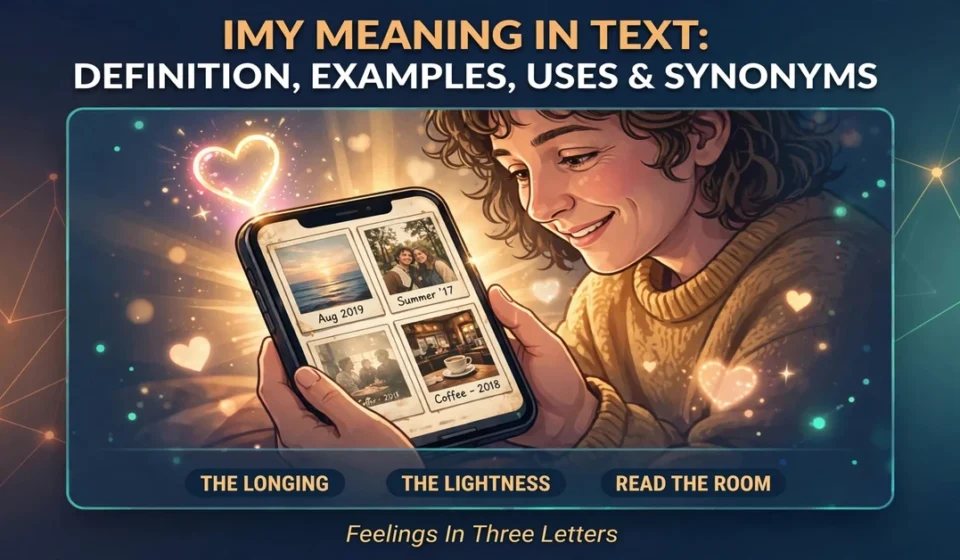

It is 11:47pm. You are scrolling through old photos — the road trip, the late-night diner, your best friend laughing so hard there are tears. Before you can talk yourself out of it, you open the chat and type three letters: “imy.” No essay, no explanation. Just the feeling, compressed.
IMY stands for “I miss you.” It is one of the warmest acronyms in texting — a quick, casual way to tell someone they have been on your mind. It can be romantic, friendly, or familial, and the same three letters carry completely different weight depending on who sends them and when.
In this guide, we will explore the full IMY meaning in text: why the abbreviation feels lighter than the full phrase, how it changes across relationships, the role of emojis and timing, where it lives on different platforms, when it gets complicated, and exactly how to reply when someone sends one your way.
What Does IMY Mean in Text?
The straightforward answer: IMY = “I miss you.” It expresses longing, affection, or fondness for someone who is not around — a friend who moved away, a partner on a trip, a family member you have not seen in months, or even a version of life you are nostalgic for.
But IMY is not just a shorter “I miss you.” The abbreviation changes the emotional physics of the message:
- “I miss you” — full, formal, heavy. It is a statement with gravity, the kind you say on the phone or write in a letter. It asks to be received seriously.
- “imy” — light, casual, low-pressure. It is a feeling tossed across the chat like a paper airplane. Easy to send, easy to receive, easy to answer.
That lightness is the whole point. Typing out “I miss you” can feel like a big emotional commitment — vulnerable, intense, maybe too much for a Tuesday afternoon. “imy” says the same thing with the stakes turned down. It lets people express affection without making it A Moment.
The casing matters too. Lowercase “imy” is the default — breezy and casual. All-caps “IMY” hits harder, more emotional, more urgent. “IMY 😭” at midnight is a different message than “imy! see you friday” at noon.
The Emotional Weight of Three Letters
Here is the paradox: IMY is lighter than “I miss you,” but it is still one of the most emotionally loaded things you can text. Missing someone is vulnerable — it admits that your day has a person-shaped hole in it. The acronym does not remove that vulnerability; it just makes it easier to voice.
Psychologists of digital communication have noted this pattern across slang: abbreviations lower the activation energy of emotional expression. It is easier to type “imy” than to say “I miss you” out loud, the same way it is easier to send ❤️ than to say “I love you.” The casualness is a feature — it gives feelings a low-stakes doorway into the conversation.
That is why IMY shows up in moments the full phrase never would: a random Tuesday, a funny meme that reminded you of someone, the third song on a playlist. The acronym turned missing someone from an occasion into a reflex — and honestly, that is kind of beautiful.
IMY in Different Relationships
The same three letters mean different things depending on who is texting whom:
Romantic IMY
Between partners or crushes, IMY is longing with a heartbeat. “imy 😢 counting down the days” is straightforward devotion. But context is everything — an “imy” from someone you are dating feels like warmth; an “imy” from an ex at 2am feels like a plot twist. Timing, history, and emoji choice write the real message around the acronym.
Friendship IMY
Between friends, IMY is affection without complications. “imy!! when are we hanging out again” is the bread and butter of long-distance friendships — a way to say the friendship matters without getting sappy. Friend-group IMYs (“imy guys 🥹”) are practically a genre: nostalgic, warm, and usually followed by ten minutes of “we NEED to plan something.”
Family IMY
To parents, siblings, grandparents — IMY is love in its simplest packaging. “imy mom ❤️” needs no elaboration. Family IMYs tend to be the most straightforward of all: no games, no subtext, just someone thinking of home.
The Ambiguous IMY
Then there is the IMY that launches a thousand overthinking sessions: from someone you are sort of seeing, or a friend you might have feelings for. “imy” with no emoji, no context, at an odd hour — is it friendly? Flirty? A test balloon? This is the IMY that gets screenshotted and sent to the group chat for analysis. (The group chat’s verdict is usually “they like you,” for the record.)
How to Use IMY Naturally
IMY is simple, but a little craft makes it land better. The native patterns:
The spontaneous IMY:
- “just heard our song. imy 🥹”
- “saw the funniest thing and you weren’t here. imy”
- The trigger — a song, a meme, a place — makes it feel genuine rather than random.
The check-in IMY:
- “imy! how have you been?”
- “hey stranger, imy. what’s new?”
- Pairing it with a question turns the feeling into a conversation.
The goodnight IMY:
- “imy, sleep well ❤️”
- The classic late-night send — when defenses are down and feelings are up.
The group IMY:
- “imy guys, this chat has been too quiet”
- Works best when the group actually has history. Do not IMY a group chat you joined yesterday.
The milestone IMY:
- “can’t believe it’s been a year. imy so much”
- Anniversaries, birthdays, holidays — the acronym scales up when the occasion does.
One rule: do not IMY-bomb. Sending “imy” five times a day drains it of meaning — it starts to read as anxious rather than affectionate. The power of IMY is in its spontaneity. A surprise “imy” on a random Wednesday beats a scheduled one every time.
The Emoji Factor: IMY’s Emotional Subtitles
IMY rarely travels alone, and its companions rewrite the message:
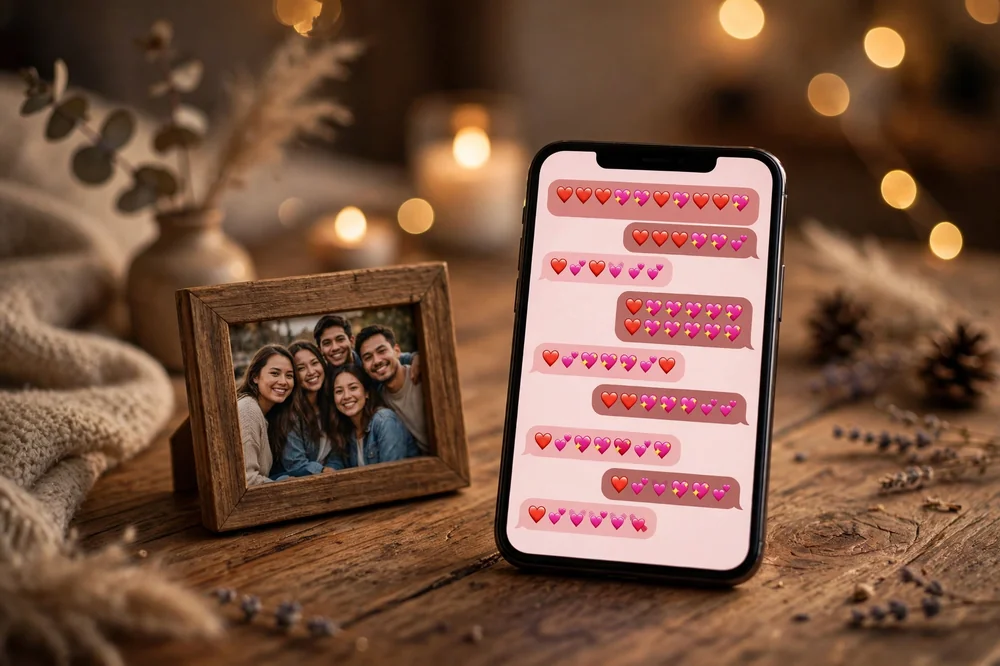
- imy ❤️ — warm, loving, straightforward. The default for romance and close family.
- imy 😭 — dramatic longing. “I miss you SO much it hurts” energy. Usually playful.
- imy 🥹 — tender and emotional. The “holding back tears because I’m happy-sad” emoji. Peak sincerity.
- imy 😢 — genuinely sad. This one has real weight — the sender is actually feeling the absence.
- imy 😘 — flirty. The kiss turns missing into missing you specifically, romantically.
- imy 🥰 — affectionate and soft. Warm without being heavy.
- imy 💀 — joking. “imy 💀 this place is boring without you” — the skull keeps it light.
- imy (no emoji) — the wildcard. Could be casual, could be loaded. Context decides.
If you are sending an IMY and want to control how it lands, the emoji is your steering wheel. No emoji leaves the interpretation to the reader — which is fine with your best friend and risky with your situationship.
IMY Across Platforms
WhatsApp and iMessage: IMY’s home turf — private, personal, real relationships. This is where the acronym carries its full emotional weight.
Instagram DMs: Often sent as a reaction to stories — replying “imy 🥹” to a friend’s vacation photo or life update. The visual trigger makes it spontaneous and specific.
Snapchat: Quick IMYs over snaps — a photo of somewhere you used to go together, captioned “imy.” The disappearing format makes it feel safe and in-the-moment.
TikTok comments: “imy” under a creator’s comeback video, or under nostalgic content — here it can mean “I miss this” as much as “I miss you.” The object of missing gets blurry, and that is fine.
Discord and gaming: “imy guys” when the squad has not played together in weeks. Gaming friendships are real friendships, and the IMY hits the same.
IMY vs. ILY vs. IMU: The Affection Family
IMY has close relatives, and the differences matter:
- IMY (I miss you) — about absence. “You are not here, and I feel it.” It is longing, not declaration.
- ILY (I love you) — about feeling. Bigger, heavier, more committed. ILY is a statement; IMY is a sigh. You can IMY someone you would never ILY.
- IMU (I miss you, alternate spelling) — same as IMY, just a different abbreviation. Less common, same meaning.
- LYSM (love you so much) — ILY turned up to eleven. More intense than IMY in every way.
The progression in a relationship often goes: IMY → ILY. Missing someone is the safe early version of loving them. That is why the ambiguous IMY gets so much analysis — everyone knows what it might be a stepping stone to.
When IMY Gets Complicated
For three light letters, IMY can create real tangles:
The unreciprocated IMY. You send “imy ❤️” and get back “haha yeah.” Ouch. The asymmetry stings because missing someone is vulnerable — and vulnerability unreturned feels like rejection. The fix is perspective: their reply reflects their texting style, not your worth. (And if the pattern repeats, it reflects the relationship, which is useful information.)
The ex’s IMY. “imy” from an ex is never just three letters — it is a door cracked open. Before responding, decide whether you want that door open. A reply continues the conversation; silence closes it. Both are valid. Just make it a choice, not a reflex.
The mixed-signal IMY. Regular IMYs with no escalation — no plans, no deeper conversation — can keep someone in emotional limbo. If you are sending them, know they create hope. If you are receiving them, it is okay to ask what they mean: “I miss you too — want to actually hang out soon?”
The guilt-trip IMY. “imy… you never text anymore” — the acronym as leverage. Missing someone is fine; weaponizing it is not. If someone’s IMY consistently comes with a complaint attached, that is worth addressing directly.
How to Reply When Someone Sends IMY
The golden rule: match the vulnerability. Someone who typed “imy” took a small emotional risk. Honor it.
Reciprocate warmly: “imy too ❤️” — simple, perfect, always works.
Reciprocate with energy: “AAAA imy more!! when are you back?!” — for the dramatic friendship IMY. Match their excitement.
Reciprocate with a plan: “imy! we need to fix that — dinner friday?” — the best reply to any IMY, because it turns feeling into action.
If you are not sure how you feel: “aww 🥹 how’ve you been?” — warm without committing to the same emotion. Buys time honestly.
If it is complicated (ex, situationship): Be honest with yourself first. “hey, good to hear from you” acknowledges without opening the door — or “I’ve missed you too, can we talk?” opens it deliberately. Either way, choose.
What not to do: do not leave a heartfelt IMY on read. Even a simple ❤️ back takes one second. Silence after “imy” is one of the coldest things in texting — the vulnerability was real, even if the letters were casual.
Frequently Asked Questions
1. What is the IMY meaning in text messages?
IMY stands for “I miss you.” It is a casual, affectionate way to tell someone you have been thinking about them — used between partners, friends, and family. For example: “just heard our song. imy 🥹”
2. Is IMY romantic?
It can be, but it is not automatically. Between partners it is romantic; between friends it is friendly affection; in families it is love. The relationship, timing, and emojis decide — a midnight “imy 😘” reads very differently from a lunchtime “imy guys!”
3. What is the difference between IMY and ILY?
IMY (“I miss you”) is about absence — you feel someone’s absence. ILY (“I love you”) is about feeling — a bigger, more committed declaration. IMY is lighter and lower-stakes; you can IMY someone you would never ILY.
4. How should I reply to “imy”?
Match the warmth: “imy too ❤️” always works. Even better, add a plan — “imy! dinner friday?” If the IMY is complicated (an ex, a situationship), decide what you want before replying, and do not leave a heartfelt one on read.
5. Why do people type “imy” instead of “I miss you”?
The abbreviation lowers the emotional stakes. “I miss you” feels like a big vulnerable statement; “imy” expresses the same feeling casually, making it easier to send spontaneously — on a random Tuesday, not just on special occasions.
Conclusion
The IMY meaning in text is simple — “I miss you” — but what it does is remarkable: it gives a huge human feeling a small, sendable shape. It lets people say the vulnerable thing on an ordinary day, to a partner, a best friend, or a mom, without making it a production. In a medium built for speed, IMY is proof that brevity and tenderness can share three letters.
So send the IMY. The random-Wednesday one, the song-triggered one, the 1am one (maybe think twice about that one). And when one lands in your chat, do not leave it hanging — a feeling that small took courage to send. imy too.
Explore more on Celeb Snips.