
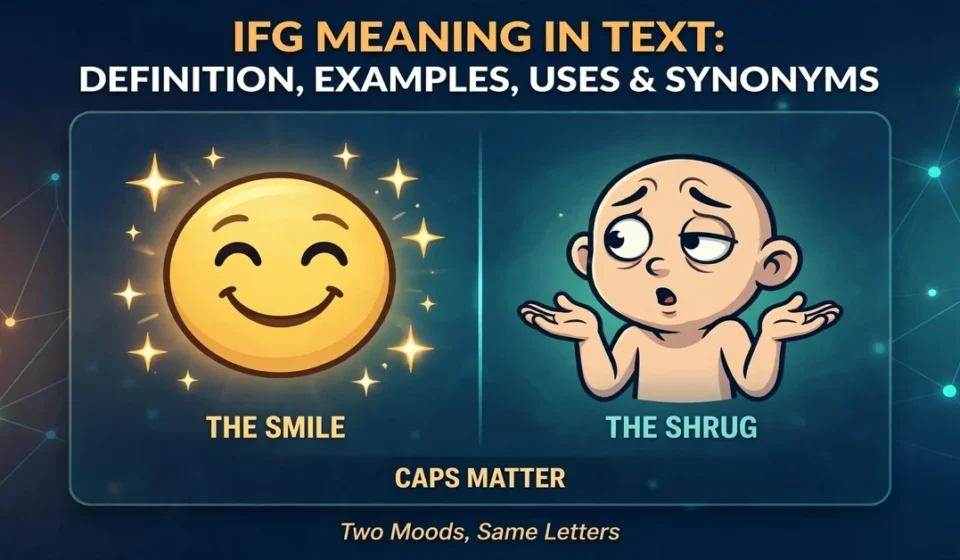

Three letters, two moods, zero overlap. That’s IFG for you — an abbreviation that can mean you’re having the best day of your life or that you’ve completely given up on the conversation, depending on which version someone typed. Get it right and you read the room perfectly. Get it wrong and you might congratulate someone who was actually rolling their eyes at you.
Here’s the essential breakdown: the ifg meaning in text is most commonly “I feel good” — a quick, sunny way to say you’re thriving. But IFG (usually in all caps) can also stand for “I f***ing guess,” the universal text-speak for reluctant, eye-rolling agreement. Same letters, opposite energies. Context — especially capitalization and tone — tells you which one you’re dealing with.
In this guide, I’ll unpack both meanings of IFG, show you how to spot each one instantly, walk through real examples, and cover the etiquette of using the spicier version without starting a fight. Let’s decode it.

What Does IFG Mean in Text?
IFG is a genuine two-faced abbreviation. The two meanings you’ll encounter are:
- “I feel good” — the positive, wholesome reading. A compact way to announce a good mood, a win, or general thriving. This is the more common and more widely understood meaning.
- “I f***ing guess” — the sarcastic, reluctant reading. A compressed sigh that means “fine, whatever, I’ll go along with it (but I’m not happy about it).” Almost always written in all caps.
There’s also a rare third reading — “internet friends group,” used on Discord and Reddit for online communities — but you’ll encounter it far less often than the big two. For everyday texting, it’s a two-horse race, and the capitalization is your fastest clue: lowercase “ifg” is almost always the happy one.
Meaning #1: “I Feel Good” — The Positive One
“I feel good” is IFG’s sunny side and its most popular meaning across Snapchat, Instagram, TikTok, and everyday texting. It’s shorthand for a whole mood: things are going well, the vibes are right, life is good. Instead of typing out a full status update, you drop three letters and let the positivity speak for itself.
Typical uses look like this: “Just got promoted at work — ifg today!” or “Finished my exams, ifg!” or “Beach day with my favorite people, ifg.” It’s the kind of message that usually travels with smiling emojis, celebration GIFs, or a photo of whatever’s making the day great. The tone is light, genuine, and shareable — it’s a broadcast of happiness, not a private confession.
What makes this version work so well is its efficiency. “I feel good” as a full sentence can sound oddly formal in a fast-moving chat, like you’re narrating a therapy session. “ifg” keeps the same meaning but matches the rhythm of texting — quick, casual, and warm. It’s positivity that doesn’t slow the conversation down.
Meaning #2: “I F***ing Guess” — The Reluctant One
Now the other face. “I f***ing guess” is what you type when someone asks you something and your honest answer is a shrug wrapped in mild annoyance. It’s reluctant agreement — you’re going along with it, but your enthusiasm is sitting at absolute zero. Think of it as the textual equivalent of a heavy sigh followed by “fine.”
In practice it looks like this: “Do I want to go to the party? IFG, I don’t have other plans.” Or: “Should we invite him? IFG I suppose.” The message says yes, but the energy says “I’d rather be anywhere else.” It’s dry, a little edgy, and very much a friend-group-and-DMs-only expression — this is not language for work emails, teachers, or grandparents.
The all-caps styling is doing real work here. Capital letters add volume and edge, which is exactly what separates “IFG” the shrug from “ifg” the smile. Some people soften it to “ifg” in lowercase even with the sarcastic meaning, relying on context and eye-roll emojis to carry the tone — but as a rule of thumb, caps lock means the spicy version.
How to Tell Which “IFG” Someone Means
This is the part that actually matters, because misreading the mood here leads to real awkwardness. Run this checklist:
- Check the caps. Lowercase “ifg” = “I feel good” about 95% of the time. ALL CAPS “IFG” = “I f***ing guess” more often than not. This single clue resolves most cases.
- Read the emotional temperature. Good news, wins, sunshine, celebration — that’s “I feel good.” Complaints, reluctant plans, debates, sighing energy — that’s “I f***ing guess.”
- Look at the emojis. Smiling faces, party poppers, hearts, and sparkles ride along with “I feel good.” Eye-rolls, shrugs, skulls, and deadpan faces ride along with the sarcastic version.
- Check the sentence around it. “IFG about the party tonight!” (positive context) versus “IFG, whatever you want” (resigned context). The surrounding words almost always betray the mood.
- Know your sender. Some friends live in lowercase positivity; others communicate exclusively in sarcastic caps. Your history with the person is a legitimate decoding tool — use it.
Real Texting Examples of Both Meanings
Here’s the split personality in action:
“I feel good”:
A: “how’d the interview go??”
B: “nailed it, ifg!! 😄”
A: “yesss knew you would!”
“I f***ing guess”:
A: “we’re doing karaoke tonight, you’re coming right?”
B: “IFG 🙄 I have nothing better to do”
A: “that’s the spirit lol”
The rare “internet friends group”:
A: “my IFG has been gaming together for three years and we’ve never met irl”
B: “that’s actually so wholesome”
Notice how the first two could not be confused once you see them side by side — the emotional weather of each message is completely different. That’s your real decoding key: don’t just read the letters, read the weather.
When and How to Use IFG Yourself
The “I feel good” version is versatile and safe. Use it in captions, status updates, replies to “how are you?”, and celebrations of all sizes. It works with friends, acquaintances, and even in semi-casual spaces — it’s wholesome enough that nobody will ever side-eye you for it. Pair it with an emoji or a detail (“ifg, finally Friday!”) and it lands perfectly.
The “I f***ing guess” version needs a tighter leash. Reserve it for close friends who know your humor, group chats with an established sarcastic dynamic, and DMs where dry tone is the house style. Never use it with authority figures, in professional settings, or with someone you’re still getting to know — sarcasm in text is already risky, and profanity-adjacent sarcasm doubles the risk. And if you’re the one receiving it, don’t take it at face value as enthusiasm; it’s a mood, not a yes.
IFG on Different Platforms
Where you see IFG changes its flavor slightly. On Snapchat and Instagram, the “I feel good” meaning dominates — it’s caption and story-reply territory, all positivity. On TikTok, both meanings thrive: “ifg” in comments is usually genuine good vibes, while “IFG” in a stitch or duet caption often carries the sarcastic edge. In Discord and gaming chats, watch for the rare “internet friends group” reading, though the big two still lead. In plain SMS and WhatsApp, it’s almost entirely a tone game between the two main meanings, decoded by caps and context.
Mistakes to Avoid With IFG
The classic blunder is congratulating the sarcasm — replying “yay!!” to someone’s resigned “IFG.” Read the weather first. The second is deploying the spicy version upward: sending “IFG” to a boss, teacher, or new acquaintance who can’t tell you’re joking. The third is mixing up IFG with lookalikes like IDG (“I don’t get it”) or IG (“I guess” / Instagram) — similar letters, different messages. And finally, don’t use either version where clarity matters: if someone needs a real answer, give them a real sentence instead of a three-letter mood.
IFG vs. Similar Slang
IFG has neighbors worth knowing. IDK (“I don’t know”) and IDC (“I don’t care”) share the shrug-energy family with sarcastic IFG, minus the reluctant agreement. WBU (“what about you?”) often follows positive IFG as a conversational bounce-back. FR (“for real”) can amplify either meaning — “ifg fr” doubles down on the good vibes, while “IFG fr” doubles down on the resignation. And IG (“I guess”) is the milder, profanity-free cousin of the sarcastic reading — use it when you want the shrug without the edge.
IFG in Dating and Relationship Texts
IFG gets its trickiest workout in dating conversations, where tone is everything and a single abbreviation can tilt the whole mood. The “I feel good” version is a green flag: “how was your day?” / “ifg, just got promoted!” — that’s warmth, openness, someone happy to share. Drop it early in a conversation and it sets an upbeat tone that invites the other person to match your energy.
The “I f***ing guess” version, on the other hand, is a masterclass in reluctant agreement — and in dating, reluctance speaks volumes. “Wanna try that new sushi place?” / “ifg” lands very differently from “yes!!” It’s not quite a no, but it’s the textual equivalent of a shrug with an eye-roll. If you’re getting “ifg” as a response to your plans, read the room: the person is agreeing without enthusiasm, and pushing forward without addressing it usually backfires.
This is also where the capitalization rule matters most. A lowercase “ifg” in a flirty, flowing conversation is almost always the positive one — nobody types the profane version in lowercase mid-flirt without the conversation already being spicy. An all-caps “IFG” after a question about weekend plans is far more likely to be the reluctant one. And when in doubt in a romantic context, don’t decode — just ask: “haha is that a happy ifg or a reluctant ifg?” It’s a charming question, it shows emotional intelligence, and it beats misreading the situation by a mile.
One more dating-specific note: because “I f***ing guess” carries profanity, some people avoid typing it in early-stage dating altogether and reserve it for established relationships where the dynamic is clear. If someone you’ve just started talking to drops it, they’re either very comfortable already or testing boundaries — either way, now you know what to look for.
Frequently Asked Questions
What does IFG mean in texting?
IFG most commonly means “I feel good” — a quick way to express happiness or a positive mood. In all caps, it often means “I f***ing guess,” expressing reluctant or sarcastic agreement. Capitalization and tone tell you which one applies.
Is IFG positive or negative?
It can be either, which is what makes it tricky. Lowercase “ifg” is almost always positive (“I feel good”). Uppercase “IFG” is often negative or sarcastic (“I f***ing guess”). Check the emojis and the surrounding conversation to confirm.
What does “ifg” mean on Snapchat?
On Snapchat, “ifg” overwhelmingly means “I feel good.” It’s popular in story replies, streaks, and captions celebrating good news or good moods. The sarcastic “I f***ing guess” reading is much rarer on Snapchat than in general texting.
Can I use IFG in formal or professional messages?
The “I feel good” version is casual but harmless — still, spell things out at work. The “I f***ing guess” version should never appear in professional, academic, or formal settings. When clarity or politeness matters, use full sentences.
What’s the difference between IFG and IG?
“IG” usually means “I guess” (a mild, neutral shrug) or refers to Instagram. “IFG” as “I f***ing guess” is the stronger, edgier, more annoyed version of the same shrug. If you want the reluctant tone without profanity, “IG” is the safer pick.
Conclusion
IFG is a perfect example of how much work three little letters can do — and how much rides on the details around them. “I feel good” and “I f***ing guess” are emotional opposites, yet they share the same abbreviation, separated only by capitalization, emojis, and the weather of the conversation.
The takeaway is simple: never read IFG in isolation. Glance at the caps, feel the tone, check the emojis, and you’ll know in a heartbeat whether someone’s thriving or just barely tolerating the group chat. Master that two-second read, and this particular piece of slang will never trip you up again.