
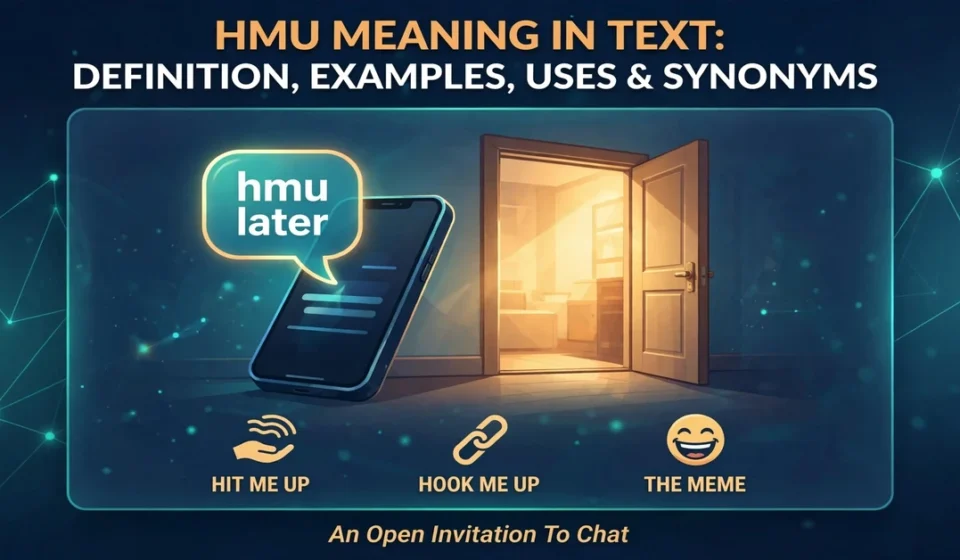

It’s three letters long, it shows up everywhere from DMs to dating apps to marketplace listings, and it always means the same friendly thing: talk to me. “HMU” might be the most versatile invitation in all of texting — part greeting, part open door, part “I want to hear from you.” And yet, plenty of people see it for the first time and freeze, unsure whether it’s a question, a demand, or something flirty.
Let’s clear it up right away: the hmu meaning in text is “hit me up,” a casual way of saying “contact me,” “message me,” or “get in touch.” It’s an invitation, not an order — relaxed, friendly, and open-ended. Someone who texts “hmu later” is simply leaving the door open for future conversation.
In this guide, I’ll explain exactly what HMU means, where it came from, how to use it naturally in every kind of chat, how to respond when someone sends it to you, and the few situations where you should leave it out. By the end, you’ll wield this little abbreviation like a native.
What Does HMU Mean in Text?
HMU stands for “hit me up.” The phrase itself is old — it comes from 1990s hip-hop culture and African American Vernacular English, where “hit me up” meant “call me” or “get in touch” (back when that meant a phone call or even a pager beep). As texting took over in the 2000s, the phrase got compressed to three letters, and HMU became a staple of digital small talk.
At its core, HMU is an invitation to make contact. The exact flavor shifts with context:
- “Hit me up” — the standard meaning: message me, call me, reach out. (“I’ll be in town Friday — hmu if you’re free.”)
- “Hook me up” — the secondary meaning: help me out or connect me with something. (“Hmu with those concert tickets” = get me access.)
- “Hold my unicorn” — a joke definition from an old Urban Dictionary entry that went viral as a meme. Nobody uses this seriously.
In everyday texting, assume “hit me up” unless the conversation is clearly about favors or access, in which case “hook me up” fits better.
Where You’ll See HMU
HMU is a true digital nomad — it lives comfortably on almost every platform:
- Text messages and iMessage — the classic home turf. Quick, casual, between friends.
- Instagram and Snapchat DMs — story replies, new connections, casual check-ins.
- WhatsApp and Messenger — group chats and one-on-one threads alike.
- Dating apps — “hmu if you’re ever downtown” is a low-pressure way to show interest.
- Social media posts and stories — “Selling my old bike, hmu for details” turns a post into an open invitation.
- Gaming chats and Discord — coordinating squads and sessions.
What unites all of these is informality. HMU belongs to the world of thumbs-typing and quick replies, not boardrooms and cover letters.
How to Use HMU: Real Examples
The beauty of HMU is its flexibility. Here are the situations where it shines, with realistic examples:
Making plans:
“I’m free Saturday night, hmu if you wanna do something”
Reconnecting:
“haven’t talked in forever — hmu sometime!”
Offering help:
“need notes from yesterday’s class? hmu”
Selling or sharing:
“got two extra concert tickets, hmu if interested”
Asking for a favor (the “hook me up” sense):
“hmu with your wifi password when I get there”
Casual flirting:
“you seem fun, hmu sometime 😉”
Notice the pattern: HMU almost always comes with a little context about why someone should reach out. A bare “hmu” with no context works between close friends, but adding the reason (“hmu about the trip”) makes it ten times more effective — and more likely to get a reply.
How to Respond When Someone Says “HMU”
Getting an “hmu” is easy to handle — just match the energy. If it’s a friendly invitation, reply in kind: “will do!”, “for sure, what did you have in mind?”, or just start the conversation they invited. If they gave you a reason (“hmu about the tickets”), respond to that reason directly.
If the HMU feels flirty and you’re interested, mirror the warmth. If you’re not interested, a friendly-but-neutral reply (“haha will do”) keeps things kind without encouraging more. And if a stranger’s “hmu” feels off, you’re never obligated to engage — the same instincts that apply to any unsolicited message apply here.
One more tip: if someone says “hmu later” and you actually want to talk, don’t wait for a formal invitation. The whole point of HMU is that the door is open — walk through it.
HMU Etiquette: Do’s and Don’ts
Like all slang, HMU works best when it matches the room. Here’s the etiquette cheat sheet:
- Do use it with friends, peers, and casual contacts
- Do add context so people know why they should reach out
- Do pair it with a friendly tone — it’s an invitation, not a summons
- Do use it in DMs, stories, and casual posts where brevity is welcome
- Don’t drop it in professional emails, job applications, or school assignments
- Don’t use it with authority figures or in serious conversations
- Don’t send a context-free “hmu” to someone you barely know and expect a reply
- Don’t overuse it — like any catchphrase, it loses charm with repetition
The core principle: HMU signals casual openness. Anywhere casual openness is welcome, HMU is welcome. Anywhere it isn’t, spell out what you mean instead.
The History of “Hit Me Up”
“Hit me up” has been in the American slang vocabulary since the 1990s, born in hip-hop culture where “hit” already meant to contact someone (as in “hit me on my pager”). The phrase rode the wave of mobile culture — pagers, then cell phones, then texting — always meaning “reach me when you can.”
The abbreviation “HMU” emerged in the early 2000s alongside AIM, MSN Messenger, and the first big wave of texting shorthand. It spread the same way LOL and BRB did: teenagers typing fast, character limits encouraging brevity, and a phrase useful enough to earn its place. By the 2010s, social media had made it global — and in 2010, a joke Urban Dictionary definition (“hold my unicorn”) briefly turned it into a meme, a sure sign a slang term has truly arrived.
HMU vs. Similar Slang
HMU sits in a family of contact-and-connection abbreviations. DM me (“direct message me”) is the platform-specific cousin — more literal, less warm. Lmk (“let me know”) is similar but more about information than connection. Holler (“holler at me”) is HMU’s older relative from the same hip-hop roots. And WYA (“where you at”) often pairs with HMU in plan-making: “wya? hmu when you’re close.” Knowing the family helps you pick the exact invitation you want to extend.
HMU Across Platforms: Snapchat, Instagram, and Dating Apps
HMU is a shapeshifter — the same three letters carry different weight depending on where they land. On Snapchat, “hmu” is practically punctuation. It lives in stories (“bored, hmu”), streaks maintenance, and late-night “hmu if you’re up” snaps. The platform’s ephemeral, low-stakes vibe makes HMU feel casual and reversible — you’re not committing to anything, just opening a door.
On Instagram, HMU usually travels through DMs or story replies, and it skews slightly more intentional. Replying “hmu” to someone’s story is a soft opening — less forward than a compliment, more forward than a like. In bios, “hmu for collabs” or “hmu for prints” turns it into a business call-to-action, which is why context-checking matters: the same letters can be flirty or professional depending on the account.
On dating apps, HMU does the most delicate work of all. “Hmu if you’re in the area” in a bio is an invitation with built-in plausible deniability — interested, but not chasing. In an active conversation, though, “hmu” can signal waning interest: it shifts the effort of continuing onto you. The rule of thumb: HMU as an opener is welcoming; HMU as a response to your question is a yellow flag.
And on Twitter/X and TikTok, “hmu” often goes public and performative — quote-tweeting opportunities, duet requests, “hmu if you make edits.” Here it’s networking slang, closer to “DM me” as a professional reflex than a personal invitation. Same letters, four different social contracts. Reading the platform is half of reading the message.
The Psychology of HMU: Why Three Letters Work So Well
There’s a reason “hit me up” survived the journey from 2000s hip-hop lyrics to 2026 group chats while hundreds of other slang terms died: it’s psychologically engineered to succeed. First, it reverses the social risk. Saying “call me” puts the burden on the other person; saying “hit me up” frames you as the available one and hands them a no-pressure invitation. The asker risks nothing. That’s a powerful offer in a world where everyone fears seeming needy.
Second, it’s deliberately vague — and vagueness is a feature. “Hit me up” doesn’t specify when, how, or about what, which means it can’t be declined on specifics. Compare “want to get coffee Thursday?” (easy to dodge) with “hmu sometime” (nothing to dodge). The vagueness keeps the door open without forcing anyone through it, which is exactly why it’s the go-to for reconnecting with old friends, soft-launching crushes, and networking without awkwardness.
Third, the abbreviation itself does work. Typing “hmu” instead of “hit me up” signals casualness — the full phrase can sound oddly formal in text, like something from a 2005 email signature. The lowercase acronym says “I’m relaxed, this is low-stakes, no pressure.” Tone is carried by form as much as content, and HMU’s form is perfectly tuned for the message it delivers.
Understanding this psychology also helps you use it better. Want a real response? Add the specifics HMU usually lacks: “hmu this weekend, I’m free Saturday” converts dramatically better than a bare “hmu.” The slang opens the door; the details walk people through it.
Frequently Asked Questions
What does HMU mean in texting?
HMU means “hit me up” — a casual way to say “contact me,” “message me,” or “get in touch.” It’s a friendly, open-ended invitation to continue a conversation or make plans, not a demand.
Is HMU flirty?
It can be, but it isn’t automatically. “Hmu sometime 😉” from a crush is clearly flirty; “hmu if you need the notes” from a classmate is purely practical. Like most slang, the flirt factor comes from context, emojis, and who’s sending it — not the letters themselves.
What’s the difference between “hit me up” and “hook me up”?
“Hit me up” means “contact me” — it’s about communication. “Hook me up” means “help me out” or “get me access to something” — it’s about favors. HMU can mean either, but “hit me up” is the default; the conversation topic tells you when it’s the “hook me up” sense.
Can I use HMU at work or school?
Generally, no. HMU is informal slang, and it can look unprofessional in work emails, school assignments, or messages to authority figures. In a casual Slack message to a close colleague it might pass, but when in doubt, write “let me know” or “feel free to reach out” instead.
How do I reply to “hmu”?
Match the tone: “will do!”, “sounds good, what did you have in mind?”, or simply start the conversation. If they mentioned a reason (“hmu about the tickets”), reply to that. There’s no wrong answer — HMU is an open door, so walking through it is always correct.
Conclusion
HMU is one of those rare slang terms that’s survived decades without losing its meaning or its warmth: “hit me up,” the casual invitation to connect. Whether it’s making plans, selling something, reconnecting with an old friend, or testing the waters with a crush, those three letters open a door that full sentences sometimes can’t.
Use it with context, keep it casual, and leave it out of anything formal. Do that, and HMU will do what it’s always done — keep conversations, friendships, and plans moving with the least possible friction.