

Few English phrases carry as much drama as "hit the deck." When someone shouts it, you can almost hear the urgency in their voice — something is happening, and you need to move, fast. But what exactly does it mean? It depends on who says it and where. A drill sergeant on a battlefield means something very different from a dad knocking on his teenager’s bedroom door on a school morning.
The phrase "hit the deck" has sailed a long way from its original home. It started on the wooden decks of ships, marched through military history, danced across Broadway in a 1920s musical, and eventually landed in everyday conversation. Today, it is used in action movies, sports commentary, offices, and text messages — often by people who have never set foot on a ship in their lives.
In this guide, we will break down the full hit the deck meaning, trace the phrase back to its origins, explore its different uses in modern English, walk through real-life examples, clear up common confusions, and answer the questions people ask most often. By the end, you will not only understand the phrase — you will know exactly when and how to use it yourself.
What Does "Hit the Deck" Mean?
At its core, "hit the deck" means to drop to the ground or floor quickly — usually to protect yourself from danger. If someone hears gunfire, feels an earthquake, or sees something falling toward them, "hit the deck!" is a fast, forceful way of saying "get down, now!"
But that is only one of the phrase's jobs. Over more than a century of use, "hit the deck" has picked up additional meanings, and context is everything:
- Drop to the ground for protection. The most common and most urgent meaning. "When we heard the shots, we all hit the deck behind the car."
- Get out of bed / wake up. A playful, often military-style way to tell someone morning has arrived. "Hit the deck, sleepyhead — school starts in thirty minutes!"
- Get going / get to work with energy. Used to signal that it is time to start something, usually with speed and enthusiasm. "New project, new quarter — let's hit the deck on this presentation."
Notice how all three meanings share one idea: sudden, energetic movement. Whether you are dropping down, jumping up, or charging forward, "hit the deck" always carries a sense of urgency. It is never a casual stroll — it is a command to move.
Origin and History of "Hit the Deck"
Nautical Roots: The Ship's Deck
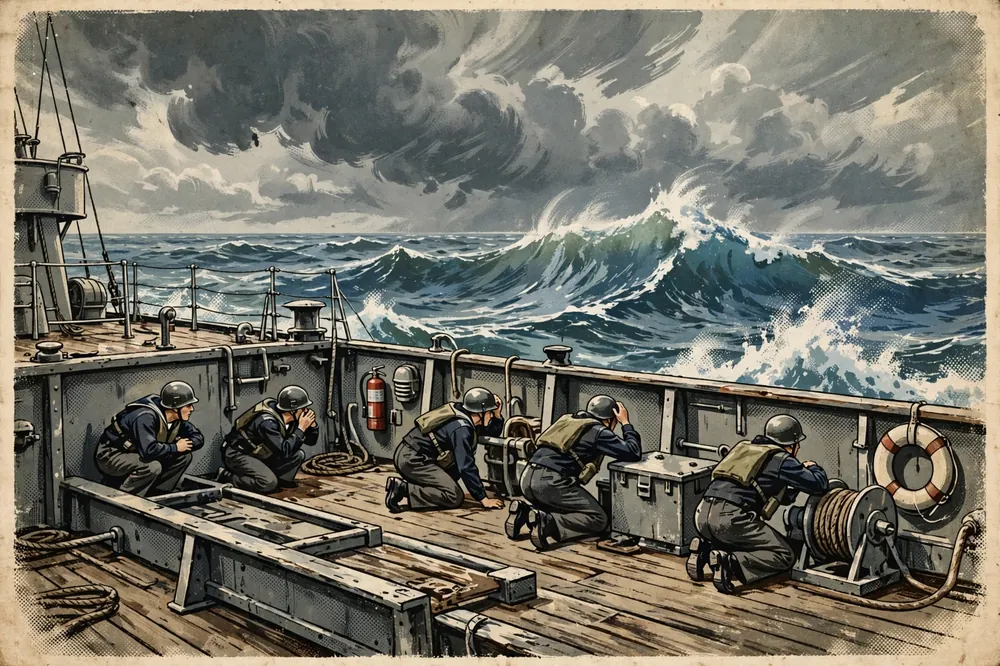
The story of this idiom begins at sea. On a ship, the "deck" is the flat floor you stand on — the main surface of the vessel. For sailors in the age of naval warfare, the deck was the line between safety and exposure. When enemy ships fired, anyone standing on deck was a target. The instinctive, life-saving response was to throw yourself flat against the wooden planks — to literally hit the deck.
This is why the phrase carries such urgency. It was not advice; it was survival. A sailor who hesitated could be hit by cannon fire, splinters, or falling rigging. Over time, "hit the deck" became standard spoken shorthand among sailors and naval officers for "get down immediately."
Military Use: A Warning Under Fire
From the navy, the phrase spread to other branches of the armed forces. Soldiers under artillery fire, airmen under attack, and marines in combat zones all adopted it as a battlefield warning. During the World Wars, officers and sergeants shouted "Hit the deck!" to order troops to take cover during shelling or strafing runs. Its brevity made it perfect for combat: three short words that every soldier understood instantly, even amid chaos.
Veterans carried the phrase home after their service, which is how it entered civilian life. Many idioms we use today — "the whole nine yards," "bite the bullet," "snafu" — traveled the same route from military slang to everyday speech.
The Early Meaning: "Wake Up and Get Out of Bed"
Here is a twist many people do not know. According to idiom dictionaries, in the early 1900s, "hit the deck" was nautical slang meaning "jump out of bed" or "wake up." Sailors lived in tight quarters below deck and were ordered up in the morning to begin work. Being told to "hit the deck" meant: your feet should be on the deck, not in your bunk — it is time to rise.
The current, more familiar meaning — dropping to the ground — dates from the 1920s. So the phrase actually flipped: first it meant getting up, then it came to mean getting down. Both senses survived, which is why the same words can now mean two opposite movements depending on context.
Pop Culture: The 1928 Musical
The phrase became so familiar in the 1920s that it was used as the title of a Broadway musical — Hit the Deck (1928), about a woman trying to convince her sailor sweetheart to marry her. The title alone worked because audiences already knew the expression. A stage show borrowing military slang for its name shows just how deeply the phrase had entered popular culture by the late 1920s.
How to Use "Hit the Deck" in Everyday Life
The Urgent Sense: Drop Down Now
This is the movie-scene meaning, and it is still the phrase's strongest association. Use it when someone needs to get down immediately, whether the danger is real or playful.
Real-life examples:
- "The moment the shelf started to wobble, Dad shouted, 'Hit the deck!' and we all dove away."
- "When the fireworks malfunctioned and sparks flew toward the crowd, security yelled for everyone to hit the deck."
You will also see it used humorously. If a friend sneezes dramatically, someone might grin and say, "Hit the deck!" It works as a joke precisely because everyone knows the serious version.
The Wake-Up Sense: Get Out of Bed
This meaning lives on in families, dorm rooms, and anywhere someone needs dragging out of bed. It adds a playful, drill-sergeant flavor to a morning routine.
Real-life examples:
- "Hit the deck, everyone! We're leaving for the airport in twenty minutes."
- "I could hear Mom downstairs: 'Hit the deck, you two — pancakes are getting cold!'"
Text-message version:
Mom: HIT THE DECK. School bus in 10. 🚌
Teen: ugh five more minutes
Mom: zero more minutes. DECK. NOW.
This use works best when everyone involved knows each other well. Shouting "hit the deck" at a stranger in a hotel hallway would be strange — but between family and friends, it reads as affectionate bossiness.
The Motivational Sense: Get Moving, Get Working
This is the most flexible meaning, and arguably the most common in professional settings. When a team needs energy or a deadline is looming, "hit the deck" means stop drifting and start moving.
Real-life examples:
- "The client moved the deadline up, so we're going to have to hit the deck on this presentation."
- "New year, new goals — time to hit the deck and get this business off the ground."
Notice the pattern: it almost always appears with a sense of momentum. You would not say "hit the deck" about relaxing on a beach. It is about action — starting, accelerating, charging in.
On Social Media and in Slang
Online, the phrase pops up in all three senses, plus a few creative ones. Gamers yell it in voice chat when a grenade lands nearby. Fitness coaches use it to kick off a workout ("Hit the deck — fifty push-ups!"). DJs have even played with it, since turntables are nicknamed "decks," giving "hit the deck" a fun double meaning in music culture.
The phrase also shows up in sports commentary, where "he hit the deck" describes a player falling — whether tackled, tripped, or diving for the ball. Relatedly, the slang verb "to deck someone" (to punch or tackle them hard to the ground) comes from the same image: the person ends up on the deck.
Contexts: Casual, Formal, and Everything Between
One of the trickiest things about idioms is knowing where they fit. "Hit the deck" is a chameleon — its formality depends entirely on which meaning you use and who is listening.
Casual conversation: Completely at home. Friends, family, group chats, and banter are where the phrase feels most natural. "Hit the deck, the pizza's here and I'm not sharing" lands as a joke because the setting is relaxed.
Workplace: The motivational sense works well in informal team settings, especially in industries that value energy — startups, sales floors, creative agencies. The wake-up sense can work between close colleagues. Avoid the "drop to the ground" sense at work unless there is an actual emergency, for obvious reasons.
Formal writing: Not a good fit. You would not put "hit the deck" in a legal contract, an academic paper, or a formal business report. In those settings, use literal language instead: "evacuate the area," "begin immediately," "rise at dawn."
Movies, books, and storytelling: Perfect. The phrase adds instant tension and vividness to action scenes and dialogue. Writers use it precisely because readers feel the urgency without needing an explanation.
Military and emergency services: Still used and still respected. In these worlds, the phrase retains its original weight — when someone says it, people move.
Common Misunderstandings About "Hit the Deck"
Misunderstanding 1: It Always Means Danger
Not necessarily. While the "take cover" meaning is the most famous, the phrase is just as likely to mean "get out of bed" or "get to work" in everyday life. Always read the situation. If a manager says it at 9 a.m. on a Monday, they want productivity — not people diving under their desks.
Misunderstanding 2: "Deck" Means a Card Deck or a Patio
Some learners guess the "deck" refers to playing cards or a backyard patio. In American English, a deck can be a raised wooden platform behind a house, and in British English, it is the floor of a ship. But in this idiom, "deck" specifically comes from the ship's deck — the surface sailors stood on. The American backyard deck borrowed the same word later, but the idiom predates that usage.
Misunderstanding 3: It Is Aggressive or Rude
The phrase sounds like a barked order, but tone and relationship decide whether it is friendly or harsh. Between friends, it is playful. From a coach to a team, it is motivational. From a commanding officer in danger, it is life-saving. Only when strangers use it aggressively does it feel rude. Like most idioms, it borrows its mood from the speaker.
Misunderstanding 4: You Can Only Say It, Never Write It
"Hit the deck" appears in novels, screenplays, news reports, and articles all the time. It is a legitimate, dictionary-recognized idiom — not slang that only exists in speech. Just match it to the right register: great for storytelling and informal writing, wrong for formal documents.
Misunderstanding 5: It Means the Same as "Hit the Road"
These two sound similar but mean different things. "Hit the road" means to leave or begin a journey. "Hit the deck" means to drop down, wake up, or get moving. The shared verb "hit" is the only real connection — do not swap them.
Related Phrases and Synonyms
English is full of phrases that overlap with "hit the deck." Here are the closest relatives, grouped by meaning:
For dropping to the ground:
- Take cover — seek protection from danger
- Duck down / duck and cover — lower yourself quickly
- Drop to the ground — the literal version
- Get down — the simplest command
For waking up and getting out of bed:
- Rise and shine — the cheerful classic
- Up and at 'em — energetic morning encouragement
- Hit the ground running — a cousin of "hit the deck," meaning to start something at full speed (note: despite the similar sound, this one is about starting, not falling)
For getting to work with energy:
- Get cracking — start immediately
- Get a move on — hurry up
- Pull your socks up — improve your effort
- Get down to business — stop wasting time
Opposite in spirit:
- Take it easy — relax, slow down
- Take five — take a short break
- Drag your feet — delay or avoid action
Hit the Deck in Real Conversations: Mini Dialogues
Sometimes the best way to learn an idiom is to watch it in action. Here are three short dialogues showing each main meaning.
1. The take-cover sense (camping trip):
Sara: Did you hear that? Something's moving in the bushes!
Dan: Probably a raccoon. Wait — is that a branch cracking above us?
Sara: HIT THE DECK!
[a dead branch crashes down where they were standing]
Dan: Okay, that was too close. New rule: we check for dead branches before setting up the tent.
2. The wake-up sense (family morning):
Dad: (knocking on doors) Hit the deck, troops! We're supposed to be at the stadium by nine!
Ayesha: It's Saturday! Why do we have to wake up at seven on a Saturday?
Dad: Because your brother's final starts at ten, and traffic is going to be terrible. Deck. Now. Toothbrush. Go.
3. The get-to-work sense (office chat):
Manager: Big news — the client loved the pitch and wants the full proposal by Friday.
Team: Friday?! That's two days!
Manager: I know. So let's hit the deck, people. Same energy as last month's launch — we can do this.
FAQs About "Hit the Deck"
1. What does "hit the deck" mean in simple words?
In simple words, "hit the deck" means to move fast — and the exact move depends on the situation. Most often it means to drop to the ground quickly to stay safe. It can also mean to get out of bed in the morning, or to start working on something with energy. All three meanings share the idea of sudden, urgent movement.
2. Where did the phrase "hit the deck" come from?
The phrase comes from naval and military language. On a ship, the "deck" is the floor sailors stand on. When under attack, sailors would throw themselves flat on the deck to avoid enemy fire. In the early 1900s, it was also sailors' slang for "wake up and get out of bed." The drop-to-the-ground meaning became dominant in the 1920s, and the phrase spread from the military into everyday speech through veterans and popular culture, including a 1928 Broadway musical titled Hit the Deck.
3. Is "hit the deck" formal or informal?
It is informal. It works perfectly in casual conversation, texts, movies, novels, and motivational team talks. It does not belong in formal writing like academic papers, legal documents, or official reports. In formal contexts, replace it with literal language such as "take cover," "begin immediately," or "evacuate."
4. Can "hit the deck" be used in a funny way?
Absolutely — and it often is. Because everyone knows the dramatic, action-movie version, using it in a low-stakes situation creates instant comedy. Saying "hit the deck, the Wi-Fi is back!" when the internet reconnects, or yelling it when a friend sneezes, is funny precisely because the phrase sounds so serious. Humor comes from the gap between the urgent words and the harmless situation.
5. What is the difference between "hit the deck" and "hit the ground running"?
They sound like relatives but describe different things. "Hit the deck" means drop down fast (or wake up, or get moving). "Hit the ground running" means to start a new activity or job at full speed, with no warm-up period — for example, a new employee who needs no training. Use "hit the deck" for urgency and sudden movement; use "hit the ground running" for starting something new with immediate competence and energy.
Conclusion
"Hit the deck" is one of those rare phrases that has survived more than a century without losing its punch. From the wooden decks of warships to Broadway stages, from battlefield warnings to Monday-morning pep talks, it has adapted to every era while keeping its core promise: move now, move fast.
That versatility is exactly why the idiom remains so useful. A single phrase can warn of danger, drag a teenager out of bed, or fire up an entire team — and every listener understands which one you mean from the context. Few expressions in English pack that much meaning into three short words.
So the next time someone tells you to hit the deck, pay attention to the room you are in. If there is a wobbling shelf above you, get down. If it is 7 a.m. and you are still under the blanket, get up. And if the deadline just moved closer and the whole team is watching — get going. Either way, the message is the same: this is not the moment to stand still.