
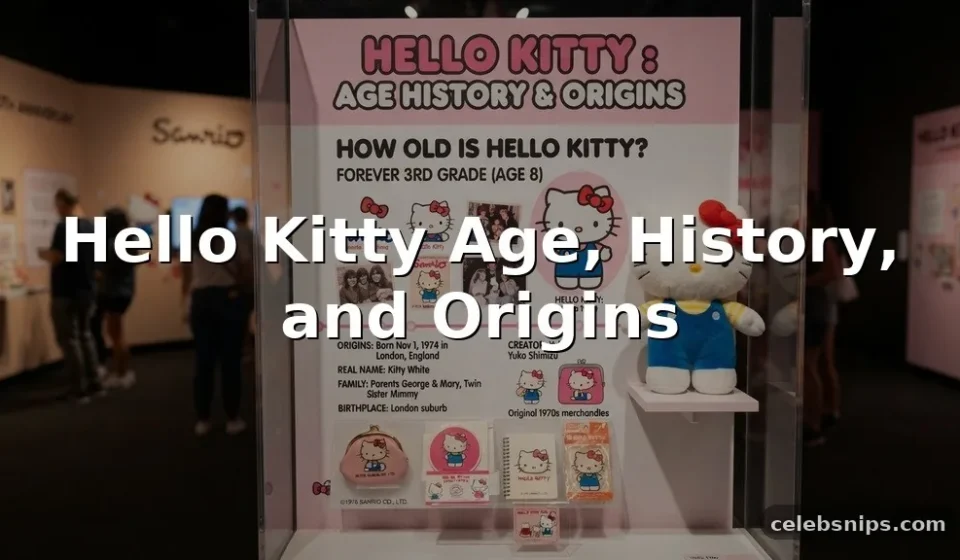

Hello Kitty’s age, history, and origins are more interesting than a simple birthday calculation. The white character with the red bow first appeared in Japan in 1974, yet her official profile gives her a continuing childhood identity rather than an ordinary human age. She is known as Kitty White, a British schoolgirl who lives with her family near London, although many people still understandably call her a cat.
The distinction matters because Hello Kitty is both a fictional character and one of Sanrio’s most successful brands. Her design, first product, friendships, and worldwide licensing history explain why a small white figure became a lasting part of Japanese popular culture. Her official biography also clears up several common myths, including the claim that she is secretly a human girl or that her origins involve a dark story.
How Old Is Hello Kitty?
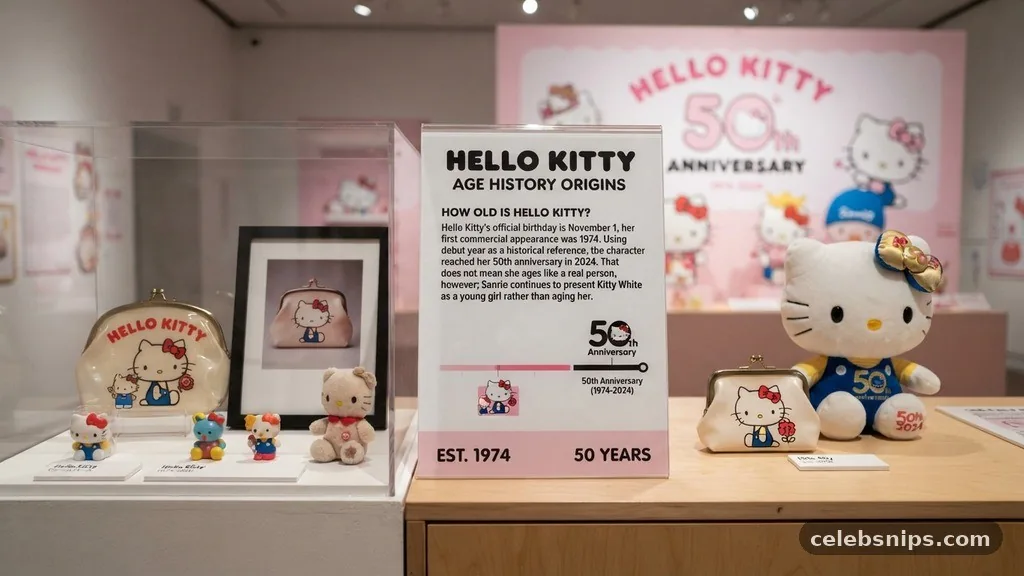
Hello Kitty’s official birthday is November 1, and her first commercial appearance was in 1974. Using the debut year as a historical reference, the character reached her 50th anniversary in 2024.
That does not mean she ages like a real person, however. Sanrio continues to present Kitty White as a young girl rather than updating her age each year.
Her birthday is part of the character’s established profile, not evidence that she has a fixed biological age. In practical terms, readers may describe Hello Kitty as a character created in 1974 who is celebrated annually on November 1. That wording separates her publication history from her fictional identity.
The first appearance was on a small vinyl coin purse produced by Sanrio. At that point, Hello Kitty was not yet the global icon associated with clothing, video games, theme parks, cosmetics, school supplies, and restaurant collaborations. Her early success developed gradually as Sanrio expanded the character’s world and placed her on more kinds of products.
The anniversary is therefore best understood in two ways:
- Character birthday: November 1 in the official Hello Kitty profile.
- Commercial debut: 1974, when Hello Kitty appeared on Sanrio merchandise in Japan.
- Historical age: 50 years from her debut in 2024, with the count increasing as a brand milestone rather than as her fictional age.
- Fictional identity: Kitty White is presented as a young British girl, not as an adult character who grows older each year.
This is why answers that give Hello Kitty one simple number can be misleading. Her real-world history has a clear starting point, while her fictional age remains intentionally stable.
Who Is Hello Kitty?
Hello Kitty is the professional name of Kitty White, a fictional character created for Sanrio. Her official character profile describes her as a girl from the suburbs of London who lives with her parents, George and Mary White, and her twin sister, Mimmy. Her family setting is part of the character’s identity, although it has never been developed like a conventional television biography.
Sanrio does not define Hello Kitty as an ordinary pet cat. The company has repeatedly described her as a little girl, and her profile gives her human family relationships, a school life, hobbies, and personal interests. She has a catlike visual design, but the official distinction is important: Hello Kitty is a character depicted in a simplified anthropomorphic style.
Her full name is generally given as Kitty White. The surname fits the family-oriented profile created for her, while “Hello Kitty” functions as the public character name used on merchandise, media, and promotional campaigns. She is also frequently called simply Kitty.
The character is associated with several recognizable details:
| Detail | Established information |
|---|---|
| Character name | Kitty White |
| Common name | Hello Kitty |
| Birthday | November 1 |
| Debut year | 1974 |
| Official profile | A young girl from the suburbs of London |
| Family | Parents George and Mary, and twin sister Mimmy |
| Signature design | White face, whiskers, oval eyes, yellow nose, and a bow near the left ear |
| Height and weight | Three apples tall and five apples heavy |
| Creator credited by Sanrio | Yuko Shimizu |
The apple measurements are fictional character details, not human physical measurements. They add charm to the profile without pretending that Hello Kitty has a realistic height or weight.
The Origins of Hello Kitty in Japan
Hello Kitty originated in Japan during a period when Sanrio was building a business around small gift items and appealing illustrated characters. Sanrio began as a company associated with gift products, and its strategy relied on placing friendly designs on everyday objects. This approach made characters part of ordinary routines rather than limiting them to cartoons or comic books.
The character was created by Yuko Shimizu, a Japanese designer who worked for Sanrio. Her original design used a few simple visual elements: a white face, black whiskers, oval eyes, a yellow nose, and a bow. The reduced detail made Hello Kitty easy to print on a small surface and easy for customers to recognize at a glance.
That simplicity was commercially useful. A complicated illustration can lose clarity when reduced to a coin purse, pencil, sticker, or small stationery item. Hello Kitty’s face remained readable across products because the design depended on strong shapes and a limited number of features.
The first product is commonly identified as a small vinyl coin purse released in 1974. It featured Hello Kitty seated between a bottle and a fishbowl, a scene that gave the otherwise simple character a little narrative context.
The product was not a television premiere or a theatrical debut. It was merchandise first, which is central to understanding Hello Kitty’s history.
Sanrio has preserved the company’s character history through official materials, including its official Hello Kitty character profile. Those materials are more reliable for questions about her fictional biography than internet stories that treat rumors as hidden canon.
Hello Kitty’s origins also reflect a broader Japanese design tradition centered on approachable, decorative characters. The concept is often discussed through the term “kawaii,” meaning cute or lovable, though Hello Kitty’s success cannot be reduced to one aesthetic label. Her clear design, flexible personality, and placement on useful products all mattered.
Yuko Shimizu and the Original Design
Yuko Shimizu is the designer most closely credited with creating Hello Kitty. Her work for Sanrio helped establish the visual foundation that later generations of artists and product teams expanded. The original character was not built around a detailed fictional backstory; the image came first, and the surrounding world developed afterward.
The face contains no mouth, which has become one of Hello Kitty’s most discussed design choices. Sanrio has explained the absence in emotional terms: the character can appear to share the viewer’s feelings rather than displaying one fixed expression.
A smiling mouth would always make her cheerful, while a sad mouth would always make her unhappy. The blank lower face leaves more room for interpretation.
Her bow became another defining feature. The accessory is generally positioned near her left ear, while her twin sister Mimmy wears a yellow bow on the opposite side. That small difference helps audiences distinguish the sisters even though they share a similar face and family design.
The design works because it is recognizable without being visually crowded. A viewer can identify Hello Kitty from a few shapes:
- A rounded white head and body.
- Two small black eyes.
- Six whisker lines.
- A small yellow oval nose.
- A bow or other accessory near one ear.
Over the years, artists have dressed Hello Kitty as a student, traveler, athlete, musician, holiday character, or professional. The core face usually remains intact, so the character can enter new settings without losing her identity. This adaptability helped Sanrio create merchandise for different ages, countries, and interests.
The design also avoids a strongly defined speaking voice. Hello Kitty can appear on a lunchbox, a luxury collaboration, a children’s book, or a gaming product without requiring one particular personality performance. That flexibility is one reason she has lasted for decades while many short-lived mascot designs disappeared.
Why Hello Kitty Is Not Officially a Cat
The most persistent Hello Kitty question is also one of the simplest to answer: according to Sanrio’s official characterization, Hello Kitty is a little girl, not a four-legged pet cat. Her appearance is catlike, and her name includes “Kitty,” but her biography describes Kitty White as a British schoolgirl.
This distinction does not mean the character has no connection to cats. Her visual language clearly borrows from feline features, including whiskers, pointed ears, and a small animal-like nose. Sanrio uses those features as part of a stylized character design rather than as a realistic statement about species.
The confusion became especially visible after a 2014 media explanation that emphasized Hello Kitty’s human identity. Some readers treated the clarification as a sudden change, but the idea was already present in her established profile.
She has parents, a twin sister, school-related interests, and a home near London. Those details frame her as a girl within a fictional world.
The phrase “Hello Kitty is not a cat” therefore needs context. It does not mean that every visual reference to a cat is wrong, nor does it erase the inspiration behind the design. It means the official character should not be described as an ordinary domestic animal.
The distinction can be stated plainly:
| Question | Best-supported answer |
|---|---|
| Does Hello Kitty look like a cat? | Yes. Her design uses feline-inspired features. |
| Is she officially a pet cat? | No. Sanrio presents her as Kitty White, a young girl. |
| Does she have a catlike name? | Yes. “Hello Kitty” is her public character name. |
| Does she live as a human-style family member? | Yes. Her profile includes parents, a twin sister, and a schoolgirl identity. |
This is not a contradiction in the character’s world. Hello Kitty is a humanlike fictional girl whose design is inspired by the visual language of a cat.
Kitty White’s Family and Fictional World
Kitty White’s official family includes her father George, her mother Mary, and her twin sister Mimmy. Mimmy is an important supporting character because she provides a close visual counterpart to Hello Kitty while remaining distinguishable through her bow placement and personality details.
Hello Kitty’s family background is fictional, so it should not be treated like a real person’s genealogy. There are no reliable real-world parents, birthplace records, or private family events behind the character. The names and relationships belong to Sanrio’s published character setting.
Her profile places the family in the suburbs of London. That detail gives Hello Kitty a British identity within a character created in Japan. The combination helped Sanrio position her as internationally approachable rather than tying her only to one national setting.
The profile also describes interests such as baking cookies and playing the piano. These hobbies support the character’s gentle, everyday image.
They do not represent a documented career or a chronological life story. Hello Kitty’s world is built from recognizable personal details that can be used across stories and products.
Her friends and related characters broaden that world. Depending on the product or story, readers may encounter characters such as My Melody, Keroppi, Badtz-Maru, Cinnamoroll, Pompompurin, or Kuromi. They are not all members of Hello Kitty’s immediate family, and their inclusion in a Sanrio collection does not mean they share the same origins.
Hello Kitty also has a fictional boyfriend named Dear Daniel, often called Daniel Starr in character materials. He is part of the official Sanrio character universe, but questions about his exact age or the couple’s current relationship status do not have the same clear answer as Hello Kitty’s birthday. Their relationship is better understood as a recurring character element than as a continuously documented romantic timeline.
How Hello Kitty Became a Global Brand
Hello Kitty’s international growth came through licensing, merchandise, retail distribution, media appearances, and collaborations. Sanrio placed the character on products that traveled easily across borders: stationery, accessories, clothing, toys, personal items, and household goods. Customers did not need to know a long backstory to understand the image.
The United States became an important market during the character’s expansion outside Japan. Hello Kitty merchandise reached American consumers in the late 1970s and became increasingly visible during the 1980s and 1990s.
The brand’s growth was not based on one film or one hit television series. It came from repeated exposure across many categories.
That model differs from the usual route for a fictional character. Mickey Mouse, for example, is strongly connected to animated films and theme-park entertainment. Hello Kitty’s identity developed primarily through design and consumer products, with media and experiences supporting the brand rather than creating it from the beginning.
Sanrio’s licensing model allowed Hello Kitty to appear in collaborations with fashion labels, airlines, food companies, technology brands, museums, and entertainment properties. Some partnerships were inexpensive everyday products, while others were limited editions aimed at collectors. This range helped the character reach children, teenagers, adults, and dedicated fans.
Her international appeal also comes from the absence of a fixed spoken language. A red bow and white face communicate more quickly than a long paragraph of dialogue. The character can be localized for Japanese, American, European, or other markets without changing the central design.
By the 2000s and 2010s, Hello Kitty had become a major global licensing property. Exact revenue figures for the character alone are difficult to verify because Sanrio’s public financial reporting covers corporate operations and multiple characters, products, and markets. Claims that assign a precise personal “net worth” to Hello Kitty are not meaningful because she is a fictional intellectual property, not an individual earning a salary.
Media, Merchandise, and Cultural Influence
Hello Kitty has appeared in animated productions, video games, books, mobile applications, music projects, and promotional events. These appearances helped audiences encounter her beyond stationary and accessories, but merchandise remains central to her cultural presence.
Her face has been used on school supplies, backpacks, lunch containers, clothing, watches, cosmetics, home goods, electronics, vehicles, and travel products. The range is unusually broad because the design can be adapted without losing recognition. A product can use a small bow, a full figure, a monochrome pattern, or a seasonal costume and still communicate the brand.
Video games have also extended the character into interactive entertainment. Hello Kitty titles have appeared on multiple platforms and often focus on puzzle, lifestyle, educational, or casual play rather than a single continuous adventure narrative. This makes the character accessible to audiences who know her from products rather than animated stories.
The brand’s cultural influence can be seen in the way Hello Kitty crosses categories:
- Stationery: The original product category remains closely associated with her history.
- Fashion: Designers have used her image on clothing, accessories, and limited collaborations.
- Travel: The character has appeared in transportation and tourism partnerships.
- Food and retail: Restaurants, cafés, and stores have used themed products and experiences.
- Entertainment: Television, games, books, and events give the character narrative and interactive settings.
- Collecting: Limited releases and regional variations have created a substantial collector market.
The influence is not limited to Japan. Hello Kitty became a recognizable symbol of Japanese character goods and kawaii culture in many parts of the world.
At the same time, the brand has been interpreted differently by different audiences. Some fans value childhood nostalgia, while others approach the character through fashion, design, collecting, or pop-culture history.
Why the Character Has Lasted for Decades
Longevity is not explained by age alone. Hello Kitty has lasted because Sanrio has kept the central image stable while changing the surrounding product, audience, and collaboration. The face remains familiar, but the context can be updated for a new generation.
Her lack of a mouth plays a role in that durability. The expression is open enough for viewers to project their own mood onto it. A fan can see the character as cheerful, comforting, stylish, funny, or nostalgic depending on the design and situation.
The character also occupies a middle ground between personal and commercial identity. She is specific enough to have a name, birthday, family, and hobbies, but open enough to appear on products far outside those details. Sanrio does not need to resolve every part of her biography before putting her on a new item.
Another factor is the strength of repetition. Seeing Hello Kitty on a pencil case, television screen, store display, or social post reinforces recognition. That repeated visibility gives the character a presence larger than any single product.
The brand has also benefited from collaboration rather than isolation. Hello Kitty can share a collection with another Sanrio character, a fashion brand, a sports organization, or a local cultural institution. Collaborations give long-time fans something new while introducing the design to people who may not buy traditional children’s merchandise.
This explains why Hello Kitty can feel both old-fashioned and current. The original 1974 design remains part of her identity, but new colors, materials, platforms, and partnerships keep the character active. Her history is fixed; her commercial presentation is flexible.
Common Myths About Hello Kitty’s Origins
Online discussions often add dramatic stories to familiar characters. Hello Kitty has been the subject of claims about satanic origins, hidden medical conditions, or a secret adult identity. No reliable evidence supports those stories as part of Sanrio’s official history.
The “dark story” claims are best treated as internet folklore. They are not supported by the documented creation of the character, the 1974 merchandise debut, or Sanrio’s established profile for Kitty White. Repeating them without qualification can make a fictional rumor sound like an historical fact.
Another misconception says that Hello Kitty has no origin because she is “just a logo.” That understates the character’s development. She was designed by Yuko Shimizu, given the name Kitty White, placed in a family setting, assigned a birthday, and developed through Sanrio’s character and product system.
The opposite mistake is to treat every detail in a commercial profile as a fully developed fictional biography. Hello Kitty does not have a complete chronology comparable to a novel protagonist. Her age, schooling, friendships, and hobbies are presented as stable character traits, not as events that advance every year.
A careful account should separate four categories:
- Confirmed character information: Kitty White, November 1 birthday, 1974 debut, London profile, and Sanrio’s girl-not-cat description.
- Historical information: Yuko Shimizu’s design work and the first coin purse merchandise.
- Interpretation: Ideas about why the mouth is absent or why the design feels emotionally open.
- Rumor: Dark origin stories and unsupported claims about hidden meanings.
The safest approach is simple: use Sanrio’s own profile for canon and established histories for commercial facts, then label interpretation as interpretation. That keeps the character’s real origins clear without stripping away the imagination that makes her popular.
Hello Kitty’s Place in Japanese Character Culture
Hello Kitty is one of the clearest examples of how a Japanese character can become an international cultural symbol without depending on a single story franchise. Her rise belongs to the history of character merchandising, a field in which illustrations are licensed across products, stores, media, and events.
Sanrio helped define this approach by building an ecosystem of characters rather than relying on only one mascot. Hello Kitty became the best-known member of that system, but she exists alongside many other Sanrio designs. This wider network allows the company to offer different personalities and visual styles to different audiences.
The term kawaii is often used to describe Hello Kitty’s appeal. It can refer to cuteness, softness, charm, or an emotionally approachable design. Hello Kitty fits the term through her rounded shapes, simple face, small scale, and accessories, but her worldwide impact also reflects careful licensing and consistent brand management.
Her Japanese origin remains important even though her fictional profile is British. That combination shows how character identity can contain multiple cultural references. The design came from Japan, the company is Japanese, and the fictional home near London gives her an international narrative frame.
Hello Kitty’s cultural status is also visible in academic and museum discussions of design, consumer culture, and globalization. She is not merely a children’s image. She has become a case study in how a simple character can move between childhood, fashion, advertising, collecting, tourism, and national cultural representation.
That movement creates occasional tension. Some audiences see her as comforting and innocent, while others critique the commercial scale of character licensing.
Both reactions can exist at the same time. The historical fact is that Hello Kitty’s meaning has expanded far beyond the small coin purse on which she first appeared.
Frequently Asked Questions
How old is Hello Kitty?
Hello Kitty first appeared commercially in 1974, so she marked her 50th debut anniversary in 2024. Her official fictional profile does not give her a changing human age; she remains a young girl character.
What is Hello Kitty’s real name?
Her official character name is Kitty White. “Hello Kitty” is the public name used for Sanrio’s character and brand.
Is Hello Kitty a cat or a human girl?
Sanrio presents Hello Kitty as a little girl named Kitty White, not as an ordinary pet cat. Her visual design uses catlike features, which is why many people naturally describe her as a cat.
When did Hello Kitty first appear?
Hello Kitty made her commercial debut in Japan in 1974, appearing on a small vinyl coin purse. Her official birthday is November 1.
Who created Hello Kitty?
Japanese designer Yuko Shimizu is credited with creating the original Hello Kitty design for Sanrio.
Where is Hello Kitty from?
She was created in Japan by Sanrio, but her fictional profile says that Kitty White is a British girl from the suburbs of London.
Who is Hello Kitty’s twin sister?
Her twin sister is Mimmy White. Mimmy is usually distinguished by the placement and color of her bow.
Does Hello Kitty have a boyfriend?
Yes. Sanrio’s character world includes Dear Daniel, who is presented as Hello Kitty’s boyfriend and childhood friend. The details of their relationship are fictional and are not updated like a real-world celebrity timeline.
What is the dark story behind Hello Kitty?
No reliable evidence supports the popular dark-origin stories about Hello Kitty. Those claims are internet rumors rather than part of Sanrio’s documented character history.
What are Hello Kitty’s height and weight?
Her official profile describes her as three apples tall and five apples heavy. These are playful fictional measurements, not human physical statistics.
Final Takeaway
Hello Kitty’s age, history, and origins make sense once her real-world debut is separated from her fictional identity. She was created by Yuko Shimizu for Sanrio, first appeared on a Japanese coin purse in 1974, and is officially Kitty White, a young British girl with a cat-inspired design. Her November 1 birthday is fixed, but she does not grow older like a real person.
The strongest facts come from Sanrio’s character profile and documented merchandise history, while dark origin stories and exact financial claims remain unsupported. Hello Kitty’s lasting appeal comes from a simple white face, flexible design, and a brand that keeps placing the character in new cultural settings.