


Heather Dinich is an American sports journalist best known for covering college football, the College Football Playoff, and the selection process that shapes the sport’s national championship field. The search for “Heather Dinich Age, Career, and ESPN Journey” reflects interest in both her personal background and her rise from newspaper reporting to a prominent ESPN role.
Publicly available biographies identify Dinich as an experienced writer and sports reporter with a journalism degree from Indiana University. Her exact salary, net worth, height, and some family details are not officially disclosed, so those subjects require careful treatment rather than recycled online guesses.
Heather Dinich at a Glance
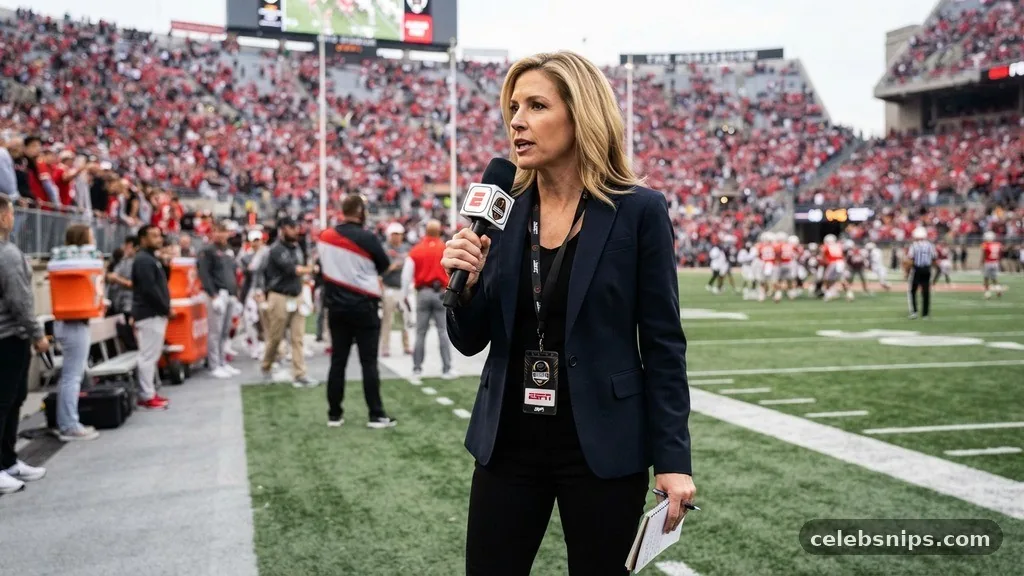
Heather Dinich has built her reputation around reporting, analysis, and television work rather than celebrity-driven sports commentary. Her strongest professional association is with ESPN’s college football coverage, where she has reported on the College Football Playoff, conference competition, rankings, and the people involved in major decisions.
| Category | Publicly reported information |
|---|---|
| Full name | Heather Dinich |
| Profession | Sports journalist, writer, and television analyst |
| Primary subject | College football and the College Football Playoff |
| Education | Indiana University, journalism |
| Major early employer | The Baltimore Sun |
| Major national employer | ESPN |
| Reported birth information | Some public biographies list a 1970s birth year; the exact details are not consistently documented by an official source |
| Children | Public profiles have reported three children, although Dinich generally keeps family life private |
| Height | No reliably confirmed public measurement |
| Net worth and salary | No authoritative public figure |
The table separates established career information from details that are incomplete or commonly repeated without strong documentation. In particular, an age calculation depends on a confirmed birthday, and no current official ESPN biography appears to provide enough information to settle every date-based claim found online.
- Dinich is primarily associated with college football reporting.
- Her journalism training came through Indiana University.
- She developed her reporting background at newspapers before joining ESPN.
- Her ESPN work includes television appearances, written analysis, and CFP coverage.
- Her salary, net worth, height, and precise current age are not officially verified in a reliable public record.
Age, Birth Information, and Background
Heather Dinich’s age is one of the most searched details about her, yet the available public record is less complete than many biography pages suggest. Several online profiles place her birth in the 1970s, but those pages do not always agree on the exact date, and repeated claims are not the same as independent confirmation.
That distinction matters because an age can change depending on whether a source has a verified birthday or only a reported birth year. A careful answer is that Dinich is an established adult journalist with a long professional career, while her exact current age should not be presented as certain without a dependable primary source.
Her background is rooted in sports media, especially the reporting culture surrounding college football. She did not become known through a playing career, coaching position, or entertainment role; her public identity comes from gathering information, interpreting competition, and explaining decisions that affect teams and conferences.
Dinich’s professional path also helps clarify why she appears in searches alongside terms such as writer, contributor, and sports reporter. Those labels describe different parts of the same career, from newspaper assignments to national television coverage and digital journalism.
There is limited reliable information about her childhood, parents, siblings, or hometown. Dinich has made her work public, but she has not built her profile around detailed personal storytelling, and responsible biographies should not fill those gaps with assumptions.
Education and Early Journalism
Public biographies identify Dinich as an Indiana University graduate with a degree in journalism. That education supplied the reporting foundation for a career that has depended on interviewing, research, deadline writing, source development, and the ability to explain complicated sports issues clearly.
A journalism degree does not by itself establish a person’s later accomplishments, but Dinich’s career shows how those skills translated into beat reporting. College football coverage often requires more than describing what happened on the field; reporters must understand eligibility rules, conference structures, rankings, schedules, selection procedures, and the business surrounding major programs.
Her early professional experience included work connected to The Baltimore Sun. Newspaper sports departments traditionally trained reporters to develop local sources and produce accurate copy under tight deadlines, and that environment was important to Dinich’s development before she became a familiar national television contributor.
Coverage of Maryland and the wider Mid-Atlantic sports scene gave her a regional base in college football reporting. That work placed her close to coaches, athletic departments, players, and conference news, all of which helped build the subject knowledge later required for national CFP reporting.
Dinich has also been associated with writing about the Big Ten and other major college football issues. Her early work was not simply a stepping stone in name; it established the reporting habits that later made her useful during periods of coaching changes, conference movement, ranking debates, and postseason decisions.
Readers sometimes search for a dramatic “first break,” but journalism careers often develop through repeated assignments rather than one instant event. In Dinich’s case, the publicly documented pattern is a progression from newspaper reporting to broader digital and broadcast responsibility.
Career Beginnings and Move to National Coverage
Dinich’s career began in the reporting side of sports media, where credibility is earned through consistent access and accurate details. A beat reporter must know the schedule, understand the team’s internal context, identify meaningful sources, and distinguish a real development from routine promotional language.
Her work at The Baltimore Sun connected her with college football in a way that was practical and local. The position required coverage of teams and institutions in the region, giving her experience with game reporting as well as the off-field subjects that often drive serious sports journalism.
She later moved into work for ESPN and ESPN.com, expanding from a regional audience to a national one. That transition changed the scale of her assignments: instead of writing primarily for readers following one market, she was addressing fans tracking conferences, ranked teams, playoff projections, and national governance.
The move also placed Dinich in a media system that combines articles, video, studio segments, podcasts, social updates, and live-event coverage. A journalist operating across those formats has to report quickly while keeping the underlying facts consistent from one platform to another.
Her career development reflects the growing importance of digital sports journalism. ESPN.com made it possible for a college football writer to reach fans across the country, while television appearances gave the reporting a recognizable on-screen presence.
Dinich’s national role did not eliminate the value of local reporting. It built on it. Knowledge gained from covering individual programs and conferences can make national analysis more precise because the journalist understands how broad policy decisions affect actual teams and athletic departments.
Heather Dinich and ESPN
Heather Dinich became widely known through ESPN’s college football coverage, where she has worked as a reporter, writer, and television contributor. Her appearances have commonly focused on the College Football Playoff, rankings, conference races, postseason scenarios, and the information surrounding major decisions.
ESPN’s college football operation reaches viewers through studio programs, digital articles, live broadcasts, and platforms such as SportsCenter. Dinich’s role fits that multi-platform model because she can contribute both reported information and concise on-air explanation.
Her professional identity is separate from the network’s play-by-play announcers and from former players who appear as analysts. Dinich’s value comes primarily from reporting access and subject knowledge, although her television work naturally includes interpretation and context.
Readers can follow the network’s broader competition coverage through the ESPN college football section, while individual articles and broadcasts may vary by season and assignment. That distinction is useful because an ESPN.com byline, a television appearance, and a contributor role do not necessarily represent identical job titles.
Dinich has appeared in coverage involving the College Football Playoff, often abbreviated as CFP. The playoff has been one of the most consequential parts of the sport’s modern structure because its field, ranking process, and format determine which teams receive access to the national championship competition.
Her work became particularly visible during periods when fans wanted information before official announcements. Reporting around rankings and selection requires careful wording, since an expected outcome, a source’s view, and a committee’s final decision are three different things.
ESPN’s national platform also exposes journalists to a much larger audience than a local newspaper. That visibility explains why searches for Dinich often combine her name with ESPN, college football, and the CFP rather than with one particular game story.
Her Role in College Football and CFP Reporting
The College Football Playoff created a specialized reporting beat. A journalist covering it must understand conference championships, strength of schedule, losses, ranked victories, head-to-head results, and the principles used by the selection committee.
Those factors are not always simple mathematical inputs. Committee members evaluate teams through a broader competitive framework, which means reporters must explain both the available numbers and the judgment applied to them.
Dinich’s CFP coverage has therefore involved more than predicting which teams will qualify. The work includes reporting what committee members are saying, identifying how teams are being discussed, clarifying the impact of late-season games, and explaining how a result changes the national picture.
She has also covered the relationship between conference strength and playoff access. A team’s path can depend on its league schedule, championship-game result, nonconference opponents, and the performance of other contenders, creating a story that changes every week.
College football reporting also involves rules and administration. Transfer policies, conference realignment, playoff expansion, bowl arrangements, and the evolving structure of the sport can be just as important to fans as the final score.
Dinich’s role is especially useful during high-pressure news cycles because she can translate institutional language into practical meaning. A statement from a conference office may sound formal and limited, while its consequences for scheduling or postseason access can be significant.
She has not been presented as a member of the CFP selection committee. That distinction should remain clear. Her job is to report on the committee and explain its work, not to make the official decisions herself.
Reporting Style and Professional Significance
Dinich’s reporting style is associated with direct questions, concise explanations, and attention to the decision-making side of sports. Television viewers may see only a short segment, but that segment usually rests on background reporting, source conversations, and preparation around a fast-moving story.
Her work illustrates the difference between opinion commentary and reported analysis. An analyst may argue which team deserves a playoff place, while a reporter may explain what the committee values, what sources are hearing, and what evidence supports a developing scenario.
That line can become difficult during live coverage. Fans want a clear answer, but responsible reporting must distinguish confirmed information from a forecast. Dinich’s role requires making that distinction without losing the pace expected by television and digital audiences.
She has also become part of a broader shift in sports journalism, where one professional may write an article, appear on a studio program, contribute to a digital video, and answer questions during a live event. The audience experiences those formats differently, but they are connected by the same reporting process.
Her subject specialization has helped make complex college football structures more understandable to casual viewers. Terms such as strength of schedule, conference champion, resume, ranking, and playoff expansion can sound technical, yet they affect the teams fans follow each weekend.
Dinich’s national visibility is tied to the importance of the stories she covers. The CFP determines postseason opportunity, while conference changes can affect rivalries, travel, scheduling, revenue, and long-term competitive balance.
She has also earned recognition as a journalist within college football media, though specific awards should not be listed unless they are documented by an awarding body or an official professional biography. Public prominence alone is not proof of a formal honor.
Personal Life, Family, and Privacy
Public profiles have reported that Heather Dinich has three children. That detail is often repeated in biographies, but she generally keeps her family away from the center of her professional identity, and there is limited reliable information about the children themselves.
Questions about her spouse or partner are harder to answer with confidence. Some internet pages identify a husband or provide relationship details, but not every claim is supported by a current interview, official profile, or reputable publication.
A responsible biography should not turn an unverified name into a confirmed relationship. If Dinich has discussed her family privately or in limited public settings, that does not create permission to add speculative details about a partner, children, home, or daily life.
There is also no dependable public record confirming her height. Images from television appearances cannot establish an exact measurement because camera angles, footwear, seating positions, and other people in the frame can distort comparisons.
The same caution applies to her parents, siblings, and early family background. No reliable public source establishes enough information to describe those relatives in detail, so claims about them should be treated as unconfirmed unless Dinich herself or a reputable publication provides evidence.
Her limited public discussion of personal matters is consistent with a career built around professional access rather than lifestyle fame. Viewers know her primarily because she covers college football, not because she markets a private-life brand.
Salary, Net Worth, and Income
Heather Dinich’s salary and net worth are not publicly verified. ESPN is a private employer, and individual contracts, bonuses, benefits, taxes, investments, and other financial arrangements are generally not disclosed.
Online net-worth estimates should therefore be treated as speculative. A website may publish a precise number without showing audited records, contract documents, property filings, or a reliable explanation of how the figure was calculated.
Her likely professional income sources can be discussed in general terms, but not converted into an invented total. They may include compensation for journalism, television appearances, digital work, and other professional assignments connected to her role, yet the amounts and structure remain private.
Television visibility does not automatically reveal a journalist’s salary. Network employees can have different contracts based on experience, responsibilities, exclusivity, travel, production duties, and the value of their reporting specialty.
Dinich’s long association with ESPN may support the conclusion that she has an established professional career. It does not support a verified net-worth figure. Those are separate questions, and a careful article should keep them separate.
Readers should also be cautious with claims that mix ESPN salaries, generic sports reporter averages, and estimates about other employees. A salary reported for one anchor or analyst cannot be transferred to Dinich merely because both work in sports media.
Social Media and Current Professional Profile
Dinich has maintained a public professional presence through ESPN programming, digital journalism, and social-media activity associated with college football coverage. However, a name-matching account is not automatically an official account, and profiles can change over time.
Follower counts are especially unstable. They can rise, fall, or differ between platforms, so a current number should be checked directly on a verified or strongly attributable profile rather than copied from an old biography page.
Her online professional presence is most useful for following reporting during the college football season. Updates may involve rankings, injuries, conference news, playoff scenarios, committee discussions, or live reactions to major games.
Social posts should still be read in context. A short update can reflect a developing report, a question, a personal observation, or a link to a longer article, and those categories do not carry the same level of confirmation.
The most reliable way to assess her current role is to look for recent ESPN bylines, network appearances, and official program listings. Archived pages can preserve older titles, while current assignments may reflect changes in the CFP format or the network’s coverage structure.
Dinich’s digital work also shows how sports journalism has changed. The modern audience expects immediate updates, but high-quality reporting still depends on source verification and clear language about what is known, expected, or unresolved.
Why Heather Dinich Remains a Recognizable Name
Heather Dinich is recognizable because she occupies a specialized place in one of the most closely watched areas of American sports. College football combines passionate fan bases, conference politics, rankings, postseason access, and large institutional interests, creating constant demand for informed reporting.
Her career connects several stages of sports journalism: local newspaper work, regional college football coverage, national digital writing, and television analysis. That progression explains why searches about her often ask both where she started and how she reached ESPN.
She also represents the importance of subject expertise. A general sports reporter may cover many leagues, while Dinich’s public profile has centered on the structures and decisions that shape college football at the highest level.
Her work has been especially relevant during changes to the playoff system and conference alignment. As the sport’s organization evolves, viewers need journalists who can explain not just what changed, but which teams, leagues, and postseason pathways may be affected.
The phrase “never flinch” sometimes appears in promotional descriptions of journalists, but it should not replace evidence. Dinich’s actual record is better demonstrated through her documented assignments, ESPN appearances, and sustained coverage of the CFP than through broad praise.
Her significance is professional rather than sensational. She has built a public career by reporting on college football’s most consequential questions while keeping many personal details outside the news cycle.
Frequently Asked Questions
How old is Heather Dinich?
Her exact current age is not firmly established by a consistently authoritative public source. Some online biographies report a birth year in the 1970s, but the precise date and resulting age should be treated cautiously unless confirmed by an official biography or direct interview.
What is Heather Dinich known for?
She is known for her work as an ESPN college football reporter, writer, and television contributor. Her coverage has focused heavily on the College Football Playoff, rankings, conference competition, and the decisions that shape national postseason access.
Where did Heather Dinich go to college?
Public biographies identify Indiana University as her college and journalism as her field of study. Her later work reflects training in reporting, writing, interviewing, and deadline-based news coverage.
Did Heather Dinich work for The Baltimore Sun?
Yes. Her early career included reporting connected with The Baltimore Sun, where she developed experience covering sports before moving into broader ESPN and national college football work.
When did Heather Dinich join ESPN?
Public career summaries place her ESPN work in the late 2000s, with many profiles identifying 2007 as the beginning of her association with the network. The exact employment timeline can vary depending on whether a source counts an initial assignment, contributor role, or formal staff position.
Is Heather Dinich married?
Some online biographies have described her as married, but current relationship details are not consistently confirmed by a strong public source. Her spouse or partner’s identity should not be stated as fact without direct or reputable documentation.
Does Heather Dinich have children?
Public profiles have reported that she has three children. She generally keeps them out of her professional coverage, and reliable public information about their identities, ages, or personal lives is limited.
How tall is Heather Dinich?
No reliably confirmed public source establishes her height. Estimates based on television images or comparisons with other people are not precise enough to present as factual.
What is Heather Dinich’s salary or net worth?
No authoritative public figure confirms her salary or net worth. Online estimates are speculative because ESPN contracts, bonuses, taxes, assets, investments, and expenses are private.
What does Heather Dinich do now?
She is associated with ESPN’s college football coverage as a reporter, writer, and television contributor. Her work has continued to center on major college football news, the CFP, rankings, and postseason analysis, although specific assignments can change by season.
Final Takeaway
Heather Dinich’s career is best understood as a progression from newspaper journalism to national college football reporting. Her Indiana University journalism background, work connected with The Baltimore Sun, and long ESPN association explain why she is regularly consulted on the College Football Playoff and the wider college football landscape.
The facts behind Heather Dinich Age, Career, and ESPN Journey are strongest on her professional work and less certain on personal measurements, exact age, salary, and net worth. Readers should rely on current ESPN material and direct reporting for updates, while treating unsupported biography-page figures as estimates rather than established facts.