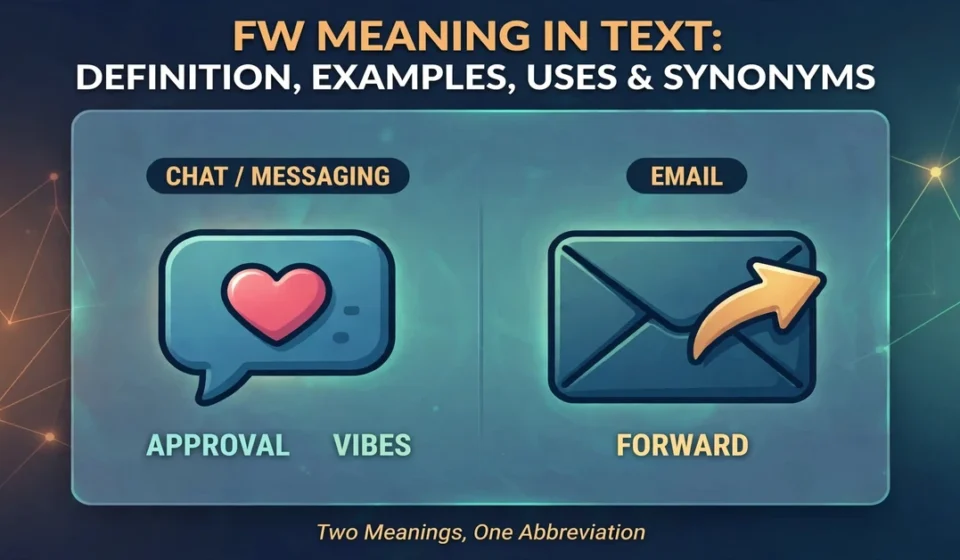

“I fw that song heavy.” “FW: Q3 budget review.” Same two letters, two completely different universes. If you have ever stared at “fw” in a message and felt your brain short-circuit — is this a compliment, an email instruction, or something I should not say at work? — you have met one of texting’s great double agents.
FW is genuinely two abbreviations wearing one trench coat. In casual chats and comment sections, it is slang with attitude and warmth. In inboxes and offices, it is the most boring, professional abbreviation imaginable. Mixing them up is not just confusing — in the wrong direction, it can be genuinely embarrassing.
This guide breaks down the complete fw meaning in text: the slang “f*ck with” in all its positive and negative forms, the email “forward,” how to tell them apart instantly, and the etiquette that keeps you out of trouble. You will get real examples from DMs, captions, and inboxes, plus answers to the questions everyone asks once those two letters show up somewhere unexpected.

What Does FW Mean in Texting?
In casual texting and social media, FW most commonly stands for “f*ck with” — slang meaning to like, support, enjoy, vibe with, or be into someone or something.
Despite the profanity in its full form, FW in slang is almost always positive. It is a stamp of approval, a declaration of taste, a small loyalty oath. “I fw that song heavy” means “I really love that song.” “I fw your vibe” means “I like your energy.” “We fw that restaurant” means “that place is our spot now.” The intensity varies — “fw” alone is mild approval, “fw heavy” is strong love — but the direction is almost always warm.
The critical twist: adding “don’t” flips the entire meaning. “I don’t fw him” means “I don’t like him / I want nothing to do with him.” “Don’t fw that idea” means “I’m not into it.” This negation is one of the most important things to understand about FW, because misreading it turns a compliment into an insult or vice versa. Always check for the “don’t.”
FW in slang is almost always lowercase (“fw”) in real texts and comments. All-caps “FW” in a casual chat is unusual — and in most contexts, all-caps FW means something else entirely, which brings us to the other life of these two letters.
FW as “Forward”: The Email Meaning
In professional and email contexts, FW means “forward” — as in forwarding a message to someone else. This is the meaning your boss, your inbox, and your email client all agree on.
You will see it most often in subject lines: “FW: Meeting notes,” “FW: Client feedback,” “FW: Your invoice.” Email programs add it automatically when you forward a message, which is why it appears at the start of so many threads. In work chats, people also use it as a verb: “Can you fw me that doc?” means “can you forward me that document?”
This FW is completely neutral — no slang, no attitude, no hidden meaning. It is office furniture. The tone is formal, the intent is logistical, and there is zero emotional subtext. Understanding this meaning matters because it is the one that shows up in your professional life, where misreading it as slang would be… unfortunate.
The collision between the two FWs is a genuine workplace hazard. A Gen Z employee who texts a coworker “I fw this proposal” means “I really like this proposal” — but a manager unfamiliar with the slang may read something very different. Conversely, replying “fw” to a forwarded email thread means “forward it,” not “I vibe with it.” When worlds collide, spell things out.
Where “F*ck With” Came From
“F*ck with” as a phrase has deep roots in African American Vernacular English (AAVE) and hip-hop culture, where it has long meant everything from “associate with” to “mess with” to “be into.” The phrase is famously flexible — “don’t f*ck with me” is a warning, “I f*ck with you” is a compliment, and only context tells you which one you are hearing.
The abbreviation grew up with texting culture in the 2010s, as the phrase moved from spoken slang into DMs, comments, and captions. Typing the full phrase felt heavy for casual chat; “fw” kept the meaning and dropped the weight. Hip-hop lyrics, Twitter, and Instagram captions carried it mainstream, and by the 2020s it was standard equipment in Gen Z slang.
What is notable is how the abbreviation softened the phrase. The full “f*ck with” still carries an edge — it sounds intense, even confrontational, to unfamiliar ears. But “fw” in a comment section reads as breezy and positive, closer to “I’m into this” than to anything aggressive. The letters sanded off the sharp corners, which is exactly why the slang version now lives comfortably in public comments and brand captions where the full phrase never could.
How People Actually Use FW: Real Examples
FW is a versatile little verb. Here are the patterns you will see most:
The music endorsement. “I fw this album heavy.” “Fw that new single so much.” Music is FW’s natural habitat — declaring what you are into is the core use case, and songs are the most common object.
The personal compliment. “Ngl I fw you.” “I fw your energy fr.” Aimed at a person, FW means liking, trusting, or vibing with them. It is warmer than “you’re cool” and more casual than a heartfelt compliment — the sweet spot for DM affection.
The loyalty statement. “We fw our people.” “I fw this brand.” Here FW shades into support and allegiance. It says “I’m with you” in the way sports fans are with their team.
The rejection (negated). “I don’t fw fake people.” “Nah, I don’t fw him anymore.” The “don’t” version draws boundaries. It is not aggressive on its own — it is a statement of distance, not an attack. But it is firm: this is someone drawing a line.
The plan approval. “You coming tonight?” “Yeah I fw that.” FW as agreement — “I’m down,” “I’m in,” “that works for me.” The slang stretches comfortably from people to plans.
The caption flex. “New drop, fw it or miss out.” Brands and influencers use FW to sound native to the culture. It signals “we speak your language” — which works when it is genuine and cringes when it is forced.
FW on Instagram, TikTok, Snapchat, and in Texts
Each platform gives FW a slightly different stage.
On Instagram, FW is a comment-section staple. “FW this fit.” “Fw your content.” It functions as public approval — a like with words attached. In DMs, it gets more personal: “I fw you” in a DM is a real statement of affection or interest, not just a casual comment.
On TikTok, FW lives in comments and captions, often stacked with other slang: “fw this heavy.” It is the standard way to endorse a video, a creator, or a trend. You will also see it in stitch and duet culture, where creators signal which trends they are riding.
On Snapchat, FW is conversational and private. “I fw that story.” “Fw your fit today.” Because snaps are ephemeral and the audience is small, FW here tends to be more genuine and less performative than on public platforms.
In plain texts, FW does all of the above depending on the relationship. “I fw you” to a crush is a confession. “I fw that idea” to a friend is agreement. “I don’t fw Mondays” to the group chat is a joke. The intimacy of texting makes every FW land a little harder than the same letters in a comment section.
The Etiquette of FW: When It Works and When It Does Not
FW is casual slang with profane roots, which means it has a social range — and edges.
Where it works: with friends, in DMs, in comment sections, on social media, in group chats, in gaming lobbies. Anywhere the vibe is informal and everyone speaks the same slang, “fw” is natural and welcome. It is positive, expressive, and efficient.
Where it does not work: professional emails, messages to managers or clients, formal writing, conversations with older relatives who do not know the slang, and any setting where profanity — even abbreviated, even softened — would raise eyebrows. “I fw this proposal” in a client meeting is a gamble; “I’m very enthusiastic about this proposal” is not.
The audience test: if you would not say the full phrase “f*ck with” out loud in front of this person, do not type “fw” to them. The abbreviation softens the phrase, but it does not erase its origin. When in doubt, use “I’m into,” “I like,” or “I support” — same meaning, zero risk.
The negation caution: be careful with “don’t fw” around people. “I don’t fw that restaurant” is harmless. “I don’t fw him” about a mutual friend can start drama fast. The negated version draws lines, and lines have consequences.
FW vs Similar Slang: Quick Comparisons
FW sits in a family of approval slang. Here is how it relates to the relatives:
FW vs “vibe with”: They are nearly identical — “I vibe with that” and “I fw that” mean the same thing. “Vibe with” is the slightly softer, slightly more mainstream cousin; “fw” is the cooler, more text-native version.
FW vs “rate”: “I rate that” (popular in UK slang) also means approval, but it is more evaluative — like giving something a score. FW is more emotional — it is about feeling, not judging.
FW vs “rock with”: “I rock with you” is FW’s closest synonym, from the same slang family. They are interchangeable in most contexts. “Rock with” sounds slightly more old-school hip-hop; “fw” sounds more current texting.
FW vs “down with”: “I’m down with that” means agreement or willingness. FW is broader — it covers liking, supporting, and enjoying, not just agreeing. “I’m down” answers a plan; “I fw that” endorses a thing.
You may also like: ND, SP, LKR
Frequently Asked Questions
What does FW mean in texting?
In texting and social media slang, FW most commonly stands for “f*ck with,” meaning to like, support, enjoy, or vibe with someone or something. “I fw that song” means “I really like that song.” Adding “don’t” flips it negative: “I don’t fw him” means “I don’t like him.” In emails and professional contexts, FW instead means “forward.”
Is FW rude?
Not in normal slang use. Among friends and on social media, “fw” is casual and generally positive — a compliment or endorsement. The full phrase behind it contains profanity, so avoid it in professional, formal, or family settings where the abbreviation’s origin might offend. The negated “don’t fw” can feel cold, but it is a statement of distance, not an insult.
What does “I fw you” mean?
“I fw you” means “I like you,” “I vibe with you,” or “I’m into you” — it expresses genuine liking, trust, or attraction toward a person. The exact shade depends on context: from a friend it means camaraderie, from a crush it leans romantic, and from a collaborator it means respect. It is a warm, positive statement in all its forms.
What does FW mean in email?
In email, FW means “forward.” It appears in subject lines (“FW: Meeting notes”) when a message is being passed along, and in work chats as a verb (“fw me that file” = “forward me that file”). This meaning is completely separate from the slang — it is neutral, professional office shorthand.
What is the difference between “fw” and “don’t fw”?
They are opposites. “Fw” alone expresses liking, support, or approval: “I fw that.” “Don’t fw” expresses dislike, distance, or rejection: “I don’t fw that.” The tiny word “don’t” completely reverses the meaning, so always check for it before interpreting someone’s message.
Conclusion
FW is two abbreviations sharing one set of letters: the slang “f*ck with” that endorses everything from songs to soulmates, and the email “forward” that quietly moves your meeting notes along. The letters never change — only the room they are in does.
Now you can read both fluently. In the group chat, “fw” is a compliment waiting to happen. In the inbox, “FW:” is just logistics. And if you ever catch yourself typing “I fw this proposal” to a client, you will know — before you hit send — exactly why you should rephrase.
Explore more on Celeb Snips.