


Coolio’s age, career, and music legacy remain closely tied to “Gangsta’s Paradise,” the 1995 rap song that made him a global star. Born Artis Leon Ivey Jr., Coolio built a career across hip-hop, acting, television, and culinary entertainment before his death in Los Angeles on September 28, 2022, at age 59.
His story is larger than one hit. From Compton’s rap scene to a Grammy-winning album, international performances, film appearances, and television work, Coolio crossed several parts of popular culture. The key facts below separate confirmed biography details from estimates and explain why his music still reaches new listeners.
Coolio at a Glance
Coolio was an American rapper, songwriter, actor, and television personality. His biggest commercial success came during the 1990s, but he continued performing and appearing on screen for decades after “Gangsta’s Paradise.”
| Detail | Information |
|---|---|
| Full name | Artis Leon Ivey Jr. |
| Professional name | Coolio |
| Born | August 1, 1963 |
| Birthplace | Monessen, Pennsylvania, United States |
| Raised in | Compton, California |
| Died | September 28, 2022, in Los Angeles, California |
| Age at death | 59 |
| Profession | Rapper, songwriter, actor, television personality |
| Best known for | “Gangsta’s Paradise,” “Fantastic Voyage,” and “1, 2, 3, 4 (Sumpin’ New)” |
| Years active | 1980s through 2022 |
| Major award | 1996 Grammy Award for Best Rap Performance, Solo |
Some online biography pages list different birthplaces or physical details, but the established public record identifies Coolio as born in Monessen and raised in Compton. His birth date and date of death are also consistently reported by major reference sources and official records.
- Real name: Artis Leon Ivey Jr.
- Signature song: “Gangsta’s Paradise,” featuring L.V.
- Breakthrough album: It Takes a Thief
- Grammy recognition: Best Rap Performance, Solo, in 1996
- Age at death: 59
Early Life and Compton Background
Coolio was born in Monessen, Pennsylvania, on August 1, 1963. His family later moved to Compton, California, where he grew up and encountered the Southern California hip-hop culture that would shape his professional identity.
Compton was already an important reference point in West Coast rap by the time Coolio began pursuing music seriously. The city’s local scenes connected neighborhood experience, DJ culture, breakdancing, street poetry, and independent recording, giving young artists routes into music outside the traditional record-label system.
Before commercial success, Coolio developed as a rapper through local performances and radio exposure. He also used the name Coolio Iglesias early in his career, a playful reference to singer Julio Iglesias, before shortening the name to Coolio.
Public sources do not provide a complete, independently verified account of every aspect of his childhood, including detailed information about his parents or siblings. Those gaps should remain gaps rather than being filled with repeated but unsupported claims found on low-quality biography sites.
Coolio’s early work placed him within the expanding Los Angeles rap community. He was associated with the group WC and the Maad Circle, led by West Coast rapper WC, and appeared on the group’s early material before establishing himself as a solo artist.
How Coolio Began His Rap Career
Coolio’s first professional years were rooted in the Los Angeles underground rather than immediate mainstream fame. He recorded and performed during a period when West Coast rap was becoming a major force in American music, but success still depended heavily on local credibility and regional radio.
His association with WC and the Maad Circle gave him an early connection to a working rap group and to the broader network of artists, producers, and labels operating in Southern California. That experience helped him move from local performer to recording artist with a recognizable public identity.
Coolio’s first major solo opportunity came through Tommy Boy Records. The label released his debut album, It Takes a Thief, in 1994, a project that showed a more accessible side of West Coast rap without abandoning the genre’s street-oriented subject matter.
“Fantastic Voyage” and the First Breakthrough
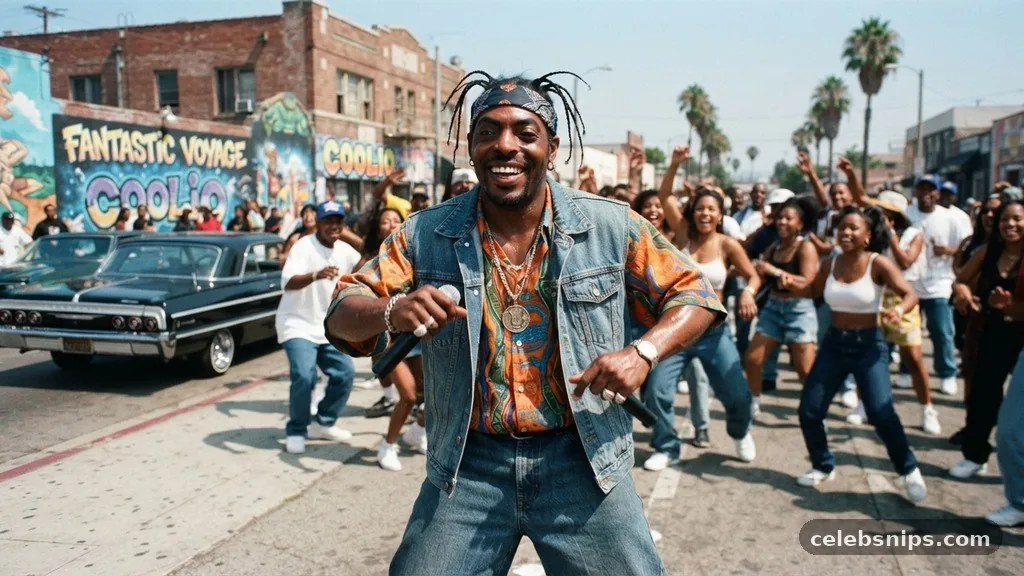
The album’s central breakthrough was “Fantastic Voyage,” a reworking of the Lakeside funk hit of the same name. Coolio’s version used an upbeat groove, a memorable chorus, and a video built around movement and neighborhood energy, helping it reach listeners beyond the core rap audience.
“Fantastic Voyage” became a major hit in 1994 and reached the top five of the Billboard Hot 100. The song also gave Coolio an important advantage: it presented him as a rapper who could make commercially accessible music while still sounding connected to hip-hop’s West Coast traditions.
That balance became important to his later career. Coolio could write about danger, pressure, ambition, and survival, but he could also deliver a highly memorable hook that worked on pop radio and in clubs.
It Takes a Thief established Coolio as more than a one-off regional act. Its success created the platform for the soundtrack appearance that would define his public image.
“Gangsta’s Paradise” and the 1995 Breakthrough
Coolio’s defining song was “Gangsta’s Paradise,” released in 1995 for the film Dangerous Minds. The track featured singer L.V. and used a prominent interpolation of Stevie Wonder’s “Pastime Paradise,” creating a dark, dramatic sound that differed sharply from the brighter feel of “Fantastic Voyage.”
The song became one of the most recognizable rap records of the 1990s. It reached number one on the Billboard Hot 100 and stayed there for three weeks, while its soundtrack placement helped connect Coolio’s music with a major Hollywood film and a broad international audience.
Its lyrics focused on fatalism, violence, guilt, spiritual fear, and the limited choices facing someone trapped in a dangerous environment. The song’s appeal came partly from that tension: it sounded cinematic and accessible, but its writing was much more troubled than a simple celebration of street life.
The title was sometimes informally written with variations in capitalization or punctuation, but the recognized title is “Gangsta’s Paradise.” The track is also frequently searched alongside “Coolio age in 1995,” because he was 32 years old when the song became a worldwide hit.
“Gangsta’s Paradise” received the 1996 Grammy Award for Best Rap Performance, Solo. Coolio also received major popular recognition during the same period, including American Music Award attention and other industry honors connected to the song’s success.
The song’s place in film history was reinforced by its association with Dangerous Minds, starring Michelle Pfeiffer. Its video also became a major part of its identity, using scenes connected to the movie while presenting Coolio and L.V. within a serious narrative setting.
For readers who want an authoritative record of the award itself, the Recording Academy’s Coolio profile provides a useful reference for his Grammy recognition.
Albums, Songs, and Musical Development
After the success of It Takes a Thief, Coolio released Gangsta’s Paradise in 1995. The album capitalized on the title song’s momentum but also included other material that showed his range as a rapper, including “1, 2, 3, 4 (Sumpin’ New),” a more upbeat single that became another substantial commercial success.
“1, 2, 3, 4 (Sumpin’ New)” helped prevent Coolio from being defined entirely by one serious soundtrack ballad. Its energetic production, dance-oriented presentation, and accessible chorus made it effective in clubs and on mainstream radio.
His next studio album, My Soul, arrived in 1997. By then, expectations had changed. Coolio was no longer simply building an audience; he was following two major albums and a pair of widely known singles that had established him as one of the most visible rappers in popular music.
Later releases included Coolio.com in 2001, El Cool Magnifico in 2002, The Return of the Gangsta in 2006, and From the Bottom 2 the Top in 2009. These albums did not match the global impact of his 1990s work, but they demonstrate that music remained part of his professional life long after the peak of “Gangsta’s Paradise.”
A Blend of West Coast Rap and Pop Accessibility
Coolio’s most successful records often combined a clear narrative with strong melodic structure. Rather than relying only on dense lyrical technique, he built songs around hooks that listeners could remember after one play.
His music also moved between different moods. “Gangsta’s Paradise” was solemn and reflective, “Fantastic Voyage” was celebratory, and “1, 2, 3, 4” leaned toward party music, giving his catalog more range than a single-song reputation suggests.
He worked with several artists across rap, R&B, and pop, including L.V. on “Gangsta’s Paradise.” His work with soundtrack producers and film-related collaborators helped him reach people who might not have followed rap albums closely.
Coolio’s catalog should therefore be understood in two layers. The first is the cultural force of his signature song; the second is a longer career that included multiple albums, tours, collaborations, soundtrack appearances, and live performances.
Film, Television, and Other Work
Coolio expanded beyond recorded music during the late 1990s. He appeared in films including Batman & Robin and Belly, taking roles that connected his public identity as a rapper with the growing practice of casting musicians in film and television.
His screen work was not limited to major theatrical releases. Coolio made guest appearances in television programs and became a recognizable personality in reality and entertainment programming, where his direct speaking style and distinctive appearance translated easily from music videos to unscripted formats.
He also participated in animated television. Coolio appeared as the voice of Kwanzaa-bot in Futurama, a role that introduced his voice to viewers who might not have followed his music career closely.
Cooking became another visible part of his public work. His web series and cookbook project, Cooking with Coolio, presented inexpensive, informal recipes through a personality-driven format rather than a conventional chef-centered television show.
The cooking project mattered because it showed how he adapted his brand without abandoning his background. He used humor, casual language, and music-industry familiarity to make food content feel like an extension of his entertainment career.
He also appeared on reality programs such as Celebrity Big Brother in the United Kingdom. These appearances increased his visibility among audiences who knew him as a television personality rather than primarily as a rapper.
Awards, Recognition, and Cultural Impact
The strongest formal recognition of Coolio’s music came from the Grammy Awards. “Gangsta’s Paradise” won Best Rap Performance, Solo, at the 1996 ceremony, placing Coolio among the most recognized rap artists of that period.
The award was significant because rap was still negotiating its place within major mainstream institutions. A serious, socially anxious song winning a top rap category showed that commercial visibility and darker narrative writing could coexist.
Coolio also received recognition from popular music organizations and award programs during his peak years. The exact lists vary depending on whether a source counts wins, nominations, regional honors, or soundtrack-related awards, so individual claims should be checked against official award records.
His wider cultural impact is easier to see through the continued life of “Gangsta’s Paradise.” The song has remained present in film, television, online video, cover versions, comedy, and music sampling, while new listeners continue to discover it through streaming services.
That persistence reflects more than nostalgia. The song’s combination of a familiar Stevie Wonder-derived musical foundation, a dramatic arrangement, and a story about moral and social pressure gives it a structure that still works outside its original 1995 setting.
Why the Song Remains Important
“Gangsta’s Paradise” helped establish a model for rap songs that could carry serious subject matter into the center of pop culture. Its success also showed how a soundtrack could become a major musical platform rather than simply a promotional attachment to a film.
Coolio’s influence was not identical to that of artists known mainly for technical innovation or underground credibility. His contribution was the ability to translate rap’s narratives, rhythms, and visual language into songs that reached a broad international audience.
That crossover approach influenced how later audiences understood rap performers. A rapper could make albums, appear in films, host television projects, publish food content, and remain connected to music without being limited to one medium.
Coolio’s Age and Cause of Death
Coolio was born on August 1, 1963, and died on September 28, 2022. Because his birthday had already occurred that year, he was 59 years old when he died.
He died at a friend’s home in Los Angeles, according to public reporting. Emergency responders were called, but he was pronounced dead at the scene.
The Los Angeles County Medical Examiner later identified cardiac arrest as the immediate cause of death. The report also cited cardiomyopathy, a disease of the heart muscle, as an underlying condition and listed asthma and obesity as other significant conditions.
Toxicology findings reported by the medical examiner identified fentanyl, cocaine, and methamphetamine in his system. Those findings are part of the official medical record, but they should not be turned into sensational claims about a specific moment or private circumstance that has not been established.
Searches for “Coolio death scene” often reflect confusion created by online videos and recycled social-media posts. No widely verified public footage of the death itself establishes what happened inside the residence, and responsible biographies should not present rumors or graphic material as fact.
His death prompted tributes from musicians, actors, producers, and fans. The response centered especially on “Gangsta’s Paradise,” although many tributes also recognized his earlier “Fantastic Voyage,” his later entertainment work, and his role in bringing rap to a broad audience.
Personal Life and Public Information
Coolio was a father, but detailed information about all of his children and family relationships has not always been presented consistently in public sources. Some outlets have reported that he had several children, while exact family details should be treated carefully unless confirmed by reliable reporting or his representatives.
He was previously married to Josefa Salinas. The marriage ended in divorce, and later reports linked Coolio romantically with other women, but his relationship status at the time of his death was not consistently documented in authoritative public sources.
There is no reliable basis for presenting every person named in entertainment coverage as a confirmed spouse or long-term partner. Public biographies should distinguish between a documented marriage, a reported relationship, a brief appearance together, and online speculation.
Coolio’s public persona was often larger than his private disclosures. He spoke openly at times about music, food, touring, and entertainment, but that does not make unverified claims about his family, residence, finances, or personal habits reliable.
Height is another detail frequently repeated by celebrity websites without a dependable primary source. No consistently authoritative public record establishes a verified height, so it is better to identify that information as unavailable than to repeat a precise but unsupported measurement.
Net Worth and Income Sources
Coolio’s net worth is not confirmed by an audited public record. Online estimates vary substantially, and a precise figure should not be presented as fact because private royalties, taxes, debts, property, contracts, management fees, and estate arrangements are generally not public.
His likely professional income came from several established areas of work. These included record sales, music publishing, streaming, live performances, licensing, soundtrack royalties, television appearances, film work, and branded cooking projects.
“Gangsta’s Paradise” would have generated income through several rights channels, including the sound recording, publishing, performance royalties, and licensing. The amount retained by Coolio personally cannot be calculated accurately from the song’s chart performance alone.
Album sales also do not equal personal profit. Record-label agreements, production costs, distribution percentages, taxes, legal expenses, and payments to co-writers or featured artists all affect what an artist ultimately receives.
Coolio’s estate may continue to receive income from music use after his death, but the public does not have a complete accounting of those earnings. Any website claiming an exact current net worth should identify its methodology and source; otherwise, the figure is only an estimate.
For practical purposes, his financial legacy is best understood through the durability of his catalog rather than a single number. A song that continues to be streamed, licensed, performed, or included in media can remain commercially active for decades, but that activity does not reveal the exact value of an individual estate.
Online Presence and Continuing Legacy
Coolio maintained a public presence through music releases, interviews, performances, television appearances, and social platforms. However, not every account using his name can be assumed to be official, particularly after his death.
Some accounts may be managed by relatives, representatives, estate personnel, or fan communities. Readers should check account verification, historical posts, links from established publications, and statements from known representatives before treating a profile as authentic.
His continuing legacy is strongest in music. “Gangsta’s Paradise” remains the song most closely associated with his name, but “Fantastic Voyage” and “1, 2, 3, 4 (Sumpin’ New)” show that his success was not based on one isolated recording.
He also represents a particular phase of hip-hop history. Coolio emerged when rap was moving rapidly from regional scenes and specialized radio into the center of pop culture, film soundtracks, award ceremonies, television, and international touring.
His career illustrates the value of adaptability without requiring the claim that every project was equally influential. The Grammy-winning song was the defining achievement, while acting, cooking, animation, and reality television extended his public life beyond the album cycle.
Listeners exploring his work today can start with It Takes a Thief, continue with Gangsta’s Paradise, and then compare those albums with his later releases. That sequence makes the change in his sound and audience easier to hear than a playlist built only around his most famous song.
Frequently Asked Questions
How old was Coolio when he died?
Coolio was 59 years old when he died on September 28, 2022. He was born on August 1, 1963, so his 59th birthday had already passed that year.
What was Coolio’s real name?
Coolio’s real name was Artis Leon Ivey Jr. He used Coolio as his professional name after developing his career in the Los Angeles rap scene.
What caused Coolio’s death?
The Los Angeles County Medical Examiner identified cardiac arrest as the cause of death and listed cardiomyopathy as an underlying condition. Asthma and obesity were also reported as significant conditions, and toxicology identified fentanyl, cocaine, and methamphetamine.
What was Coolio’s most famous song?
His most famous song was “Gangsta’s Paradise,” featuring L.V. Released in 1995 for Dangerous Minds, it reached number one on the Billboard Hot 100 and won the 1996 Grammy Award for Best Rap Performance, Solo.
What was Coolio’s net worth?
No authoritative public source confirms a precise net-worth figure for Coolio or his estate. Online numbers are estimates and may not account for royalties, debts, taxes, contracts, private assets, or estate expenses.
Final Takeaway
Coolio’s age, career, and music legacy are best understood through the combination of one era-defining song and a much broader working life. He moved from Compton’s rap scene to Grammy-winning success with “Gangsta’s Paradise,” then continued through albums, acting, television, cooking, and live performance.
The clearest confirmed facts are his identity as Artis Leon Ivey Jr., his birth in 1963, his death at age 59 in 2022, and the lasting impact of his music. If you explore Coolio’s work beyond the headline song, compare his early albums, soundtrack success, and later projects rather than relying on uncertain online claims about his private life or finances.