
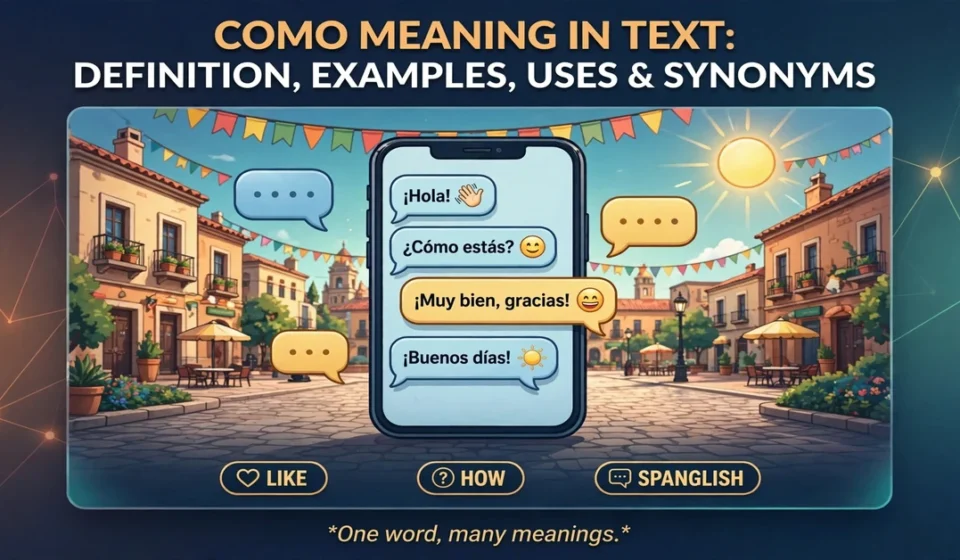

You get a text from a friend: “como estas??” Or maybe someone replies to your story with just “como??” You do not speak Spanish, and now you are staring at four letters wondering if you have been complimented, insulted, or asked a question you cannot answer.
Relax — this one is simpler than it looks. “Como” is a Spanish word, and the como meaning in text is the same as its meaning anywhere else: depending on context, it translates to “like,” “as,” “how,” or “about.” It is one of the most common words in the Spanish language, which is exactly why it keeps popping up in texts, DMs, and comments — especially in Spanglish conversations where people mix English and Spanish freely.
In this guide, we will unpack every meaning of “como,” explain the all-important accent mark that changes everything, show you the phrases you will actually see in texts, and answer the questions everyone asks when this little word lands in their inbox.

What Does “Como” Mean?
“Como” is a workhorse word in Spanish — it shows up constantly because it covers several everyday jobs:
- “Like” / “as” — making comparisons. “Habla como un experto” (He speaks like an expert).
- “How” — but only with an accent: cómo. “¿Cómo estás?” (How are you?)
- “About” / “approximately” — casual estimates. “Cuesta como veinte dólares” (It costs about twenty dollars).
- “Since” / “if” — in some constructions. “Como no vino, nos fuimos” (Since he didn’t come, we left).
In a text message, though, you will overwhelmingly encounter it in just two situations: someone speaking Spanish to you (or mixing Spanish into English), or the famous phrase “como estas” and its cousins. The philosophical depths of Spanish grammar rarely surface in a DM — but the basics absolutely do.
Como vs. Cómo: The Accent Changes Everything
This is the single most important thing to understand, and it trips up every learner:
- como (no accent) = “like,” “as,” “about.” It is a conjunction/preposition — a connector word.
- cómo (with accent) = “how.” It is the question word.
So “como estas” (technically should be “cómo estás”) means “how are you” — the accent is doing the heavy lifting. In casual texting, native speakers drop accent marks all the time, which is why you will see “como estas” written without them. Everyone still understands it. But if you want to be correct — and to understand what you are reading — know that the “how” meaning lives in that little accent mark.
There is also a completely separate como that is the “I eat” form of the verb comer (“yo como” = “I eat”). You will rarely meet this one in a text unless someone is literally telling you they are eating.
The Main Meanings of “Como” With Examples
Let us walk through each meaning with the kind of examples you might actually see:
“Como” = Like / As (Comparisons)
This is the most frequent use. Anytime someone compares two things, “como” is probably involved.
- “Eres como tu madre” — You are like your mother.
- “Me trata como un amigo” — He treats me like a friend.
- “Quiero ser como ella” — I want to be like her.
In Spanglish texting, you will see hybrids: “you dance como Shakira” — half English, half Spanish, fully understood.
“Cómo” = How (Questions)
With the accent, it asks about manner or way:
- “¿Cómo estás?” — How are you?
- “¿Cómo se dice ‘table’ en español?” — How do you say “table” in Spanish?
- “No sé cómo hacerlo” — I don’t know how to do it.
This is the “como” you meet most in texts, because “how are you” is one of the first phrases anyone learns — and one of the most texted.
“Como” = About / Approximately (Casual Estimates)
In relaxed speech and texting, “como” softens numbers and quantities:
- “Llego en como diez minutos” — I’ll be there in about ten minutes.
- “Había como cincuenta personas” — There were like fifty people.
Notice how this mirrors the English filler “like” (“there were like fifty people”) — languages rhyme more than we admit.
“Como” = Since / As (Reasons)
Less common in texts, but worth knowing:
- “Como hacía frío, me quedé en casa” — Since it was cold, I stayed home.
“Como” in Spanglish Texting
Here is where “como” truly lives in the texting world: Spanglish — the fluid mix of Spanish and English used by millions of bilingual texters, especially in the US and Latin America. In Spanglish chats, “como” slides into English sentences without anyone blinking:
- “como are you doing??” (mixing “cómo estás” with English)
- “that’s como the best thing ever”
- “te llamo como in an hour”
Nobody in these conversations is confused. Spanglish has its own grammar of convenience: use whichever language’s word arrives first. “Como” arrives first a lot, because it is short, useful, and everyone in the chat knows it.
If you receive Spanglish texts and do not speak Spanish, “como” is actually a great entry point — it appears so often that learning its three or four jobs will unlock a surprising amount of what your friends are saying.
Common “Como” Phrases You Will See in Texts
These are the greatest hits — the phrases that actually show up in DMs:
- “Como estas?” (¿Cómo estás?) — “How are you?” The classic. Often shortened to just “como estas” with no accents, no upside-down question mark, no ceremony.
- “Como te llamas?” (¿Cómo te llamas?) — “What is your name?” Common when meeting someone new.
- “Como se dice…?” (¿Cómo se dice…?) — “How do you say…?” The language-learner’s lifeline.
- “Como no” — “Of course” / “Why not.” Literally “how not” — used to agree enthusiastically. “¿Vienes a la fiesta?” “¡Como no!”
- “Como siempre” — “As always” / “Like usual.” “Tarde, como siempre” — “Late, as always.”
- “Como quieras” — “Whatever you want” / “As you wish.” Can be sweet or passive-aggressive depending on context — just like in English.
- “¿Como?” — “Huh?” / “What?” A one-word “come again?” when you did not catch something.
Learn these seven and you will understand roughly 90% of the “como” texts you ever receive.
Wait — Could “Como” Mean the Place?
One more possibility worth ruling out: Como is also a place. Lake Como (Lago di Como) in northern Italy is one of the most famous lakes in the world — a glamorous destination of villas, mountains, and celebrity weddings. The city of Como sits at its southwestern tip.
If the text you received is about travel, vacations, or Italy — “we’re going to como in june!” — the sender probably means the lake, not the Spanish word. Capitalization is your clue: the place is usually written “Como” with a capital C, while the Spanish word in casual texting is usually lowercase “como.” Context does the rest. A text saying “como estas” is Spanish; a text saying “Como was unreal, you have to go” is Italy.
This is a genuinely common mix-up, and it is why searching “como meaning” returns both Spanish dictionaries and travel guides. Now you can tell them apart in one glance.
How to Answer “Como Estas” Like a Native
So someone texts you “como estas?” — what do you actually reply? Here is the cheat sheet, from warm to honest:
- “Bien, ¿y tú?” — Good, and you? The classic. Safe everywhere.
- “Muy bien, gracias” — Very good, thanks. Slightly warmer.
- “Todo bien por aquí” — All good over here. Casual and natural.
- “Más o menos” — So-so. For honest days.
- “¡No me quejo!” — Can’t complain! Friendly and upbeat.
And if you want to keep it in Spanglish, nobody will mind “good! como estas tu?” — the whole point of mixed-language texting is that perfection is not required. Effort is the compliment.
“Como” in Music and Pop Culture
Even if you have never studied Spanish, you have probably heard “como” hundreds of times — it is everywhere in Latin music. Selena’s iconic “Como La Flor” (“Like the Flower”) put the comparison-use on global blast in 1992. Countless reggaeton and Latin pop lyrics lean on “como” for similes: “como tú no hay nadie” (like you there is no one).
This musical saturation is part of why the word feels familiar even to non-speakers — and why it slides so naturally into Spanglish texting. Your brain already knows “como” from songs; your thumbs just followed.
The 5 “Como” Mistakes English Speakers Make in Texts
1. Writing “como” when you mean “¿cómo?” — The missing accent is the #1 issue. Everyone will still understand you, but if you want to be correct in questions, that accent matters.
2. Using “como” for “what.” — English speakers hear “¿cómo?” used as “huh?” and assume “como” means “what.” It does not — “what” is “qué.” Saying “como” alone to mean “what” only works as the informal “come again?”
3. Confusing “como” with “coma.” — One letter apart, totally different: “coma” means “comma” (or a medical coma). Autocorrect has betrayed many a texter here.
4. Translating “like” word-for-word. — “I was like, no way” does not translate to “como.” Spanish has its own quotative (“y yo de que…” or “y yo como que…” in some regions — which is its own rabbit hole).
5. Forgetting it is also a verb. — “Yo como” = “I eat.” If a Spanish speaker texts “ya como” they are saying “I’m eating now,” not making a philosophical statement about likeness.
Frequently Asked Questions
1. What does “como” mean in a text message?
“Como” is a Spanish word that usually means “like,” “as,” or “about” — and with an accent (cómo), “how.” In texts, you will most often see it in Spanish or Spanglish messages, especially in greetings like “como estas” (how are you).
2. What is the difference between “como” and “cómo”?
“Como” without an accent means “like,” “as,” or “about” — it connects ideas. “Cómo” with an accent means “how” and is used in questions. In casual texting, people often skip the accent, so “como estas” is understood as “how are you” even without it.
3. What does “como estas” mean?
“Como estas” (properly ¿cómo estás?) means “how are you?” in Spanish. It is one of the most common Spanish phrases in the world and the number-one reason English speakers encounter “como” in texts.
4. Is “como” slang?
Not really — it is a standard, extremely common Spanish word, not slang. What is slang-adjacent is how it gets used in Spanglish texting, dropped into English sentences casually. But the word itself is as mainstream as Spanish gets.
5. How do you pronounce “como”?
“Como” is pronounced KOH-moh — like “co” in “coat” (but shorter) plus “mo” in “most” (but softer). Keep it smooth and even; both syllables get roughly equal stress.
Conclusion
The como meaning in text is no mystery once you know the trick: it is simply Spanish doing what Spanish does, right in the middle of your messages. Whether it means “like,” “as,” “about,” or — with that hardworking accent — “how,” it is one of the friendliest words you can meet in a text, because it almost always arrives inside a greeting, a comparison, or a question someone wants you to answer.
So the next time “como estas??” lights up your phone, you do not need Google. You need three words back: “bien, ¿y tú?” — good, and you? Congratulations: you just texted in Spanish.