


Barry Manilow is an American singer, songwriter, arranger, pianist, and producer whose polished pop sound helped define adult contemporary music from the 1970s onward. Born in Brooklyn in 1943, he became known for emotional songs such as “Mandy,” “Copacabana,” “Looks Like We Made It,” and “Could It Be Magic.” Interest in Barry Manilow’s age, career, and music success often leads to wider questions about his real name, marriage, albums, Broadway work, and lasting influence. The clearest picture comes from separating documented achievements from uncertain online claims about wealth, family, health, and private life.
Barry Manilow at a Glance
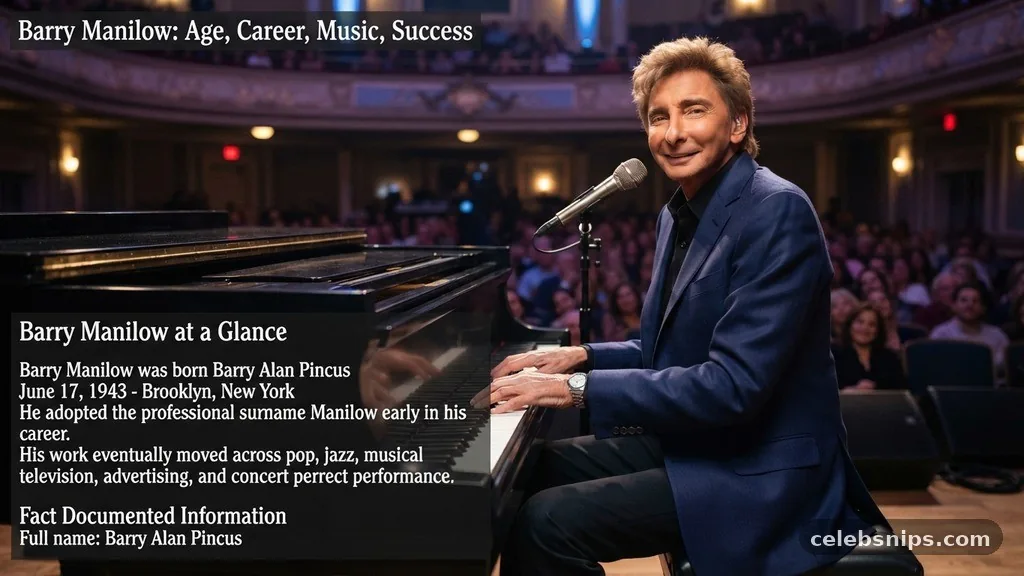
Barry Manilow was born Barry Alan Pincus on June 17, 1943, in Brooklyn, New York. He adopted the professional surname Manilow early in his career, and his work eventually moved across pop, jazz, musical theater, television, advertising, and concert performance.
| Fact | Documented information |
|---|---|
| Full name | Barry Alan Pincus |
| Professional name | Barry Manilow |
| Date of birth | June 17, 1943 |
| Birthplace | Brooklyn, New York, United States |
| Age | 82 as of March 2026; he turns 83 on June 17, 2026 |
| Profession | Singer, songwriter, arranger, pianist, producer, and composer |
| Known for | “Mandy,” “Copacabana,” “Could It Be Magic,” “Looks Like We Made It,” and “Weekend in New England” |
| Years active | 1960s to the present, with work across recording, touring, theater, and television |
| Spouse | Garry Kief; they married in 2014 |
The age shown above is tied to the date of publication. Manilow’s birthday is June 17, so a page discussing his age should always identify the year or date being used rather than presenting a permanent number.
- Birth name: Barry Alan Pincus.
- Musical foundation: Piano, arranging, orchestration, and songwriting.
- Early professional work: Commercial jingles, advertising music, arranging, and accompaniment.
- Breakthrough: “Mandy” became his first major solo hit in the United States in 1975.
- Signature style: Melodic pop built around piano, orchestral color, dramatic vocals, and memorable choruses.
Early Life and New York Background
Barry Manilow grew up in Brooklyn, a New York borough with a strong musical culture and a large network of working musicians. Public biographies identify his parents as Harold Pincus and Edna Manilow, and the family background included Jewish heritage on his mother’s side. His parents’ surnames helped shape the professional name he later used.
Music entered Manilow’s life through the piano rather than through a single dramatic discovery. He developed practical skills in arranging and composition while still young, and those skills became as important as his singing. That distinction matters because Manilow’s career was never based only on being a frontman; he also understood how to construct a recording from the keyboard outward.
He attended the Juilliard School in New York, where he studied music and developed a stronger technical foundation. Juilliard did not simply give him a credential. It helped him work comfortably with harmony, orchestration, charts, and musicians, abilities that later supported both his pop records and his work in theater and television.
Before fame, Manilow worked in the commercial side of the music business. He wrote and arranged advertising music, including the well-known “You Deserve a Break Today” campaign for McDonald’s. Commercial composition trained him to communicate an idea quickly, a skill that later helped him write songs with immediately recognizable openings and choruses.
How Barry Manilow Began His Career
Manilow’s first professional decades were unusually broad. He worked as a pianist, arranger, producer, and musical director before he became widely recognized as a recording artist. Those roles gave him experience with singers, studio musicians, advertising clients, and record-company expectations.
A major early opportunity came through his association with Bette Midler. Manilow played piano and served as musical director for Midler during the period when her career was expanding rapidly. He also produced her early albums, including The Divine Miss M, which won the Grammy Award for Album of the Year for the 1973 awards cycle.
Working with Midler taught Manilow how to support a distinctive performer without overwhelming the performance. He learned to balance theatrical presentation with accessible arrangements, a combination that later became central to his own concerts. The relationship also placed him in front of record executives who could see that he was more than a studio technician.
His own recording career began with the album Barry Manilow in 1972. The album did not instantly make him a major star, but it established a platform for the releases that followed. His early records combined piano-led ballads with orchestral pop and a carefully produced studio sound.
Manilow’s development was gradual rather than sudden. The arranger’s discipline remained visible in the finished songs, but he also learned how to make those arrangements serve a singer with a clear emotional identity. That combination became one of the most important reasons his music connected with a broad audience.
The Breakthrough: “Mandy” and the Rise of a Star
The turning point came with “Mandy,” released as a single in 1974 and reaching the top of the Billboard Hot 100 in early 1975. The song was originally written by Scott English and Richard Kerr, and Manilow recorded it under the title “Brandy,” later changing the title to “Mandy” to avoid confusion with another hit.
“Mandy” gave listeners a clear introduction to the traits that would define Manilow’s best-known work. The arrangement rises patiently, the vocal remains emotionally direct, and the chorus delivers a strong release without abandoning the song’s melancholy mood. It was polished, but not emotionally distant.
The success of “Mandy” changed the scale of Manilow’s career. His second album, commonly known as Barry Manilow II, benefited from the single’s momentum and included “Could It Be Magic,” a song built from a melody based on Frédéric Chopin’s Prelude in C Minor. Manilow’s version connected classical influence with contemporary pop songwriting.
His breakthrough was not limited to one song. “It’s a Miracle,” “Looks Like We Made It,” and “Weekend in New England” followed as major recordings, helping establish a reliable audience for both singles and albums. In the late 1970s, Manilow became one of the defining names in American adult contemporary pop.
The period also revealed an important feature of his career: he was willing to use theatrical storytelling without treating pop music as a novelty. His songs often sounded large, but their subjects were recognizable: separation, regret, reunion, ambition, and romantic memory.
Major Songs, Albums, and Musical Style
Barry Manilow’s catalog is built around melody. Even when his arrangements use strings, horns, layered backing vocals, or a large rhythm section, the central tune usually remains easy to follow. That clarity helped his songs cross between radio, live performance, television appearances, and later compilation albums.
“Copacabana,” released in 1978, became one of his most recognizable songs. Its nightclub setting, sharply drawn characters, Latin-influenced rhythm, and dramatic plot made it different from a conventional romantic ballad. The song later expanded into a television film and a stage musical, showing how Manilow could develop a short pop recording into a larger piece of entertainment.
Other enduring songs include “Could It Be Magic,” “Looks Like We Made It,” “Weekend in New England,” “Somewhere Down the Road,” “I Made It Through the Rain,” and “Ready to Take a Chance Again.” The titles represent different sides of his catalog, from romantic confession to resilience and professional ambition.
His albums also show a consistent interest in interpretation. Manilow recorded original material, standards, holiday songs, and projects built around particular themes. He has released numerous studio albums, live albums, compilations, and special collections, although lists of his total album count can vary depending on whether reissues and regional releases are included.
As a singer, he is associated with a controlled, conversational delivery that can expand into a more theatrical climax. As a producer and arranger, he favors structure: an identifiable introduction, carefully managed harmonic movement, and a chorus designed to stay in the listener’s memory. That is why many of his songs remain recognizable even when heard outside their original albums.
Broadway, Television, and Work Beyond Pop Records
Manilow’s career cannot be measured only by chart singles. His background in arranging and advertising led naturally to television, theater, and special-event production. He wrote music for the television program Copacabana, and the story later appeared in stage-musical form.
He also wrote the music for Harmony, a musical about the Comedian Harmonists, a German vocal group whose rise occurred before and during the Nazi era. The show had a long development process, including workshops and productions before its Broadway run. Its subject allowed Manilow to combine close vocal harmony with a serious historical setting.
Although Harmony opened on Broadway in 2023 and closed later that year, the project remained significant in understanding his creative interests. It showed that he continued to write for characters, scenes, and narrative structure rather than restricting himself to the three-minute pop format.
Television has also been a recurring part of Manilow’s public profile. His songs have appeared in variety programs, specials, and dramatic performances, while his own appearances have relied heavily on live musicianship and production design. He has often presented himself as a bandleader and arranger as much as a singer.
This wider body of work explains why his career has lasted beyond the period of his biggest radio hits. A listener may know him from one song, while a theater audience may encounter him through a musical and a television viewer through a special. The professional identity is larger than the singles alone.
Awards, Records, and Recognition
Manilow has received major industry recognition across several fields. He has won Grammy Awards, including recognition connected to his work as a producer and performer, and he has received nominations for his recordings and special projects. Exact award totals can differ across databases because some count nominations, special honors, or collaborative credits differently.
His songwriting has also been recognized institutionally. Manilow was inducted into the Songwriters Hall of Fame in 2002, an honor that reflects his work as a composer and not merely his visibility as a singer. The organization’s Barry Manilow profile in the Songwriters Hall of Fame provides an authoritative reference for that recognition and his songwriting background.
Commercially, his songs performed especially well in the United States and other English-speaking markets. His albums and singles helped define the adult contemporary radio format, a category built around accessible melodies, polished production, and broad listener appeal. He also developed a strong concert audience, where familiar songs could be expanded into longer dramatic performances.
Manilow’s achievements include more than chart position. His work has been used in advertising, television, theater, and film-related projects, and several songs became cultural shorthand for a particular period of polished 1970s and 1980s pop. “Copacabana,” for example, has remained recognizable because its title and story are unusually vivid.
Recognition has not always come from the same institution or for the same kind of work. Some honors emphasize his vocal performances, others his production skills, and others his songwriting. Taken together, they show a career that moved between commercial pop and professional music craft.
Personal Life, Marriage, and Public Boundaries
Barry Manilow married Garry Kief in 2014. Kief has worked as Manilow’s manager, and the marriage became widely reported after Manilow publicly discussed his sexuality and relationship in 2017. The pair had been together for many years before that public disclosure.
Questions about how many times Manilow has been married often arise because he had an earlier marriage to Susan Deixler in the 1960s. That marriage was annulled, and his relationship with Kief is his later, publicly documented marriage. Claims that add other spouses or partners should not be treated as established without reliable evidence.
No reliable public record establishes that Manilow has biological or adopted children. Online searches sometimes produce references to a “daughter,” but those claims are not supported by dependable biographical evidence. A responsible biography should say that children have not been publicly confirmed rather than repeat an attractive but unsupported detail.
Manilow has generally kept parts of his private life away from the stage. Public information can confirm his marriage and professional partnership, but it cannot answer every question about his home, daily routine, friendships, or family relationships. Lack of public detail is not evidence of a hidden event.
People also ask whether Barry Manilow is nice in real life. Individual audience accounts and professional anecdotes may describe positive encounters, but there is no objective measure that can establish a person’s private character. The safest answer is that his public image includes many warm fan interactions, while personal judgments remain subjective.
Health Questions and Unverified Claims
Searches about whether Barry Manilow has cancer illustrate why health information requires extra care. No reliable public source establishes that he has cancer, and an internet rumor should not be presented as a diagnosis. A canceled appearance or a change in touring plans cannot prove a specific medical condition.
Manilow has continued to perform and announce professional projects at different points in his later career, but professional activity should not be used to infer private health. Healthy-looking appearances do not prove that someone has no medical concerns, just as an absence from a stage does not prove illness.
Health claims about public figures should be evaluated through direct statements, reputable reporting, or official announcements. Anonymous posts, search snippets, and unsourced biography pages are not enough. This standard is especially important for cancer claims, which can cause unnecessary distress for the person and their family.
His age is a confirmed biographical fact, but age alone tells readers nothing precise about his current medical status. As of March 2026, Manilow is 82 and remains a working musician, yet any statement about a diagnosis would require separate evidence.
Net Worth, Income, and Current Career
Barry Manilow’s net worth is not established by a single audited public figure. Websites often publish precise estimates, but those numbers usually lack a transparent accounting of royalties, taxes, touring costs, recording expenses, property, investments, management fees, and private contracts.
His documented income sources have included recorded music, songwriting royalties, music publishing, concert performances, production work, television, theater, and licensing. A songwriter may continue earning from a song after its initial release through radio use, covers, synchronization, compilations, and other forms of licensing.
Live performance can be a major part of a veteran artist’s business, but gross ticket revenue is not the same as personal income. Venue costs, musicians, crews, travel, insurance, promotion, taxes, and management reduce the amount that eventually reaches an artist. For that reason, box-office reports cannot be converted directly into net worth.
Manilow has remained active in recording and live entertainment during his later career. He has continued to perform for established audiences while also developing projects outside conventional pop albums. His longevity rests partly on a catalog that works in several settings: radio, theater, television, nostalgia programs, and full concerts.
The most accurate financial conclusion is therefore limited. He has had a long and commercially successful career with multiple revenue streams, but no authoritative public source confirms an exact current net worth. Treat online dollar figures as estimates, not verified facts.
Why Barry Manilow’s Music Still Matters
Manilow’s importance comes from the way he connected technical musicianship with immediate emotional communication. He could write for a large orchestra, arrange a commercial jingle, produce another singer, and still make a song feel personal when delivered at a piano.
His music also occupies an interesting place in popular culture. Critics have sometimes treated highly polished adult contemporary pop as less serious than rock or experimental music, yet Manilow’s records required demanding work in melody, harmony, arrangement, vocal production, and studio coordination.
The songs lasted because they were specific without becoming inaccessible. “Copacabana” tells a compact story, while “Weekend in New England” turns distance and memory into a direct romantic setting. “Looks Like We Made It” captures the complicated feeling of surviving a breakup while recognizing that the relationship is over.
His influence is easiest to see in the continuing use of strong melodic hooks and theatrical pop arrangements. Later singers have covered his songs, television programs have reused them, and audiences still recognize the opening phrases of several major hits. That kind of recognition is different from a short-lived chart peak.
Manilow’s career also demonstrates how many jobs can exist inside the word “musician.” He has been a performer, writer, producer, arranger, accompanist, theater composer, and live-show creator. The public usually sees the singer first, but the durability of the career depends on all of those roles working together.
Frequently Asked Questions
How old is Barry Manilow?
Barry Manilow was born on June 17, 1943. He is 82 years old as of March 2026 and will turn 83 on June 17, 2026.
What is Barry Manilow’s real name?
His birth name is Barry Alan Pincus. He adopted the professional name Barry Manilow, using a surname connected to his family background.
What is Barry Manilow best known for?
He is best known for songs including “Mandy,” “Could It Be Magic,” “Copacabana,” “Looks Like We Made It,” and “Weekend in New England.” He is also known for arranging, producing, concert performance, advertising music, and musical theater.
Who is Barry Manilow’s husband?
Barry Manilow’s husband is Garry Kief, his longtime manager and professional partner. They married in 2014, and Manilow publicly discussed the relationship in 2017.
Does Barry Manilow have children?
No reliable public source confirms that Barry Manilow has biological or adopted children. Online references to a daughter are not supported by dependable biographical evidence.
Final Takeaway
Barry Manilow’s age is easy to verify, but his career cannot be reduced to a birthday or a list of hit songs. His lasting success came from combining performance with arranging, production, songwriting, theater, television, and sustained live work. “Mandy,” “Copacabana,” and “Could It Be Magic” remain central to that story, while his marriage to Garry Kief is the clearest publicly documented part of his personal life.
The most reliable view of Barry Manilow’s age, career, and music success also leaves room for uncertainty: no authoritative current net-worth figure is available, and cancer claims are unconfirmed. For readers exploring his work, the best next step is to listen across his early albums, major singles, live recordings, and theater projects rather than relying on rumor-driven biography pages.